



Search titles
Displaying results 111 to 120 of 163.

Land and Life in Timor-Leste »
Ethnographic Essays
Edited by: Andrew McWilliam, Elizabeth G. Traube
Publication date: December 2011
Following the historic 1999 popular referendum, East Timor emerged as the first independent sovereign nation of the 21st Century. The years since these momentous events have seen an efflorescence of social research across the country drawn by shared interests in the aftermath of the resistance struggle, the processes of social recovery and the historic opportunity to pursue field-based ethnography following the hiatus of research during 24 years of Indonesian rule (1975-99).
This volume brings together a collection of papers from a diverse field of international scholars exploring the multiple ways that East Timorese communities are making and remaking their connections to land and places of ancestral significance. The work is explicitly comparative and highlights the different ways Timorese language communities negotiate access and transactions in land, disputes and inheritance especially in areas subject to historical displacement and resettlement. Consideration is extended to the role of ritual performance and social alliance for inscribing connection and entitlement. Emerging through analysis is an appreciation of how relations to land, articulated in origin discourses, are implicated in the construction of national culture and differential contributions to the struggle for independence. The volume is informed by a range of Austronesian cultural themes and highlights the continuing vitality of customary governance and landed attachment in Timor-Leste.

Law's Anthropology »
From ethnography to expert testimony in native title
Authored by: Paul Burke
Publication date: November 2011
Anthropologists have been appearing as key expert witnesses in native title claims for over 20 years. Until now, however, there has been no theoretically-informed, detailed investigation of how the expert testimony of anthropologists is formed and how it is received by judges. This book examines the structure and habitus of both the field of anthropology and the juridical field and how they have interacted in four cases, including the original hearing in the Mabo case. The analysis of background material has been supplemented by interviews with the key protagonists in each case. This allows the reader a unique, insider’s perspective of the courtroom drama that unfolds in each case. The book asks, given the available ethnographic research, how will the anthropologist reconstruct it in a way that is relevant to the legal doctrine of native title when that doctrine gives a wide leeway for interpretation on the critical questions: what is the relevant grouping, what can be counted as a traditional law and when has there been too much change of tradition? How will such evidence be received by judges who are becoming increasingly sceptical about experts tailoring their evidence to suit the party which called them? This book answers these questions by assuming that there is more at stake here than the mere performance of roles. Rather, there is a complex interaction of distinct social fields each with its own habitus, and individual actors are engaged in an active and constructive agency, however subtle, which the painstaking research for this book uncovers.

Pacific Island Heritage »
Archaeology, Identity & Community
Edited by: Jolie Liston, Geoffrey Clark, Dwight Alexander
Publication date: November 2011
‘This volume emerges from a ground-breaking conference held in the Republic of Palau on cultural heritage in the Pacific. It includes bold investigations of the role of cultural heritage in identity-making, and the ways in which community engagement informs heritage management practices. This is the first broad and detailed investigation of the unique and irreplaceable cultural heritage of the Pacific from a heritage management perspective. It identifies new trends in research and assesses relationships between archaeologists, heritage managers and local communities. The methods which emerge from these relationships will be critical to the effective management of heritage sites in the 21st century. A wonderful book which emerges from an extraordinary conference. Essential reading for cultural heritage managers, archaeologists and others with an interest in caring for the unique cultural heritage of the Pacific Islands.’
— Professor Claire Smith, President World Archaeological Congress

Echoes of the Tambaran »
Masculinity, history and the subject in the work of Donald F. Tuzin
Edited by: David Lipset, Paul Roscoe
Publication date: October 2011
In the Sepik Basin of Papua New Guinea, ritual culture was dominated by the Tambaran —a male tutelary spirit that acted as a social and intellectual guardian or patron to those under its aegis as they made their way through life. To Melanesian scholarship, the cultural and psychological anthropologist, Donald F. Tuzin, was something of a Tambaran, a figure whose brilliant and fine-grained ethnographic project in the Arapesh village of Ilahita was immensely influential within and beyond New Guinea anthropology. Tuzin died in 2007, at the age of 61. In his memory, the editors of this collection commissioned a set of original and thought provoking essays from eminent and accomplished anthropologists who knew and were influenced by his work. They are echoes of the Tambaran.
The anthology begins with a biographical sketch of Tuzin’s life and scholarship. It is divided into four sections, each of which focuses loosely around one of his preoccupations. The first concerns warfare history, the male cult and changing masculinity, all in Melanesia. The second addresses the relationship between actor and structure. Here, the ethnographic focus momentarily shifts to the Caribbean before turning back to Papua New Guinea in essays that examine uncanny phenomena, narratives about childhood and messianic promises. The third part goes on to offer comparative and psychoanalytic perspectives on the subject in Fiji, Bali, the Amazon as well as Melanesia. Appropriately, the last section concludes with essays on Tuzin’s fieldwork style and his distinctive authorial voice.

Working Together in Vanuatu »
Research Histories, Collaborations, Projects and Reflections
Edited by: John Taylor, Nick Thieberger
Publication date: October 2011
This collection is derived from a conference held at the Vanuatu National Museum and Cultural Centre (VCC) that brought together a large gathering of foreign and indigenous researchers to discuss diverse perspectives relating to the unique program of social, political and historical research and management that has been fostered in that island nation. While not diminishing the importance of individual or sole-authored methodologies, project-centered collaborative approaches have today become a defining characteristic of Vanuatu’s unique research environment. As this volume attests, this environment has included a dynamically wide range of both ni-Vanuatu and foreign researchers and related research perspectives, most centrally including archaeologists and anthropologists, linguists, historians, legal studies scholars and development practitioners. This emphasis on collaboration has emerged from an ongoing awareness across Vanuatu’s research community of the need for trained researchers to engage directly with pressing social and ethical concerns, and out of the proven fact that it is not just from the outcomes of research that communities or individuals may be empowered, but also through their modes and processes of implementation, as through the ongoing strength and value of the relationships they produce. With this in mind, the papers presented here go beyond the mere celebration of collaboration by demonstrating Vanuatu’s specific environment of cross-cultural research as a diffuse set of historically emergent methodological approaches, and by showing how these work in actual practice.

Sung Tales from the Papua New Guinea Highlands »
Studies in Form, Meaning, and Sociocultural Context
Edited by: Alan Rumsey, Don Niles
Publication date: August 2011
The genres of sung tales that are the subject of this volume are one of the most striking aspects of the cultural scene in the Papua New Guinea Highlands. Composed and performed by specialist bards, they are a highly valued art form. From a comparative viewpoint they are remarkable both for their scale and complexity, and for the range of variation that is found among regional genres and individual styles. Though their existence has previously been noted by researchers working in the Highlands, and some recordings made of them, most of these genres have not been studied in detail until quite recently, mainly because of the challenging range of disciplinary expertise that is required—in anthropology, linguistics, and ethnomusicology.
This volume presents a set of interrelated studies by researchers in all of those fields, and by a Papua New Guinea Highlander who has assisted with the research based on his lifelong familiarity with one of the regional genres. The studies presented here (all of them previously unpublished and written especially for this volume) are of groundbreaking significance not only for specialists in Melanesia or the Pacific, but also for readers with a more general interest in comparative poetics, mythology, musicology, or verbal art.
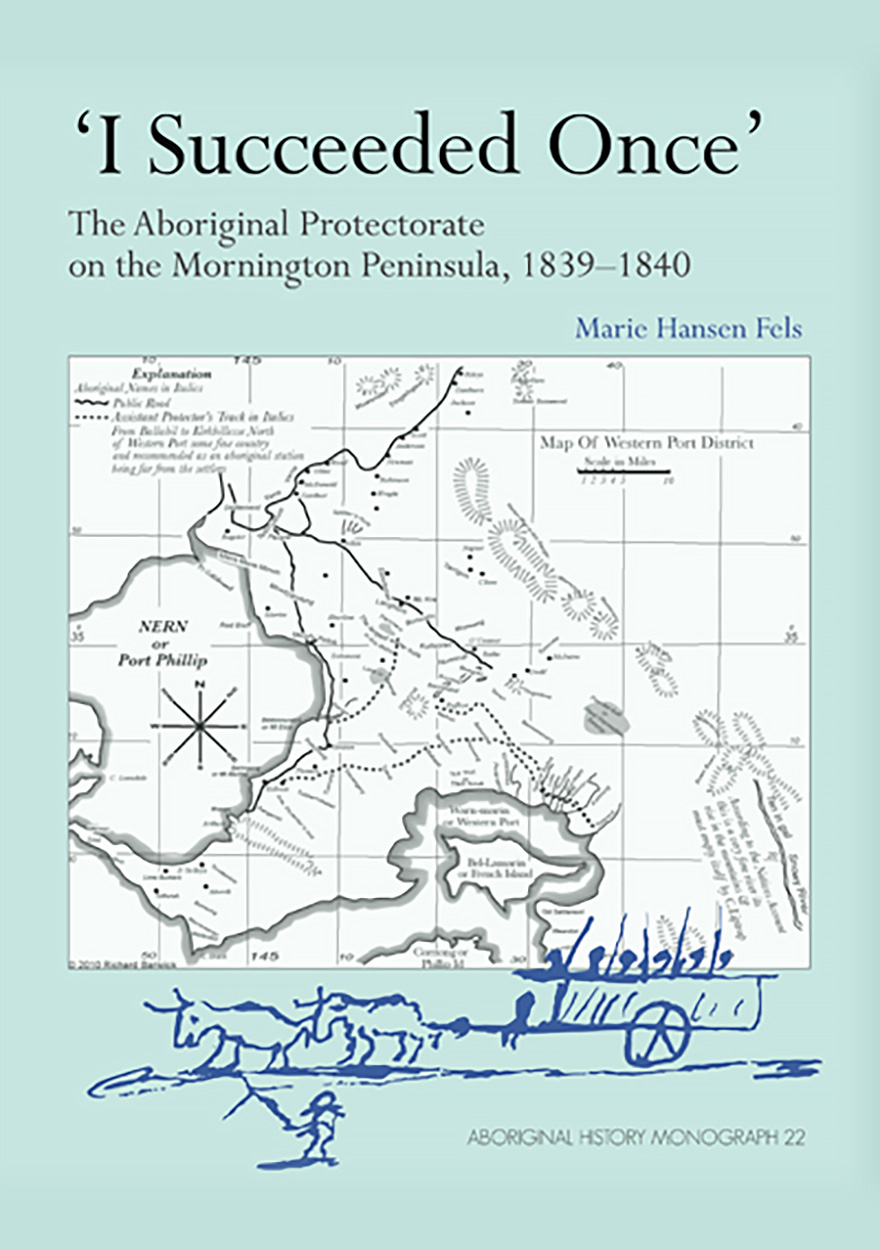
'I Succeeded Once' »
The Aboriginal Protectorate on the Mornington Peninsula, 1839–1840
Authored by: Marie Hansen Fels
Publication date: May 2011
In ‘I Succeeded Once’ – The Aboriginal Protectorate on the Mornington Peninsula, 1839-1840, Marie Fels makes the work of William Thomas accessible to anthropologists, archaeologists, historians and the descendants of the Aboriginal people he wrote about. More importantly, people who live, work, study, holiday or just have a general interest in the area from Melbourne to Point Nepean can learn about the original inhabitants who walked the land before it was cleared for agriculture and urban development. Of course, development of the Mornington Peninsula is ongoing and this book will help those involved in development or the management of Aboriginal cultural heritage to identify, document and protect Aboriginal places that may not be identifiable through archaeological investigations alone. Marie Fels supplements Thomas’s writings with other contemporary accounts and her exhaustive historical research sheds new light on critical events and the significant places of the Boon Wurrung people. Of particular importance is the critical review of information about the kidnapping of Boon Wurrung people from the Mornington Peninsula.
Winner of the Best Community Research, Register, Records at the Community History Awards by the Royal Historical Society of Victoria and the Public Record Office of Victoria in 2011.
For more information on Aboriginal History Inc. please visit aboriginalhistory.org.au.

Man Bac »
The Excavation of a Neolithic Site in Northern Vietnam
Edited by: Marc F. Oxenham, Hirofumi Matsumura, Nguyen Kim Dung
Publication date: May 2011
The site of Man Bac in the Red River Delta of Vietnam, one of the most meticulously excavated and carefully analysed of Southeast Asian archaeological sites in the past few years, is emerging as a key site in the region. This book carefully analyses the human and animal remains and puts them into context. The authors describe in detail the health status, the unusual demographic profile and the interestingly divergent affinities of the cemetery population, and discuss their meaning, particularly in association with evidence for the use of marine and terrestrial animal resources; they argue convincingly that the site documents a time when the face of the region’s population was undergoing a fundamental shift, associated with a changing economic subsistence base. Physical anthropologists and archaeologists have argued for years over the timeline, the manner and the very nature of Southeast Asian population history, and this book is essential reading in this debate. Two supporting appendices describe the individual remains in detail.

Ethnography & the Production of Anthropological Knowledge »
Essays in honour of Nicolas Peterson
Edited by: Yasmine Musharbash, Marcus Barber
Publication date: February 2011
Professor Nicolas Peterson is a central figure in the anthropology of Aboriginal Australia. This volume honours his anthropological body of work, his commitment to ethnographic fieldwork as a source of knowledge, his exemplary mentorship of generations of younger scholars and his generosity in facilitating the progress of others. The diverse collection produced by former students, current colleagues and long-term peers provides reflections on his legacy as well as fresh anthropological insights from Australia and the wider Asia-Pacific region. Inspired by Nicolas Peterson’s work in Aboriginal Australia and his broad ranging contributions to anthropology over several decades, the contributors to this volume celebrate the variety of his ethnographic interests. Individual chapters address, revisit, expand on, and ethnographically re-examine his work about ritual, material culture, the moral domestic economy, land and ecology. The volume also pays homage to Nicolas Peterson’s ability to provide focused research with long-term impact, exemplified by a series of papers engaging with his work on demand sharing and the applied policy domain.

In Good Faith? »
Governing Indigenous Australia through God, Charity and Empire, 1825-1855
Authored by: Jessie Mitchell
Publication date: January 2011
In the early decades of the 19th century, Indigenous Australians suffered devastating losses at the hands of British colonists, who largely ignored their sovereignty and even their humanity. At the same time, however, a new wave of Christian humanitarians were arriving in the colonies, troubled by Aboriginal suffering and arguing that colonists had obligations towards the people they had dispossessed. These white philanthropists raised questions which have shaped Australian society ever since.
Did Indigenous Australians have rights to land, rationing, education and cultural survival? If so, how should these be guaranteed, and what would people have to give up in return? Would charity and paternalism lead to effective government or dismal failure – to a powerful defence of an oppressed people, or to new forms of oppression?
In Good Faith? paints a vivid picture of life on Australia’s first missions and protectorate stations, examining the tensions between charity and rights, empathy and imperialism, as well as the intimacy, dependence, resentment and obligations that developed between missionary philanthropists and the people they tried to protect and control. In this work, Mitchell brings to life hitherto neglected moments in Australia’s history, and traces the origins of dilemmas still present today.
For more information on Aboriginal History Inc. please visit aboriginalhistory.org.au.