



Search titles
Displaying results 141 to 150 of 163.

Permissive Residents »
West Papuan refugees living in Papua New Guinea
Authored by: Diana Glazebrook
Publication date: September 2008
This book offers another frame through which to view the event of the outrigger landing of 43 West Papuans in Australia in 2006. West Papuans have crossed boundaries to seek asylum since 1962, usually eastward into Papua New Guinea (PNG), and occasionally southward to Australia. Between 1984–86, around 11,000 people crossed into PNG seeking asylum. After the Government of PNG acceded to the United Nations Convention and Protocol Relating to the Status of Refugees, West Papuans were relocated from informal camps on the international border to a single inland location called East Awin. This volume provides an ethnography of that settlement based on the author’s fieldwork carried out in 1998–99.

First Contacts in Polynesia »
The Samoan Case (1722–1848) Western Misunderstandings about Sexuality and Divinity
Authored by: Serge Tcherkézoff
Publication date: August 2008
This book explores the first encounters between Samoans and Europeans up to the arrival of the missionaries, using all available sources for the years 1722 to the 1830s, paying special attention to the first encounter on land with the Lapérouse expedition. Many of the sources used are French, and some of difficult accessibility, and thus they have not previously been thoroughly examined by historians. Adding some Polynesian comparisons from beyond Samoa, and reconsidering the so-called ‘Sahlins-Obeyesekere debate’ about the fate of Captain Cook, ‘First Contacts’ in Polynesia advances a hypothesis about the contemporary interpretations made by the Polynesians of the nature of the Europeans, and about the actions that the Polynesians devised for this encounter: wrapping Europeans up in ‘cloth’ and presenting ‘young girls’ for ‘sexual contact’. It also discusses how we can go back two centuries and attempt to reconstitute, even if only partially, the point of view of those who had to discover for themselves these Europeans whom they call ‘Papalagi’. The book also contributes an additional dimension to the much-touted ‘Mead-Freeman debate’ which bears on the rules and values regulating adolescent sexuality in ‘Samoan culture’. Scholars have long considered the pre-missionary times as a period in which freedom in sexuality for adolescents predominated. It appears now that this erroneous view emerged from a deep misinterpretation of Lapérouse’s and Dumont d’Urville’s narratives.

The Workshop for Morality »
The Islamic Creativity of Pesantren Daarut Tauhid in Bandung, Java
Authored by: Dindin Solahudin
Publication date: August 2008
This volume is a remarkable study of a most unusual pesantren. Officially known as Pesantren Daarut Tauhid, this pesantren was located in Bandung and flourished at the beginning of a period of Islamic resurgence in Indonesia. More commonly referred to as the Bengkel Akhlaq, this ‘Workshop for Morality’ exerted a special appeal to groups of young urban Muslims, particularly students. Its founder was H. K. Abdullah Gymnastiar, popularly known as Aa Gym, who later went on to become one of Indonesia’s most important Muslim preachers and television celebrities.
The Workshop for Morality is a superb work of both historical and ethnographic relevance that reflects the capacity of its author, Dindin Solahudin, to capture a critical moment in the development of Islam in contemporary Indonesian society.
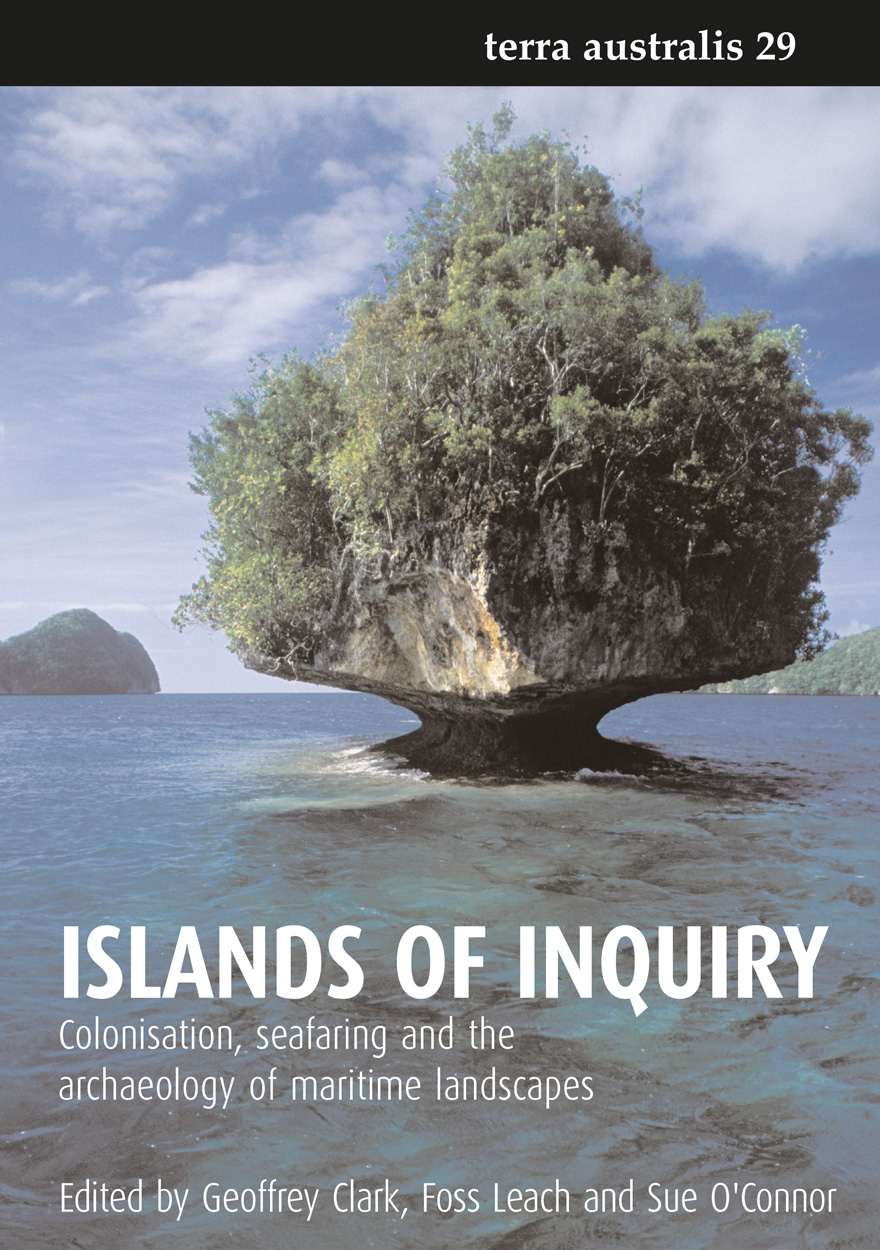
Islands of Inquiry »
Colonisation, seafaring and the archaeology of maritime landscapes
Edited by: Geoffrey Clark, Foss Leach, Sue O'Connor
Publication date: June 2008
This collection makes a substantial contribution to several highly topical areas of archaeological inquiry. Many of the papers present new and innovative research into the processes of maritime colonisation, processes that affect archaeological contexts from islands to continents. Others shift focus from process to the archaeology of maritime places from the Bering to the Torres Straits, providing highly detailed discussions of how living by and with the sea is woven into all elements of human life from subsistence to trade and to ritual. Of equal importance are more abstract discussions of islands as natural places refashioned by human occupation, either through the introduction of new organisms or new systems of production and consumption. These transformation stories gain further texture (and variety) through close examinations of some of the more significant consequences of colonisation and migration, particularly the creation of new cultural identities. A final set of papers explores the ways in which the techniques of archaeological science have provided insights into the fauna of islands and the human history of such places. Islands of Inquiry highlights the importance of an archaeologically informed history of landmasses in the oceans and seas of the world.

Telling Pacific Lives »
Prisms of Process
Edited by: Brij V. Lal, Vicki Luker
Publication date: June 2008
How are Pacific lives imagined, written and read? How are they refracted through prisms of process? From legends about culture heroes to biographies of national leaders, from tales of ancestors to stories of contemporary men and women, from lives told of both the famous and the nameless, this collection of essays — by historians and anthropologists, Islanders and Island scholars — probes questions of personhood, identity, memory, and time across the sweep of the Pacific, as well as practical issues of research and writing.

Australia Under Construction »
Nation-building past, present and future
Edited by: John Butcher
Publication date: April 2008
The Australian nation is a work in progress. So conclude the authors whose views are represented in this most recent offering in the ANZSOG monograph series, Australia Under Construction: Nation-building past, present and future. From its beginnings as a settler society through to present day concerns about ‘broadbanding the nation’, the nation-building narrative has resonated with Australians. The very idea of nation-building has both excited the popular imagination about what we might achieve as a society and a nation, and has occasioned despair about missed opportunities. The eleven authors contributing to this monograph reflect on these, and other themes from a variety of perspectives. They challenge our understanding of the term ‘nation-building’, reflect on its contemporary relevance as a framework for public policy and even re-appraise the contribution of past ‘iconic’ nation-building endeavours. To this subject the authors bring intelligence, wit and a healthy disdain for sacred cows. A stimulating read for anyone interested in the history, challenges and prospects of nation-building in Australia.
Signs of the Wali »
Narratives at the Sacred Sites in Pamijahan, West Java
Authored by: Tommy Christomy
Publication date: April 2008
In Signs of the Wali, Dr Tommy Christomy focuses on the one of the early founders of Islam on Java, Shakyh Abdul Muhyi, whose burial site at Pamijahan in Tasikmalaya is a place of contemporary ziarah. This study initially conceived of as a philological exploration of historical manuscripts has been transformed into a study of ‘living manuscripts’ – the contemporary narratives of the custodians at Pamijahan.
As elsewhere in the Islamic world, tarekat and ziarah intersect in popular practice at Pamijahan. Dr Christomy explores this intersecting world, explaining the steps of his own research investigations that enfold as a journey of discovery as he proceeds. This investigation involves the search for traces of Tarekat Shattiriyyah in Pamijahan, given the pervasive presence of Tarekat Qadirriyah-Nashabandiyyah throughout Tasikmalaya. That Tarekat Shattiriyyah survives to this day is itself evidence of the tenacity that its historical roots have established in a particular place.

Oceanic Explorations »
Lapita and Western Pacific Settlement
Edited by: Stuart Bedford, Christophe Sand, Sean P. Connaughton
Publication date: November 2007
Lapita comprises an archaeological horizon that is fundamental to the understanding of human colonisation and settlement of the Pacific as it is associated with the arrival of the common ancestors of the Polynesians and many Austronesian-speaking Melanesians more than 3000 years ago. While Lapita archaeology has captured the imagination and sustained the focus of archaeologists for more than 50 years, more recent discoveries have inspired renewed interpretations and assessments. Oceanic Explorations reports on a number of these latest discoveries and includes papers which reassess the Lapita phenomenon in light of this new data. They reflect on a broad range of interrelated themes including Lapita chronology, patterns of settlement, migration, interaction and exchange, ritual behaviour, sampling strategies and ceramic analyses, all of which relate to aspects highlighting both advances and continuing impediments associated with Lapita research.

Struggling for the Umma »
Changing Leadership Roles of Kiai in Jombang, East Java
Authored by: Endang Turmudi
Publication date: October 2007
This thesis focuses on the relationship of Indonesian kiai (‘ulama: religious leaders) in Jombang to their wider social and political situation. It argues that the charismatic authority exerted through the leadership of the kiai in Java has limitations in terms of its legitimacy. At the very least it has boundaries that determine areas or circumstances for its legitimate expression. It also argues that the kiai’s influence in politics is not as strong as in other domains. Despite being a charismatic figure, only a minority of followers feel compelled to follow the kiai’s political example. Differences between the kiai and his followers in relation to political behaviour are common, especially after the transformation of the Islamic political party. Nevertheless, the role of the kiai in general remains important in the eyes of Muslim society.

Culture in Translation »
The anthropological legacy of R. H. Mathews
Edited by: Martin Thomas
Publication date: September 2007
R. H. Mathews (1841–1918) was an Australian-born surveyor and self-taught anthropologist. From 1893 until his death in 1918, he made it his mission to record all ‘new and interesting facts’ about Aboriginal Australia. Despite falling foul with some of the most powerful figures in British and Australian anthropology, Mathews published some 2200 pages of anthropological reportage in English, French and German. His legacy is an outstanding record of Aboriginal culture in the Federation period.
This first edited collection of Mathews’ writings represents the many facets of his research, ranging from kinship study to documentation of myth. It include eleven articles translated from French or German that until now have been unavailable in English. Introduced and edited by Martin Thomas, who compellingly analyses the anthropologist, his milieu, and the intrigues that were so costly to his reputation, Culture in Translation is essential reading on the history of cross-cultural research.
The translations from the French are by Mathilde de Hauteclocque and from the German by Christine Winter.
For more information on Aboriginal History Inc. please visit aboriginalhistory.org.au.