



Search titles
Displaying results 131 to 140 of 163.

The Two Rainbow Serpents Travelling »
Mura track narratives from the ‘Corner Country’
Authored by: Jeremy Beckett, Luise Hercus
Publication date: September 2009
The ‘Corner Country’, where Queensland, South Australia and New South Wales now converge, was in Aboriginal tradition crisscrossed by the tracks of the mura, ancestral beings, who named the country as they travelled, linking place to language. Reproduced here is the story of the two Ngatyi, Rainbow Serpents, who travelled from the Paroo to the Flinders Ranges and back as far as Yancannia Creek, where their deep underground channels linked them back to the Paroo. Jeremy Beckett recorded these stories from George Dutton and Alf Barlow in 1957. Luise Hercus, who has worked on the languages in the area for many years, has collaborated with Jeremy Beckett to analyse the names and identify the places.
For more information on Aboriginal History Inc. please visit aboriginalhistory.org.au.

Migration and Transnationalism »
Pacific Perspectives
Edited by: Helen Lee, Steve Tupai Francis
Publication date: August 2009
Pacific Islanders have engaged in transnational practices since their first settlement of the many islands in the region. As they moved beyond the Pacific and settled in nations such as New Zealand, the U.S. and Australia these practices intensified and over time have profoundly shaped both home and diasporic communities. This edited volume begins with a detailed account of this history and the key issues in Pacific migration and transnationalism today. The papers that follow present a range of case studies that maintain this focus on both historical and contemporary perspectives. Each of the contributors goes beyond a narrowly economic focus to present the human face of migration and transnationalism; exploring questions of cultural values and identity, transformations in kinship, intergenerational change and the impact on home communities.
Pacific migration and transnationalism are addressed in this volume in the context of increasing globalisation and growing concerns about the future social, political and economic security of the Pacific region. As the case studies presented here show, the future of the Pacific depends in many ways on the ties diasporic Islanders maintain with their homelands.

Oceanic Encounters »
Exchange, Desire, Violence
Edited by: Margaret Jolly, Serge Tcherkézoff, Darrell Tryon
Publication date: July 2009
This volume, the result of ongoing collaborations between Australian and French anthropologists, historians and linguists, explores encounters between Pacific peoples and foreigners during the longue durée of European exploration, colonisation and settlement from the sixteenth century to the twentieth century. It deploys the concept of ‘encounter’ rather than the more common idea of ‘first contact’ for several reasons. Encounters with Europeans occurred in the context of extensive prior encounters and exchanges between Pacific peoples, manifest in the distribution of languages and objects and in patterns of human settlement and movement. The concept of encounter highlights the mutuality in such meetings of bodies and minds, whereby preconceptions from both sides were brought into confrontation, dialogue, mutual influence and ultimately mutual transformation. It stresses not so much prior visions of ‘strangers’ or ‘others’ but the contingencies in events of encounter and how senses other than vision were crucial in shaping reciprocal appraisals. But a stress on mutual meanings and interdependent agencies in such cross-cultural encounters should not occlude the tumultuous misunderstandings, political contests and extreme violence which also characterised Indigenous-European interactions over this period.

The Disaster of the Third Princess »
Essays on The Tale of Genji
Authored by: Royall Tyler
Publication date: June 2009
These seven essays by the most recent English translator of The Tale of Genji emphasize three major interpretive issues. What is the place of the hero (Hikaru Genji) in the work? What story gives the narrative underlying continuity and form? And how does the closing section of the tale (especially the ten “Uji chapters”) relate to what precedes it? Written over a period of nine years, the essays suggest fresh, thought-provoking perspectives on Japan’s greatest literary classic.

Precedence »
Social Differentiation in the Austronesian World
Edited by: Michael P. Vischer
Publication date: May 2009
This collection of papers is the sixth volume in the Comparative Austronesian series. The papers that comprise this volume examine the concept of precedence as a form of local discourse and as a mechanism for ordering status, at different levels, within specific Austronesian-speaking societies. This is the first volume of its kind to focus entirely on precedence and to provide an explication of its social uses and the way in which it is contested. Each paper is ethnographically-focused and offers its own distinctive approach to the examination of precedence. The papers, however, relate closely to one another and are thus able to proffer a variety of comparative reflections.

The Land is a Map »
Placenames of Indigenous Origin in Australia
Edited by: Luise Hercus, Flavia Hodges, Jane Simpson
Publication date: March 2009
The entire Australian continent was once covered with networks of Indigenous placenames. These names often evoke important information about features of the environment and their place in Indigenous systems of knowledge. On the other hand, placenames assigned by European settlers and officials are largely arbitrary, except for occasional descriptive labels such as ‘river, lake, mountain’. They typically commemorate people, or unrelated places in the Northern hemisphere.
In areas where Indigenous societies remain relatively intact, thousands of Indigenous placenames are used, but have no official recognition. Little is known about principles of forming and bestowing Indigenous placenames. Still less is known about any variation in principles of placename bestowal found in different Indigenous groups. While many Indigenous placenames have been taken into the official placename system, they are often given to different features from those to which they originally applied. In the process, they have been cut off from any understanding of their original meanings. Attempts are now being made to ensure that additions of Indigenous placenames to the system of official placenames more accurately reflect the traditions they come from.
The eighteen chapters in this book range across all of these issues. The contributors (linguistics, historians and anthropologists) bring a wide range of different experiences, both academic and practical, to their contributions. The book promises to be a standard reference work on Indigenous placenames in Australia for many years to come.

Lak Chang »
A reconstruction of Tai identity in Daikong
Authored by: Yos Santasombat
Publication date: December 2008
The Thai—Yunnan Project is proud to present this English-language version of Professor Yos Santasombat’s fascinating ethnography of the Tai in Daikong, southwestern China. It represents a significant contribution to the ethnographic record of the Tai peoples.
The village of Lak Chang is located close to the edge of the Tai world and is increasingly embraced by Chinese influence. Professor Yos skilfully weaves ethnographic and historical writing to chart the course of Lak Chang’s incorporation into the modern Chinese state. This has been a painful history but what emerges in this account is a sense of Tai cultural identity that is vigorous and adaptive.
“The Tai ethnic category is thus a complex and dynamic construct which takes place within the context of changing power relations and socio-economic conditions where the past is reconstructed to give meaning to the present and hope for the future.”
In his account of the labours, rituals and beliefs of the Tai villagers of Daikong, Professor Yos brings contemporary ethnic identity to their life. Among the patchwork paddyfields and haphazard laneways of Lak Chang we come to a greater understanding of how global and regional processes of modernisation are managed and selectively incorporated by one local community.

Islamising Indonesia »
The Rise of Jemaah Tarbiyah and the Prosperous Justice Party (PKS)
Authored by: Yon Machmudi
Publication date: November 2008
The Prosperous Justice Party (PKS) is the most interesting phenomenon in contemporary Indonesian politics. Not only is it growing rapidly in membership and electoral support, it is also bringing a new and markedly different approach to Islamic politics, one which has no precedent in Indonesian history.
Understanding PKS and analysing its political behaviour presents challenges to scholars and observers. This is partly due to the fact that the party represents a new trend within Indonesian Islam which has few parallels with preceding movements.
Yon Machmudi has rendered us a valuable service. In this book, he provides a thoughtful and authoritative context for viewing PKS. He critiques the existing categorisations for Indonesian Islam and points to their inadequacy when describing the PKS and the campus-based Tarbiyah movement from which it sprang. He reworks the santri typology, dividing it into convergent, radical and global substreams. This offers new possibilities for explaining the PKS phenomenon and assists in differentiating between various types of Islamic revivalism in contemporary Indonesia. It also allows a more understanding of the accommodatory stance which PKS has towards the state and other political forces.
Yon’s text provides a good overview of the development of PKS from its Tarbiyah movement origins to its impressive success at the 2004 general elections. It considers the party’s attitude towards the issues of sharia implementation and community welfare and closes by examining the future challenges facing PKS.
It is a well written and authoritative account from a scholar who has done wideranging research on the party.

Remaining Karen »
A Study of Cultural Reproduction and the Maintenance of Identity
Authored by: Ananda Rajah
Publication date: November 2008
This publication of Remaining Karen is intended as a tribute to Ananda Rajah and his consummate skills as an ethnographer. It is also a tribute to his long-term engagement in the study of the Karen. Remaining Karen was Ananda Rajah’s first focused study of the Sgaw Karen of Palokhi in northern Thailand, which he submitted in 1986 for this PhD in the Department of Anthropology in the Research School of Pacific and Asian Studies at The Australian National University. It is a work of superlative ethnography set in an historical and regional context and as such retains its value to the present.
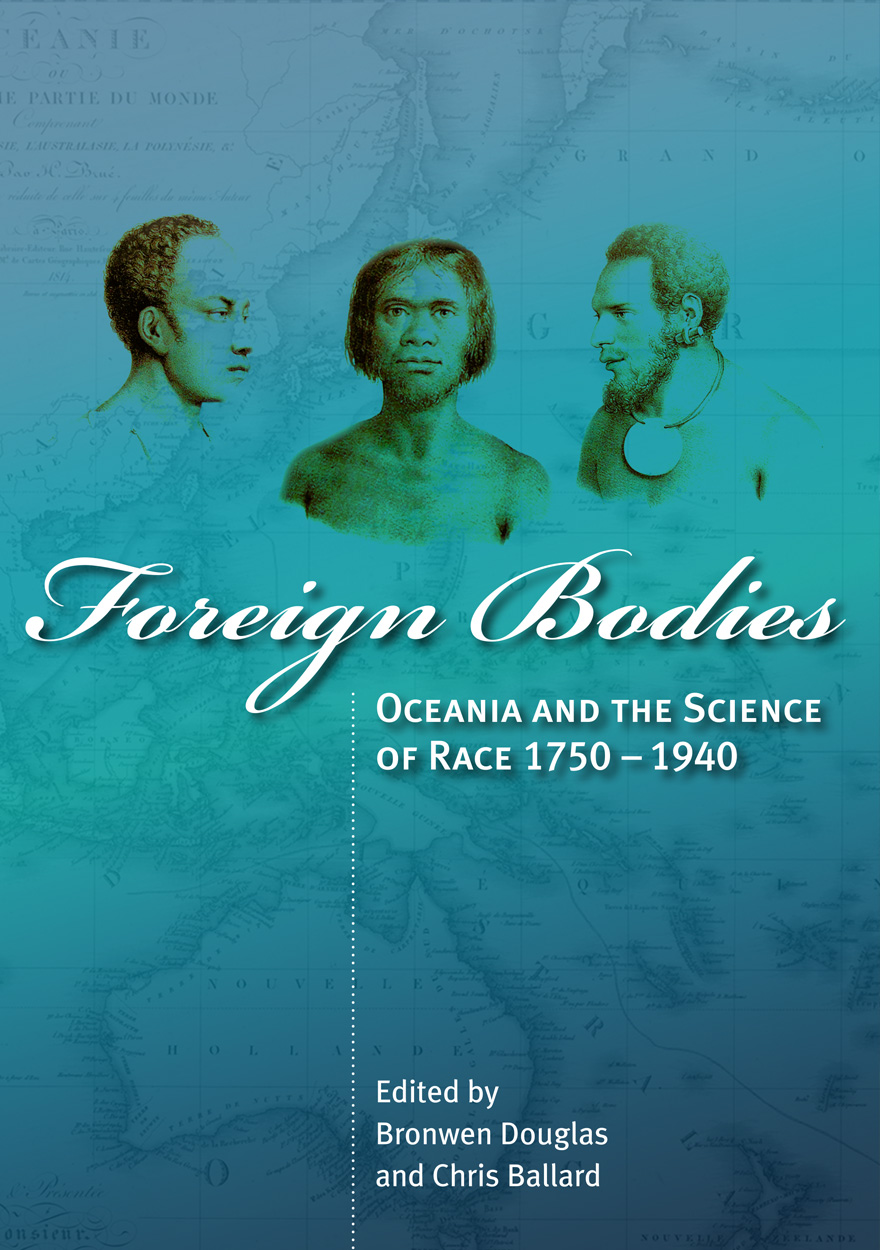
Foreign Bodies »
Oceania and the Science of Race 1750–1940
Edited by: Bronwen Douglas, Chris Ballard
Publication date: October 2008
From the 18th century, Oceania became the principal laboratory of raciology for scholars, voyagers, and colonisers alike. By juxtaposing encounters and theory, this magisterial book explores the semantics of human difference in all its emotional, intellectual, religious, and practical dimensions. The argument developed is subtle, engrossing, and gives the paradigm of ‘race’ its full use value. Foreign Bodies is a model of analysis and erudition from which historians of science and everyone interested in intercultural relations will greatly profit.
— Claude Blanckaert, CNRS (Centre Alexandre Koyré), Paris, and Honorary President, French Society for the History of the Science of Man