



Search titles
Displaying results 91 to 100 of 163.
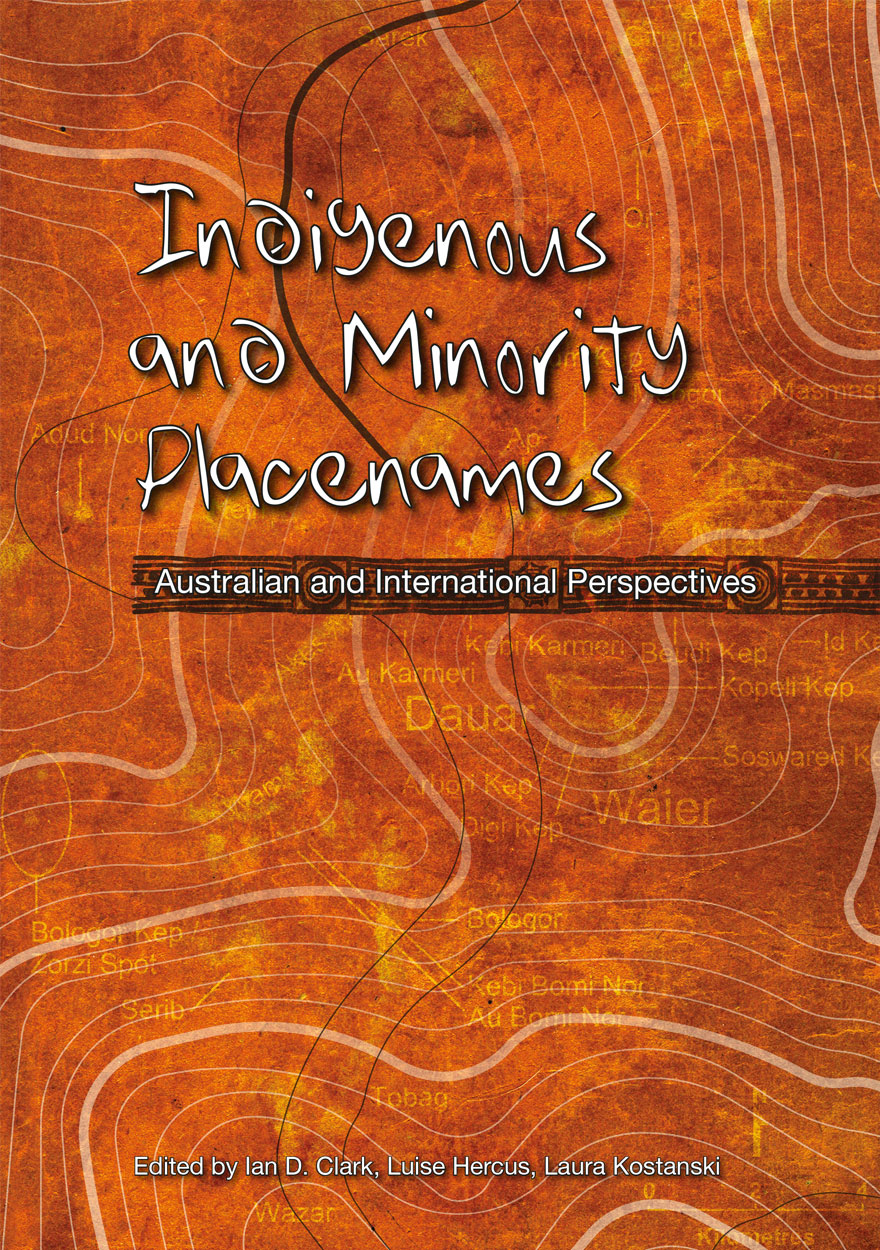
Indigenous and Minority Placenames »
Australian and International Perspectives
Publication date: August 2014
This book showcases current research into Indigenous and minority placenames in Australia and internationally. Many of the chapters in this volume originated as papers at a Trends in Toponymy conference hosted by the University of Ballarat in 2007 that featured Australian and international speakers. The chapters in this volume provide insight into the quality of toponymic research that is being undertaken in Australia and in countries such as Canada, Finland, South Africa, New Zealand, and Norway. The research presented here draws on the disciplines of linguistics, geography, history, and anthropology. The book includes meticulous studies of placenames in central NSW and the Upper Hunter region; Gundungurra cave names; western Arnhem Land; Northern Cape York Peninsula and Mount Wheeler in Queensland; saltwater placenames around Mer in the Torres Strait; and the Kaurna in South Australia.
For more information on Aboriginal History Inc. please visit aboriginalhistory.org.au.
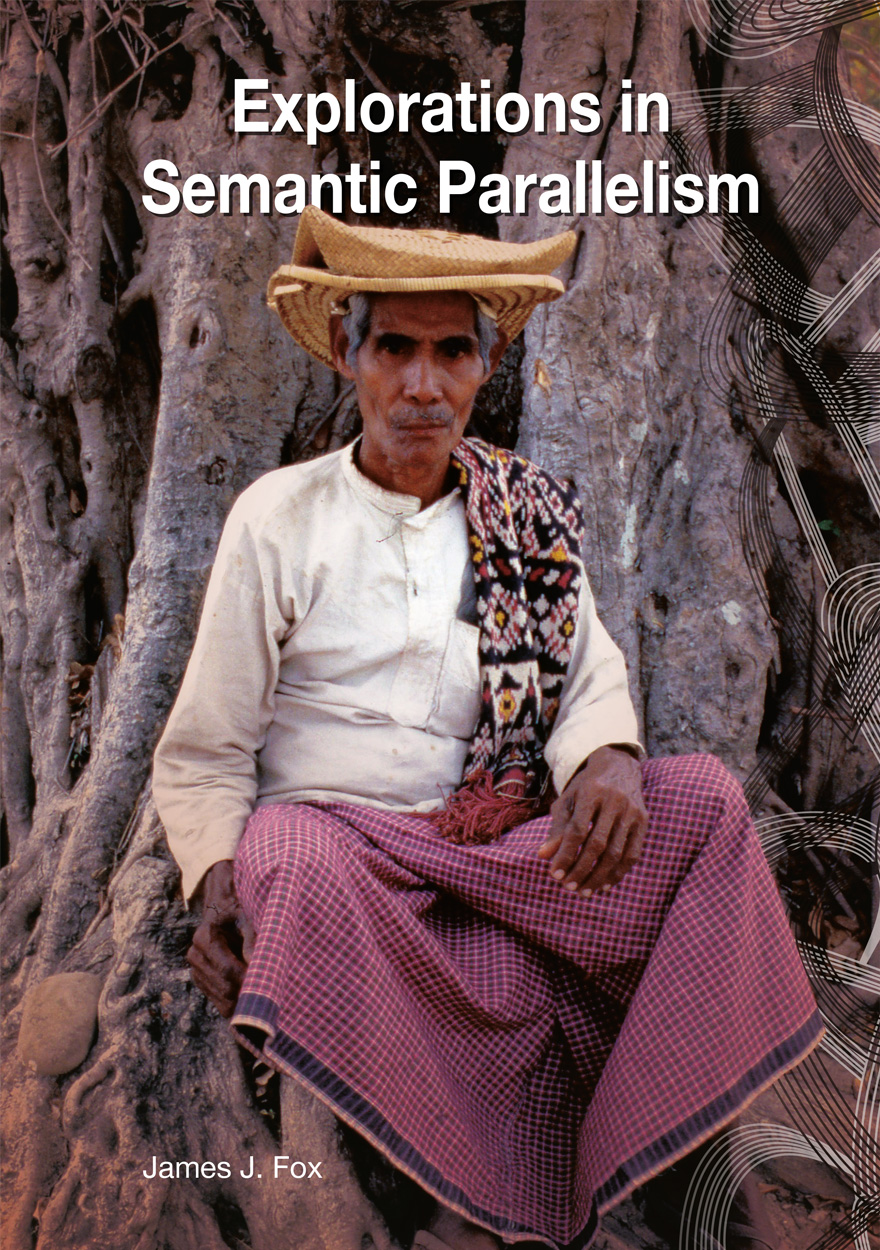
Explorations in Semantic Parallelism »
Authored by: James J. Fox
Publication date: July 2014
This collection of eighteen papers explores issues in the study of semantic parallelism — a world-wide tradition in the composition of oral poetry. It is concerned with both comparative issues and the intensive study of a single living poetic tradition of composition in strict canonical parallelism. The papers in the volume were written at intervals from 1971 to 2014 — a period of over forty years. They are a summation of a career-long research effort that continues to take shape. The concluding essay reflects on possible directions for future research.
Explorations in Semantic Parallelism also offers an enhanced epub: a downloadable ebook format with embedded video. Please download using the link below.

The Aranda's Pepa »
An introduction to Carl Strehlow’s Masterpiece Die Aranda- und Loritja-Stämme in Zentral-Australien (1907-1920)
Authored by: Anna Kenny
Publication date: December 2013
The German missionary Carl Strehlow (1871-1922) had a deep ethnographic interest in Aboriginal Australian cosmology and social life which he documented in his 7 volume work Die Aranda- und Loritja-Stämme in Zentral-Australien that remains unpublished in English. In 1913, Marcel Mauss called his collection of sacred songs and myths, an Australian Rig Veda. This immensely rich corpus, based on a lifetime on the central Australian frontier, is barely known in the English-speaking world and is the last great body of early Australian ethnography that has not yet been built into the world of Australian anthropology and its intellectual history.
The German psychological and hermeneutic traditions of anthropology that developed outside of a British-Australian intellectual world were alternatives to 19th century British scientism. The intellectual roots of early German anthropology reached back to Johann Gottfried Herder (1744-1803), the founder of German historical particularism, who rejected the concept of race as well as the French dogma of the uniform development of civilisation. Instead he recognised unique sets of values transmitted through history and maintained that cultures had to be viewed in terms of their own development and purpose. Thus, humanity was made up of a great diversity of ways of life, language being one of its main manifestations. It is this tradition that led to a concept of cultures in the plural.

Life on the Margins »
An Archaeological Investigation of Late Holocene Economic Variability, Blue Mud Bay, Northern Australia
Authored by: Patrick Faulkner
Publication date: December 2013
The research presented here is primarily concerned with human-environment interactions on the tropical coast of northern Australia during the late Holocene. Based on the suggestion that significant change can occur within short time-frames as a direct result of interactive processes, the archaeological evidence from the Point Blane Peninsula, Blue Mud Bay, is used to address the issue of how much change and variability occurred in hunter-gatherer economic and social structures during the late Holocene in coastal northeastern Arnhem Land. The suggestion proposed here is that processes of environmental and climatic change resulted in changes in resource distribution and abundance, which in turn affected patterns of settlement and resource exploitation strategies, levels of mobility and, potentially, the size of foraging groups on the coast. The question of human behavioural variability over the last 3000 years in Blue Mud Bay has been addressed by examining issues of scale and resolution in archaeological interpretation, specifically the differential chronological and spatial patterning of shell midden and mound sites on the peninsula in conjunction with variability in molluscan resource exploitation. To this end, the biological and ecological characteristics of the dominant molluscan species is considered in detail, in combination with assessing the potential for human impact through predation. Investigating pre-contact coastal foraging behaviour via the archaeological record provides an opportunity for change to recognised in a number of ways. For example, a differential focus on resources, variations in group size and levels of mobility can all be identified. It has also been shown that human-environment interactions are non-linear or progressive, and that human behaviour during the late Holocene was both flexible and dynamic.

Prehistoric Marine Resource Use in the Indo-Pacific Regions »
Edited by: Rintaro Ono, Alex Morrison, David Addison
Publication date: December 2013
Although historic sources provide information on recent centuries, archaeology can contribute longer term understandings of pre-industrial marine exploitation in the Indo-Pacific region, providing valuable baseline data for evaluating contemporary ecological trends. This volume contains eleven papers which constitute a diverse but coherent collection on past and present marine resource use in the Indo-Pacific region, within a human-ecological perspective. The geographical focus extends from Eastern Asia, mainly Japan and Insular Southeast Asia (especially the Philippines) to the tropical Pacific (Micronesia, Melanesia, and Polynesia) and outlying sites in coastal Tanzania (Indian Ocean) and coastal California (North Pacific).
The volume is divided thematically and temporally into four parts: Part 1, Prehistoric and historic marine resource use in the Indo-Pacific Region; Part 2, Specific marine resource use in the Pacific and Asia; Part 3, Marine use and material culture in the Western Pacific; and Part 4, Modern marine use and resource management.
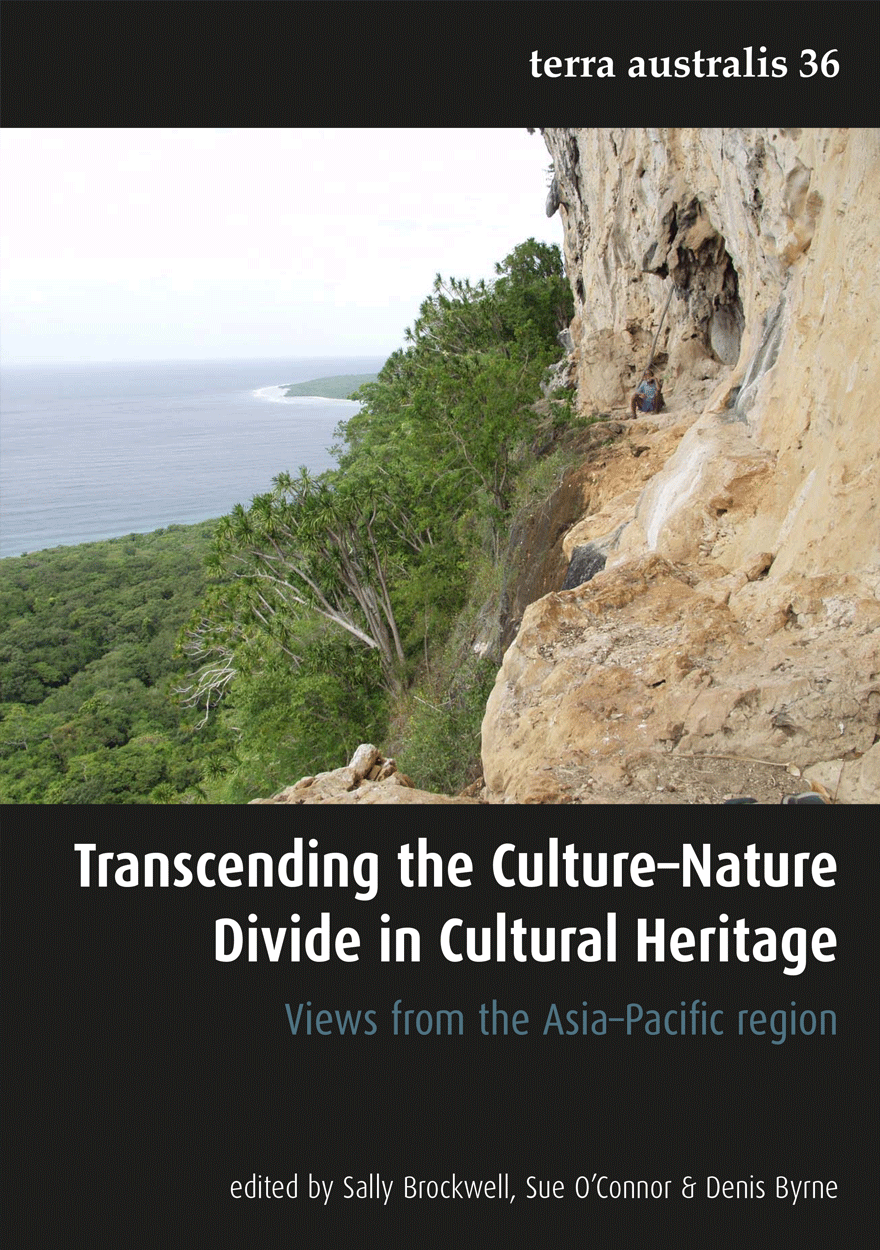
Transcending the Culture–Nature Divide in Cultural Heritage »
Views from the Asia–Pacific region
Edited by: Sally Brockwell, Sue O'Connor, Denis Byrne
Publication date: December 2013
While considerable research and on-ground project work focuses on the interface between Indigenous/local people and nature conservation in the Asia-Pacific region, the interface between these people and cultural heritage conservation has not received the same attention. This collection brings together papers on the current mechanisms in place in the region to conserve cultural heritage values. It will provide an overview of the extent to which local communities have been engaged in assessing the significance of this heritage and conserving it. It will address the extent to which management regimes have variously allowed, facilitated or obstructed continuing cultural engagement with heritage places and landscapes, and discuss the problems agencies experience with protection and management of cultural heritage places.

The Struggle of the Shi‘is in Indonesia »
Authored by: Zulkifli
Publication date: November 2013
The Struggle of the Shi‘is in Indonesia is a pioneering work. It is the first comprehensive scholarly examination in English of the development of Shiism in Indonesia. It focuses primarily on the important period between 1979 and 2004 – a period of nearly a quarter of a century that saw the notable dissemination of Shi’i ideas and a considerable expansion of the number of Shi’i adherents in Indonesia. Since Islam in Indonesia is overwhelmingly Sunni, this development of Shiism in a predominantly Sunni context is a remarkable phenomenon that calls for careful, critical investigation. There is also an important examination of the principal ideas underlying the Madhab Ahl al-Bayt, the Imamate and Imam Madhi, Ja‘fari jurisprudence and ritual piety. Appropriately, in his discussion, Zulkifli provides a succinct outline of contrasts with Sunni ideas and practice. He also examines the publishing efforts that underpinned the dissemination of Shi’i ideas and the founding of IJABI (Ikatan Jamaah Ahlul Bait Indonesia) in July 2000 for the propagation of Ahl al-Bayt teachings. Given the Indonesian context, Zulkifli is also concerned with Sunni reactions to these Shi’i developments – a story that continues to unfold to the present. This book as a work of great value and significance for the continuing understanding of the richness and complexity of Indonesian Islam.

Tajikistan »
A Political and Social History
Authored by: Kirill Nourzhanov, Christian Bleuer
Publication date: October 2013
This book is a historical study of the Tajiks in Central Asia from the ancient times to the post-Soviet period. For millennia, these descendants of the original Aryan settlers were part of many different empires set up by Greek, Arab, Turkic and Russian invaders, as well as their own, most notably during the Middle Ages. The emergence of the modern state of Tajikistan began after 1917 under Soviet rule, and culminated in the promulgation of independence from the moribund USSR in 1991. In the subsequent civil war that raged between 1992 and 1997, Tajikistan came close to becoming a failed state. The legacy of that internal conflict remains critical to understanding politics in Tajikistan a generation later.
Exploring the patterns of ethnic identity and the exigencies of state formation, the book argues that despite a strong sense of belonging underpinned by shared history, mythology and cultural traits, the Tajiks have not succeeded in forming a consolidated nation. The politics of the Russian colonial administration, the national-territorial delimitation under Stalin, and the Soviet strategy of socio-economic modernisation contributed to the preservation and reification of sub-ethnic cleavages and regional identities. The book demonstrates the impact of region-based elite clans on Tajikistan’s political trajectory in the twilight years of the Soviet era, and identifies objective and subjective factors that led to the civil war. It concludes with a survey of the process of national reconciliation after 1997, and the formal and informal political actors, including Islamist groups, who compete for influence in Tajik society.
“Tajikistan: A Political and Social History is the best source of information on this important country in the English language. Drs Nourzhanov and Bleuer present a comprehensive yet detailed account of the past and prospects of this emerging nation, and have filled one of the major gaps in Central Asian scholarship. This book must be read by those who wish to grasp the vagaries of Central Asia’s evolving political and cultural landscapes.”
— Reuel Hanks, Professor of Geography, Oklahoma State University, and Editor of the Journal of Central Asian Studies.
“If Tajikistan is known outside its region, it is often for the civil war that gravely damaged it. This volume authoritatively provides the longer perspective to the unsettling events of the 1990s and skilfully explains them in terms of history, social structure, and sub-state identities. In addition to highlighting a wealth of local factors, it is insightful on the ways in which antagonists can be transformed into broader ethnic and regional blocs. Kirill Nourzhanov and Christian Bleuer are erudite guides to an understudied part of Central Asia, while astutely instructing us about larger patterns of state-society relations and their impact on the logic of conflict.”
— James Piscatori, Professor of International Relations, Durham University.
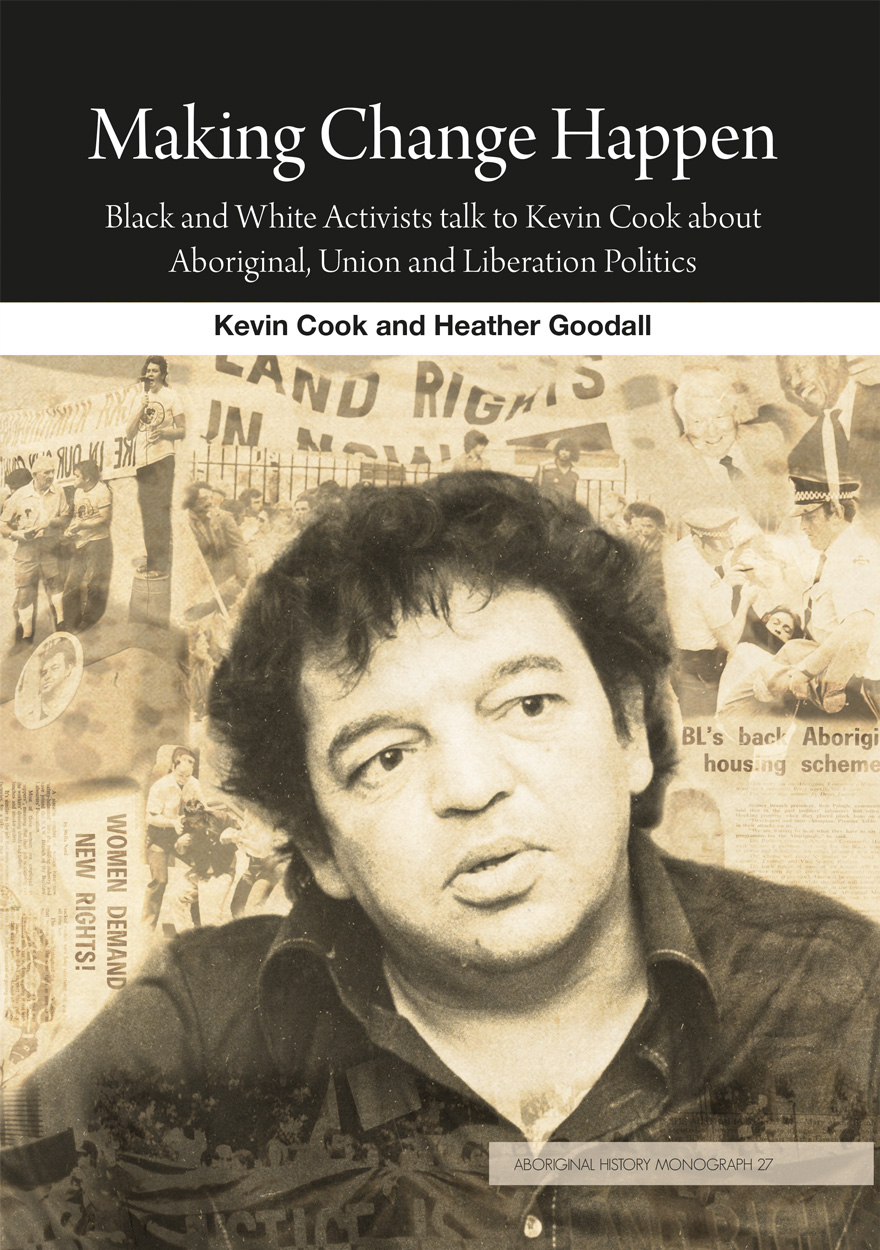
Making Change Happen »
Black and White Activists talk to Kevin Cook about Aboriginal, Union and Liberation Politics
Authored by: Kevin Cook, Heather Goodall
Publication date: September 2013
This book is a unique window into a dynamic time in the politics and history of Australia. The two decades from 1970 to the Bicentennial in 1988 saw the emergence of a new landscape in Australian Indigenous politics. There were struggles, triumphs and defeats around land rights, community control of organisations, national coalitions and the international movement for Indigenous rights. The changes of these years generated new roles for Aboriginal people. Leaders had to grapple with demands to be administrators and managers as well as spokespeople and lobbyists. The challenges were personal as well as organisational, with a central one being how to retain personal integrity in the highly politicised atmosphere of the ‘Aboriginal Industry’. Kevin Cook was in the middle of many of these changes – as a unionist, educator, land rights campaigner, cultural activist and advocate for liberation movements in Southern Africa, the Pacific and around the world. But ‘Cookie’ has not wanted to tell the story of his own life in these pages. Instead, with Heather Goodall, a long time friend, he has gathered together many of the activists with whom he worked to tell their stories of this important time. Readers are invited into the frank and vivid conversations Cookie had with forty-five black and white activists about what they wanted to achieve, the plans they made, and the risks they took to make change happen.
“You never doubted Kevin Cook. His very presence made you confident because the guiding hand is always there. Equal attention is given to all. I am one of many who worked with Cookie and Judy through the Tranby days and in particular the 1988 Bicentennial March for Freedom, Justice and Hope. What days they were. I’m glad this story is being told.”
— Linda Burney, MLA New South Wales
“Kevin Cook was a giant in the post-war struggle for Aboriginal rights. His ability to connect the dots and make things happen was important in both the political and cultural resurgence of the 1970s onwards.”
— Meredith Burgmann, former MLC, New South Wales
“Kevin has had a transformative effect on the direction of my life and the lives of so many other people. This book is an important contribution to understanding not only Kevin’s life but also the broader struggles for social and economic justice, for community empowerment and of the cooperative progressive movement. It will greatly assist the ongoing campaign for full and sustainable reconciliation.”
— Paddy Crumlin, National Secretary, Maritime Union of Australia
“Cookie has made great contributions in enhancing the struggles of our people. He is a motivator, an astute strategist, and an excellent communicator with wonderful people skills. It’s a pleasure to be able to call him a mate and a brother.”
— John Ah Kit, former MLA, Northern Territory
For more information on Aboriginal History Inc. please visit aboriginalhistory.org.au.

Macassan History and Heritage »
Journeys, Encounters and Influences
Edited by: Marshall Clark, Sally K. May
Publication date: June 2013
This book presents inter-disciplinary perspectives on the maritime journeys of the Macassan trepangers who sailed in fleets of wooden sailing vessels known as praus from the port city of Makassar in southern Sulawesi to the northern Australian coastline. These voyages date back to at least the 1700s and there is new evidence to suggest that the Macassan praus were visiting northern Australia even earlier. This book examines the Macassan journeys to and from Australia, their encounters with Indigenous communities in the north, as well as the ongoing social and cultural impact of these connections, both in Indonesia and Australia.