



Search titles
Displaying results 281 to 290 of 391.

Fiji before the storm »
Elections and the politics of development
Edited by: Brij V. Lal
Publication date: December 2012
A racially-weighted Constitution, promulgated by decree in 1990, divided the country and invited international condemnation, and the economy suffered from the collapse of institutions of good governance. In 1995, an independent Constitution Review Commision appointed by the Fijian parliament, recommended wide-ranging changes to the Constitution. Its report formed the basis of a new Constitution promulgated, after wide-ranging consultation and debate, in 1997. Two years later, Fiji held a general election under it. This collection of essays looks at the politics and dynamics of that momentous event, and the role of key individuals and institutions in producing an outcome that, a year later, plunged Fiji into its first major crisis of the twenty-first century. The essays look at some of the key political and development issues on the eve of the crisis, but the relevance to the current debates about the nature and meaning of politics in Fiji remains. All the contributors are recognised and longstanding specialists in their fields.
This work, originally published by Asia Pacific Press, is reproduced here in the interests of maintaining open access to high-quality academic works no longer in print.

Australia: Identity, Fear and Governance in the 21st Century »
Edited by: Juliet Pietsch, Haydn Aarons
Publication date: November 2012
The latter years of the first decade of the twenty-first century were characterised by an enormous amount of challenge and change to Australia and Australians. Australia’s part in these challenges and changes is borne of our domestic and global ties, our orientation towards ourselves and others, and an ever increasing awareness of the interdependency of our world. Challenges and changes such as terrorism, climate change, human rights, community breakdown, work and livelihood, and crime are not new but they take on new variations and impact on us in different ways in times such as these.
In this volume we consider these recent challenges and changes and how Australians themselves feel about them under three themes: identity, fear and governance. These themes suitably capture the concerns of Australians in times of such change. Identity is our sense of ourselves and how others see us. How is this affected by the increased presence of religious diversity, especially Islamic communities, and increased awareness of moral and political obligations towards Indigenous Australians? How is it affected by our curious but changing relationship with Asia? Fear is an emotional reaction to particular changes and challenges and produces particular responses from individuals, politicians, communities and nations alike; fear of crime, fear of terrorism and fear of change are all considered in this volume.

Situating Women »
Gender Politics and Circumstance in Fiji
Authored by: Nicole George
Publication date: November 2012
Since the time of decolonisation in Fiji, women’s organisations have navigated a complex political terrain. While they have stayed true to the aim of advancing women’s status, their work has been buffeted by national political upheavals and changing global and regional directions in development policy-making. This book documents how women activists have understood and responded to these challenges. It is the first book to write women into Fiji’s postcolonial history, providing a detailed historical account of that country’s gender politics across four tumultuous decades. It is also the first to examine the ‘situated’ nature of gender advocacy in the Pacific Islands more broadly. It does this by analysing trends in activity, from women’s radical and provocative activism of the 1960s to a more self-evaluative and reflexive mood of engagement in later decades, showing how interplaying global and local factors can shape women’s understandings of gender justice and their pursuit of that goal.

Intersections »
History, Memory, Discipline
Authored by: Brij V. Lal
Publication date: November 2012
“A wonderfully rich, insightful and personally touching collection of essays by the Pacific region’s most prolific and engaging historian. Brij Lal writes eloquently and poetically about his professional and political journeys, and the many different people and worlds he has encountered on the way. Readers will be inspired by this collective account of a courageous life committed to the achievement of democratic freedom and social justice. What shines through these pages is Lal’s love of and commitment to Fiji, from which he has been painfully exiled.”
— David Hanlon, Professor of History & Former Director of the Center for Pacific Islands Studies, University of Hawaii at Manoa.
“Intersections is a compilation of Brij Lal’s essays where academic knowledge combines with life world experience. The voice behind these essays is always courageous and the writing itself indicative of a highly disciplined mind. Read this book with an open mind as Lal explores with sensitivity a country he loves intensely and as he reminisces on the vocation of a scholar. Savour the book’s historical insights, enter into its subaltern worlds, debate and challenge its findings, and in that moment of engagement shed a tear for a country which has lost its memory.”
— Vijay Mishra, Professor of English, Murdoch University
“Brij Lal is a master craftsman and all his skills are on display in this fascinating work which blends autobiography with social, political and historical analysis to produce a work of impeccable scholarship. Lal emerges as much more than a historian as he reflects on the discipline of History, the changing nature of academic life, the challenges of the Indian diaspora, indenture and his travels. He may be banned from his homeland, but somehow one gets the impression that his influence is alive in Fiji, his adopted Australia and across the world. True to his indentured roots, he is still digging, still writing, and still making history.”
— Goolam Vahed, Associate Professor of History, University of KwaZulu-Natal

East Asia Forum Quarterly: Volume 4, Number 3, 2012 »
Publication date: October 2012
East Asia Forum Quarterly grew out of East Asia Forum (EAF) online, which has developed a reputation for providing a platform for the best in Asian analysis, research and policy comment on the Asia Pacific region in world affairs. EAFQ aims to provide a further window onto research in the leading research institutes in Asia and to provide expert comment on current developments within the region. The East Asia Forum Quarterly, like East Asia Forum online, is an initiative of the East Asia Forum (EAF) and its host organisation, the East Asian Bureau of Economic Research (EABER) in the Crawford School of Economics and Government in the College of Asia & the Pacific at The Australian National University.
Download for free
Not available for purchase
Ministerial Careers and Accountability in the Australian Commonwealth Government »
Edited by: Keith Dowding, Chris Lewis
Publication date: September 2012
This book examines the roles, responsibilities and accountabilities of Australian cabinet ministers. It examines the sorts of jobs ministers do, what is expected of them, what they expect of the job and how they (are supposed to) work together as a team. It considers aspects of how they are chosen to become ministers; how they are scrutinised by parliament and the media; and how ministers themselves view accountability. It also looks at the causes of calls for ministers to resign, examines scandals around ministers and assesses ministerial accountability.
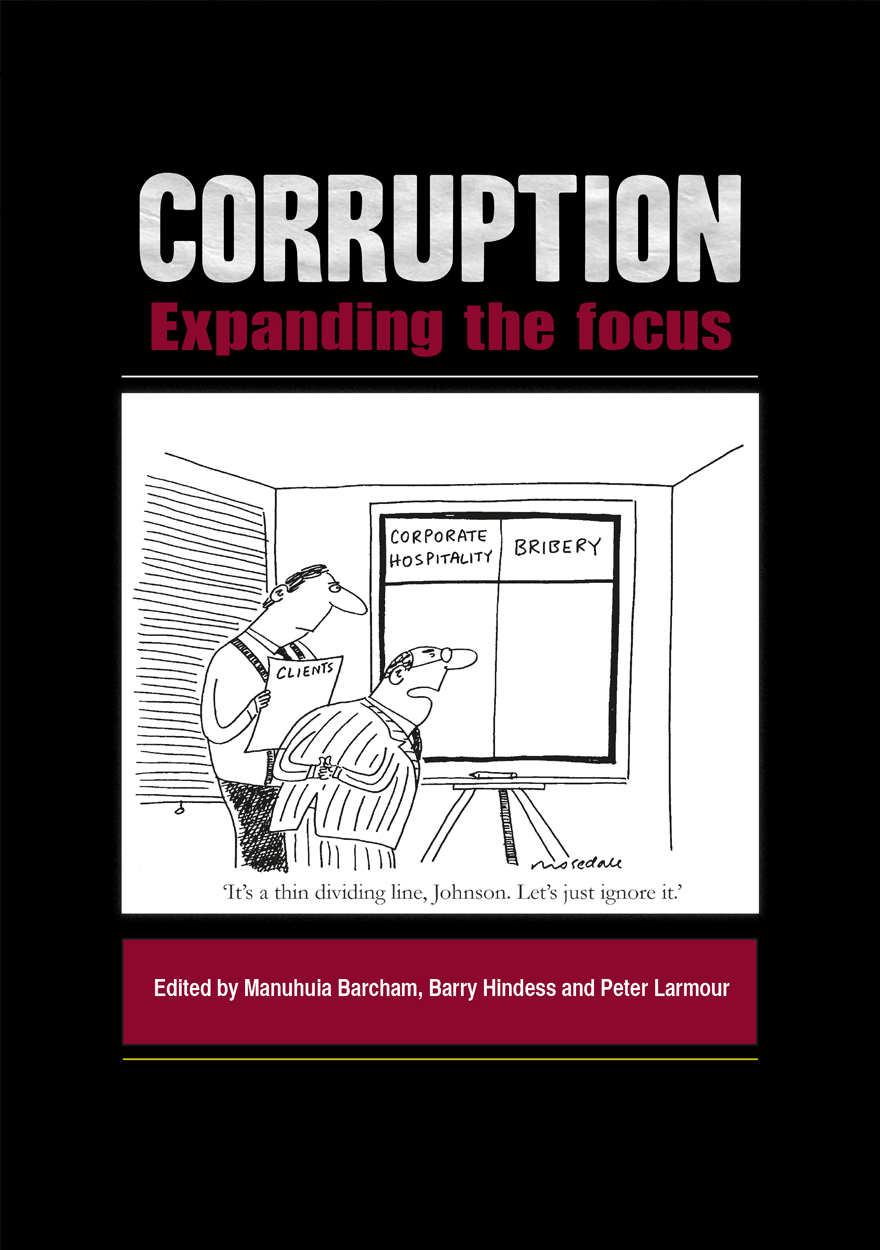
Corruption »
Expanding the Focus
Edited by: Manuhuia Barcham, Barry Hindess, Peter Larmour
Publication date: September 2012
Recent years have seen an unprecedented rise in interest in the topic of corruption, resulting in a rising demand for suitable teaching materials. This edited collection brings together two different approaches to the study of corruption — the first represented by a large, practically-oriented literature devoted to identifying the causes of corruption, assessing its incidence and working out how to bring it under control; the second by a smaller collection of critical literature in political theory and intellectual history that addresses conceptual and historical issues concerned with how corruption should be, and how it has been, understood — and uses the second to reflect on the first.
This collection will be of interest to post-graduate students in political science, law, sociology, public policy and development studies, to senior public servants, and to professionals working in multilateral agencies, NGOs and the media.
Public Sector Governance in Australia »
Authored by: Meredith Edwards, John Halligan, Bryan Horrigan, Geoffrey Nicoll
Publication date: July 2012
Australia lacks a scholarly book that covers recent developments in public sector governance in Australia and blends cross-disciplinary perspectives from law, management, public administration and public policy. The primary reason for writing this book is to fill the gap in the treatment of this subject, and to provide insights from empirical evidence and current practice.
The book provides the first comprehensive theoretical and empirical work on governance in the Commonwealth public sector. It addresses the issues that emerged under the Howard government as well as their handling under the Rudd and Gillard governments. The book aims to enhance understanding of and communication about public governance across government, industry and the community.
The authors bring to this book expertise gained from political science, public administration and policy, public and private sector law.

Rebalancing and Sustaining Growth in China »
Edited by: Huw Mckay, Ligang Song
Publication date: July 2012
The idea that China’s economy needs to rebalance is no longer controversial inside or outside the country. Whether it be the increasing recognition of income inequality at home; the still large external surplus; the focus on consumption and industrial upgrading in the policy discourse; the economic, political and social tensions associated with the major decline in housing affordability; the profound conflict between industrialisation, urbanisation and the biosphere; the profitability gulf between the top SOEs and private firms; or the uni-directional pressures pushing on the real exchange rate; the evidence in favour of a highly imbalanced structure is omnipresent.
Rebalancing and Sustaining Growth in China brings together some of the world’s leading observers of the Chinese economy to debate the multifarious questions pertaining to rebalancing. How are we to make sense of the many, often contradictory, proposals that seek the same ultimate objective of a more sustainable growth model? What mix of policies will be most effective in addressing the required structural change without sacrificing prosperity along the way? Where should we look for root causes, and how can we avoid getting distracted by symptoms? How do China’s unique internal migration dynamics – and the Lewis turning point – constrain its options? What role will and should financial, fiscal and welfare reform play in the process? Where do water and energy security fit in? Can China innovate before it gets old – or can China get smart before it gets rich? And are intergenerational issues being taken into account?

A Trial Separation »
Australia and the Decolonisation of Papua New Guinea
Authored by: Donald Denoon
Publication date: May 2012
When it came in September 1975, Papua New Guinea’s independence was marked by both anxiety and elation. In the euphoric aftermath, decolonisation was declared a triumph and immediate events seemed to justify that confidence. By the 1990s, however, events had taken a turn for the worse and there were doubts about the capacity of the State to function. Before independence, Papua New Guinea was an Australian Territory. Responsibility lay with a minister in Canberra and services were provided by Commonwealth agencies. In 1973, Prime Minister Gough Whitlam declared that independence should be achieved within two years. While Australians were united in their desire to decolonise, many Papua New Guineans were nervous of independence.
This superlative history presents the full story of the ‘trial separation’ of Australia and Papua New Guinea, concluding that — given the intertwined history, geography and economies of the two neighbours — the decolonisation project of ‘independence’ is still a work in progress.