



Search titles
Displaying results 261 to 270 of 391.
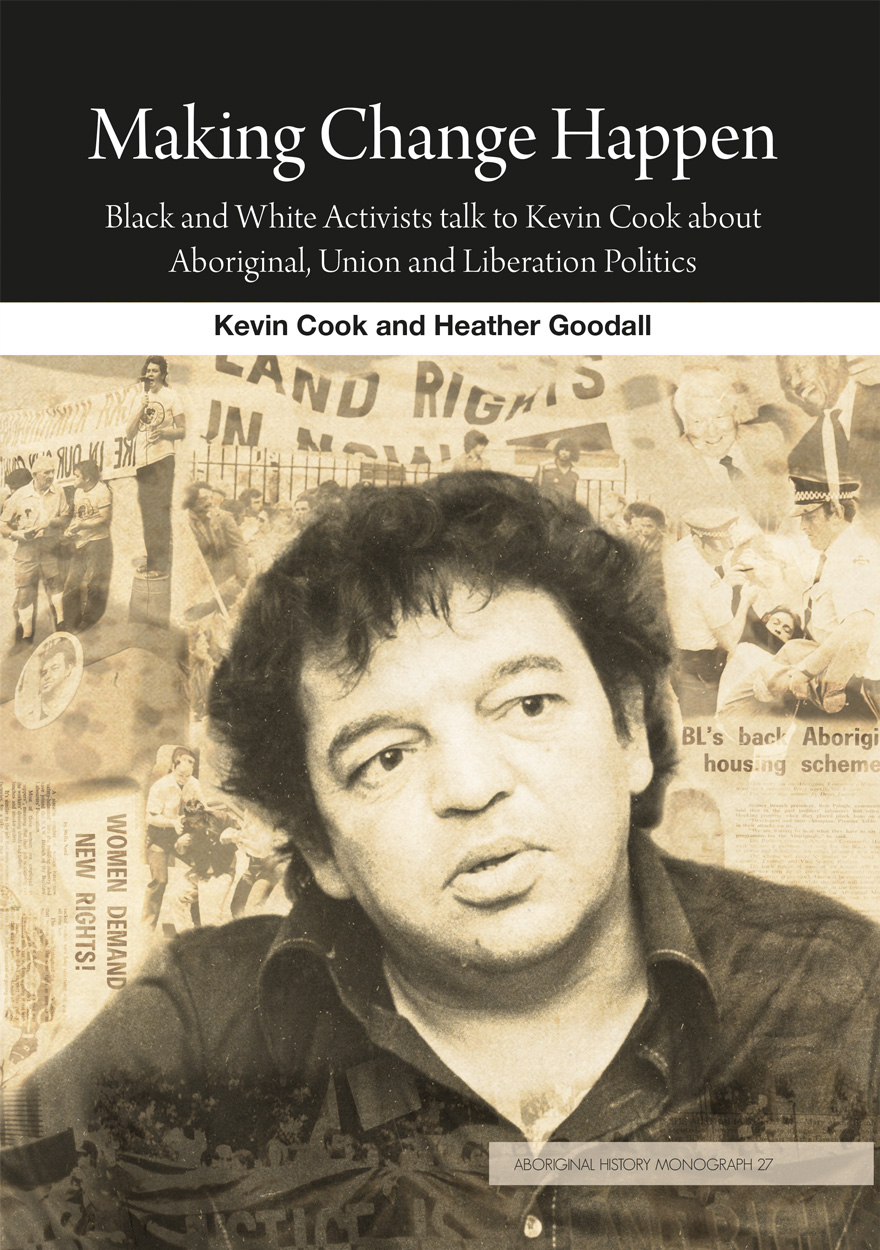
Making Change Happen »
Black and White Activists talk to Kevin Cook about Aboriginal, Union and Liberation Politics
Authored by: Kevin Cook, Heather Goodall
Publication date: September 2013
This book is a unique window into a dynamic time in the politics and history of Australia. The two decades from 1970 to the Bicentennial in 1988 saw the emergence of a new landscape in Australian Indigenous politics. There were struggles, triumphs and defeats around land rights, community control of organisations, national coalitions and the international movement for Indigenous rights. The changes of these years generated new roles for Aboriginal people. Leaders had to grapple with demands to be administrators and managers as well as spokespeople and lobbyists. The challenges were personal as well as organisational, with a central one being how to retain personal integrity in the highly politicised atmosphere of the ‘Aboriginal Industry’. Kevin Cook was in the middle of many of these changes – as a unionist, educator, land rights campaigner, cultural activist and advocate for liberation movements in Southern Africa, the Pacific and around the world. But ‘Cookie’ has not wanted to tell the story of his own life in these pages. Instead, with Heather Goodall, a long time friend, he has gathered together many of the activists with whom he worked to tell their stories of this important time. Readers are invited into the frank and vivid conversations Cookie had with forty-five black and white activists about what they wanted to achieve, the plans they made, and the risks they took to make change happen.
“You never doubted Kevin Cook. His very presence made you confident because the guiding hand is always there. Equal attention is given to all. I am one of many who worked with Cookie and Judy through the Tranby days and in particular the 1988 Bicentennial March for Freedom, Justice and Hope. What days they were. I’m glad this story is being told.”
— Linda Burney, MLA New South Wales
“Kevin Cook was a giant in the post-war struggle for Aboriginal rights. His ability to connect the dots and make things happen was important in both the political and cultural resurgence of the 1970s onwards.”
— Meredith Burgmann, former MLC, New South Wales
“Kevin has had a transformative effect on the direction of my life and the lives of so many other people. This book is an important contribution to understanding not only Kevin’s life but also the broader struggles for social and economic justice, for community empowerment and of the cooperative progressive movement. It will greatly assist the ongoing campaign for full and sustainable reconciliation.”
— Paddy Crumlin, National Secretary, Maritime Union of Australia
“Cookie has made great contributions in enhancing the struggles of our people. He is a motivator, an astute strategist, and an excellent communicator with wonderful people skills. It’s a pleasure to be able to call him a mate and a brother.”
— John Ah Kit, former MLA, Northern Territory
For more information on Aboriginal History Inc. please visit aboriginalhistory.org.au.
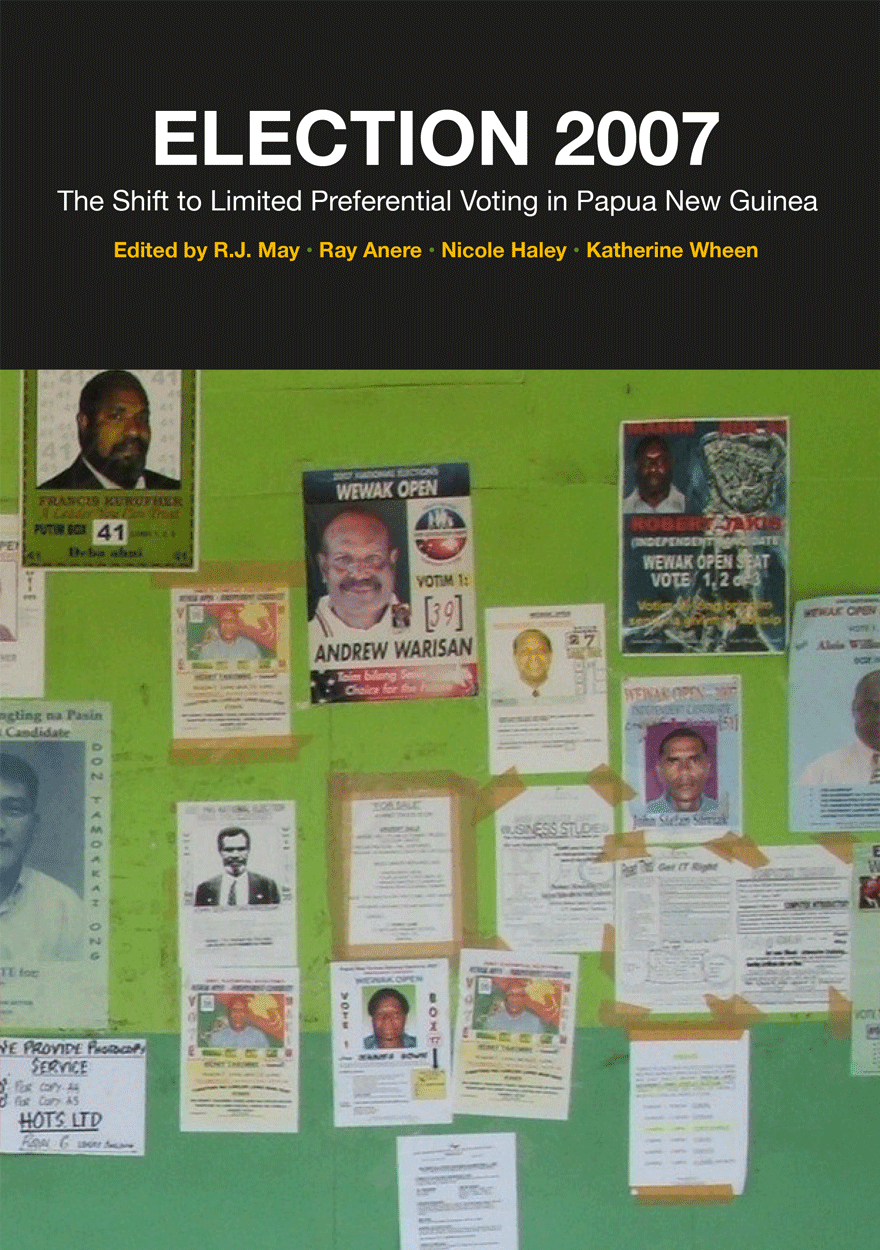
Election 2007 »
The Shift to Limited Preferential Voting in Papua New Guinea
Edited by: R.J. May, Ray Anere, Nicole Haley, Katherine Wheen
Publication date: September 2013
Papua New Guinea’s general election in 2007 attracted particular interest for several reasons. Not only did it follow what was widely acknowledged as the country’s worst election ever, in 2002 (in which elections in six of the country’s 109 electorates were declared to be ‘failed elections’), it was the first general election to be held under a new limited preferential voting system. It also followed the first full parliamentary term under the Organic Law on the Integrity of Political Parties and Candidates, which had been introduced in 2001 in an attempt to strengthen political parties and create a greater degree of stability in the national parliament, and was the first to embrace a ‘whole-of-government’ approach to electoral administration, through an Interdepartmental Electoral Committee. This volume provides an analysis of the 2007 election, drawing on the work of a domestic monitoring team organized through the National Research Institute, and several visiting scholars. It addresses key issues such as voter education, electoral administration, election security, the role of political parties, women as candidates and voters, the shift to limited preferential voting, and HIV transmission, and provides detailed accounts of the election in a number of open and provincial electorates. It is generally agreed that the election of 2007 was an improvement on that of 2002. But problems of electoral administration and voting behaviour remain. These are identified in this volume, and recommendations made for electoral reform.

Putting Citizens First »
Engagement in Policy and Service Delivery for the 21st Century
Publication date: August 2013
This book explores the ways in which governments are putting citizens first in their policy-making endeavours. Making citizens the focus of policy interventions and involving them in the delivery and design is for many governments a normative ideal; it is a worthy objective and sounds easy to achieve. But the reality is that putting citizens at the centre of policy-making is hard and confronting. Are governments really serious in their ambitions to put citizens first? Are they prepared for the challenges and demands such an approach will demand? Are they prepared to commit the time and resources to ensure genuine engagement takes place and that citizens’ interests are considered foremost? And, more importantly, are governments prepared for the trade-offs, risks and loss of control such citizen-centric approaches will inevitably involve?
The book is divided into five parts:
setting the scene: The evolving landscape for citizen engagement
drivers for change: Innovations in citizen-centric governance
case studies in land management and Indigenous empowerment
case studies in fostering community engagement and connectedness
case studies engaging with information technology and new media.
While some chapters question how far governments can go in engaging with citizens, many point to successful examples of actual engagement that enhanced policy experiences and improved service delivery. The various authors make clear that citizen engagement is not restricted to the domain of service delivery, but if taken seriously affects the ways governments conduct their activities across all agencies. The implications are enormous, but the benefits to public policy may be enormous too.

China: A New Model for Growth and Development »
Edited by: Ross Garnaut, Cai Fang, Ligang Song
Publication date: July 2013
The Chinese economy is undergoing profound change in policy and structure. The change is necessary to increase the value of growth to the Chinese community, and to sustain growth into the future. The changes are so comprehensive and profound that they represent a new model of Chinese economic growth. This book describes the replacement of an old uninhibited investment expansion model of growth, by transition to modern economic growth and provides insights into recent changes and where they are likely to lead. These include requirements for building the new institutions including its public finances for future growth, adjustments in its savings, industry and agriculture, changes in its demographic structure, business environment, and pattern of rural-urban migration, prospects for ‘green growth’, its energy policy trilemma and the climate change mitigation strategy, and changes for China’s interaction with the international economy through its overseas investment and trade in high tech products. China’s adoption of a new model of economic growth is of immense importance to people in China and everywhere. This book is an early attempt to take a close look at many of the features of the new model.
China: A New Model for Growth and Development (Chinese version) »
中国长期增长与发展的新战略: 责任与启示
Authored by: Ross Garnaut, 蔡 昉 宋立刚
Publication date: July 2013
中国经济正经历着政策和结构方面的深刻变革. 这种变革对于提高中国 社会的增长绩效、 保持未来中国经济的发展潜力都很有必要. 成功的经济发展改变了中国传统的增长模式, 也给经济发展带来了压力, 而这种压力正是变革的内驱力之一. 近年来, 劳动力短缺及真实工资迅速上涨给中国经济的传统模式带来了巨大挑战, 使得资源和收入分配、自然环境、经济增长率、储蓄率、 投资率与国际资本流动等都有所变化. 原有的增长模式在过去取得了巨大的成功, 也引发了上文所述的种种变化, 而国家政策层面上的改革亦会改善现状, 使中国的收人分配体系更加公平, 国内环境和国际环境更加有利于中国经济的发展.
Chinese version of this book is available from this Social Science and Academic Press.
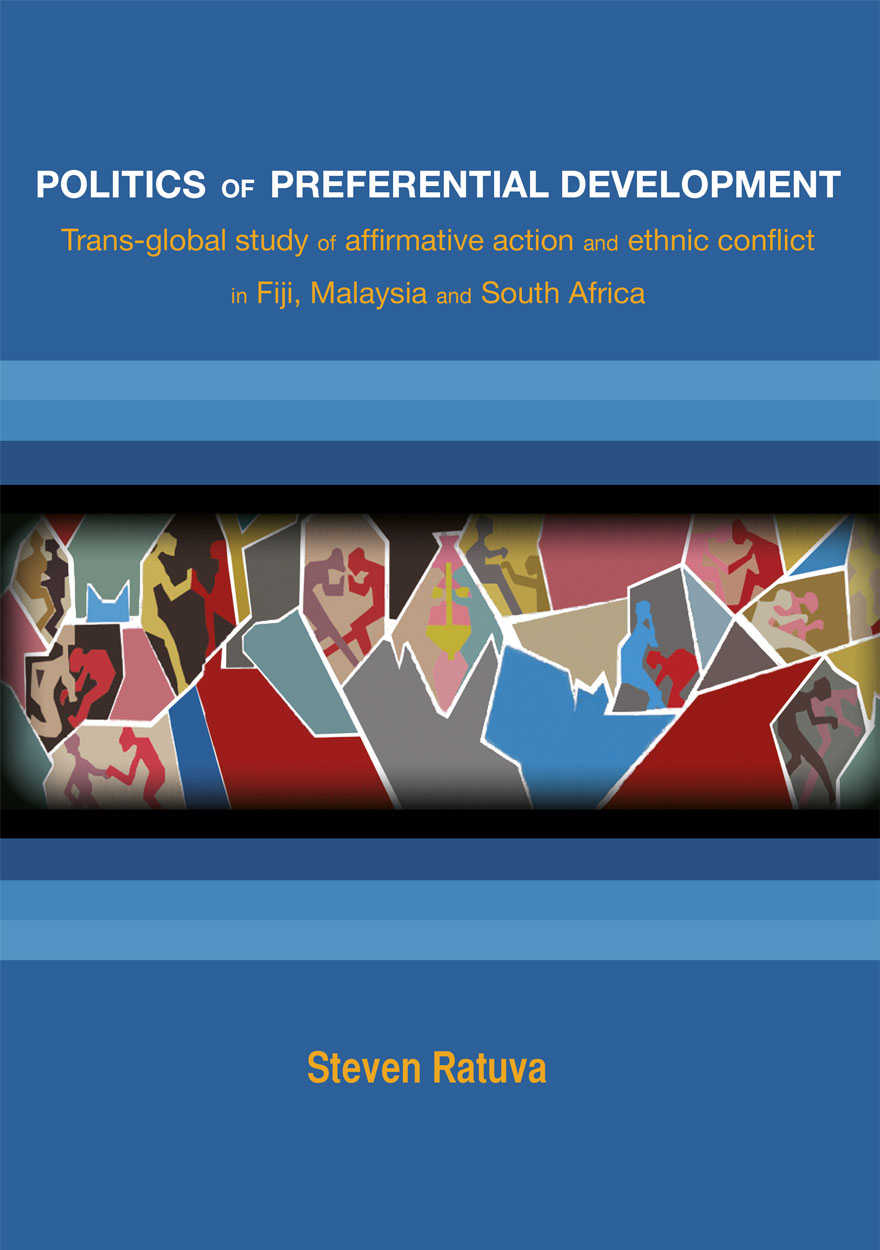
Politics of preferential development »
Trans-global study of affirmative action and ethnic conflict in Fiji, Malaysia and South Africa
Authored by: Steven Ratuva
Publication date: July 2013
The book is a critical examination of affirmative action, a form of preferential development often used to address the situation of disadvantaged groups. It uses a trans-global approach, as opposed to the comparative approach, to examine the relationship between affirmative action, ethnic conflict and the role of the state in Fiji, Malaysia and South Africa. While affirmative action has noble goals, there are often intervening political and ideological factors in the form of ethno-nationalism and elite interests, amongst others, which potentially undermine fair distribution of affirmative action resources. The book examines the affirmative action philosophies and programs of the three countries and raises pertinent questions about whether affirmative action has led to equality, social justice, harmony and political stability and explores future possibilities.
Steven Ratuva provides a brilliant critical study, not just of affirmative action policy and practice in three very different postcolonial contexts, but of the very complex matters of principle, justification and ideology that are involved more generally. It is an invaluable contribution to the literature on this important topic.
— Dr Stephanie Lawson, Professor of Politics and International Relations, Macquarie University.
Scholarly and provocative, Steven Ratuva’s Politics of Preferential Development is an original and insightful comparative contribution to the growing literature on affirmative action around the world.
— Dr Ralph Premdas, Professor of Public Policy, University of West Indies; Former Professor, University of California Berkeley and University of Toronto.

East Asia Forum Quarterly: Volume 5, Number 2, 2013 »
Publication date: June 2013
East Asia Forum Quarterly grew out of East Asia Forum (EAF) online, which has developed a reputation for providing a platform for the best in Asian analysis, research and policy comment on the Asia Pacific region in world affairs. EAFQ aims to provide a further window onto research in the leading research institutes in Asia and to provide expert comment on current developments within the region. The East Asia Forum Quarterly, like East Asia Forum online, is an initiative of the East Asia Forum (EAF) and its host organisation, the East Asian Bureau of Economic Research (EABER) in the Crawford School of Economics and Government in the College of Asia & the Pacific at The Australian National University.
Download for free
Not available for purchase

Asia-Pacific Security »
Policy Challenges
Edited by: David W. Lovell
Publication date: May 2013
Since September 11, 2001, our newspapers have been filled with the ‘war on terror’; our governments have mobilised their resources for ‘homeland security’; and people everywhere are braced for more terrorist attacks.
Yet while the new threat is genuine, we must not lose sight of the continuing security concerns in the Asia-Pacific. Tensions persist on the Korean peninsula, in the Taiwan Straits and the South China Sea, and in Kashmir. The region is well supplied with weapons of mass destruction and may face an arms race, and there are a range of pressing human security issues. Likewise, the strategic realities of the region remain linked with US power, and with the emergence of China as a key regional player.
The book examines the developing strategic relationships in the region, and clarifies the dilemmas for Australian policy-makers as they try to balance genuine engagement with the region against a long-standing and valued alliance with the United States.
Emerging from discussions between the Shanghai Institute for International Studies and the University of New South Wales at ADFA, Asia-Pacific Security has a particular relevance for foreign-policy professionals and scholars of the region.
Printed copies of this book may be ordered from ISEAS publishing.

Securing Village Life »
Development in Late Colonial Papua New Guinea
Authored by: Scott MacWilliam
Publication date: May 2013
Securing Village Life: Development in Late Colonial Papua New Guinea examines the significance for post-World War II Australian colonial policy of the modern idea of development. Australian officials emphasised the importance of bringing development for both the colony of Papua and the United Nations Trust Territory of New Guinea. The principal form that development took involved securing smallholders against the tendencies of other forms of capitalist development that might have separated households from land. In order to make household occupation of their holdings more secure and at higher standards of living, the colonial administration coordinated and supervised increases in production of crops and other agricultural produce.
Contrary to suggestions that colonial policy and practice ignored indigenous agriculture and concentrated on plantation crops grown by international firms and expatriate owner-occupiers, the study shows how the main focus was instead upon increasing smallholder output for immediate consumption as well as for local and international markets. Simultaneously development stimulated increases in consumption, including of goods produced through manufacturing processes and imported into the colony.
Only as Independence approached was the pre-eminence of the earlier focus upon smallholders weakened. In part the change occurred due to the political advance of the indigenous capitalist class and their allies seeking to extend their base in largeholding agriculture and related commercial activities. This advance and the uncertainty over which form of development would prevail once indigenes held state power in post-colonial Papua New Guinea stood in marked contrast to the definite direction pursued under the colonial administration of the 1950s and early 1960s.

France in the South Pacific »
Power and Politics
Authored by: Denise Fisher
Publication date: May 2013
France is a Pacific power, with three territories, a military presence, and extensive investments. Once seen by many as a colonial interloper in the South Pacific, by the early 2000s, after it ended nuclear testing in French Polynesia and negotiated transitional Accords responding to independence demands in New Caledonia, France seems to have become generally accepted as a regional partner, even if its efforts concentrate on its own territories rather than the independent island states.
But France’s future in the region has yet to be secured. By 2014 it is to have handed over a set of agreed autonomies to the New Caledonian government, before an independence referendum process begins. Past experience suggests that a final resolution of the status of New Caledonia will be divisive and could lead once again to violent confrontations. In French Polynesia, calls continue for independence and for treatment under UN decolonisation procedures, which France opposes. Other island leaders are watching, so far putting faith in the Noumea Accord, but wary of the final stages. The issues and possible solutions are more complex than the French Pacific island population of 515,000 would suggest.
Combining historical background with political and economic analysis, this comprehensive study offers vital insight into the intricate history – and problematic future – of several of Australia’s key neighbours in the Pacific and to the priorities and options of the European country that still rules them. It is aimed at policy-makers, scholars, journalists, businesspeople, and others who want to familiarise themselves with the issues as France’s role in the region is redefined in the years to come.