



Search titles
Displaying results 111 to 120 of 362.

Touring Pacific Cultures »
Edited by: Kalissa Alexeyeff, John Taylor
Publication date: December 2016
Tourism is vital to the economies of most Pacific nations and as such is an important site for the meaningful production of shared and disputed cultural values and practices. This is especially the case when tourism intersects with other important arenas for cultural production, both directly and indirectly. Touring Pacific Cultures captures the central importance of tourism to the visual, material and performed cultures of the Pacific region. In this volume, we propose to explore new directions in understanding how culture is defined, produced, experienced and sustained through tourism-related practices across that region. We ask, how is cultural value, ownership, performance and commodification negotiated and experienced in actual lived practice as it moves with people across the Pacific?
‘This collection is a welcome addition to tourism studies, or perhaps we should say post- or para-tourism. The essays bring out many facets and experiences too quickly bundled under a single label and focused exclusively on “destinations” visited by “outsiders”. Tourism, we see here, actively involves many different populations, societies, and economies, a range of local/global/regional engagements that can be both destructive and creative. Western outsiders aren’t the only ones on the move. Unequal power, (neo)colonial exploitation and capitalist commodification are very much part of the picture. But so are desire, adventure, pleasure, cultural reinvention and economic development. The effect, overall, is an attitude of alert, critical ambivalence with respect to a proliferating historical phenomenon.
A bumpy and rewarding ride.’
— James Clifford, Professor Emeritus, University of California, Santa Cruz
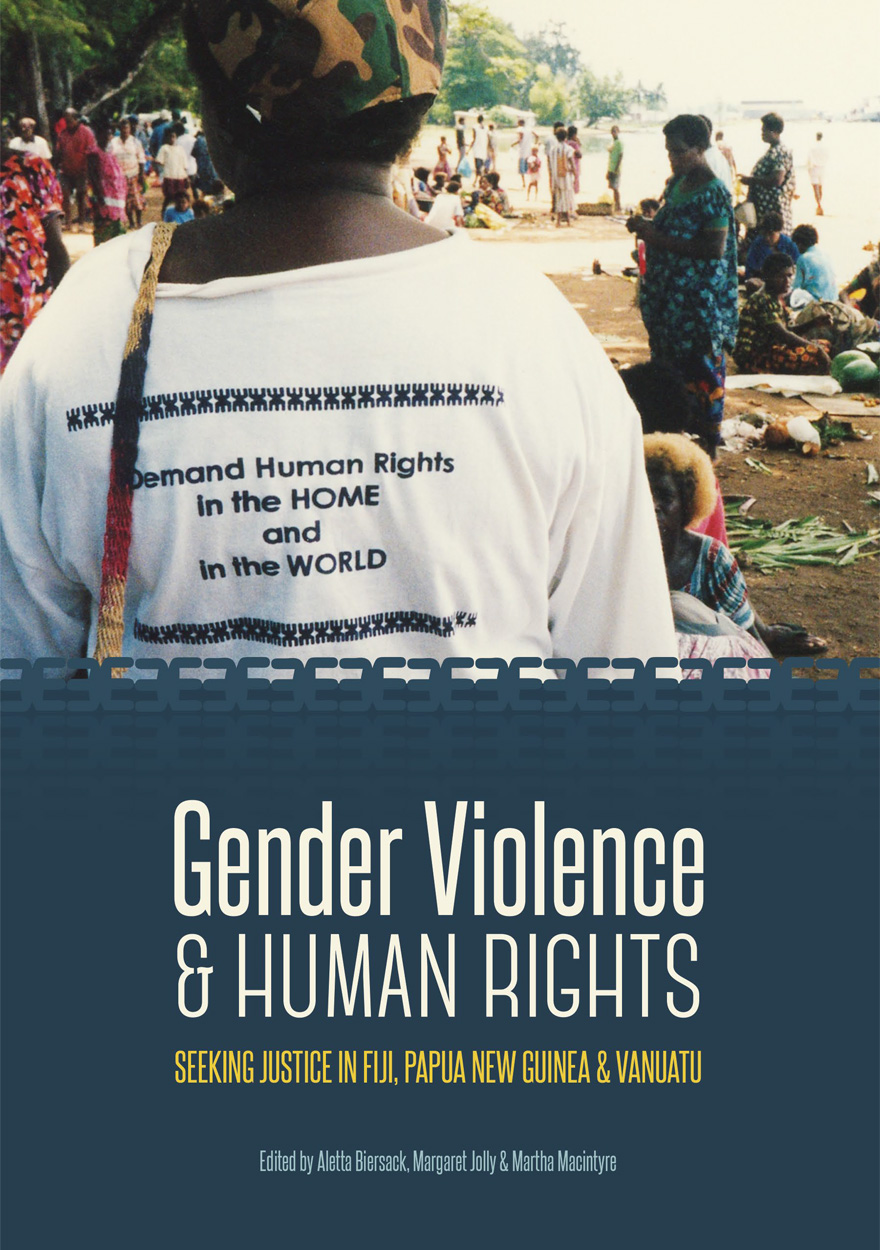
Gender Violence & Human Rights »
Seeking Justice in Fiji, Papua New Guinea and Vanuatu
Publication date: December 2016
The postcolonial states of Fiji, Papua New Guinea and Vanuatu operate today in a global arena in which human rights are widely accepted. As ratifiers of UN treaties such as the Convention on the Elimination of All Forms of Discrimination against Women and the Convention on the Rights of the Child, these Pacific Island countries have committed to promoting women’s and girls’ rights, including the right to a life free of violence. Yet local, national and regional gender values are not always consistent with the principles of gender equality and women’s rights that undergird these globalising conventions. This volume critically interrogates the relation between gender violence and human rights as these three countries and their communities and citizens engage with, appropriate, modify and at times resist human rights principles and their implications for gender violence. Grounded in extensive anthropological, historical and legal research, the volume should prove a crucial resource for the many scholars, policymakers and activists who are concerned about the urgent and ubiquitous problem of gender violence in the western Pacific.
‘This is an important and timely collection that is central to the major and contentious issues in the contemporary Pacific of gender violence and human rights. It builds upon existing literature … but the contributors to this volume interrogate the connection between these two areas deeply and more critically … This book should and must reach a broad audience.’
— Jacqui Leckie, Associate Professor, Anthropology and Archaeology, University of Otago
‘The volume addresses the tensions between human and cultural, individual and collective rights, as played out in the domain of gender … Gender is a perfect lens for exploring these tensions because cultural rights are often claimed in defence of gender oppression and because women often have imposed upon them the burden of representing cultural traditions in attire, comportment, restraint or putatively cultural conservatism. And Melanesia is a perfect place to consider these gendered issues because of the long history of ethnocentric representations of the region, because of the extent to which these are played out between states and local cultures and because of the efforts of the vibrant women’s movements in the region to develop locally workable responses to the problems of gender violence in these communities.’
— Christine Dureau, Senior Lecturer, Anthropology, University of Auckland

Agenda - A Journal of Policy Analysis and Reform: Volume 23, Number 1, 2016 »
Edited by: William Coleman
Publication date: December 2016
Agenda is a refereed, ECONLIT-indexed and RePEc-listed journal of the College of Business and Economics, The Australian National University. Launched in 1994, Agenda provides a forum for debate on public policy, mainly (but not exclusively) in Australia and New Zealand. It deals largely with economic issues but gives space to social and legal policy and also to the moral and philosophical foundations and implications of policy.
Subscribe to the Agenda Alerting service if you wish to be advised on forthcoming or new issues.
Download for free
Not available for purchase

Sharpening the Sword of State »
Building executive capacities in the public services of the Asia-Pacific
Edited by: Andrew Podger, John Wanna
Publication date: November 2016
Sharpening the Sword of State explores the various ways in which 10 jurisdictions in the Asia-Pacific enhance their administrative capabilities through training and executive development. It traces how modern governments across this region look to develop their public services and public sector organisations in the face of rapid global change. For many governments there is a delicate balance between the public interest in promoting change and capacity enhancement across the public service, and the temptation to micro-manage agencies and be complacent about challenging the status quo. There is a recognition in the countries studied that training and executive development is a crucial investment in human capital but is also couched in a much wider context of public service recruitment, patterns of entry and retention, promotion, executive appointment and career development. This empirical volume, authored by academics and practitioners, is one of the first to chart these comparative differences and provide fresh perspectives to enable learning from international experiences.

Party Rules? »
Dilemmas of political party regulation in Australia
Edited by: Anika Gauja, Marian Sawer
Publication date: October 2016
Trust in political parties has never been lower, but we have more and more of them, to the point where voters need magnifying sheets to read ballot papers. What is the relationship between party regulation and the nature of our democracy? How is it that parties have been able to gather so many public resources yet with so little scrutiny of their affairs? This is the first book on party regulation in Australia. It covers a wide range of issues, from party donations to candidate selection, from expectations of parties in a representative democracy to the reluctance to regulate and the role of the courts where legislators fear to tread.
‘The regulation of political parties is one of the most important, but unexplored areas of Australian electoral policy. This important book fills that gap in providing a stimulating and insightful analysis of the pitfalls and potential solutions in this area.’
— Professor George Williams AO
Population Ageing and Australia's Future »
Publication date: October 2016
This volume provides evidence from many of Australia’s leading scholars from a range of social science disciplines to support policies that address challenges presented by Australia’s ageing population. It builds on presentations made to the 2014 Symposium of the Academy of the Social Sciences in Australia.
The material is in four parts:
Perspectives on Ageing
Population Ageing: Global, regional and Australian perspectives
Improving Health and Wellbeing
Responses by Government and Families/Individuals
‘The Academy of the Social Sciences in Australia sees this volume as a major contribution to improving our understanding of Australia’s population ageing. Social science research in this area truly underpins our ability as a nation to manage such demographic change, and its consequences for the economy and society. Such knowledge helps ensure that our citizens can live even better lives.’
— Glenn Withers, President, ASSA
‘It is fantastic that Australians are living longer and healthier lives but we need to address these demographic changes.’
— The Hon Joe Hockey MP, 2015 Intergenerational Report

Made in China Journal: Volume 1, Issue 3, 2016 »
Publication date: September 2016
The core of this issue is dedicated to a special section on Chinese labour and investment in Africa, with a specific focus on Ghana and Zambia. You will also find an analysis of the current situation of the Chinese working classes and the prospects for the political representation of labour in China, as well as an examination of the struggles that Chinese workers face when they attempt to access the legal system. The issue also includes an overview of recent worker struggles in India and an essay on Zhao Liang’s Behemoth.
Download for free
Not available for purchase

Pollution »
Publication date: September 2016
Environmental pollution poses serious challenges for China, including to its economy as well as public health. The China Story Yearbook 2015: Pollution looks at how China’s Communist Party-state addresses these problems and how Chinese citizens have coped with and expressed their concerns about living with chronic, worsening pollution.
This Yearbook also explores the broader ramifications of pollution in the People’s Republic for culture, society law and social activism, as well as the Internet, language, thought, and approaches to history. It looks at how it affects economic and political developments, urban change, and China’s regional and global posture. The Chinese Communist Party, led by ‘Chairman of Everything’ Xi Jinping, meanwhile, has subjected mainland society to increasingly repressive control in its new determination to rid the country of Western ‘spiritual pollutants’ while achieving cultural purification through ‘propaganda and ideological work’.
To adulterate, contaminate, spoil or violate—these are among the metaphorical and literal connotations of pollution expressed in this Yearbook via the character ran 染, which forms part of the word for pollution in Chinese, wuran 污染. As the world increasingly relies on economic ties with China, the complexities of China’s one-party system and the Chinese government’s attitudes towards ‘pollution’ are of increasing global significance.
Chapter notes are available to view online.

East Asia Forum Quarterly: Volume 8, Number 3, 2016 »
Publication date: September 2016
East Asia Forum Quarterly grew out of East Asia Forum (EAF) online, which has developed a reputation for providing a platform for the best in Asian analysis, research and policy comment on the Asia Pacific region in world affairs. EAFQ aims to provide a further window onto research in the leading research institutes in Asia and to provide expert comment on current developments within the region. The East Asia Forum Quarterly, like East Asia Forum online, is an initiative of the East Asia Forum (EAF) and its host organisation, the East Asian Bureau of Economic Research (EABER) in the Crawford School of Economics and Government in the College of Asia & the Pacific at The Australian National University.
Download for free
Not available for purchase
Unintended Consequences »
The impact of migration law and policy
Publication date: August 2016
This book arose from an inaugural conference on Migration Law and Policy at the ANU College of Law. The conference brought together academics and practitioners from a diverse range of disciplines and practice. The book is based on a selection of the papers and presentations given during that conference. Each explores the unexpected, unwanted and sometimes tragic outcomes of migration law and policy, identifying ambiguities, uncertainties, and omissions affecting both temporary and permanent migrants. Together, the papers present a myriad of perspectives, providing a sense of urgency that focuses on the immediate and political consequences of an Australian migration milieu created without due consideration and exposing the daily reality under the migration program for individuals and for society as a whole.