



Search titles
Displaying results 521 to 530 of 647.

New Directions in Archaeological Science »
Edited by: Andrew Fairbairn, Sue O'Connor, Ben Marwick
Publication date: February 2009
Archaeological Science meetings will have a personality of their own depending on the focus of the host archaeological fraternity itself. The 8th Australasian Archaeometry meeting follows this pattern but underlying the regional emphasis is the continuing concern for the processes of change in the landscape that simultaneously effect and illuminate the archaeological record. These are universal themes for any archaeological research with the increasing employment of science-based studies proving to be a key to understanding the place of humans as subjects and agents of change over time.
This collection of refereed papers covers the thematic fields of geoarchaeology, archaeobotany, materials analysis and chronometry, with particular emphasis on the first two. The editors Andrew Fairbairn, Sue O’Connor and Ben Marwick outline the special value of these contributions in the introduction. The international nature of archaeological science will mean that the advances set out in these papers will find a receptive audience among many archaeologists elsewhere. There is no doubt that the story that Australasian archaeology has to tell has been copiously enriched by incorporating a widening net of advanced science-based studies. This has brought attention to the nature of the environment as a human artefact, a fact now more widely appreciated, and archaeology deals with these artefacts, among others, in this way in this publication.
Humanities Research: Volume XI. No. 1. 2004 »
Publication date: January 2009
Humanities Research is an internationally peer-reviewed journal published by the Research School of Humanities at The Australian National University. The Research School of Humanities came into existence in January 2007 and consists of the Humanities Research Centre, Centre for Cross-Cultural Research, National Europe Centre and Australian National Dictionary Centre. Launched in 1997, issues are thematic with guest editors and address important and timely topics across all branches of the humanities.
Download for free
Not available for purchase
Humanities Research: Volume X. No. 1. 2003 »
Publication date: January 2009
Humanities Research is an internationally peer-reviewed journal published by the Research School of Humanities at The Australian National University. The Research School of Humanities came into existence in January 2007 and consists of the Humanities Research Centre, Centre for Cross-Cultural Research, National Europe Centre and Australian National Dictionary Centre. Launched in 1997, issues are thematic with guest editors and address important and timely topics across all branches of the humanities.
Download for free
Not available for purchase
Humanities Research: Volume X. No. 2. 2003 »
Publication date: January 2009
Humanities Research is an internationally peer-reviewed journal published by the Research School of Humanities at The Australian National University. The Research School of Humanities came into existence in January 2007 and consists of the Humanities Research Centre, Centre for Cross-Cultural Research, National Europe Centre and Australian National Dictionary Centre. Launched in 1997, issues are thematic with guest editors and address important and timely topics across all branches of the humanities.
Download for free
Not available for purchase
Humanities Research: Volume IX. No. 1. 2002 »
Publication date: January 2009
Humanities Research is an internationally peer-reviewed journal published by the Research School of Humanities at The Australian National University. The Research School of Humanities came into existence in January 2007 and consists of the Humanities Research Centre, Centre for Cross-Cultural Research, National Europe Centre and Australian National Dictionary Centre. Launched in 1997, issues are thematic with guest editors and address important and timely topics across all branches of the humanities.
Download for free
Not available for purchase
Humanities Research: Volume VIII. No. 1. 2001 »
Publication date: January 2009
Humanities Research is an internationally peer-reviewed journal published by the Research School of Humanities at The Australian National University. The Research School of Humanities came into existence in January 2007 and consists of the Humanities Research Centre, Centre for Cross-Cultural Research, National Europe Centre and Australian National Dictionary Centre. Launched in 1997, issues are thematic with guest editors and address important and timely topics across all branches of the humanities.
Download for free
Not available for purchase
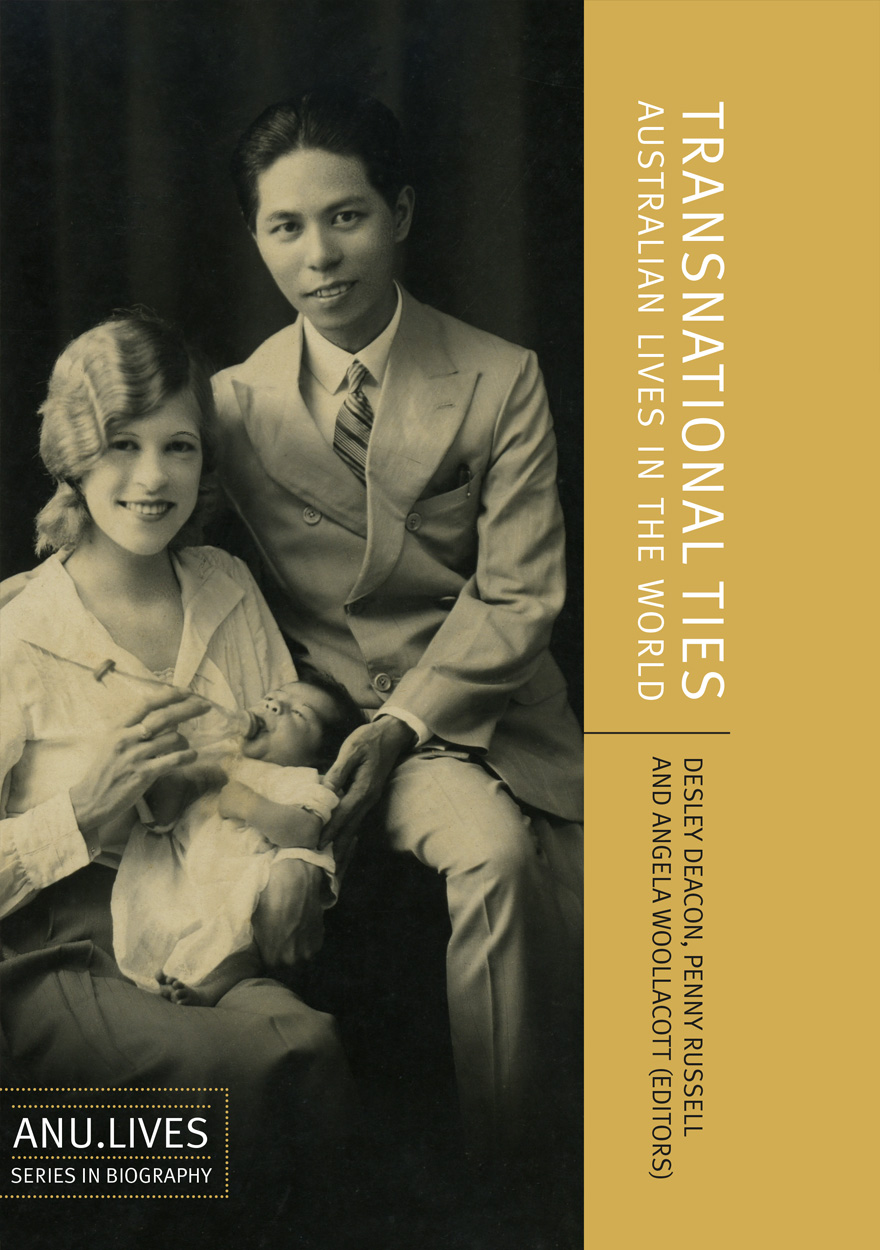
Transnational Ties »
Australian Lives in the World
Edited by: Desley Deacon, Penny Russell, Angela Woollacott
Publication date: December 2008
Australian lives are intricately enmeshed with the world, bound by ties of allegiance and affinity, intellect and imagination. In Transnational Ties: Australian Lives in the World, an eclectic mix of scholars—historians, literary critics, and museologists—trace the flow of people that helped shape Australia’s distinctive character and the flow of ideas that connected Australians to a global community of thought. It shows how biography, and the study of life stories, can contribute greatly to our understanding of such patterns of connection and explores how transnationalism can test biography’s limits as an intellectual, professional and commercial practice.

Lak Chang »
A reconstruction of Tai identity in Daikong
Authored by: Yos Santasombat
Publication date: December 2008
The Thai—Yunnan Project is proud to present this English-language version of Professor Yos Santasombat’s fascinating ethnography of the Tai in Daikong, southwestern China. It represents a significant contribution to the ethnographic record of the Tai peoples.
The village of Lak Chang is located close to the edge of the Tai world and is increasingly embraced by Chinese influence. Professor Yos skilfully weaves ethnographic and historical writing to chart the course of Lak Chang’s incorporation into the modern Chinese state. This has been a painful history but what emerges in this account is a sense of Tai cultural identity that is vigorous and adaptive.
“The Tai ethnic category is thus a complex and dynamic construct which takes place within the context of changing power relations and socio-economic conditions where the past is reconstructed to give meaning to the present and hope for the future.”
In his account of the labours, rituals and beliefs of the Tai villagers of Daikong, Professor Yos brings contemporary ethnic identity to their life. Among the patchwork paddyfields and haphazard laneways of Lak Chang we come to a greater understanding of how global and regional processes of modernisation are managed and selectively incorporated by one local community.

Negotiating the Sacred II »
Blasphemy and Sacrilege in the Arts
Edited by: Elizabeth Burns Coleman, Maria Suzette Fernandes-Dias
Publication date: December 2008
Blasphemy and other forms of blatant disrespect to religious beliefs have the capacity to create significant civil and even international unrest. Consequently, the sacrosanctity of religious dogmas and beliefs, stringent laws of repression and codes of moral and ethical propriety have compelled artists to live and create with occupational hazards like uncertain audience response, self-censorship and accusations of deliberate misinterpretation of cultural production looming over their heads. Yet, in recent years, issues surrounding the rights of minority cultures to recognition and respect have raised new questions about the contemporariness of the construct of blasphemy and sacrilege. Controversies over the aesthetic representation of the sacred, the exhibition of the sacred as art, and the public display of sacrilegious or blasphemous works have given rise to heated debates and have invited us to reflect on binaries like artistic and religious sensibilities, tolerance and philistinism, the sacred and the profane, deification and vilification.
Endeavouring to move beyond ‘simplistic’ points about the rights to freedom of expression and sacrosanctity, this collection explores how differences between conceptions of the sacred can be negotiated. It recognises that blasphemy may be justified as a form of political criticism, as well as a sincere expression of spirituality. But it also recognises that within a pluralistic society, blasphemy in the arts can do an enormous amount of harm, as it may also impair relations within and between societies.
This collection evolved out a two-day conference called ‘Negotiating the Sacred: Blasphemy and Sacrilege in the Arts’ held at the Centre for Cross Cultural Research at The Australian National University in November 2005. This is the second volume in a series of five conferences and edited collections on the theme ‘Negotiating the Sacred’. The first conference, ‘Negotiating the Sacred: Blasphemy and Sacrilege in a Multicultural Society’ was held at The Australian National University’s Centre for Cross-Cultural Research in 2004, and published as an edited collection by ANU Press in 2006. Other conferences in the series have included Religion, Medicine and the Body (ANU, 2006), Tolerance, Education and the Curriculum (ANU, 2007), and Governing the Family (Monash University, 2008). Together, the series represents a major contribution to ongoing debates on the political demands arising from religious pluralism in multicultural societies.
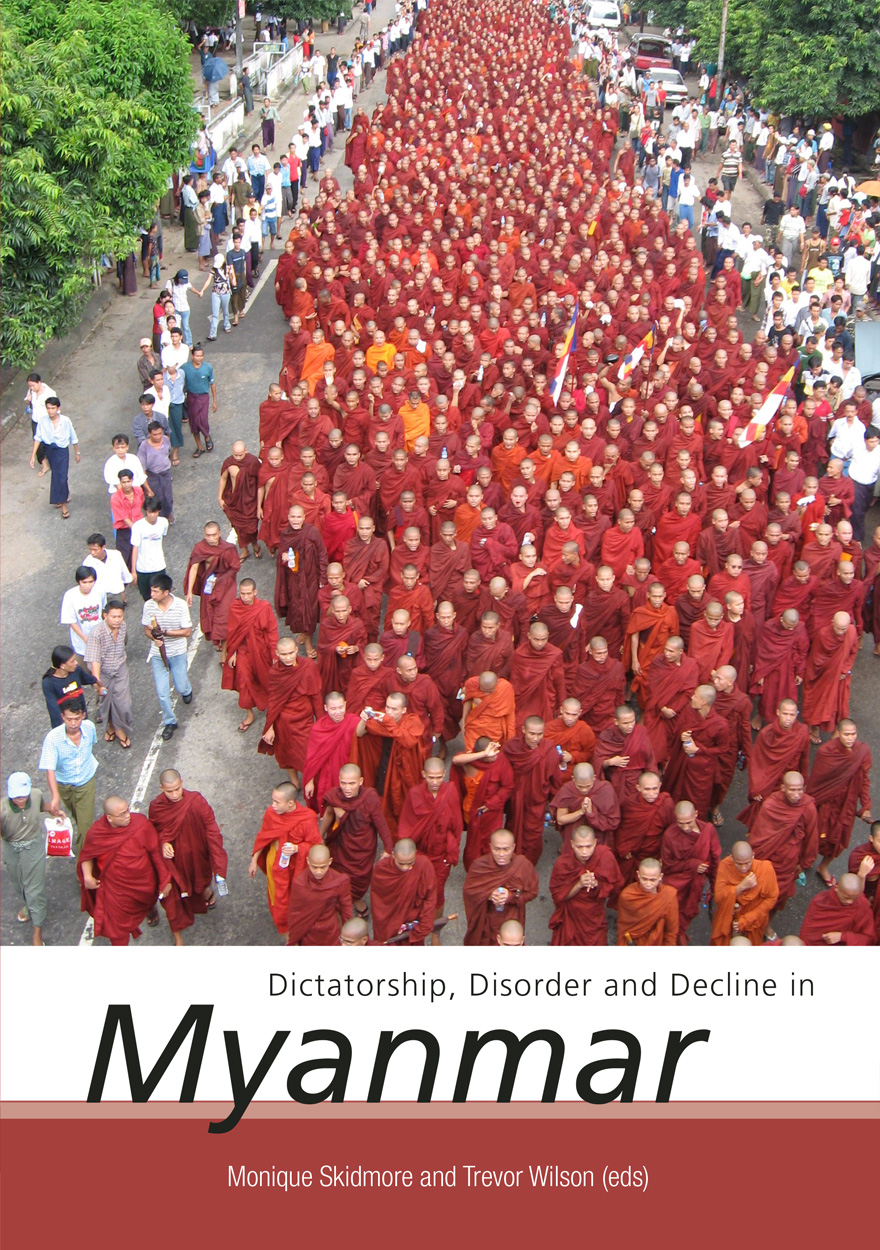
Dictatorship, Disorder and Decline in Myanmar »
Edited by: Monique Skidmore, Trevor Wilson
Publication date: December 2008
Mass peaceful protests in Myanmar/Burma in 2007 drew the world’s attention to the ongoing problems faced by this country and its oppressed people. In this publication, experts from around the world analyse the reasons for these recent political upheavals, explain how the country’s economy, education and health sectors are in perceptible decline, and identify the underlying authoritarian pressures that characterise Myanmar/Burma’s military regime.