



Search titles
Displaying results 471 to 480 of 642.

Sex Discrimination in Uncertain Times »
Edited by: Margaret Thornton
Publication date: September 2010
This collection of essays arose from a conference held to mark the silver anniversary of the Australian Sex Discrimination Act (1984). The collection has two aims: first; to honour the contributions of both the spirited individuals who valiantly fought for the enactment of the legislation against the odds, and those who championed the new law once it was passed; secondly, to present a stock-take of the Act within the changed socio-political environment of the 21st century.
The contributors present clear-eyed appraisals of the legislation, in addition to considering new forms of legal regulation, such as Equality Act, and the significance of a Human Rights Act. The introduction of a proactive model, which would impose positive duties on organisations, is explored as an alternative to the existing individual complaint-based model of legislation. The contributors also pay attention to the international human rights framework, particularly the Convention on the Elimination of all Forms of Discrimination against Women and the UN Declaration on the Rights of Indigenous People. The essays are illuminated by recourse to a rich vein of historical and contemporary literature. Regard is also paid to the comparative experience of other jurisdictions, particularly the UK and Canada.

Soeharto's New Order and Its Legacy »
Essays in honour of Harold Crouch
Edited by: Edward Aspinall, Greg Fealy
Publication date: August 2010
Indonesia’s President Soeharto led one of the most durable and effective authoritarian regimes of the second half of the twentieth century. Yet his rule ended in ignominy, and much of the turbulence and corruption of the subsequent years was blamed on his legacy. More than a decade after Soeharto’s resignation, Indonesia is a consolidating democracy and the time has come to reconsider the place of his regime in modern Indonesian history, and its lasting impact. This book begins this task by bringing together a collection of leading experts on Indonesia to examine Soeharto and his legacy from diverse perspectives. In presenting their analyses, these authors pay tribute to Harold Crouch, an Australian political scientist who remains one of the greatest chroniclers of the Soeharto regime and its aftermath.

The Ayes Have It »
The history of the Queensland Parliament, 1957–1989
Authored by: John Wanna, Tracey Arklay
Publication date: July 2010
‘The Ayes Have It’ is a fascinating account of the Queensland Parliament during three decades of high-drama politics. It examines in detail the Queensland Parliament from the days of the ‘Labor split’ in the 1950s, through the conservative governments of Frank Nicklin, John Bjelke- Petersen and Mike Ahern, to the fall of the Nationals government led briefly by Russell Cooper in December 1989. The volume traces the rough and tumble of parliamentary politics in the frontier state. The authors focus on parliament as a political forum, on the representatives and personalities that made up the institution over this period, on the priorities and political agendas that were pursued, and the increasingly contentious practices used to control parliamentary proceedings. Throughout the entire history are woven other controversies that repeatedly recur – controversies over state economic development, the provision of government services, industrial disputation and government reactions, electoral zoning and disputes over malapportionment, the impost of taxation in the ‘low tax state’, encroachments on civil liberties and political protests, the perennial topic of censorship, as well as the emerging issues of integrity, concerns about conflicts of interest and the slide towards corruption. There are fights with the federal government – especially with the Whitlam government – and internal fights within the governing coalition which eventually leads to its collapse in 1983, after which the Nationals manage to govern alone for two very tumultuous terms. On the non-government side, the bitterness of the 1950s split was reflected in the early parliaments of this period, and while the Australian Labor Party eventually saw off its rivalrous off-shoot (the QLP-DLP) it then began to implode through waves of internal factional discord.

Rituals of Islamic Spirituality »
A Study of Majlis Dhikr Groups in East Java
Authored by: Arif Zamhari
Publication date: July 2010
This study examines the emergence of new forms of Islamic spirituality in Indonesia identified as Majlis Dhikr. These Majlis Dhikr groups have proliferated on Java in the last two decades, both in urban and rural areas, and have attracted followers from a wide social background. The diverse aspects of these Majlis Dhikr groups – their rituals, teachings and strategies of dissemination as well as the popular understanding of these rituals and their contestation by critics and opponents – are examined in detail and illustrated by reference to three particular groups – Salawat Wahidiyat, Istighathat Ihsaniyyat and Dhikr al-Ghafilin each of which has its own distinctive features and notable religious leadership. These Majlis Dhikr groups regard their activities as legitimate ritual practices that are in accordance with the legacy of Islamic Sufism based on the interpretation of the Qur’anic and Prophetic tradition.

Australian Humanities Review: Issue 48, 2010 »
Edited by: Monique Rooney, Russell Smith
Publication date: June 2010
Australian Humanities Review is a peer-reviewed interdisciplinary journal featuring articles, essays and reviews focusing on a wide array of topics related to literature, culture, history and politics.
Download for free
Not available for purchase

The Power of Economic Ideas »
The origins of Keynesian macroeconomic management in interwar Australia 1929–39
Authored by: Alex Millmow
Publication date: May 2010
Economics, Keynes once wrote, can be a ‘very dangerous science’. Sometimes, though, it can be moulded to further the common good though it might need a leap in mental outlook, a whole new zeitgeist to be able do do. This book is about a transformation in Australian economists’ thought and ideas during the interwar period. It focuses upon the interplay between economic ideas, players and policy sometimes in the public arena. In a decade marked by depression, recovery and international political turbulence Australian economists moved from a classical orthodox economic position to that of a cautious Keynesianism by 1939.
We look at how a small collective of economists tried to influence policy-making in the nineteen-thirties. Economists felt obliged to seek changes to the parameters as economic conditions altered but, more importantly, as their insights about economic management changed. There are three related themes that underscore this book. Firstly, the professionalisation of Australian economics took a gigantic leap in this period, aided in part, by the adverse circumstances confronting the economy but also by the aspirations economists held for their discipline. A second theme relates to the rather unflattering reputation foisted upon interwar economists after 1945.
That transition underlies a third theme of this book, namely, how Australian economists were emboldened by Keynes’s General Theory to confidently push for greater management of economic activity. By 1939 Australian economists conceptualized from a new theoretic framework and from one which they advanced comment and policy advice. This book therefore will rehabilitate the works of Australian interwar economists, arguing that they not only had an enviable international reputation but also facilitated the acceptance of Keynes’s General Theory among policymakers before most of their counterparts elsewhere.

East Asia Forum Quarterly: Volume 2, Number 2, 2010 »
Publication date: May 2010
East Asia Forum Quarterly grew out of East Asia Forum (EAF) online, which has developed a reputation for providing a platform for the best in Asian analysis, research and policy comment on the Asia Pacific region in world affairs. EAFQ aims to provide a further window onto research in the leading research institutes in Asia and to provide expert comment on current developments within the region. The East Asia Forum Quarterly, like East Asia Forum online, is an initiative of the East Asia Forum (EAF) and its host organisation, the East Asian Bureau of Economic Research (EABER) in the Crawford School of Economics and Government in the College of Asia & the Pacific at The Australian National University.
Download for free
Not available for purchase
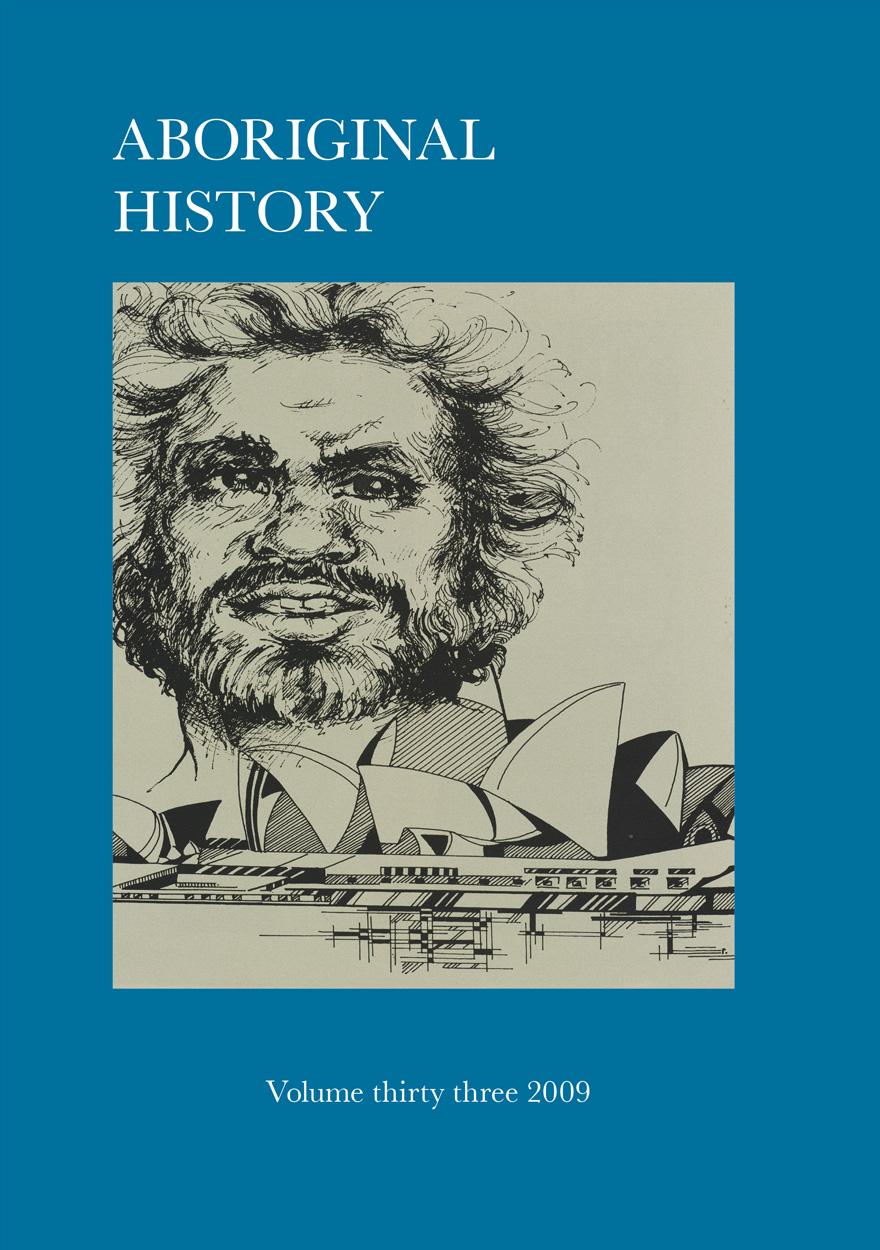
Aboriginal History Journal: Volume 33 »
Edited by: Peter Read
Publication date: April 2010
In her recent magisterial history of early Sydney, Grace Karskens mused on a critical distinction in emphasis between settler history and Aboriginal history: ‘in settler history we seem to be searching constantly for beginnings’, she notes, ‘but in Aboriginal history in the colonial period so often the search is for endings’. This preoccupation with endings especially haunts the ‘storywork’ surrounding Woollarawarre Bennelong, one of the best known but least understood Aboriginal men of the early colonial era. Most of this storywork has figured Bennelong as a tragic soul – caught between two worlds, reconciled to neither, the victim of an addiction that was his only means of enduring the fall. Despite some variations in the telling of his life with the British colonists, the tragedy of his end usually dominates the overall tone.
A reconsideration of one of the most significant Aboriginal figures in colonial history invites us to move away from the search for endings. It suggests a fresh start for the life of Bennelong. It also suggests a fresh start for the meaning of Bennelong in Australia’s modern imagination. If Bennelong’s life stands for any greater truth, it is that indigenous people begin new relations when history demands them as frequently and as variously as any other folk.
Aboriginal History Inc. is a publishing organisation based in the Australian Centre for Indigenous History, Research School of Social Sciences, The Australian National University, Canberra.
For more information on Aboriginal History Inc. please visit aboriginalhistory.org.au.
Download for free
Not available for purchase
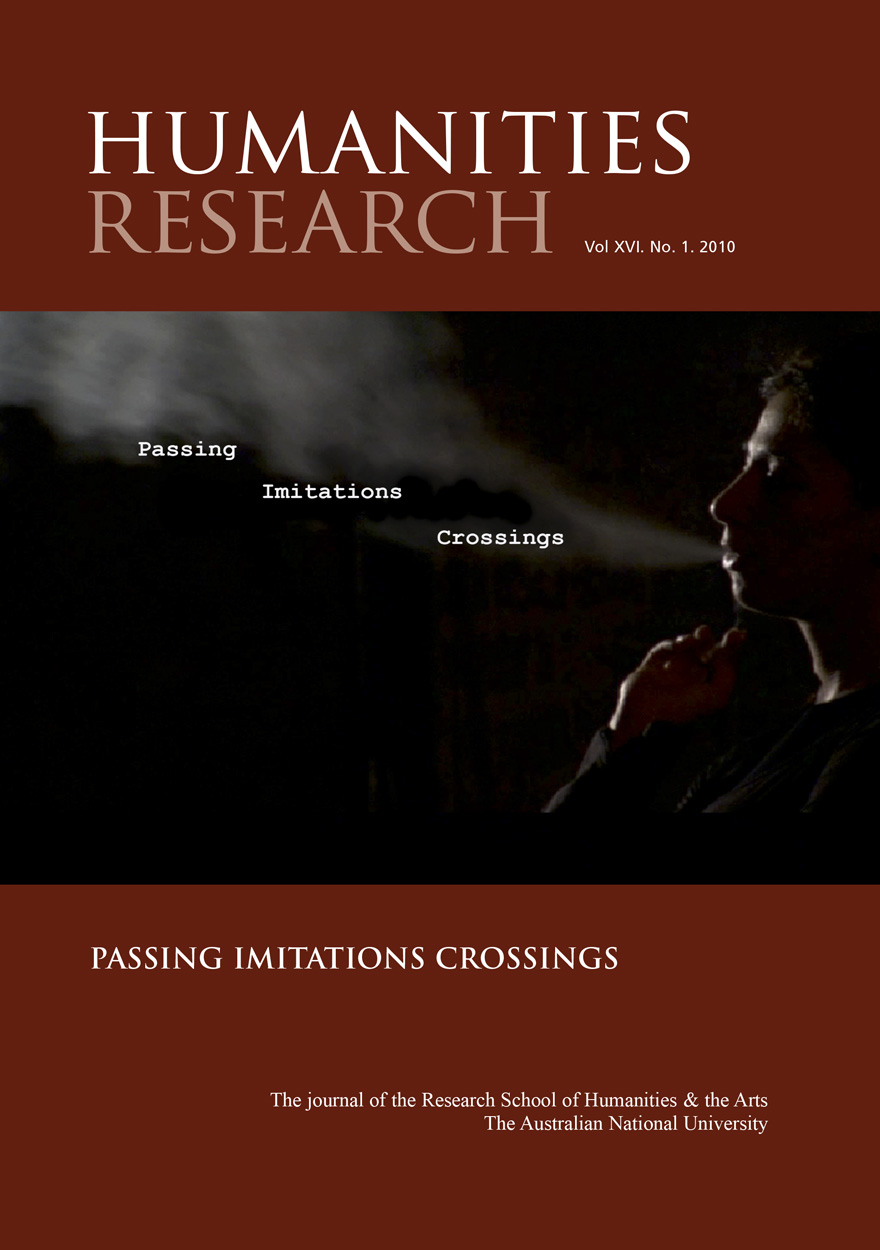
Humanities Research: Volume XVI. No. 1. 2010 »
Passing, Imitations, Crossings
Edited by: Monique Rooney, Carolyn Strange
Publication date: April 2010
Humanities Research is an internationally peer-reviewed journal published by the Research School of Humanities at The Australian National University. The Research School of Humanities came into existence in January 2007 and consists of the Humanities Research Centre, Centre for Cross-Cultural Research, National Europe Centre and Australian National Dictionary Centre. Launched in 1997, issues are thematic with guest editors and address important and timely topics across all branches of the humanities.
Download for free
Not available for purchase

Racial Folly »
A Twentieth-Century Aboriginal Family
Authored by: Gordon Briscoe
Publication date: February 2010
Briscoe’s grandmother remembered stories about the first white men coming to the Northern Territory. This extraordinary memoir shows us the history of an Aboriginal family who lived under the race laws, practices and policies of Australia in the twentieth century. It tells the story of a people trapped in ideological folly spawned to solve ‘the half-caste problem’. It gives life to those generations of Aboriginal people assumed to have no history and whose past labels them only as shadowy figures.
Briscoe’s enthralling narrative combines his, and his contemporaries, institutional and family life with a high-level career at the heart of the Aboriginal political movement at its most dynamic time. It also documents the road he travelled as a seventeen year old fireman on the South Australia Railways to becoming the first Aboriginal person to achieve a PhD in history.
For more information on Aboriginal History Inc. please visit aboriginalhistory.org.au.