



Search titles
Displaying results 551 to 560 of 647.

Telling Pacific Lives »
Prisms of Process
Edited by: Brij V. Lal, Vicki Luker
Publication date: June 2008
How are Pacific lives imagined, written and read? How are they refracted through prisms of process? From legends about culture heroes to biographies of national leaders, from tales of ancestors to stories of contemporary men and women, from lives told of both the famous and the nameless, this collection of essays — by historians and anthropologists, Islanders and Island scholars — probes questions of personhood, identity, memory, and time across the sweep of the Pacific, as well as practical issues of research and writing.
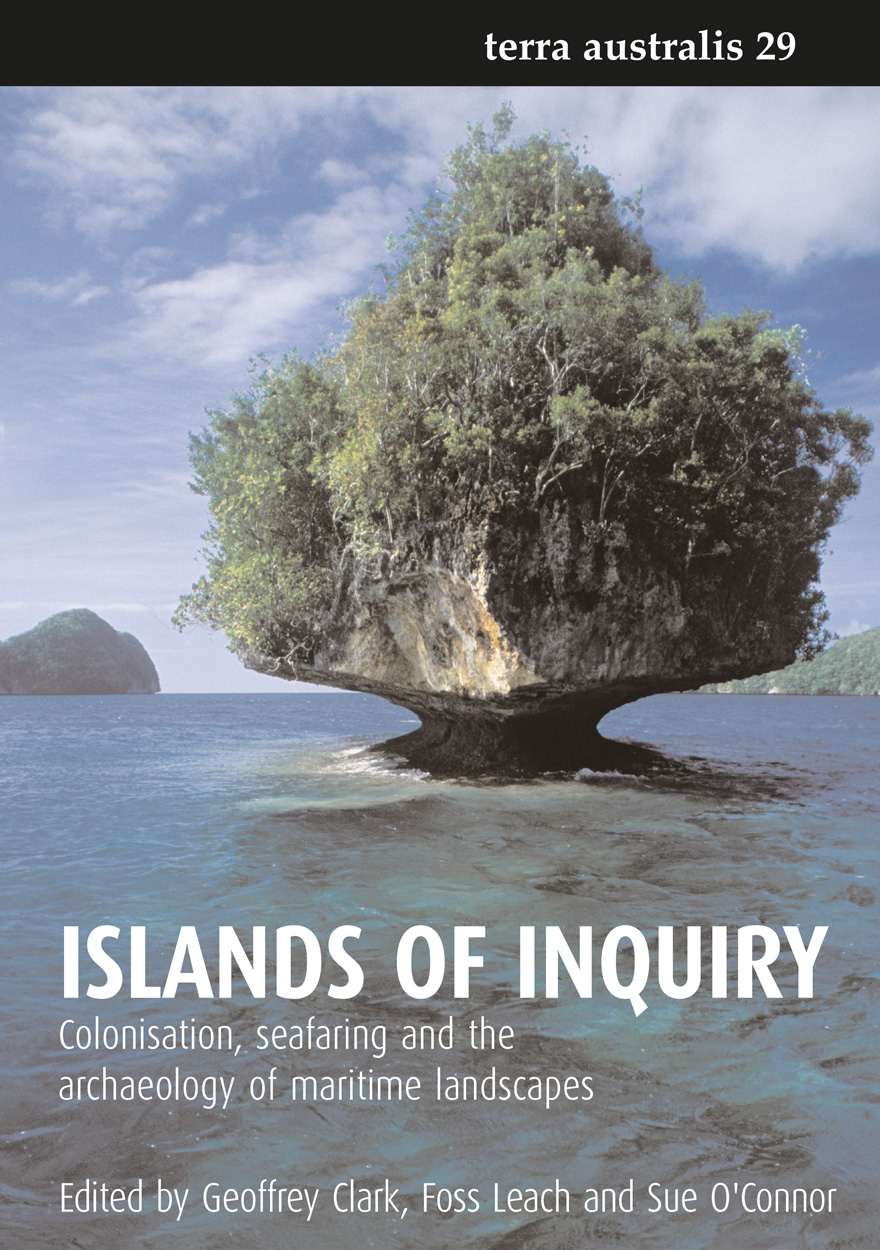
Islands of Inquiry »
Colonisation, seafaring and the archaeology of maritime landscapes
Edited by: Geoffrey Clark, Foss Leach, Sue O'Connor
Publication date: June 2008
This collection makes a substantial contribution to several highly topical areas of archaeological inquiry. Many of the papers present new and innovative research into the processes of maritime colonisation, processes that affect archaeological contexts from islands to continents. Others shift focus from process to the archaeology of maritime places from the Bering to the Torres Straits, providing highly detailed discussions of how living by and with the sea is woven into all elements of human life from subsistence to trade and to ritual. Of equal importance are more abstract discussions of islands as natural places refashioned by human occupation, either through the introduction of new organisms or new systems of production and consumption. These transformation stories gain further texture (and variety) through close examinations of some of the more significant consequences of colonisation and migration, particularly the creation of new cultural identities. A final set of papers explores the ways in which the techniques of archaeological science have provided insights into the fauna of islands and the human history of such places. Islands of Inquiry highlights the importance of an archaeologically informed history of landmasses in the oceans and seas of the world.

Minding the Gap »
Appraising the promise and performance of regulatory reform in Australia
Authored by: Peter Carroll, Rex Deighton-Smith, Helen Silver, Chris Walker
Publication date: June 2008
‘Mind the Gap!’ is an almost iconic exhortation, originating in the London Underground, warning travellers to be careful when navigating the ‘gap’ between the platform and train. In this volume, Peter Carroll, Rex Deighton-Smith, Helen Silver and Chris Walker retrospectively assess the ‘gap’ — no less dynamic and perilous in a public policy context — between the promise and performance of successive waves of regulation in Australia since the 1980s. Regulatory bodies exist to exercise what might be broadly termed ‘control functions’ and, by nature, tend to be conservative both in their culture and operations. Institutional conservatism does not, of necessity, preclude the exercise of creativity and foresight, both of which are sorely required if government is to successfully meet the challenge of delivering more effective and less costly regulation. The business and policy environment is complex, the risks are great and the rewards of success and the costs of failure will be enormous. The true measure of success will be how effectively we are able to close the gap between promise and performance.

Politics and State Building in Solomon Islands »
Edited by: Sinclair Dinnen, Stewart Firth
Publication date: May 2008
Politics and State Building in Solomon Islands examines a crisis moment in recent Solomon Islands history. Contributors examine what happened when unrest engulfed the capital of the small Melanesian country in the aftermath of the 2006 national elections, and consider what these events show about the Solomon Islands political system, the influence of Asian interests in business and politics, and why the crisis is best understood in the context of the country’s volatile blend of traditional and modern politics.
Until the disturbances of April 2006 and subsequent deterioration in bilateral relations between Australia and Solomon Islands under the Sogavare government, experts had hailed the Regional Assistance Mission to Solomon Islands (RAMSI) as an unqualified success. Some saw it as a model for ‘cooperative intervention’ in ‘failing states’ worldwide. Following these developments success seems less certain and aspects of the RAMSI model appear flawed.
Using the case of Solomon Islands, this book raises fundamental questions about the nature of ‘cooperative intervention’ as a vehicle for state building, asking whether it should be construed as a mainly technical endeavour or whether it is unavoidably a political undertaking with political consequences. Providing a critical but balanced analysis, Politics and State Building in Solomon Islands has important implications for the wider debate about international state-building interventions in ‘failed’ and ‘failing’ states.

Australia Under Construction »
Nation-building past, present and future
Edited by: John Butcher
Publication date: April 2008
The Australian nation is a work in progress. So conclude the authors whose views are represented in this most recent offering in the ANZSOG monograph series, Australia Under Construction: Nation-building past, present and future. From its beginnings as a settler society through to present day concerns about ‘broadbanding the nation’, the nation-building narrative has resonated with Australians. The very idea of nation-building has both excited the popular imagination about what we might achieve as a society and a nation, and has occasioned despair about missed opportunities. The eleven authors contributing to this monograph reflect on these, and other themes from a variety of perspectives. They challenge our understanding of the term ‘nation-building’, reflect on its contemporary relevance as a framework for public policy and even re-appraise the contribution of past ‘iconic’ nation-building endeavours. To this subject the authors bring intelligence, wit and a healthy disdain for sacred cows. A stimulating read for anyone interested in the history, challenges and prospects of nation-building in Australia.
Signs of the Wali »
Narratives at the Sacred Sites in Pamijahan, West Java
Authored by: Tommy Christomy
Publication date: April 2008
In Signs of the Wali, Dr Tommy Christomy focuses on the one of the early founders of Islam on Java, Shakyh Abdul Muhyi, whose burial site at Pamijahan in Tasikmalaya is a place of contemporary ziarah. This study initially conceived of as a philological exploration of historical manuscripts has been transformed into a study of ‘living manuscripts’ – the contemporary narratives of the custodians at Pamijahan.
As elsewhere in the Islamic world, tarekat and ziarah intersect in popular practice at Pamijahan. Dr Christomy explores this intersecting world, explaining the steps of his own research investigations that enfold as a journey of discovery as he proceeds. This investigation involves the search for traces of Tarekat Shattiriyyah in Pamijahan, given the pervasive presence of Tarekat Qadirriyah-Nashabandiyyah throughout Tasikmalaya. That Tarekat Shattiriyyah survives to this day is itself evidence of the tenacity that its historical roots have established in a particular place.

Pedigree and Panache »
A History of the Art Auction in Australia
Authored by: Shireen Huda
Publication date: April 2008
Art auctions have long captured the public imagination. They regularly make news headlines and have become synonymous with glamour, money and social distinction. The marketing of auction houses and the works they sell has resulted in firms attaining authoritative positions and the ability both to influence and reflect collecting tastes. Pedigree and Panache is the first comprehensive history of the art auction in Australia. In this fascinating work, Shireen Huda investigates the construction of the glamorous reputation of art auctions and art auction houses. Featuring absorbing case studies of key art auctions and major art auction houses in Australia (including Christie’s, Sotheby’s and Deutscher-Menzies) the work provides an overview of the origin and international development of art auctions. The development of the Australian marketplace is then explored, detailing colonial inception and continuing until Christie’s withdrawal of its saleroom presence in 2006.
This book is an engaging read for those involved in the art industry, as well as historians, artists, collectors and anyone interested in the art market, art investment, social history and art history.

A Time Bomb Lies Buried »
Fiji’s Road to Independence, 1960-1970
Authored by: Brij V. Lal
Publication date: March 2008
A Time Bomb Lies Buried discusses the debates which took place in Suva and London as well as the politics and processes which led Fiji to independence in 1970 after 96 years of colonial rule. It provides an essential background to understanding the crises and convulsions which have haunted Fiji ever since in its search for a constitutional settlement for its multiethnic population.

Aboriginal History Journal: Volume 32 »
Publication date: 2008
Since 1977, the journal Aboriginal History has pioneered interdisciplinary historical studies of Australian Aboriginal people’s and Torres Strait Islander’s interactions with non-Indigenous peoples. It has promoted publication of Indigenous oral traditions, biographies, languages, archival and bibliographic guides, previously unpublished manuscript accounts, critiques of current events, and research and reviews in the fields of anthropology, archaeology, sociology, linguistics, demography, law, geography and cultural, political and economic history.
Aboriginal History Inc. is a publishing organisation based in the Australian Centre for Indigenous History, Research School of Social Sciences, The Australian National University, Canberra.
For more information on Aboriginal History Inc. please visit aboriginalhistory.org.au.
Download for free
Not available for purchase

Transgressions »
Critical Australian Indigenous histories
Edited by: Ingereth Macfarlane, Mark Hannah
Publication date: December 2007
This volume brings together an innovative set of readings of complex interactions between Australian Aboriginal people and colonisers. The underlying theme is that of ‘transgression’, and Michel Foucault’s account of the necessary dynamic that exists between transgression and limit. We know what constitutes the limit, not by tracing or re-stating the boundaries, but by crossing over them. By exploring the mechanisms by which limits are set and maintained, unexamined cultural assumptions and dominant ideas are illuminated. We see the expectations and the structures that inform and support them revealed, often as they unravel. Such illuminations and revelations are at the core of the Australian Indigenous histories presented in this collection.
For more information on Aboriginal History Inc. please visit aboriginalhistory.org.au.