



Search titles
Displaying results 281 to 290 of 362.

Agenda - A Journal of Policy Analysis and Reform: Volume 15, Number 2, 2008 »
Authored by: William Coleman, Alex Robson
Publication date: June 2008
Agenda is a refereed, ECONLIT-indexed and RePEc-listed journal of the College of Business and Economics, The Australian National University. Launched in 1994, Agenda provides a forum for debate on public policy, mainly (but not exclusively) in Australia and New Zealand. It deals largely with economic issues but gives space to social and legal policy and also to the moral and philosophical foundations and implications of policy.
Subscribe to the Agenda Alerting service if you wish to be advised on forthcoming or new issues.
Download for free
Not available for purchase

Australia Under Construction »
Nation-building past, present and future
Edited by: John Butcher
Publication date: April 2008
The Australian nation is a work in progress. So conclude the authors whose views are represented in this most recent offering in the ANZSOG monograph series, Australia Under Construction: Nation-building past, present and future. From its beginnings as a settler society through to present day concerns about ‘broadbanding the nation’, the nation-building narrative has resonated with Australians. The very idea of nation-building has both excited the popular imagination about what we might achieve as a society and a nation, and has occasioned despair about missed opportunities. The eleven authors contributing to this monograph reflect on these, and other themes from a variety of perspectives. They challenge our understanding of the term ‘nation-building’, reflect on its contemporary relevance as a framework for public policy and even re-appraise the contribution of past ‘iconic’ nation-building endeavours. To this subject the authors bring intelligence, wit and a healthy disdain for sacred cows. A stimulating read for anyone interested in the history, challenges and prospects of nation-building in Australia.

Agenda - A Journal of Policy Analysis and Reform: Volume 15, Number 1, 2008 »
Authored by: William Coleman, Alex Robson
Publication date: April 2008
Agenda is a refereed, ECONLIT-indexed and RePEc-listed journal of the College of Business and Economics, The Australian National University. Launched in 1994, Agenda provides a forum for debate on public policy, mainly (but not exclusively) in Australia and New Zealand. It deals largely with economic issues but gives space to social and legal policy and also to the moral and philosophical foundations and implications of policy.
Subscribe to the Agenda Alerting service if you wish to be advised on forthcoming or new issues.
Download for free
Not available for purchase

A Time Bomb Lies Buried »
Fiji’s Road to Independence, 1960-1970
Authored by: Brij V. Lal
Publication date: March 2008
A Time Bomb Lies Buried discusses the debates which took place in Suva and London as well as the politics and processes which led Fiji to independence in 1970 after 96 years of colonial rule. It provides an essential background to understanding the crises and convulsions which have haunted Fiji ever since in its search for a constitutional settlement for its multiethnic population.
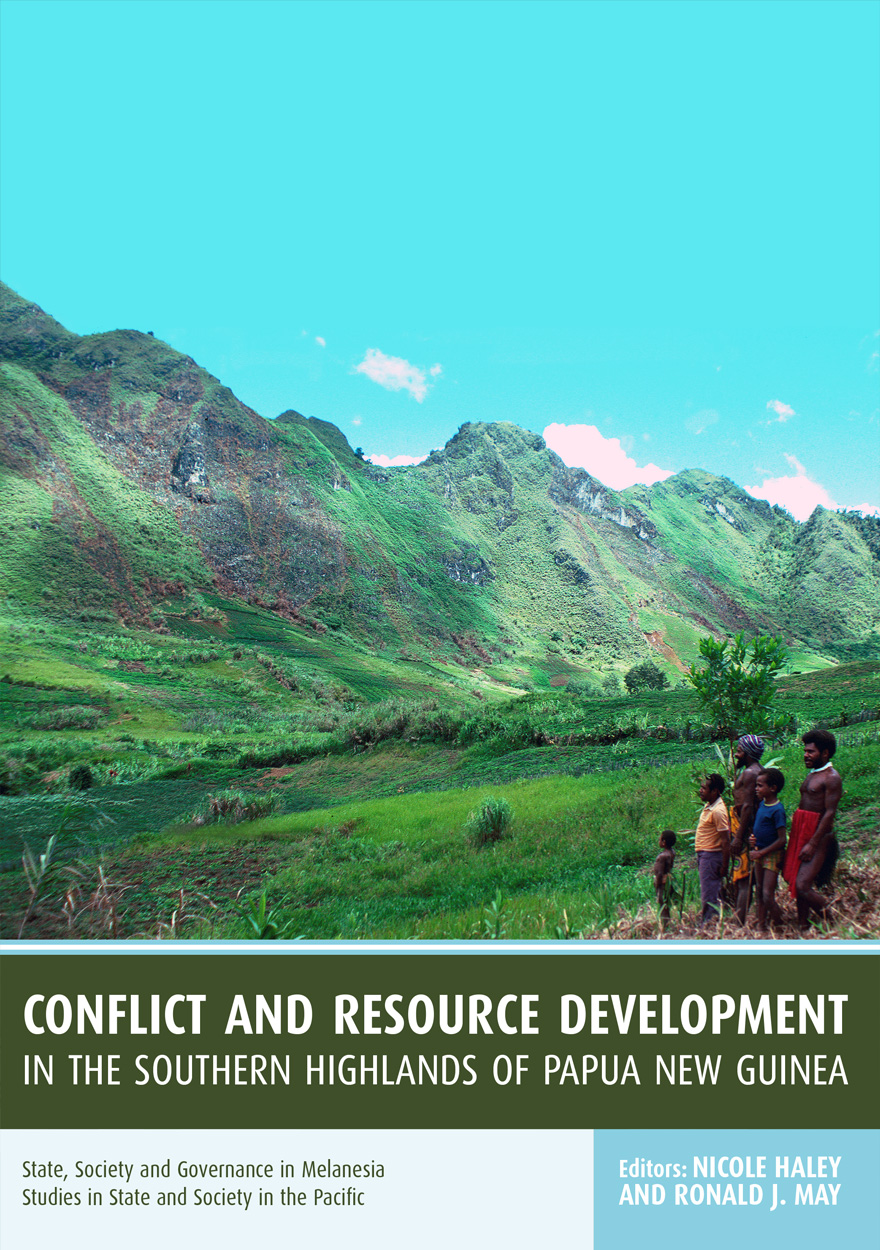
Conflict and Resource Development in the Southern Highlands of Papua New Guinea »
Edited by: Nicole Haley, R.J. May
Publication date: November 2007
The Southern Highlands is one of Papua New Guinea’s most resource-rich provinces, but for a number of years the province has been riven by conflict. Longstanding inter-group rivalries, briefly set aside during the colonial period, have been compounded by competition for the benefits provided by the modern state and by fighting over the distribution of returns from the several big mining and petroleum projects located within the province or impinging upon it. Deaths from the various conflicts over the past decade number in the hundreds. As a result of inter-group fighting, criminal activity and vandalism, a number of businesses have withdrawn from the province. Roadblocks and ambushes have made travel dangerous in many parts and expatriate missionaries and aid workers have left. Many public servants have abandoned their posts with the result that state services are not provided. Corruption is rife. Police are often reluctant to act because they are outnumbered and outgunned.
This volume brings together a number of authors with deep experience of the Southern Highlands to examine the underlying dynamics of resource development and conflict in the province. Its primary purpose is to provide some background to recent events, but the authors also explore possible approaches to limiting the human and economic costs of the ongoing conflict and breakdown of governance.

Public Sector Employment in the Twenty-First Century »
Edited by: Marilyn Pittard, Phillipa Weeks
Publication date: November 2007
This book addresses the transformations which have occurred in employment arrangements and practices in the Australian public sector over the past decade and the changes in responsibilities and accountability through employment contracts, whistleblower legislation and partnerships between government and the private sector. It provides a comparative context through studies of reconstruction of the public service in the United Kingdom and New Zealand. Themes of contractualisation, privatisation and outsourcing are explored and critically examined, as well as influences of the industrial relations legislative framework including the Work Choices legislation.
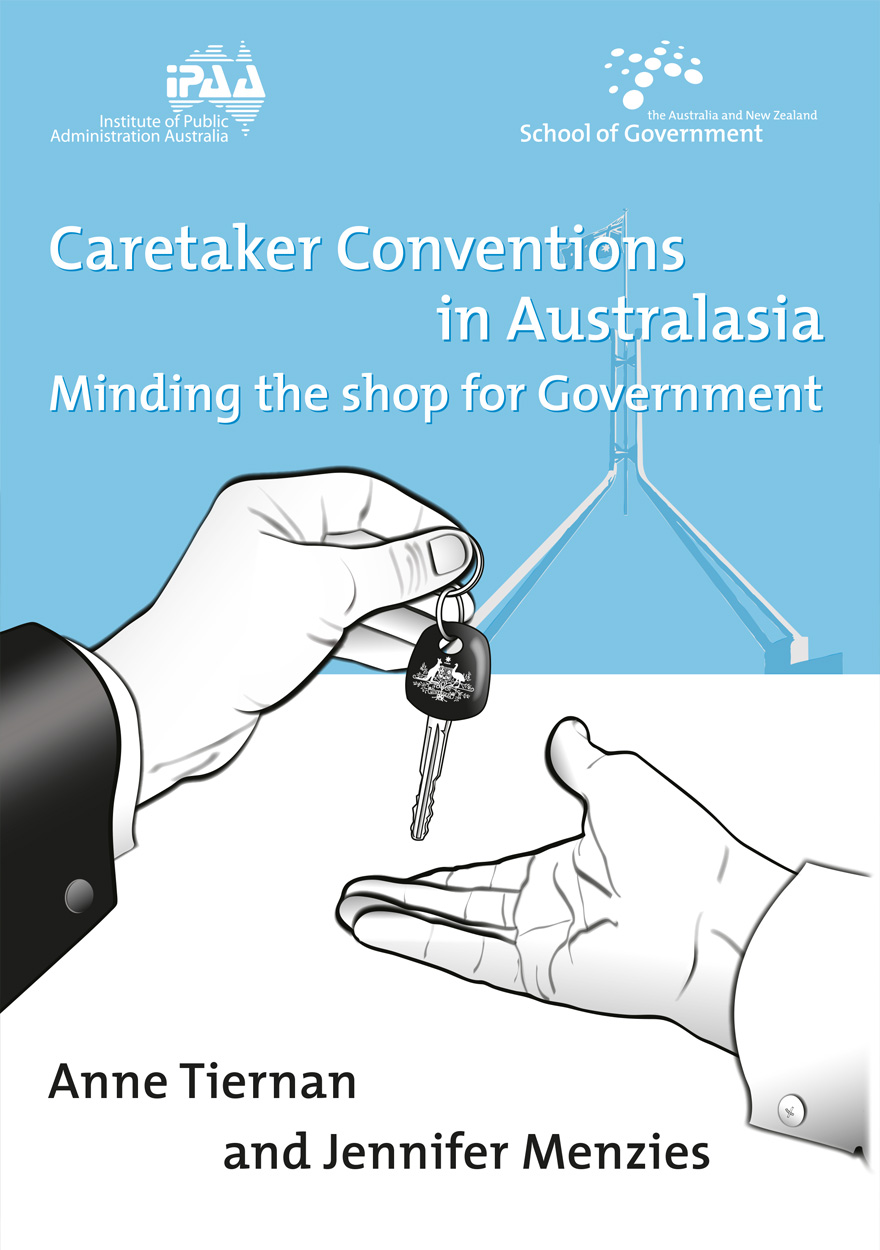
Caretaker Conventions in Australasia »
Minding the Shop for Government
Authored by: Anne Tiernan, Jennifer Menzies
Publication date: October 2007
A revised and updated 2014 edition of Caretaker Conventions in Australasia is available.
In this monograph, Anne Tiernan and Jennifer Menzies capably chart the often hazardous terrain of the ‘caretaker period’ that ensues from the time an election is called until a new government is formed. This is a landscape fraught with political and administrative dangers – particularly for public servants who are required to ‘mind the shop’ and keep the basic machinery of government going. The conventions represent an historical accretion of custom, practice and rules, often leavened with uncertainty. In tackling their subject, Tiernan and Menzies draw upon their shared past experiences as public servants and ministerial ‘staffers’ as well as the highest standards of academic scholarship – this is a ‘must read’ for politicians, public servants and students of government.

The Social Effects of Native Title »
Recognition, Translation, Coexistence
Edited by: Benjamin R. Smith, Frances Morphy
Publication date: October 2007
The papers in this collection reflect on the various social effects of native title. In particular, the authors consider the ways in which the implementation of the Native Title Act 1993 (Cwlth), and the native title process for which this Act legislates, allow for the recognition and translation of Aboriginal law and custom, and facilitate particular kinds of coexistence between Aboriginal title holders and other Australians. In so doing, the authors seek to extend the debate on native title beyond questions of practice and towards an improved understanding of the effects of native title on the social lives of Indigenous Australians and on Australian society more generally.
These attempts to grapple with the effects of native title have, in part, been impelled by Indigenous people’s complaints about the Act and the native title process. Since the Act was passed, many Indigenous Australians have become increasingly unhappy with both the strength and forms of recognition afforded to traditional law and custom under the Act, as well as with the socially disruptive effects of the native title process. In particular, as several of the papers in this collection demonstrate, there is widespread discomfort with the transformative effects of recognition within the native title process, effects which can then affect other aspects of Indigenous lives.

Agenda - A Journal of Policy Analysis and Reform: Volume 14, Number 3, 2007 »
Edited by: Franco Papandrea, Graeme Wells
Publication date: October 2007
Agenda is a refereed, ECONLIT-indexed and RePEc-listed journal of the College of Business and Economics, The Australian National University. Launched in 1994, Agenda provides a forum for debate on public policy, mainly (but not exclusively) in Australia and New Zealand. It deals largely with economic issues but gives space to social and legal policy and also to the moral and philosophical foundations and implications of policy.
Subscribe to the Agenda Alerting service if you wish to be advised on forthcoming or new issues.
Download for free
Not available for purchase

China: Linking Markets for Growth »
Edited by: Ross Garnaut, Ligang Song
Publication date: August 2007
China’s prosperity is at the core of the emerging Platinum Age of global economic growth. Rapid economic growth has been underpinned by expansion in its domestic markets, and the integration of domestic and international markets in goods, services, capital, labour and foreign exchange. Global commodity prices have reached historic highs, while China’s capital outflows have helped to hold down interest rates worldwide. Linking markets, both domestic and international, has been key to China’s success.
In sustaining its strong economic growth, China has become one of the world’s most voracious consumers of energy. The challenge now facing the government and people of China is in achieving cooperation with the international community to avert the costs–both economic and environmental–of accelerating energy consumption.
China–Linking Markets for Growth gathers together leading scholars on China’s economic success and its effect on the world economy into the next few decades.