



Search titles
Displaying results 251 to 260 of 362.

Anomie and Violence »
Non-truth and Reconciliation in Indonesian Peacebuilding
Authored by: John Braithwaite, Valerie Braithwaite, Michael Cookson, Leah Dunn
Publication date: March 2010
Indonesia suffered an explosion of religious violence, ethnic violence, separatist violence, terrorism, and violence by criminal gangs, the security forces and militias in the late 1990s and early 2000s. By 2002 Indonesia had the worst terrorism problem of any nation. All these forms of violence have now fallen dramatically. How was this accomplished? What drove the rise and the fall of violence? Anomie theory is deployed to explain these developments. Sudden institutional change at the time of the Asian financial crisis and the fall of President Suharto meant the rules of the game were up for grabs. Valerie Braithwaite’s motivational postures theory is used to explain the gaming of the rules and the disengagement from authority that occurred in that era. Ultimately resistance to Suharto laid a foundation for commitment to a revised, more democratic, institutional order. The peacebuilding that occurred was not based on the high-integrity truth-seeking and reconciliation that was the normative preference of these authors. Rather it was based on non-truth, sometimes lies, and yet substantial reconciliation. This poses a challenge to restorative justice theories of peacebuilding.

East Asia Forum Quarterly: Volume 2, Number 1, 2010 »
Publication date: February 2010
East Asia Forum Quarterly grew out of East Asia Forum (EAF) online, which has developed a reputation for providing a platform for the best in Asian analysis, research and policy comment on the Asia Pacific region in world affairs. EAFQ aims to provide a further window onto research in the leading research institutes in Asia and to provide expert comment on current developments within the region. The East Asia Forum Quarterly, like East Asia Forum online, is an initiative of the East Asia Forum (EAF) and its host organisation, the East Asian Bureau of Economic Research (EABER) in the Crawford School of Economics and Government in the College of Asia & the Pacific at The Australian National University.
Download for free
Not available for purchase

Agenda - A Journal of Policy Analysis and Reform: Volume 16, Number 4, 2009 »
Edited by: William Coleman
Publication date: December 2009
Agenda is a refereed, ECONLIT-indexed and RePEc-listed journal of the College of Business and Economics, The Australian National University. Launched in 1994, Agenda provides a forum for debate on public policy, mainly (but not exclusively) in Australia and New Zealand. It deals largely with economic issues but gives space to social and legal policy and also to the moral and philosophical foundations and implications of policy.
Subscribe to the Agenda Alerting service if you wish to be advised on forthcoming or new issues.
Download for free
Not available for purchase

East Asia Forum Quarterly: Volume 1, Number 1, 2009 »
Publication date: November 2009
East Asia Forum Quarterly grew out of East Asia Forum (EAF) online, which has developed a reputation for providing a platform for the best in Asian analysis, research and policy comment on the Asia Pacific region in world affairs. EAFQ aims to provide a further window onto research in the leading research institutes in Asia and to provide expert comment on current developments within the region. The East Asia Forum Quarterly, like East Asia Forum online, is an initiative of the East Asia Forum (EAF) and its host organisation, the East Asian Bureau of Economic Research (EABER) in the Crawford School of Economics and Government in the College of Asia & the Pacific at The Australian National University.
Download for free
Not available for purchase

A Bird That Flies With Two Wings »
Kastom and state justice systems in Vanuatu
Authored by: Miranda Forsyth
Publication date: September 2009
This book investigates the problems and possibilities of plural legal orders through an in-depth study of the relationship between the state and customary justice systems in Vanuatu. It argues that there is a need to move away from the current state-centric approach to law reform in the South Pacific region, and instead include all state and non-state legal orders in development strategies and dialogue. The book also presents a typology of models of engagement between state and non-state legal systems, and describes a process for analysing which of these models would be most advantageous for any country in the South Pacific region, and beyond.

Does History Matter? »
Making and debating citizenship, immigration and refugee policy in Australia and New Zealand
Edited by: Klaus Neumann, Gwenda Tavan
Publication date: September 2009
This volume of essays represents the first systematic attempt to explore the use of the past in the making of citizenship and immigration policy in Australia and New Zealand. Focussing on immigration and citizenship policy in Australia and New Zealand, the contributions to this volume explore how history and memory are implicated in policy making and political debate, and what processes of remembering and forgetting are utilised by political leaders when formulating and defending policy decisions. They remind us that a nuanced understanding of the past is fundamental to managing the politics and practicalities of immigration and citizenship in the early 21st century.

Framing the Global Economic Downturn »
Crisis rhetoric and the politics of recessions
Edited by: Paul `t Hart, Karen Tindall
Publication date: September 2009
The global economic downturn that followed the collapse of major US financial institutions is no doubt the most significant crisis of our times. Its effects on corporate and governmental balance sheets have been devastating, as have been its impacts on the employment and well being of tens of millions of citizens. It continues to pose major challenges to national policymakers and institutions around the world.
Managing public uncertainty and anxiety is vital in coping with financial crises. This requires not just prompt action but, most of all, persuasive communication by government leaders. At the same time, the very occurrence of such crises raises acute questions about the effectiveness and robustness of current government policies and institutions. With the stakes being so high, defining and interpreting what is going on, how and why it happened, and what ought to be done now become key questions in the political and policy struggles that crises invariably unleash.
In this volume, we study how heads of government, finance ministers and national bank governors in eight countries as well as the EU engage in such ‘framing contests’, and how their attempts to interpret the cascading events of the economic downturn were publicly received. Using systematic content analysis of speeches and media coverage, this volume offers a unique comparative assessment of public leadership in times of crisis.
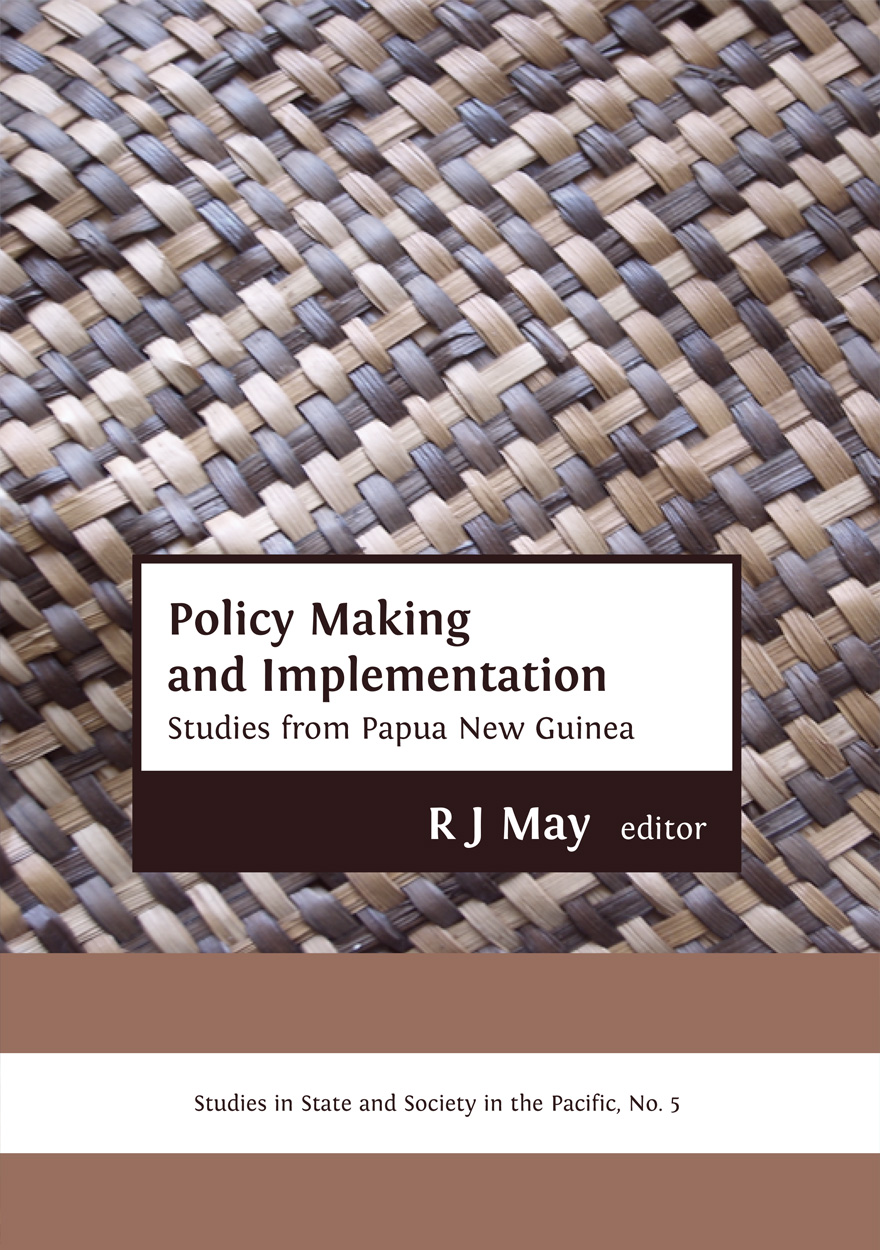
Policy Making and Implementation »
Studies from Papua New Guinea
Edited by: R.J. May
Publication date: September 2009
There is a vast literature on the principles of public administration and good governance, and no shortage of theoreticians, practitioners and donors eager to push for public sector reform, especially in less-developed countries. Papua New Guinea has had its share of public sector reforms, frequently under the influence of multinational agencies and aid donors. Yet there seems to be a general consensus, both within and outside Papua New Guinea, that policy making and implementation have fallen short of expectations, that there has been a failure to achieve ‘good governance’.
This volume, which brings together a number of Papua New Guinean and Australian-based scholars and practitioners with deep familiarity of policy making in Papua New Guinea, examines the record of policy making and implementation in Papua New Guinea since independence. It reviews the history of public sector reform in Papua New Guinea, and provides case studies of policy making and implementation in a number of areas, including the economy, agriculture, mineral development, health, education, lands, environment, forestry, decentralization, law and order, defence, women and foreign affairs, privatization, and AIDS.
Policy is continuously evolving, but this study documents the processes of policy making and implementation over a number of years, with the hope that a better understanding of past successes and failures will contribute to improved governance in the future.

Agenda - A Journal of Policy Analysis and Reform: Volume 16, Number 3, 2009 »
Edited by: William Coleman
Publication date: September 2009
Agenda is a refereed, ECONLIT-indexed and RePEc-listed journal of the College of Business and Economics, The Australian National University. Launched in 1994, Agenda provides a forum for debate on public policy, mainly (but not exclusively) in Australia and New Zealand. It deals largely with economic issues but gives space to social and legal policy and also to the moral and philosophical foundations and implications of policy.
Subscribe to the Agenda Alerting service if you wish to be advised on forthcoming or new issues.
Download for free
Not available for purchase

Food and Agriculture in Papua New Guinea »
Edited by: R. Michael Bourke, Tracy Harwood
Publication date: August 2009
Agriculture dominates the rural economy of Papua New Guinea (PNG). More than five million rural dwellers (80% of the population) earn a living from subsistence agriculture and selling crops in domestic and international markets.
Many aspects of agriculture in PNG are described in this data-rich book. Topics include agricultural environments in which crops are grown; production of food crops, cash crops and animals; land use; soils; demography; migration; the macro-economic environment; gender issues; governance of agricultural institutions; and transport. The history of agriculture over the 50 000 years that PNG has been occupied by humans is summarised. Much of the information presented is not readily available within PNG. The book contains results of many new analyses, including a food budget for the entire nation. The text is supported by 165 tables and 215 maps and figures.