



Search titles
Displaying results 171 to 180 of 213.

What Good Condition? »
Reflections on an Australian Aboriginal Treaty 1986–2006
Edited by: Peter Read, Gary Meyers, Bob Reece
Publication date: December 2006
What Good Condition? collects edited papers, initially delivered at the Treaty Advancing Reconciliation conference, on the proposal for a treaty between Aboriginal and non-Aboriginal Australians, a proposal which has been discussed and dissected for nearly 30 years.
Featuring contributions from prominent Aboriginal community leaders, legal experts and academics, this capacious work provides an overview of the context and legacy of the residue of treaty proposals and negotiations in past decades; a consideration of the implications of treaty in an Indigenous, national and international context; and, finally, some reflections on regional aspirations and achievements.
For more information on Aboriginal History Inc. please visit aboriginalhistory.org.au.

Australian Political Lives »
Chronicling political careers and administrative histories
Edited by: Tracey Arklay, John Nethercote, John Wanna
Publication date: October 2006
This monograph brings together some of the best practitioners of the art and craft of political biography in Australia. They are simultaneously some of our best scholars who, at least in part, have turned their attention to writing Australian political lives. They are not merely chroniclers of our times but multidisciplinary analysts constructing layers of explanation and theoretical insight. They include academic, professional and amateur biographers; scholars from a range of disciplines (politics, history, sociology, public administration, gender studies); and politicians who for a time strutted the political stage. The assembled papers explore the strengths and weaknesses of the biographical approach; the enjoyment it can deliver; the problems and frustrations of writing biographies; and the various ways the ‘project’ can be approached by those constructing these lives. They probe the art and craft of the political biographer.

Origins, Ancestry and Alliance »
Explorations in Austronesian Ethnography
Edited by: James J. Fox, Clifford Sather
Publication date: October 2006
This collection of papers, the third in a series of volumes on the work of the Comparative Austronesian Project, explores indigenous Austronesian ideas of origin, ancestry and alliance and considers the comparative significance of these ideas in social practice. The papers examine social practice in a diverse range of societies extending from insular Southeast Asia to the islands of the Pacific.

Assessing the Evidence on Indigenous Socioeconomic Outcomes »
A focus on the 2002 NATSISS
Edited by: Boyd Hunter
Publication date: June 2006
This monograph presents the peer-reviewed proceedings of the CAEPR conference on Indigenous Socioeconomic Outcomes: Assessing Recent Evidence, held at The Australian National University in August 2005. It presents the latest evidence on Indigenous economic and social status, and family and community life, and discusses its implications for government policy.
The main focus of this volume is on analysing the 2002 National Aboriginal and Torres Strait Islander Social Survey (NATSISS) outputs and issues about how to interpret the data. It also offers some assessment of changes in Indigenous social conditions over time and examines how Indigenous people fared vis-à-vis other Australians in other statistical collections. The discussion of the broad Indigenous policy context by three prominent Indigenous Australians—Larissa Berhendt, Tom Calma, and Geoff Scott—explores different perspectives.

Connected Worlds »
History in Transnational Perspective
Edited by: Ann Curthoys, Marilyn Lake
Publication date: March 2006
This volume brings together historians of imperialism and race, travel and modernity, Islam and India, the Pacific and the Atlantic to show how a ‘transnational’ approach to history offers fresh insights into the past. Transnational history is a form of scholarship that has been revolutionising our understanding of history in the last decade. With a focus on interconnectedness across national borders of ideas, events, technologies and individual lives, it moves beyond the national frames of analysis that so often blinker and restrict our understanding of the past. Many of the essays also show how expertise in ‘Australian history’ can contribute to and benefit from new transnational approaches to history. Through an examination of such diverse subjects as film, modernity, immigration, politics and romance, Connected Worlds weaves an historical matrix which transports the reader beyond the local into a realm which re-defines the meaning of humanity in all its complexity. Contributors include Tony Ballantyne, Desley Deacon, John Fitzgerald, Patrick Wolfe and Angela Woollacott.
At the XIII Biennial Conference of The Film and History Association of Australia and New Zealand, Jill Julius Matthews was presented with an award for Best Book Chapter: ‘Modern nomads and national film history: the multi-continental career of J. D. Williams’ in Ann Curthoys and Marilyn Lake (eds), Connected Worlds: History in Transnational Perspective, Canberra: ANU E Press, 2006, pp. 157-169
Indigenous People and the Pilbara Mining Boom »
A baseline for regional participation
Authored by: John Taylor, B. Scambary
Publication date: January 2006
The largest escalation of mining activity in Australian history is currently underway in the Pilbara region of Western Australia. Pilbara-based transnational resource companies recognise that major social and economic impacts on Indigenous communities in the region are to be expected and that sound relations with these communities and the pursuit of sustainable regional economies involving greater Indigenous participation provide the necessary foundations for a social licence to operate.
This study examines the dynamics of demand for Indigenous labour in the region, and the capacity of local supply to respond. A special feature of this study is the inclusion of qualitative data reporting the views of local Indigenous people on the social and economic predicaments that face them.
The basic message conveyed is that little has been achieved over the past four decades in terms of enhancing Indigenous socioeconomic status in the Pilbara. On the basis of planned economic development and corporate interest in pursuing Indigenous engagement, progress is now possible but major efforts are required from all interested stakeholders (Indigenous organisations, miners and governments) in order to ensure that this occurs.

Aboriginal History Journal: Volume 30 »
Publication date: 2006
Since 1977, the journal Aboriginal History has pioneered interdisciplinary historical studies of Australian Aboriginal people’s and Torres Strait Islander’s interactions with non-Indigenous peoples. It has promoted publication of Indigenous oral traditions, biographies, languages, archival and bibliographic guides, previously unpublished manuscript accounts, critiques of current events, and research and reviews in the fields of anthropology, archaeology, sociology, linguistics, demography, law, geography and cultural, political and economic history.
Aboriginal History Inc. is a publishing organisation based in the Australian Centre for Indigenous History, Research School of Social Sciences, The Australian National University, Canberra.
For more information on Aboriginal History Inc. please visit aboriginalhistory.org.au.
Download for free
Not available for purchase
The Art of Narritjin Maymuru »
Publication date: January 2005
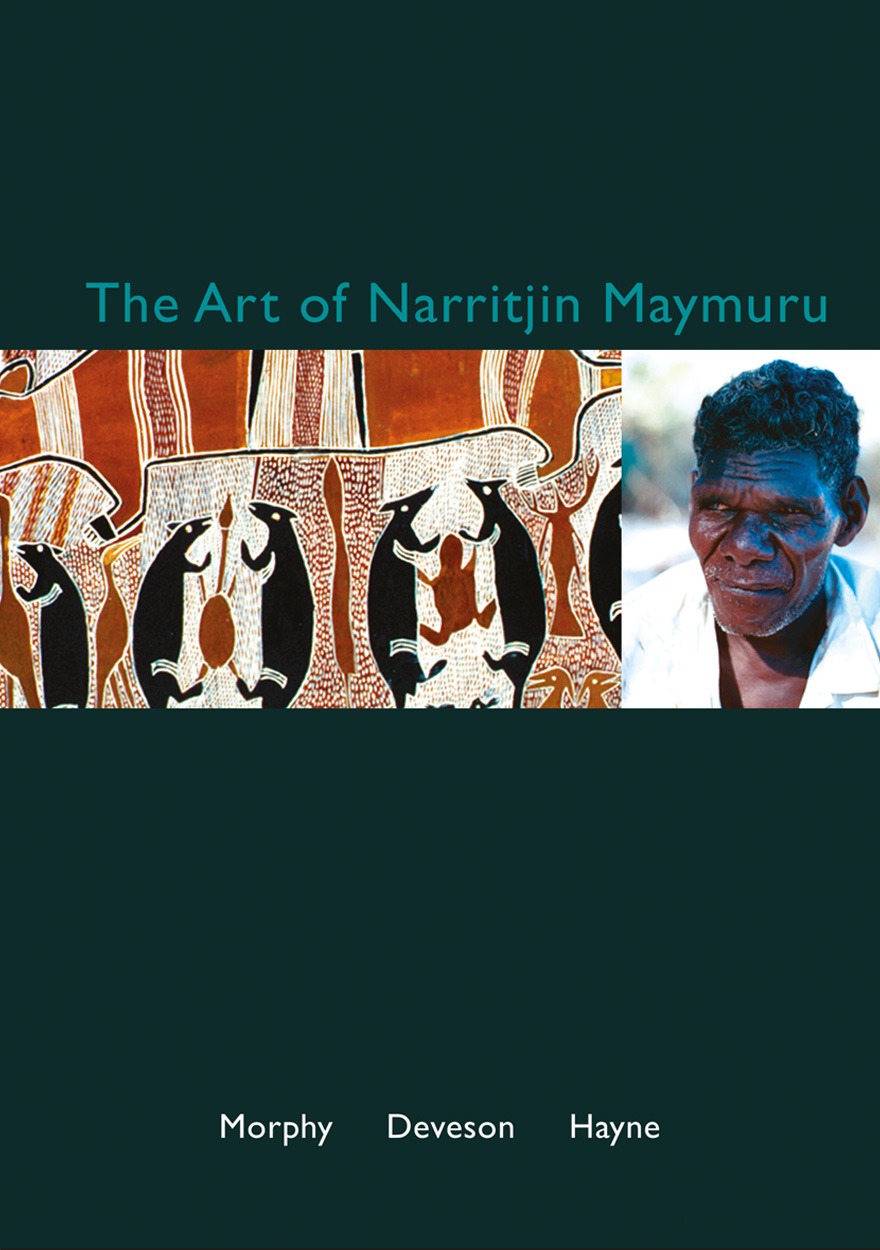
Narritjin Maymuru led a life that was as extraordinary and adventurous as that of any Australian artist of the twentieth century. Howard Morphy, with the help of Pip Deveson, has scoured the collections of museums, art galleries and private collections around the world to bring together an archive of Narritjin’s paintings and carvings spanning nearly forty years of his work.
The Art of Narritjin Maymuru enables you to explore his art. You can begin either by following the timeline that summarises the main biographical features of Narritjin’s life or by moving straight into the sets of paintings.
The Art of Narritjin Maymuru is currently unavailable for purchase due to technical issues. We hope to offer an online version of this work in the near future.
CD currently unavailable. We apologise for any inconvenience.
Reviews of the publication
Francoise Dussart, American Anthropologist, June 2007, Vol. 109, No. 2, pp. 363-364
John E. Stanton, Australian and New Zealand Journal of Art, Volume 7, Number 2, 2006
Charlotte Townsend-Gault, Visual Anthropology Review, Fall 2006, Vol. 22, No. 2, pp. 80-82
Not available for purchase

Aboriginal History Journal: Volume 29 »
Publication date: 2005
Since 1977, the journal Aboriginal History has pioneered interdisciplinary historical studies of Australian Aboriginal people’s and Torres Strait Islander’s interactions with non-Indigenous peoples. It has promoted publication of Indigenous oral traditions, biographies, languages, archival and bibliographic guides, previously unpublished manuscript accounts, critiques of current events, and research and reviews in the fields of anthropology, archaeology, sociology, linguistics, demography, law, geography and cultural, political and economic history.
Aboriginal History Inc. is a publishing organisation based in the Australian Centre for Indigenous History, Research School of Social Sciences, The Australian National University, Canberra.
For more information on Aboriginal History Inc. please visit aboriginalhistory.org.au.
Download for free
Not available for purchase

Social Indicators for Aboriginal Governance »
Insights from the Thamarrurr Region, Northern Territory
Authored by: John Taylor
Publication date: October 2004
John Taylor is a Senior Fellow at the Centre for Aboriginal Economic Policy Research, The Australian National University, Canberra.
The Council of Australian Governments is trialing Indigenous Community Coordination Pilot schemes around the country aimed at fostering whole-of-government approaches to service delivery and development. A notable example is in the Thamarrurr region of the Northern Territory focused on the Aboriginal town of Wadeye and its hinterland. Under new governance arrangements the Thamarrurr Regional Council has identified a need to profile existing social and economic conditions as a basis for its current planning and future evaluation.
This study provides an innovative template for such profiling. With substantial input from local people it uncovers a region of high population growth with major challenges in areas of employment, income, education and training, housing and infrastructure, health status and criminal justice. It yields a baseline of available data to assist discussions of regional needs, aspirations and development capacities. By using population projections, it shifts government and community thinking away from reactive responses to historic need, to a more pro-active future-oriented approach to development.
The Thamarrurr people view this document as an important planning tool for their people. Their aim is to have the same access to services and opportunities as other Australians. “Give every kid a chance” is their catch cry. This study lays out what is required from governments and the community to achieve that vision.