



Search titles
Displaying results 151 to 160 of 213.
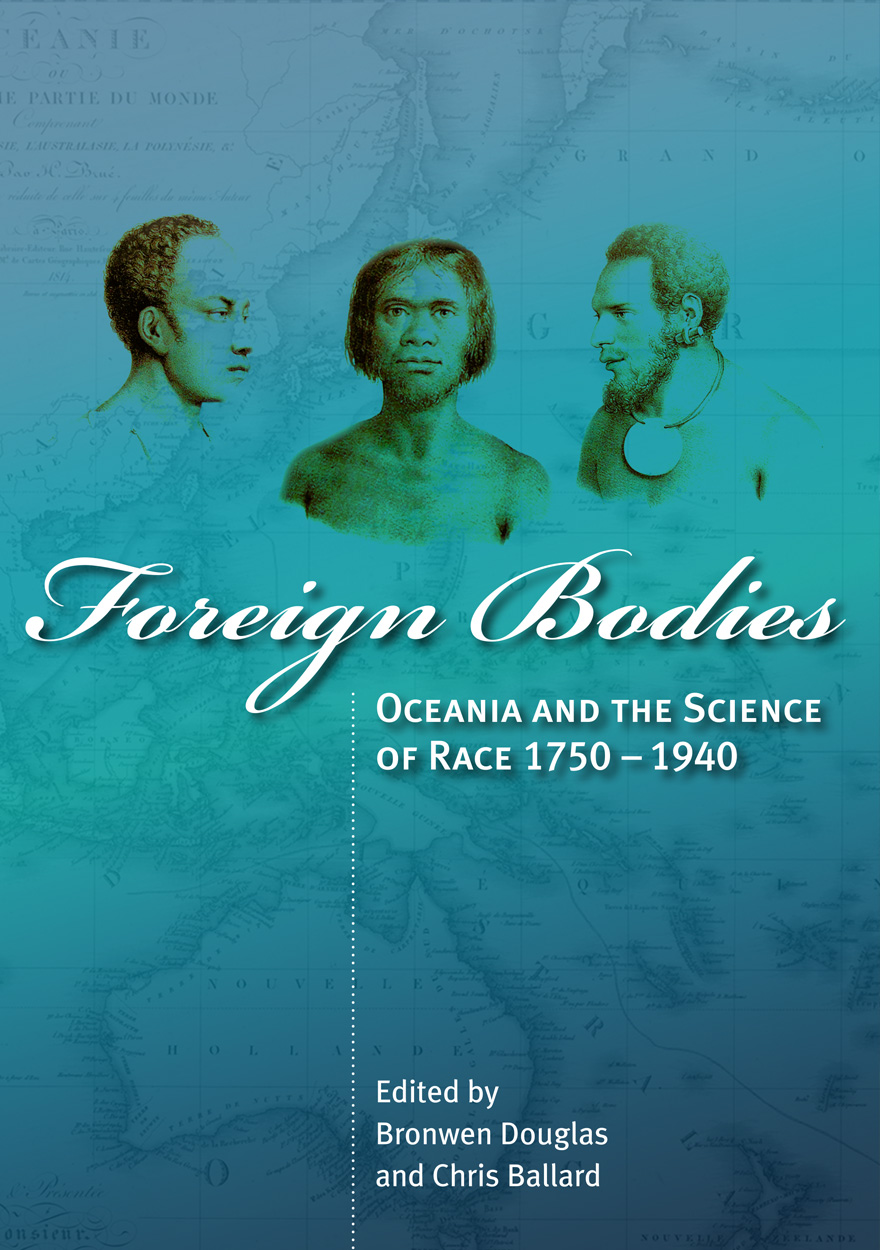
Foreign Bodies »
Oceania and the Science of Race 1750–1940
Edited by: Bronwen Douglas, Chris Ballard
Publication date: October 2008
From the 18th century, Oceania became the principal laboratory of raciology for scholars, voyagers, and colonisers alike. By juxtaposing encounters and theory, this magisterial book explores the semantics of human difference in all its emotional, intellectual, religious, and practical dimensions. The argument developed is subtle, engrossing, and gives the paradigm of ‘race’ its full use value. Foreign Bodies is a model of analysis and erudition from which historians of science and everyone interested in intercultural relations will greatly profit.
— Claude Blanckaert, CNRS (Centre Alexandre Koyré), Paris, and Honorary President, French Society for the History of the Science of Man

Permissive Residents »
West Papuan refugees living in Papua New Guinea
Authored by: Diana Glazebrook
Publication date: September 2008
This book offers another frame through which to view the event of the outrigger landing of 43 West Papuans in Australia in 2006. West Papuans have crossed boundaries to seek asylum since 1962, usually eastward into Papua New Guinea (PNG), and occasionally southward to Australia. Between 1984–86, around 11,000 people crossed into PNG seeking asylum. After the Government of PNG acceded to the United Nations Convention and Protocol Relating to the Status of Refugees, West Papuans were relocated from informal camps on the international border to a single inland location called East Awin. This volume provides an ethnography of that settlement based on the author’s fieldwork carried out in 1998–99.
Agenda - A Journal of Policy Analysis and Reform: Volume 15, Number 3, 2008 »
Authored by: William Coleman, Alex Robson
Publication date: September 2008
Agenda is a refereed, ECONLIT-indexed and RePEc-listed journal of the College of Business and Economics, The Australian National University. Launched in 1994, Agenda provides a forum for debate on public policy, mainly (but not exclusively) in Australia and New Zealand. It deals largely with economic issues but gives space to social and legal policy and also to the moral and philosophical foundations and implications of policy.
Subscribe to the Agenda Alerting service if you wish to be advised on forthcoming or new issues.
Download for free
Not available for purchase

Dreamtime Superhighway »
Sydney Basin Rock Art and Prehistoric Information Exchange
Authored by: Jo McDonald
Publication date: August 2008
Dreamtime Superhighway presents a thorough and original contextualization of the rock art and archaeology of the Sydney Basin. By combining excavation results with rock art analysis it demonstrates that a true archaeology of rock art can provide insights into rock art image-making in people’s social and cultural lives. Based on a PhD dissertation, this monograph is a significantly revised and updated study which draws forcefully on rich and new data from extensive recent research—much of it by McDonald herself. McDonald has developed a model that suggests that visual culture—such as rock artmaking and its images and forms—could be understood as a system of communication, as a way of signaling group identifying behaviour. For the archaeologist of art, the anthropologist of art and those of us who try to think about past worlds… this monograph is a must read.
Margaret W. Conkey
University of California, Berkeley
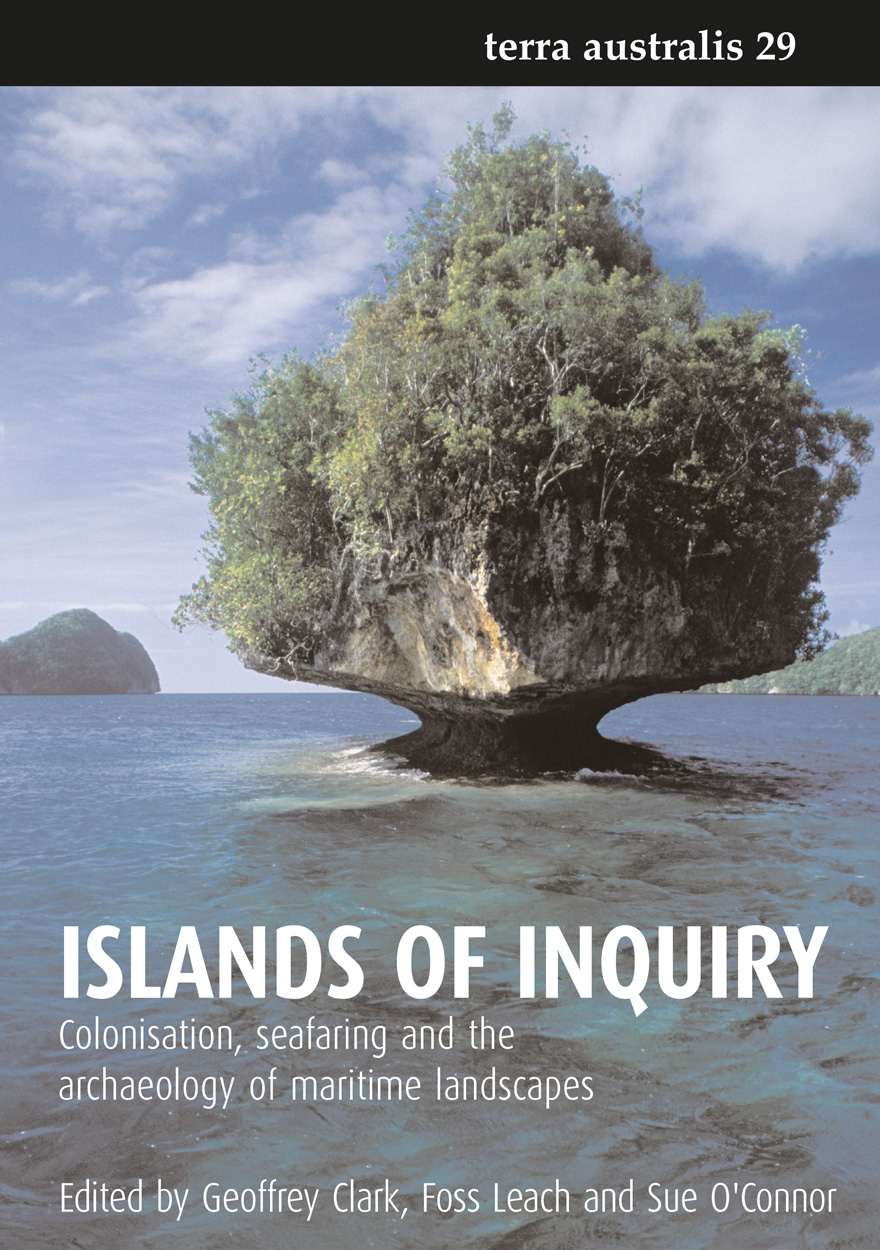
Islands of Inquiry »
Colonisation, seafaring and the archaeology of maritime landscapes
Edited by: Geoffrey Clark, Foss Leach, Sue O'Connor
Publication date: June 2008
This collection makes a substantial contribution to several highly topical areas of archaeological inquiry. Many of the papers present new and innovative research into the processes of maritime colonisation, processes that affect archaeological contexts from islands to continents. Others shift focus from process to the archaeology of maritime places from the Bering to the Torres Straits, providing highly detailed discussions of how living by and with the sea is woven into all elements of human life from subsistence to trade and to ritual. Of equal importance are more abstract discussions of islands as natural places refashioned by human occupation, either through the introduction of new organisms or new systems of production and consumption. These transformation stories gain further texture (and variety) through close examinations of some of the more significant consequences of colonisation and migration, particularly the creation of new cultural identities. A final set of papers explores the ways in which the techniques of archaeological science have provided insights into the fauna of islands and the human history of such places. Islands of Inquiry highlights the importance of an archaeologically informed history of landmasses in the oceans and seas of the world.

Aboriginal History Journal: Volume 32 »
Publication date: 2008
Since 1977, the journal Aboriginal History has pioneered interdisciplinary historical studies of Australian Aboriginal people’s and Torres Strait Islander’s interactions with non-Indigenous peoples. It has promoted publication of Indigenous oral traditions, biographies, languages, archival and bibliographic guides, previously unpublished manuscript accounts, critiques of current events, and research and reviews in the fields of anthropology, archaeology, sociology, linguistics, demography, law, geography and cultural, political and economic history.
Aboriginal History Inc. is a publishing organisation based in the Australian Centre for Indigenous History, Research School of Social Sciences, The Australian National University, Canberra.
For more information on Aboriginal History Inc. please visit aboriginalhistory.org.au.
Download for free
Not available for purchase

Agency, Contingency and Census Process »
Observations of the 2006 Indigenous Enumeration Strategy in remote Aboriginal Australia
Edited by: Frances Morphy
Publication date: December 2007
The Indigenous Enumeration Strategy (IES) of the Australian National Census of Population and Housing has evolved over the years in response to the perceived ‘difference’ of the Aboriginal and Torres Strait Islander populations. Its defining characteristics are the use of locally recruited, mostly Indigenous collector interviewers, and the administration of a modified collection instrument in discrete Indigenous communities, mostly in remote Australia.
The research reported here is unique. The authors, with the assistance of the Australian Bureau of Statistics, were able to follow the workings of the IES in the 2006 Census from the design of the collection instrument to the training of temporary census field staff at the Northern Territory’s Census Management Unit in Darwin, to the enumeration in four remote locations, through to the processing stage at the Data Processing Centre in Melbourne. This allowed the tracking of data from collection to processing, and an assessment of the effects of information flows on the quality of the data, both as input and output.
This study of the enumeration involved four very different locations: a group of small outstation communities (Arnhem Land), a large Aboriginal township (Wadeye), an ‘open’ town with a majority Aboriginal population (Fitzroy Crossing), and the minority Aboriginal population of a major regional centre (Alice Springs). A comparison between these contexts reveals differences that reflect the diversity of remote Aboriginal Australia, but also commonalities that exert a powerful influence on the effectiveness of the IES, in particular very high levels of short-term mobility. The selection of sites also allowed a comparison between the enumeration process in the Northern Territory, where a time-extended rolling count was explicitly planned for, and Western Australia, where a modified form of the standard count had been envisaged.
The findings suggest that the IES has reached a point in its development where the injection of ever-increasing resources into essentially the same generic set and structure of activities may be producing diminishing returns. There is a need for a new kind of engagement between the Australian Bureau of Statistics and local government and Indigenous community-sector organisations in remote Australia. The agency and local knowledge of Indigenous people could be harnessed more effectively through an ongoing relationship with such organisations, to better address the complex contingencies confronting the census process in remote Indigenous Australia.

Transgressions »
Critical Australian Indigenous histories
Edited by: Ingereth Macfarlane, Mark Hannah
Publication date: December 2007
This volume brings together an innovative set of readings of complex interactions between Australian Aboriginal people and colonisers. The underlying theme is that of ‘transgression’, and Michel Foucault’s account of the necessary dynamic that exists between transgression and limit. We know what constitutes the limit, not by tracing or re-stating the boundaries, but by crossing over them. By exploring the mechanisms by which limits are set and maintained, unexamined cultural assumptions and dominant ideas are illuminated. We see the expectations and the structures that inform and support them revealed, often as they unravel. Such illuminations and revelations are at the core of the Australian Indigenous histories presented in this collection.
For more information on Aboriginal History Inc. please visit aboriginalhistory.org.au.

The Social Effects of Native Title »
Recognition, Translation, Coexistence
Edited by: Benjamin R. Smith, Frances Morphy
Publication date: October 2007
The papers in this collection reflect on the various social effects of native title. In particular, the authors consider the ways in which the implementation of the Native Title Act 1993 (Cwlth), and the native title process for which this Act legislates, allow for the recognition and translation of Aboriginal law and custom, and facilitate particular kinds of coexistence between Aboriginal title holders and other Australians. In so doing, the authors seek to extend the debate on native title beyond questions of practice and towards an improved understanding of the effects of native title on the social lives of Indigenous Australians and on Australian society more generally.
These attempts to grapple with the effects of native title have, in part, been impelled by Indigenous people’s complaints about the Act and the native title process. Since the Act was passed, many Indigenous Australians have become increasingly unhappy with both the strength and forms of recognition afforded to traditional law and custom under the Act, as well as with the socially disruptive effects of the native title process. In particular, as several of the papers in this collection demonstrate, there is widespread discomfort with the transformative effects of recognition within the native title process, effects which can then affect other aspects of Indigenous lives.

Culture in Translation »
The anthropological legacy of R. H. Mathews
Edited by: Martin Thomas
Publication date: September 2007
R. H. Mathews (1841–1918) was an Australian-born surveyor and self-taught anthropologist. From 1893 until his death in 1918, he made it his mission to record all ‘new and interesting facts’ about Aboriginal Australia. Despite falling foul with some of the most powerful figures in British and Australian anthropology, Mathews published some 2200 pages of anthropological reportage in English, French and German. His legacy is an outstanding record of Aboriginal culture in the Federation period.
This first edited collection of Mathews’ writings represents the many facets of his research, ranging from kinship study to documentation of myth. It include eleven articles translated from French or German that until now have been unavailable in English. Introduced and edited by Martin Thomas, who compellingly analyses the anthropologist, his milieu, and the intrigues that were so costly to his reputation, Culture in Translation is essential reading on the history of cross-cultural research.
The translations from the French are by Mathilde de Hauteclocque and from the German by Christine Winter.
For more information on Aboriginal History Inc. please visit aboriginalhistory.org.au.