



Search titles
Displaying results 111 to 120 of 213.

Survey Analysis for Indigenous Policy in Australia »
Social Science Perspectives
Edited by: Boyd Hunter, Nicholas Biddle
Publication date: November 2012
Indigenous policy is a complex domain motivated by a range of social, cultural, political and economic issues. The Council of Australian Governments ‘closing the gaps’ agenda for addressing Indigenous disadvantage in Australia now includes six targets with well defined and measurable outcomes for policy action. In this context there is a continuing and pressing need for robust debate to understand how meaningful improvement in Indigenous outcomes might be achieved.
This monograph presents the peer-reviewed proceedings of the 2011 CAEPR/ABS conference on ‘Social Science Perspectives on the 2008 National and Aboriginal Torres Strait Islander Social Survey’. It is the fourth CAEPR monograph since 1992 to reflect on national surveys of Indigenous Australians. The conference covered topics including child development, crime and justice, culture, wellbeing, the customary economy, demography, education, employment, fertility, health, housing, income and financial stress, mobility, poverty, social exclusion, and substance abuse. The papers summarise the strengths and limitations of the 2008 NATSISS, discuss the types of policy-relevant questions it can inform, and consider future survey design.
A social survey such as the NATSISS can ultimately never tell those responsible for developing public policy what to do, but it can provide useful information to inform policy decisions. This volume will be useful for researchers and policy makers, and relevant to the wider national debate and, in particular, Indigenous communities and organisations.
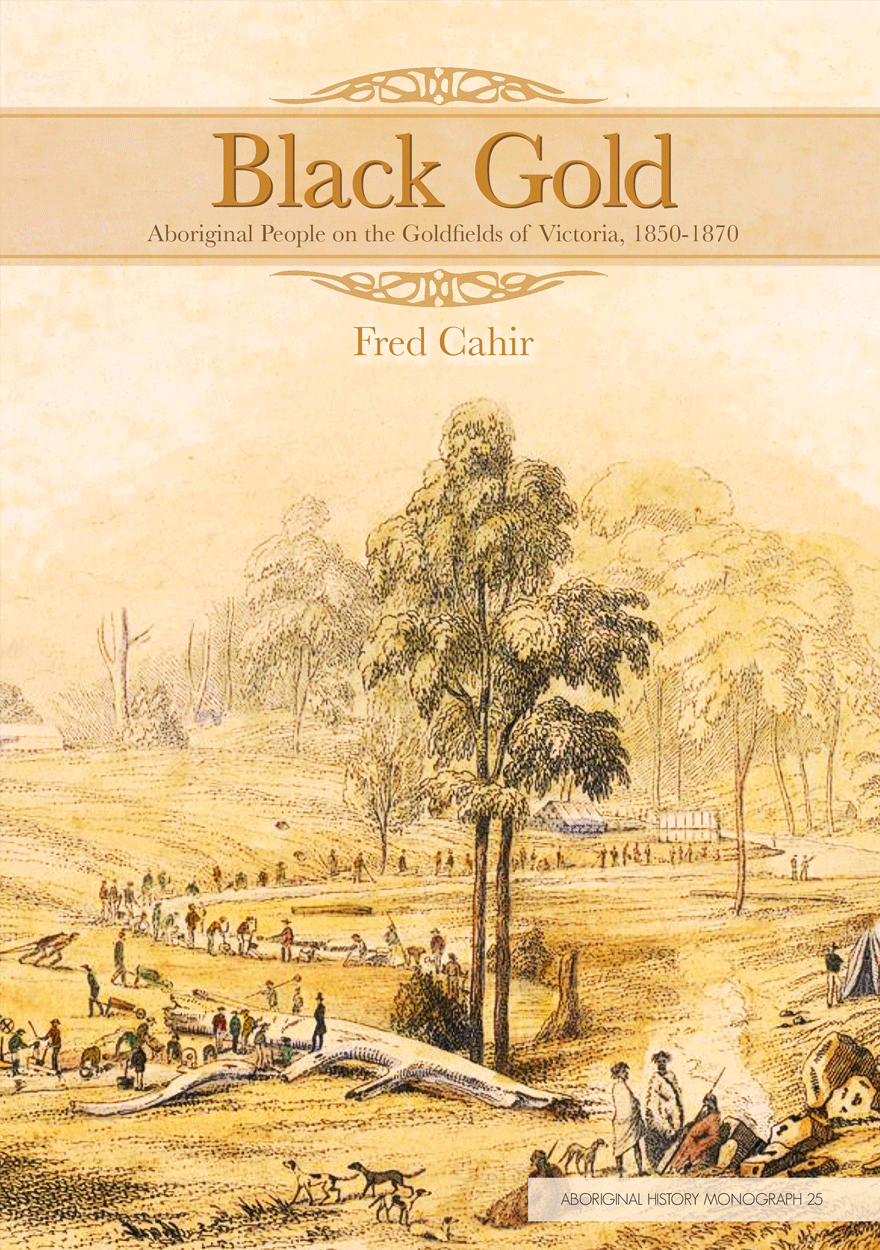
Black Gold »
Aboriginal People on the Goldfields of Victoria, 1850-1870
Authored by: Fred Cahir
Publication date: September 2012
Fred Cahir tells the story about the magnitude of Aboriginal involvement on the Victorian goldfields in the middle of the nineteenth century.
The first history of Aboriginal–white interaction on the Victorian goldfields, Black Gold offers new insights on one of the great epochs in Australian and world history—the gold story.
In vivid detail it describes how Aboriginal people often figured significantly in the search for gold and documents the devastating social impact of gold mining on Victorian Aboriginal communities. It reveals the complexity of their involvement from passive presence, to active discovery, to shunning the goldfields.
This detailed examination of Aboriginal people on the goldfields of Victoria provides striking evidence which demonstrates that Aboriginal people participated in gold mining and interacted with non-Aboriginal people in a range of hitherto neglected ways.
Running through this book are themes of Aboriginal empowerment, identity, integration, resistance, social disruption and communication.
For more information on Aboriginal History Inc. please visit aboriginalhistory.org.au.

Past Law, Present Histories »
Edited by: Diane Kirkby
Publication date: September 2012
This collection brings methods and questions from humanities, law and social sciences disciplines to examine different instances of lawmaking. Contributors explore the problematic of past law in present historical analysis across indigenous Australia and New Zealand, from post-Franco Spain to current international law and maritime regulation, from settler colonial humanitarian debates to efforts to end cruelty to children and animals. They highlight problems both national and international in their implication. From different disciplines and theoretical positions, they illustrate the diverse and complex study of law’s history.

Indigenous Peoples' Innovation »
Intellectual Property Pathways to Development
Edited by: Peter Drahos, Susy Frankel
Publication date: August 2012
Traditional knowledge systems are also innovation systems. This book analyses the relationship between intellectual property and indigenous innovation. The contributors come from different disciplinary backgrounds including law, ethnobotany and science. Drawing on examples from Australia, New Zealand and the Pacific Islands, each of the contributors explores the possibilities and limits of intellectual property when it comes to supporting innovation by indigenous people.
Learning Spaces »
Youth, Literacy and New Media in Remote Indigenous Australia
Authored by: Inge Kral, Robert G. Schwab
Publication date: August 2012
'This work offers us the rare opportunity to step inside innovative uses of technologies, mergers of global technologies into local knowledge, and community advocacy of local history and ideology…The young people who move through these pages are motivated and proud of having had the opportunities that make possible their linking together of historical knowledge and contemporary means of communication and performance. The means illustrated here have enabled them to develop skills that will help them move into the future as adults engaged with the health and life of their own communities, connected to their language and culture as their way of being in the world of the local so as to know the world of the global.'
Professor Shirley Brice Heath
Stanford University, USA
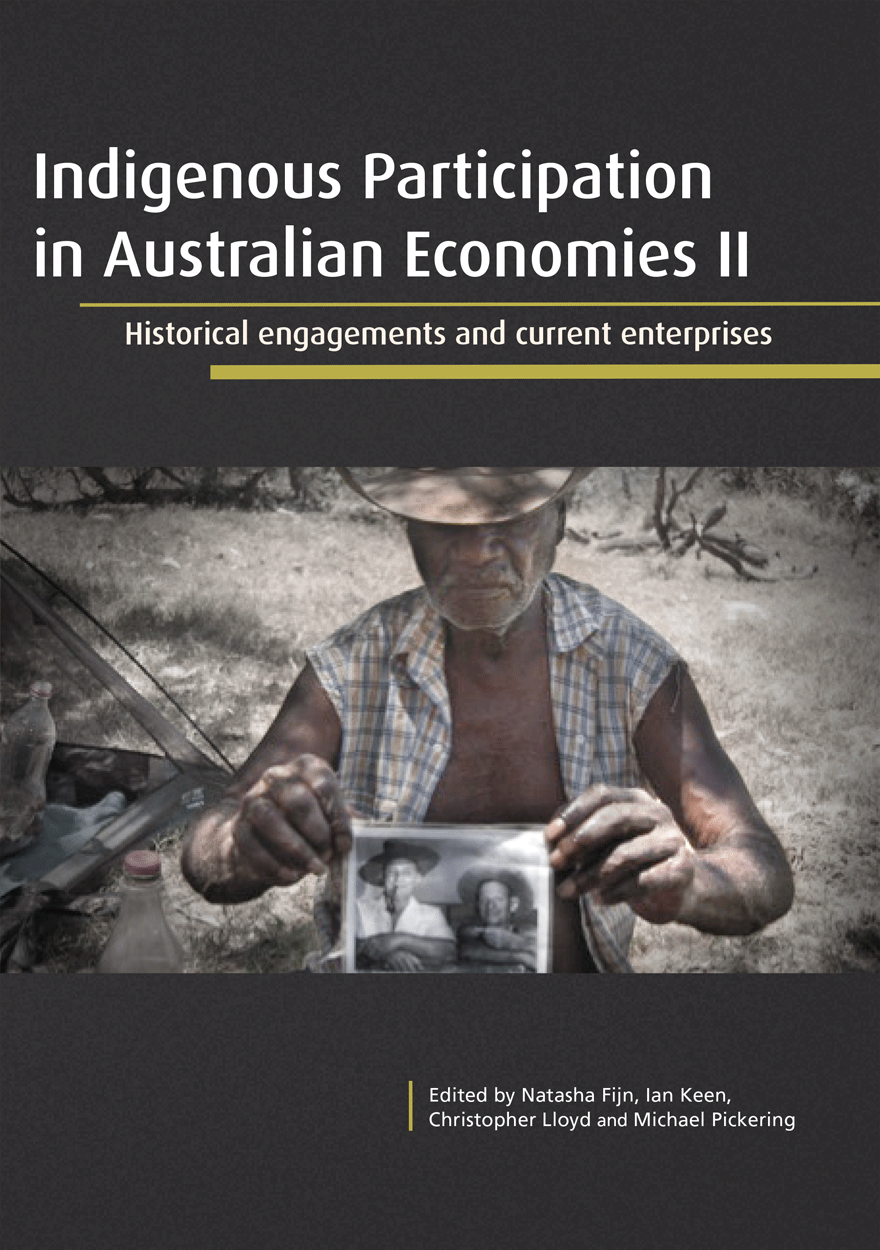
Indigenous Participation in Australian Economies II »
Historical engagements and current enterprises
Publication date: July 2012
This is the second volume to emerge from a project on Indigenous participation in the Australian economy, funded by an Australian Research Council (ARC) Linkage Grant, and involving the cooperation of the School of Archaeology and Anthropology at The Australian National University and the National Museum of Australia. The Chief Investigators were Ian Keen, Chris Lloyd, Anthony Redmond, the Partner Investigator was Mike Pickering, Fiona Skyring was an associate researcher on the project, and Natasha Fijn was research assistant. The present volume arises out of a conference in Canberra on Indigenous Participation in Australian Economies at the National Museum of Australia on 9–10 November 2009, which attracted more than thirty presenters. The diverse themes included histories of economic relations, the role of camels and dingoes in Indigenous–settler relations, material culture and the economy, the economies of communities from missions and stations to fringe camps and towns, the transitions from payment-in-kind to wage economies and Community Development Employment Projects, the issue of unpaid and stolen wages, local enterprises, and conflicts over development. Sixteen of those papers have been developed as chapters in this volume, together with a foreword by Professor Jon Altman. This book comprises a companion volume to Indigenous Participation in Australian Economies: Historical and Anthropological Perspectives, published by ANU Press in 2010.

Country, Native Title and Ecology »
Edited by: Jessica K Weir
Publication date: March 2012
Country, native title and ecology all converge in this volume to describe the dynamic intercultural context of land and water management on Indigenous lands. Indigenous people’s relationships with country are discussed from various speaking positions, including identity and knowledge, the homelands debate, water planning, climate change and market environmentalism. The inter-disciplinary chapters range from an ethnographic description of living waters in the Great Sandy Desert, negotiating the eradication of yellow crazy ants in Arnhem Land, and legal analysis of native title rights in emerging carbon markets. A recurrent theme is the contentions over meaning, knowledge, and authority.
'Because this volume is scholarly, original and very timely it represents a key resource and reference work for land and sea managers; policy makers; scholars of the interface between post-native title responsibilities, NRM objectives and appropriate heritage protocols; and students based in the social sciences, natural sciences and humanities. It is rare for volumes to have this much cross-academy purchase and for this reason alone – it will have ongoing worth and value as a seminal collection.'
– Associate Professor Peter Veth, ANU College of Arts and Social Sciences, The Australian National University.

Peopled Landscapes »
Archaeological and Biogeographic Approaches to Landscapes
Edited by: Simon G. Haberle, Bruno David
Publication date: January 2012
This impressive collection celebrates the work of Peter Kershaw, a key figure in the field of Australian palaeoenvironmental reconstruction. Over almost half a century his research helped reconceptualize ecology in Australia, creating a detailed understanding of environmental change in the Late Pleistocene and Holocene. Within a biogeographic framework one of his exceptional contributions was to explore the ways that Aboriginal people may have modified the landscape through the effects of anthropogenic burning. These ideas have had significant impacts on thinking within the fields of geomorphology, biogeography, archaeology, anthropology and history. Papers presented here continue to explore the dynamism of landscape change in Australia and the contribution of humans to those transformations. The volume is structured in two sections. The first examines evidence for human engagement with landscape, focusing on Australia and Papua New Guinea but also dealing with the human/environmental histories of Europe and Asia. The second section contains papers that examine palaeoecology and present some of the latest research into environmental change in Australia and New Zealand. Individually these papers, written by many of Australia’s prominent researchers in these fields, are significant contributions to our knowledge of Quaternary landscapes and human land use. But Peopled Landscapes also signifies the disciplinary entanglement that is archaeological and biogeographic research in this region, with archaeologists and environmental scientists contributing to both studies of human land use and palaeoecology. Peopled Landscapes reveals the interdisciplinary richness of Quaternary research in the Australasian region as well as the complexity and richness of the entangled environmental and human pasts of these lands.
— Prof. Peter Hiscock, The Australian National University

Reaching for Health »
The Australian women’s health movement and public policy
Authored by: Gwendolyn Gray Jamieson
Publication date: January 2012
The women’s health movement shocked and scandalised when it burst into Australian politics in the early 1970s. It cast the light of day onto taboo subjects such as sexual assault, abortion and domestic violence, provoking outrage and condemnation. Some of the services women created for themselves were subjected to police raids; sex education material was branded ‘indecent’. Moreover, women dared to criticise revered institutions, such as the medical system. Yet for all its perceived radicalism, the movement was part of a much broader and relatively conventional international health reform push, which included the ‘new’ public health movement, the community health centre movement and, in Australia, the Aboriginal health movement, all of which were critical of the way medical systems had been organised during the 20th century. The women who joined the movement came from diverse backgrounds and included immigrant and refugee women, Aboriginal women and Anglo women. Initially, groups worked separately for the most part but as time went on, they found ways to cooperate and collaborate. This book presents an account of the ideas, the diverse and shared efforts and the enduring hard work of women’s health activists, drawn together in one volume for the first time. This relentless activism gradually had an impact on public policy and slowly brought forth major attitudinal changes. The book also identifies the opportunities for health reform that were created along the way, opportunities which deserve to be more fully embraced.

Land and Life in Timor-Leste »
Ethnographic Essays
Edited by: Andrew McWilliam, Elizabeth G. Traube
Publication date: December 2011
Following the historic 1999 popular referendum, East Timor emerged as the first independent sovereign nation of the 21st Century. The years since these momentous events have seen an efflorescence of social research across the country drawn by shared interests in the aftermath of the resistance struggle, the processes of social recovery and the historic opportunity to pursue field-based ethnography following the hiatus of research during 24 years of Indonesian rule (1975-99).
This volume brings together a collection of papers from a diverse field of international scholars exploring the multiple ways that East Timorese communities are making and remaking their connections to land and places of ancestral significance. The work is explicitly comparative and highlights the different ways Timorese language communities negotiate access and transactions in land, disputes and inheritance especially in areas subject to historical displacement and resettlement. Consideration is extended to the role of ritual performance and social alliance for inscribing connection and entitlement. Emerging through analysis is an appreciation of how relations to land, articulated in origin discourses, are implicated in the construction of national culture and differential contributions to the struggle for independence. The volume is informed by a range of Austronesian cultural themes and highlights the continuing vitality of customary governance and landed attachment in Timor-Leste.