



Search titles
Displaying results 61 to 70 of 156.

Ten Thousand Years of Cultivation at Kuk Swamp in the Highlands of Papua New Guinea »
Publication date: July 2017
Kuk is a settlement at c. 1600 m altitude in the upper Wahgi Valley of the Western Highlands Province of Papua New Guinea, near Mount Hagen, the provincial capital. The site forms part of the highland spine that runs for more than 2500 km from the western head of the island of New Guinea to the end of its eastern tail. Until the early 1930s, when the region was first explored by European outsiders, it was thought to be a single, uninhabited mountain chain. Instead, it was found to be a complex area of valleys and basins inhabited by large populations of people and pigs, supported by the intensive cultivation of the tropical American sweet potato on the slopes above swampy valley bottoms.
With the end of World War II, the area, with others, became a focus for the development of coffee and tea plantations, of which the establishment of Kuk Research Station was a result. Large-scale drainage of the swamps produced abundant evidence in the form of stone axes and preserved wooden digging sticks and spades for their past use in cultivation. Investigations in 1966 at a tea plantation in the upper Wahgi Valley by a small team from The Australian National University yielded a date of over 2000 years ago for a wooden stick collected from the bottom of a prehistoric ditch.
The establishment of Kuk Research Station a few kilometres away shortly afterwards provided an ideal opportunity for a research project.

Made in China Journal: Volume 2, Issue 2, 2017 »
Publication date: June 2017
In June 2017, the government of the United States announced its intention to withdraw from the Paris Accords, severely undermining the global effort to contain climate change. Since then, China has entered the fray, attempting to portray itself as a world leader on environmental issues. While global attention has focussed on China’s top-down environmental efforts, this issue considers the engagement of Chinese citizens with state policies on the environment, and looks into their potential for articulating workable grassroots alternatives. In particular, we consider the management of public resources—the so-called ‘commons’.
Download for free
Not available for purchase

International Review of Environmental History: Volume 3, Issue 1, 2017 »
Edited by: James Beattie
Publication date: June 2017
International Review of Environmental History takes an interdisciplinary and global approach to environmental history. It encourages scholars to think big and to tackle the challenges of writing environmental histories across different methodologies, nations, and time-scales. The journal embraces interdisciplinary, comparative and transnational methods, while still recognising the importance of locality in understanding these global processes.
The journal’s goal is to be read across disciplines, not just within history. It publishes on all thematic and geographic topics of environmental history, but especially encourage articles with perspectives focused on or developed from the southern hemisphere and the ‘global south’.
Download for free
Not available for purchase
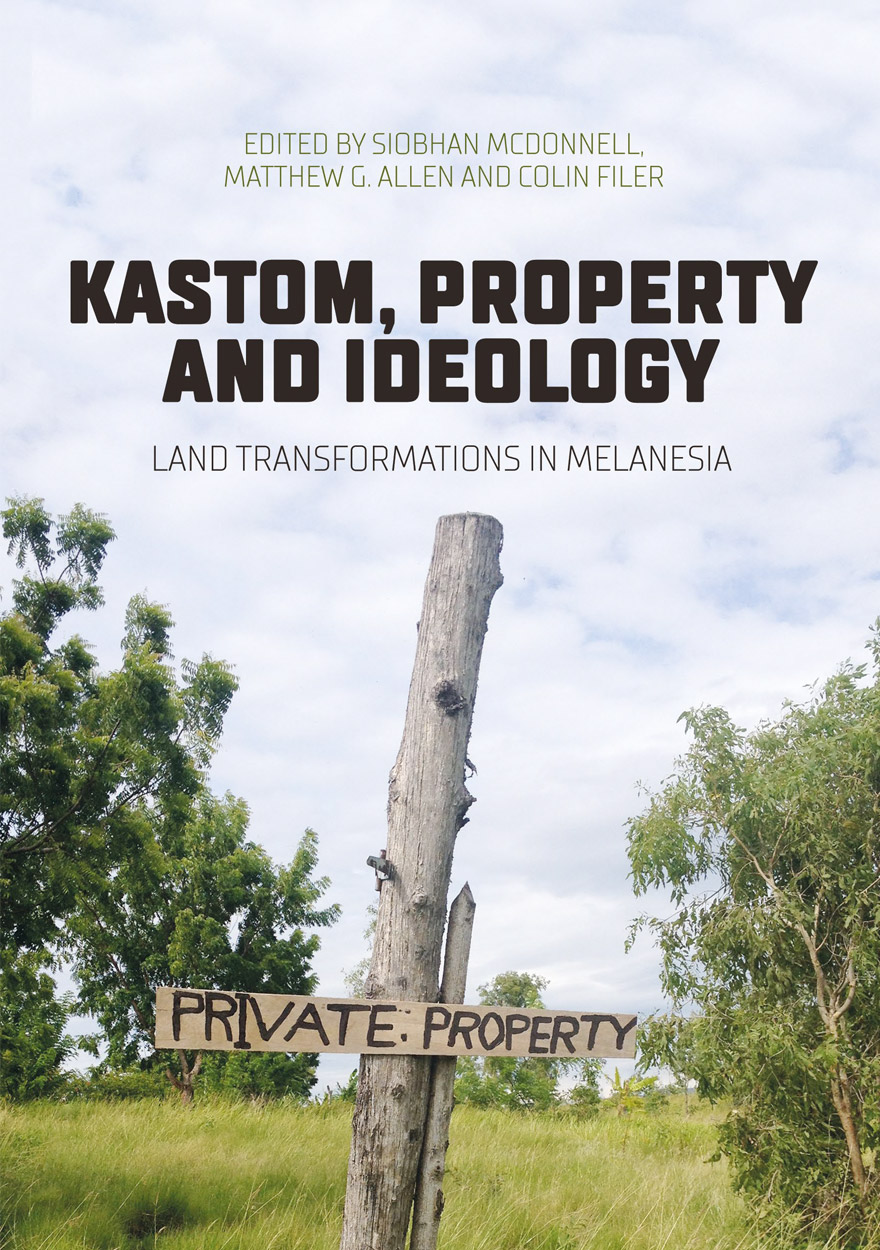
Kastom, property and ideology »
Land transformations in Melanesia
Publication date: March 2017
The relationship between customary land tenure and ‘modern’ forms of landed property has been a major political issue in the ‘Spearhead’ states of Melanesia since the late colonial period, and is even more pressing today, as the region is subject to its own version of what is described in the international literature as a new ‘land rush’ or ‘land grab’ in developing countries. This volume aims to test the application of one particular theoretical framework to the Melanesian version of this phenomenon, which is the framework put forward by Derek Hall, Philip Hirsch and Tania Murray Li in their 2011 book, Powers of Exclusion: Land Dilemmas in Southeast Asia. Since that framework emerged from studies of the agrarian transition in Southeast Asia, the key question addressed in this volume is whether ‘land transformations’ in Melanesia are proceeding in a similar direction, or whether they take a somewhat different form because of the particular nature of Melanesian political economies or social institutions. The contributors to this volume all deal with this question from the point of view of their own direct engagement with different aspects of the land policy process in particular countries. Aside from discussion of the agrarian transition in Melanesia, particular attention is also paid to the growing problem of land access in urban areas and the gendered nature of landed property relations in this region.

Deep Crustal Seismic Reflection Profiling »
Australia 1978–2015
Authored by: Brian Kennett, E. Saygin, T. Fomin, Richard Blewett
Publication date: November 2016
Deep Crustal Seismic Reflection Profiling: Australia 1978–2015 presents the full suite of reflection profiles penetrating the whole crust carried in Australia by Geoscience Australia and various partners.
The set of reflection data comprises over 16,000 km of coverage across the whole continent, and provides an insight into the variations in crustal architecture in the varied geological domains. Each reflection profile is presented at approximately true scale with up to 220 km of profile per page and overlap between pages. Each reflection section is accompanied by a geological strip map showing the configuration of the line superimposed on 1:1M geology. The compilation includes a suite of large-scale reflection transects groups of 1,000 km or more that link across major geological provinces, and an extensive bibliography of reports and relevant publications.

East Asia Forum Quarterly: Volume 8, Number 4, 2016 »
Publication date: November 2016
East Asia Forum Quarterly grew out of East Asia Forum (EAF) online, which has developed a reputation for providing a platform for the best in Asian analysis, research and policy comment on the Asia Pacific region in world affairs. EAFQ aims to provide a further window onto research in the leading research institutes in Asia and to provide expert comment on current developments within the region. The East Asia Forum Quarterly, like East Asia Forum online, is an initiative of the East Asia Forum (EAF) and its host organisation, the East Asian Bureau of Economic Research (EABER) in the Crawford School of Economics and Government in the College of Asia & the Pacific at The Australian National University.
Download for free
Not available for purchase

The Lion that Didn't Roar »
Can the Kimberley Process Stop the Blood Diamonds Trade?
Authored by: Nigel Davidson
Publication date: October 2016
In 2017 it will be Australia’s turn to chair the Kimberley Process Certification Scheme (KP), an international organisation set up to regulate the trade in diamonds. Diamonds are a symbol of love, purchased to celebrate marriage, and it is therefore deeply ironic that the diamond trade has become linked with warfare and human rights violations committed in African producer countries such as Sierra Leone, the Democratic Republic of Congo and, more recently, Zimbabwe and Angola. In their quest for diamonds, or by using diamonds to purchase weapons, armed groups in these countries have engaged in recruiting child soldiers, amputating limbs, and committing rape and murder. In response to the problem, the international community, non-governmental organisations and key industry players such as De Beers combined forces to create the Kimberley Process in 2002. The KP uses an export certificate system to distinguish the legitimate rough diamond trade from so-called ‘blood diamonds’, which are also known as ‘conflict diamonds’. This book considers the extent to which the KP, supported by other agencies at the international and national levels, has been effective in achieving its mandate. In so doing, it presents an original model derived from the domain of regulatory theory, the Dual Networked Pyramid, as a means of describing the operation of the system and suggesting possible improvements that might be made to it.
Nigel Davidson spoke with 936 ABC Hobart about what Australia can do to help stop blood diamonds. Listen to the full interview here.

International Review of Environmental History: Volume 2, 2016 »
Edited by: James Beattie
Publication date: September 2016
International Review of Environmental History takes an interdisciplinary and global approach to environmental history. It encourages scholars to think big and to tackle the challenges of writing environmental histories across different methodologies, nations, and time-scales. The journal embraces interdisciplinary, comparative and transnational methods, while still recognising the importance of locality in understanding these global processes.
The journal’s goal is to be read across disciplines, not just within history. It publishes on all thematic and geographic topics of environmental history, but especially encourage articles with perspectives focused on or developed from the southern hemisphere and the ‘global south’.
Download for free
Not available for purchase

The Bionarrative »
The story of life and hope for the future
Authored by: Stephen Boyden
Publication date: August 2016
This book is for the general reader interested in the human place in nature and the future of civilisation. It is based on the biohistorical approach to the study of human situations. This approach recognises human culture as a new and extremely important force in the biosphere.
The book discusses the evolution of life and the essential ecological processes on which all life, including human civilisation, depend. It describes the conditions of life and ecology of humans in the four ecological phases in human history, with emphasis on the impacts of human culture on biological systems.
It explains how, as cultures evolved, they often came to embrace not only factual information of good practical value, but also assumptions that are sheer nonsense, sometimes leading to activities that caused unnecessary human distress or damage to local ecosystems. These are examples of cultural maladaptation. There have been countless instances of cultural maladaptation in human history.
The days of the fourth ecological phase of human history, the Exponential Phase, are numbered. Cultural maladaptations are now on a massive scale, and business as usual will inevitably lead to the ecological collapse of civilisation.
The only hope for the survival of civilisation lies in radical changes in the worldviews and priorities of the prevailing cultures of the world, leading to a fifth ecological phase — a phase in which human society is truly sensitive to, in tune with and respectful of the processes of life. This is called a biosensitive society. The book concludes with discussion on the essential characteristics of a biosensitive society and on the means by which the necessary cultural transformation might come about.
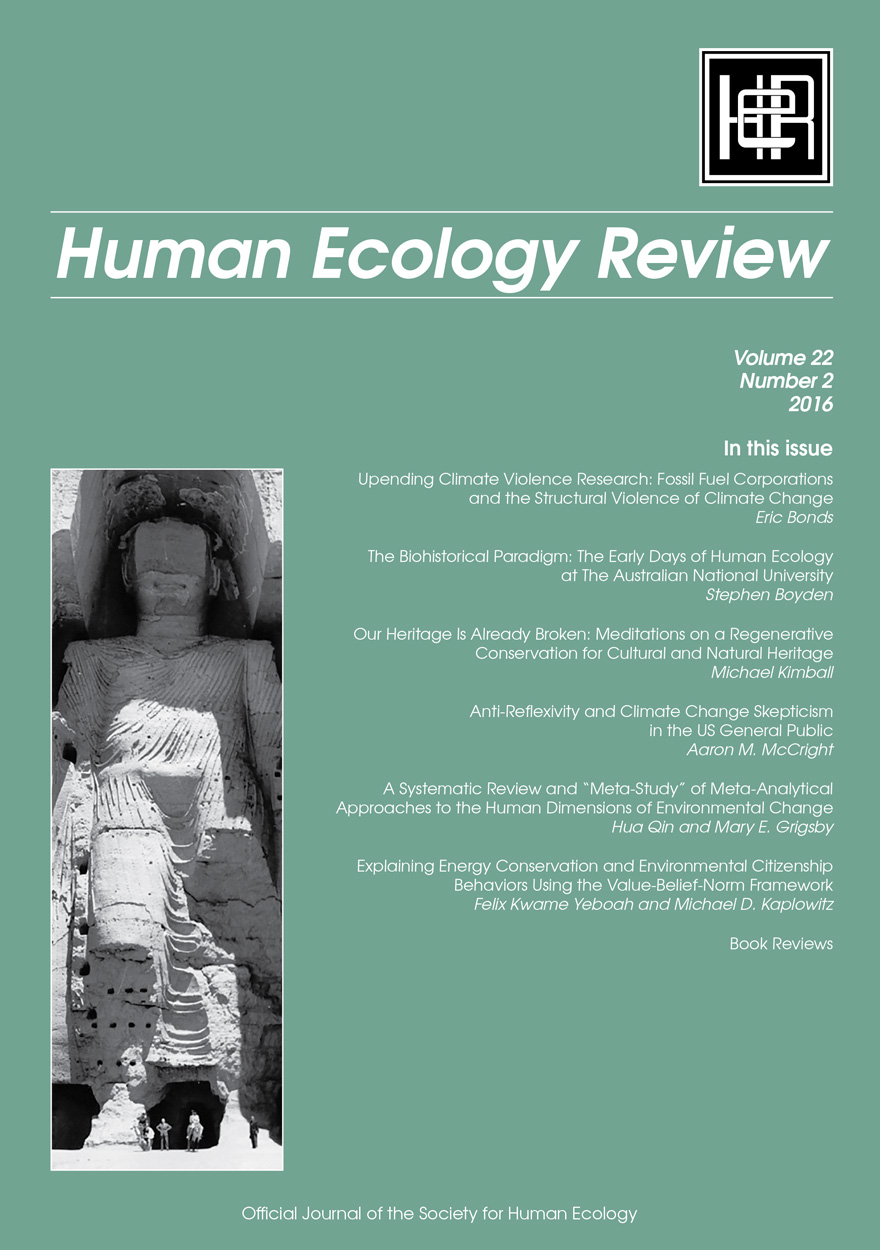
Human Ecology Review: Volume 22, Number 2 »
Publication date: July 2016
Human Ecology Review is a semi-annual journal that publishes peer-reviewed interdisciplinary research on all aspects of human–environment interactions (Research in Human Ecology). The journal also publishes essays, discussion papers, dialogue, and commentary on special topics relevant to human ecology (Human Ecology Forum), book reviews (Contemporary Human Ecology), and letters, announcements, and other items of interest (Human Ecology Bulletin). Human Ecology Review also publishes an occasional paper series in the Philosophy of Human Ecology and Social–Environmental Sustainability.
Download for free
Not available for purchase