



Search titles
Displaying results 51 to 60 of 887.

West New Guinea »
Social, Biological, and Material Histories
Edited by: Dylan Gaffney, Marlin Tolla
Publication date: February 2025
This book explores the human past in West New Guinea (otherwise known as Indonesian Papua, West Papua, or Irian Jaya). The western part of New Guinea and its surrounding islands were critical for the early peopling of the Pacific region over 50,000 years ago, when Homo sapiens moved out of Africa and into Asia, seafaring through the islands of Wallacea as far as New Guinea, the Bismarck Archipelago, and the Solomon Islands. After arriving on the shores of West New Guinea, people adapted to diverse environments including coral reefs, tropical rainforests, swamps, montane cloud forests, and savannah grasslands. Over millennia, people transformed these habitats by burning and cutting the forests, translocating plants and animals, and managing access to resources. Food production later emerged in the region as the global climate warmed up around 10,000 years ago. Between 4000–3000 years ago, the Austronesian languages began to enter West New Guinea, with its speakers settling around the coasts and offshore islands. New forms of exchange connected people and, particularly within the last 2000 years, drew West New Guinea into global networks. The objects produced and traded at ethnographic contact—like pottery, stone axes, string bags, shell ornaments, and wooden carvings—can be informative about these networks, but they are increasingly changing as people navigate and transform their material worlds in the present. The examination of these objects in museums not only casts light on their makers, traders, and collectors, but also highlights the ongoing connections that Papuans have with their material culture in the twenty-first century.
The 22 chapters in this book contribute novel perspectives and critical data on each of these themes. The authors come from archaeology, social anthropology, biological anthropology, linguistics, museology, palaeoecology, and beyond. They write about a wide array of West New Guinea’s regions, including the highlands, north and south coasts, Bird’s Head Peninsula, Cenderawasih Bay, and the Raja Ampat Islands.

China: Regaining Growth Momentum after the Pandemic »
Edited by: Ligang Song, Yixiao Zhou
Publication date: December 2024
The slower growth of the Chinese economy in the aftermath of the pandemic has prompted the Chinese Government to adopt measures to boost domestic consumption and deepen structural reform, with the effectiveness of such policies beginning to be felt. However, China still faces challenges that will affect its growth dynamics down the track. These include the slowdown of its real estate sector, the complex internal and external environments for macroeconomic policy, the high level of income inequality, weak growth in investment by the private sector, negative population growth, high levels of debt, deglobalisation, weakness in the financial sector and equity markets, the inadequacy of its fiscal system and the imperative to decarbonise the economy. China must confront these challenges to maintain growth momentum and achieve higher levels of income and living standards.
The theme of the 2024 China Update book is China: Regaining Growth Momentum after the Pandemic. It discusses some of the challenges and policy issues that are being watched with keen interest by decision-makers and markets alike, including: What are the obstacles to economic growth in the aftermath of the pandemic and how can these be overcome? What are the key challenges and opportunities for China to move to the next level of development against the backdrop of negative population growth? Is it time for a Tax-Sharing System Reform 2.0 to consolidate China’s fiscal position? What are the challenges facing China’s small and medium enterprises? How is China’s business environment faring, and what are the implications for investment? How does China’s urban housing affordability impact its low fertility rate? How will the trade conflict between China and the United States play out regarding semiconductors and other high-tech products? How does China–Africa bilateral agricultural trade impact on African rural transformation?

East Asia Forum Quarterly: Volume 16, Number 4, 2024 »
Publication date: December 2024
The global economy’s trajectory toward instability has been evident since Trump 1.0. A second Trump presidency will likely amplify protectionism, strategic competition and global disorder. This edition of East Asia Forum Quarterly examines how Asia can respond, emphasising the region’s role in defending multilateralism, addressing climate change and ensuring global stability.
Download for free
Not available for purchase
Enabling Learning »
Language Teaching for Australian Universities
Publication date: December 2024
Enabling Learning: Language Teaching for Australian Universities illuminates efforts by tertiary language educators to facilitate the learning of languages at the university level. The educators’ endeavours recounted in this volume address a range of specific aspects of the language learning experience or language teaching within tertiary education institutions. The chapters offer an overview of learning approaches and experiences, from the beginner to the advanced level, of different learning environments, from the traditional to online and hybrid, and of different languages, from Indigenous to European to East Asian. This work foregrounds the relevance of improved accessibility to language learning in the university context, presents innovative educational solutions informed by the examination of specific contexts, and asserts the importance of developing intercultural competence.

A Grammar of Warlmanpa »
Authored by: Mitchell Browne
Publication date: November 2024
As spoken by Bunny Naburula, Danny Cooper, Dick Foster, Donald Graham, Doris Kelly, Elizabeth Johnson, George Brown, Gladys Brown, Jack Walker, Jessie Cooper, Jimmy Newcastle, Julie Kelly, Lofty Japaljarri, Louie Martin, May Foster, Norah Graham, Penny Kelly, Penny Williams, Selina Grant, Susannah Nelson, Topsy Walker, Toprail Japaljarri and William Graham.
This volume is a descriptive analysis of Warlmanpa, a highly endangered language traditionally spoken northwest of the town of Tennant Creek, where most of the remaining speakers now live.
This grammatical description is based on language work carried out by community members and linguists since 1952, and is the first published reference grammar of the language.
The major areas of analysis include phonetics, phonology, morphology, and syntax. This volume also provides description of typologically notable features, including: a two-way stop contrast at each place of articulation; a complex second-position auxiliary system containing participant and tense/mood/aspect information; associated motion; and a lack of evidence for noun phrases.
This volume lays the foundation for future Warlmanpa language work.
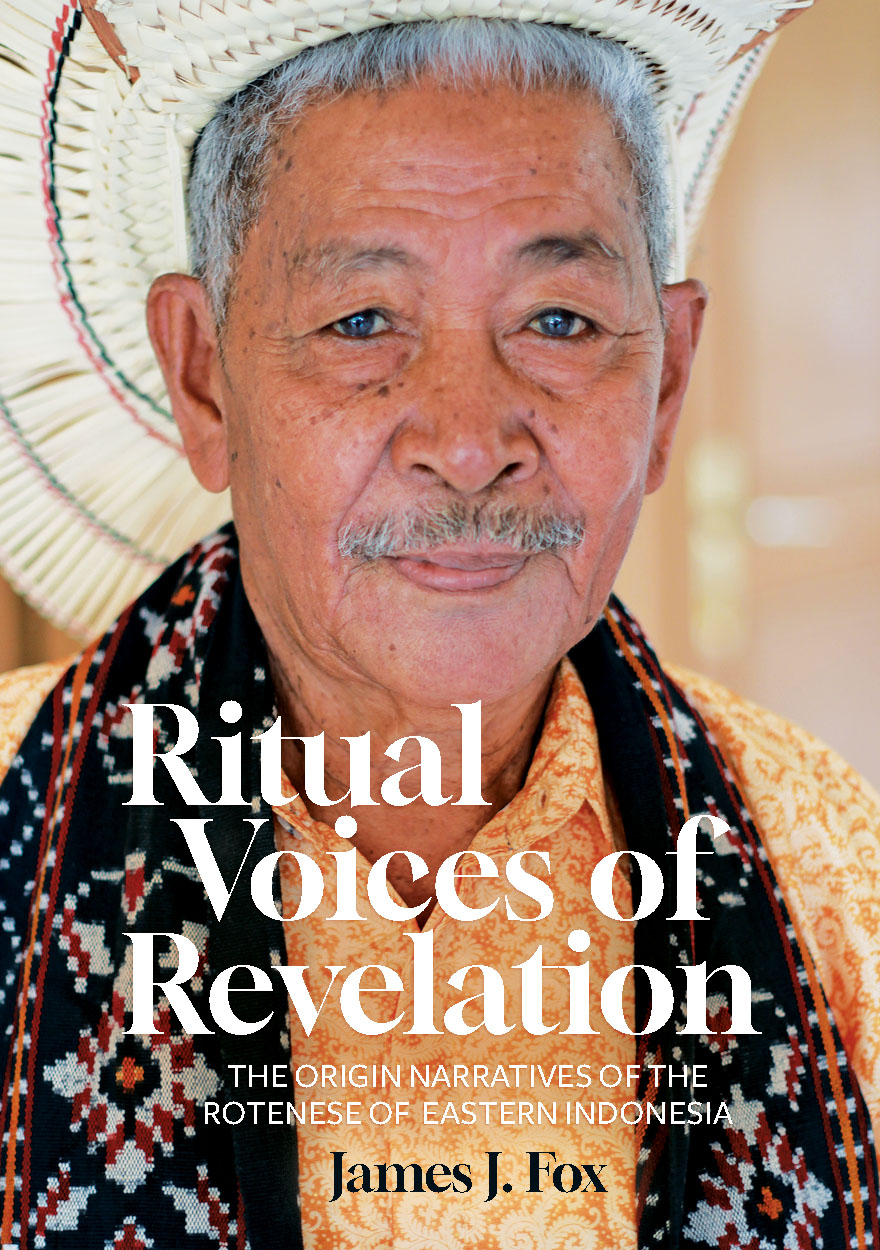
Ritual Voices of Revelation »
The Origin Narratives of the Rotenese of Eastern Indonesia
Authored by: James J. Fox
Publication date: November 2024
This is a study of a collection of oral compositions of the Rotenese of eastern Indonesia. Recited in semantic parallelism, these compositions require a strict pairing of all words to produce correspondingly ordered verses. These narrative verses create an elevated discourse—a ‘scriptural voice’—intended to reveal the origins of Rotenese cultural life. The translations and exegeses of these origin narratives offer a work of world-class poetic imagination that recounts a dynastic contest between the Sun and Moon and Lords of the Ocean Sea and its epic consequences.
As background to the presentation of these narratives, this study provides a description of Rotenese life expressed in the complementary pairs that the Rotenese themselves use to categorise their world. A concluding chapter examines the Rotenese acquisition of Christianity and the subsequent retelling of the Biblical Genesis in Rotenese parallel verse, thus continuing the general examination of the use of parallelism as elevated ritual discourse. Gathered from poets from two domains on the island, most of these compositions date from fieldwork in 1965–66 and in 1973. The publication of these materials represents the summation of more than fifty years of research.
East Asia Forum Quarterly: Volume 16, Number 3, 2024 »
Publication date: September 2024
ASEAN's rise as the cornerstone of regional diplomacy and security in the 1990s may have seemed improbable, but it was crucial. Today, a shifting regional geopolitical landscape challenges ASEAN’s relevance. Great power competition and waning global political commitment to multilateral arrangements threaten its role as East Asia’s 'steering committee'. This edition of East Asia Forum Quarterly explores how ASEAN can maintain its centrality, calling for proactive leadership and stronger regional cooperation.
Download for free
Not available for purchase
Aboriginal History Journal: Volume 47 »
Edited by: Crystal McKinnon, Ben Silverstein
Publication date: September 2024
This volume opens with Joakim Goldhahn, Sally May, and Jeffrey Lee’s study of renowned Badmardi artist Nayombolmi, best known for his rock art but here considered as an artist who produced a number of bark paintings for collectors in the 1950s and 1960s. They show us how his representation of public stories of Spirit or Ancestral Beings emerges from a negotiation between the artist, collectors, and dealers, shaping the forms in which he shared Badmardi story.
The following two articles take up the theme of negotiation in contexts of segregation. Sam Furphy describes Yorta Yorta memory activism relating to Queen Elizabeth II’s visit to Yorta Yorta Country in 1954, considering memories of the fence that was erected to place Yorta Yorta people beyond the Queen’s view and prevent any direct relationship between peoples. Cameron Raynes continues to study segregation by considering the disastrous health impacts of the colour bar that excluded Aboriginal people of the Point Pearce Station from the nearby Wallaroo and Maitland Hospitals in the early-mid twentieth century.
The next articles turn to relationships between Aboriginal people and colonists in Queensland. In a collaboratively written article, Alice Buhrich, Lewis Richards, Brian Bing, Jimmy Richards, Sharon Prior, Jenny Lacey, Tania Casey and Megan Mosquito narrate a history of past and ongoing Ewamian resistance to European invasion that stands in stark contrast to myths of Ewamian disappearance. Rebeka Manning and Sally Babidge read archives of Queensland pastoral stations for traces of Aboriginal women’s and girls’ domestic service, taking these hints as occasions for Aboriginal storytelling.
The final article, co-authored by members of the Aboriginal History Archive Will Bracks, Coen Brown, Clare Land, Gary Foley, John Hawkes, Kim Kruger, Rochelle le Pere, Natasha Ritchie and Shannon Woodcock, describes the work of that archive to produce a historical understanding that can provide the basis for describing and enacting Aboriginal self-determination.
The volume also includes a series of book reviews, as well as reflections on the life and work of Niel Gunson and Gordon Briscoe, two key figures in Aboriginal History whose influence is evident throughout these pages.

From Borders to Pathways »
Innovations and Regressions in the Movement of People into Europe
Edited by: Matthew Zagor
Publication date: September 2024
From Borders to Pathways: Innovations and Regressions in the Movement of People into Europe examines the evolution of European migration policy, offering a forward-looking analysis that extends beyond traditional border controls to innovative legal migration pathways. Contributors provide an in-depth exploration of the drivers shaping migration policies, including public opinion and the rise of populist discourses, the contrasting responses to various real and imagined migrant crises, and critiques of recent policy innovations such as refugee finance schemes, ‘safe legal pathways’, and migrant lotteries. Through interdisciplinary perspectives, the authors assess socio-political, legal, geo-political and cultural shifts to advocate for a more inclusive, humane and sustainable approach to migration. By challenging dominant narratives of deterrence, extraterritoriality and exclusion, this book advocates for policies that balance Europe’s myriad commitments, values and imperatives, highlighting the need for ethical frameworks that respect the dignity of migrants. Essential reading for policymakers, scholars and stakeholders, From Borders to Pathways offers a comprehensive reflection on the complexities of migration in Europe, signalling a paradigm shift towards cooperation, inclusivity, and shared responsibility in global mobility.

Made in China Journal: Volume 9, Issue 1, 2024 »
Publication date: August 2024
A new Chinese government textbook for university students, An Introduction to the Community of the Zhonghua Race (中华民族共同体概论), promotes President Xi Jinping's vision for governing the country’s diverse population. This approach shifts away from celebrating cultural differences—what the anthropologist Susan McCarthy once termed ‘communist multiculturalism’—and towards a Han-dominant identity, a form of racial nationalism inspired by sociologist Fei Xiaotong’s concept of ‘multiple origins, single body’ (多元一体). While the constitution of the People’s Republic of China as amended in 2018 guarantees minority rights and political autonomy through the framework of ‘minority nationalities’ (少数民族), the textbook suggests that Tibetan, Uyghur, Mongols, and other Indigenous groups should eventually assimilate into Han culture, raising concerns about the future of minority languages and traditions. Xi Jinping's new approach to national unity faced significant resistance from both minority and Han officials. Yet, this resistance only prompted an even more muscular response: revamping government departments, a harsh crackdown in minority-populated areas, and removing minority officials who oversaw ethnic affairs. In this issue of the Made in China journal, we ask contributors to reflect on the state of ethnic minority culture in the wake of Xi’s new ethno-nationalist order and explore what remains of cultural differences at the end of dreams of communist pluralism and ethnic autonomy.