



Books
Browse or search ANU Press' range of books or find out more about the publications' authors and co-publishers. Download the book for free or buy a print-on-demand copy.
Displaying results 651 to 660 of 795.

Critical Reflections on Australian Public Policy »
Selected Essays
Edited by: John Wanna
Publication date: May 2009
This collection of ‘critical reflections’ on Australian public policy offers a valuable contribution to public discussion of important political and policy issues facing our nation and society. These essays are important not only because of the reputation and position of the various contributors, but because they are incredibly ‘content rich’ and brimming with new ideas.

Precedence »
Social Differentiation in the Austronesian World
Edited by: Michael P. Vischer
Publication date: May 2009
This collection of papers is the sixth volume in the Comparative Austronesian series. The papers that comprise this volume examine the concept of precedence as a form of local discourse and as a mechanism for ordering status, at different levels, within specific Austronesian-speaking societies. This is the first volume of its kind to focus entirely on precedence and to provide an explication of its social uses and the way in which it is contested. Each paper is ethnographically-focused and offers its own distinctive approach to the examination of precedence. The papers, however, relate closely to one another and are thus able to proffer a variety of comparative reflections.
Seismic Wave Propagation in Stratified Media »
Authored by: Brian Kennett
Publication date: May 2009
Seismic Wave Propagation in Stratified Media presents a systematic treatment of the interaction of seismic waves with Earth structure. The theoretical development is physically based and is closely tied to the nature of the seismograms observed across a wide range of distance scales – from a few kilometres as in shallow reflection work for geophysical prospecting, to many thousands of kilometres for major earthquakes. A unified framework is presented for all classes of seismic phenomena, for both body waves and surface waves.
Since its first publication in 1983 this book has been an important resource for understanding the way in which seismic waves can be understood in terms of reflection and transmission properties of Earth models, and how complete theoretical seismograms can be calculated. The methods allow the development of specific approximations that allow concentration on different seismic arrivals and hence provide a direct tie to seismic observations.

The 2006 Military Takeover in Fiji »
A Coup to End All Coups?
Publication date: April 2009
This book explores the factors behind – and the implications of – the 2006 coup. It brings together contributions from leading scholars, local personalities, civil society activists, union leaders, journalists, lawyers, soldiers and politicians – including deposed Prime Ministers Laisenia Qarase and Mahendra Chaudhry. The 2006 Military Takeover in Fiji: A Coup to End All Coups? is essential reading for those with an interest in the contemporary history of Fiji, politics in deeply divided societies, or in military intervention in civilian politics.

Tracking Rural Change »
Community, Policy and Technology in Australia, New Zealand and Europe
Edited by: Francesca Merlan, David Raftery
Publication date: April 2009
A key, intensifying change affecting rural areas in the last few decades has been a decline in the proportion of national populations whose principal livelihood is farming. The corresponding re-distribution of population has typically resulted in a net population loss to rural areas, and diversification of rural activity. The corporatization and technological modification of food production has prompted new policy challenges, and has bound rural and urban populations together in new relationships articulated in moral discourses of custodianship, food safety, and sustainability. Contributors to this volume came together in the attempt to stimulate collective insight into trends of rural change in Australia, New Zealand and Europe. The first two countries have been characterised by avowedly `neoliberal’ rural policy – with considerable departures from it in practice; Europe, on the other hand, by a mix of policy measures which attempt to integrate land management and sustainability, diversification and maintenance of a competitive farming sector within an overarching policy framework more overtly, though only partially, oriented towards sustaining rural society.
Aiming to build on research relating to the character of rural transitions, this volume offers substantive and critical contributions to the understanding of the sources of unpredictability, instability, and continuity, that underpin rural transition. The papers explore changes and continuities in policy, the governance of rural spaces, technological developments relating to rural areas and populations, and social forms of subjectivation and participation in increasingly diverse rural settings.
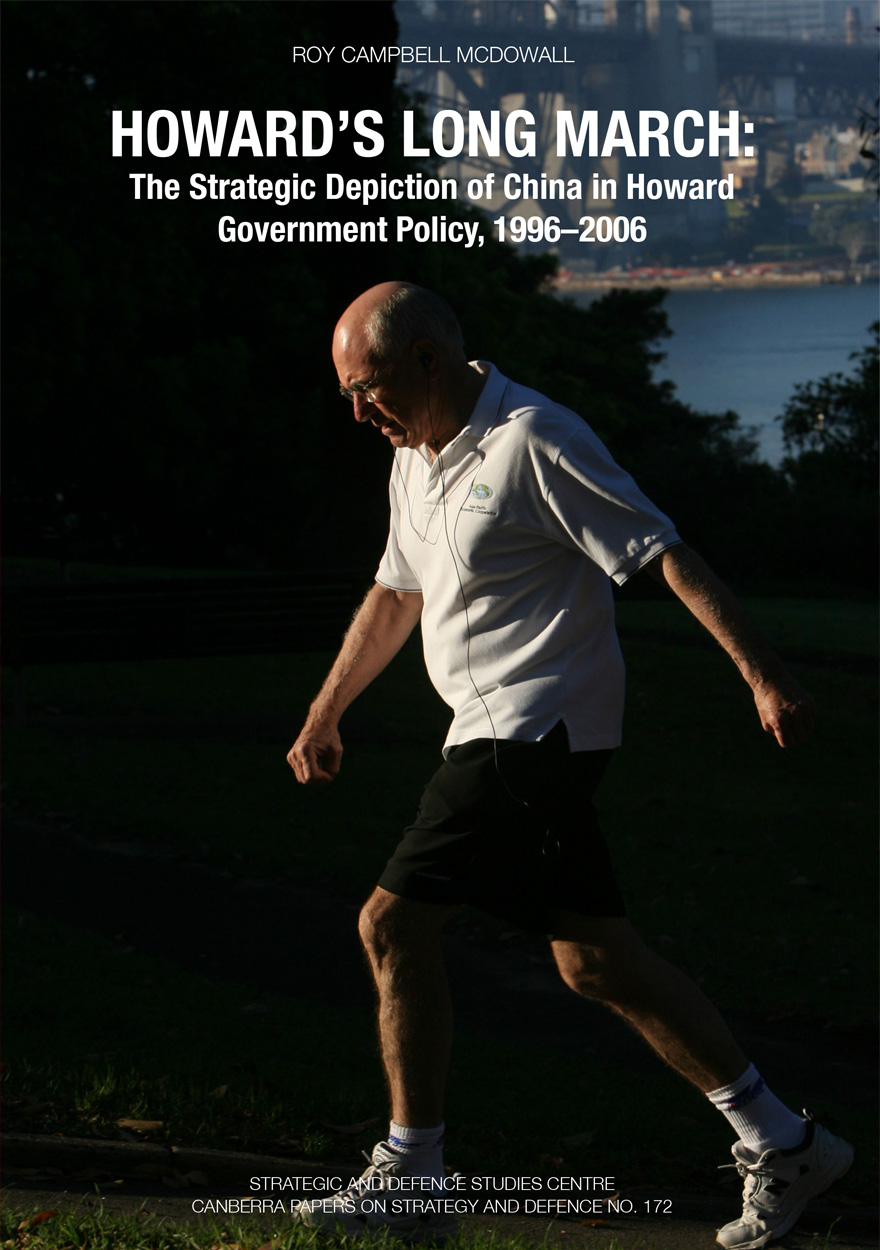
Howard's Long March »
The Strategic Depiction of China in Howard Government Policy, 1996–2006
Authored by: Roy Campbell McDowall
Publication date: March 2009
Australia’s strategic depiction of China has assumed increased importance as it attempts to harmonise economic interests (focusing on China) with security interests (primarily the United States). In this period of strategic transition, how Australia incorporates the rise of China into its existing security commitment under ANZUS has become a delicate issue. This investigation follows the intriguing evolution of the Howard Government’s depictions of China, and reveals a complex and calculated strategy that successfully transformed a potentially volatile conflict of interests into a functional foreign policy.

The Land is a Map »
Placenames of Indigenous Origin in Australia
Edited by: Luise Hercus, Flavia Hodges, Jane Simpson
Publication date: March 2009
The entire Australian continent was once covered with networks of Indigenous placenames. These names often evoke important information about features of the environment and their place in Indigenous systems of knowledge. On the other hand, placenames assigned by European settlers and officials are largely arbitrary, except for occasional descriptive labels such as ‘river, lake, mountain’. They typically commemorate people, or unrelated places in the Northern hemisphere.
In areas where Indigenous societies remain relatively intact, thousands of Indigenous placenames are used, but have no official recognition. Little is known about principles of forming and bestowing Indigenous placenames. Still less is known about any variation in principles of placename bestowal found in different Indigenous groups. While many Indigenous placenames have been taken into the official placename system, they are often given to different features from those to which they originally applied. In the process, they have been cut off from any understanding of their original meanings. Attempts are now being made to ensure that additions of Indigenous placenames to the system of official placenames more accurately reflect the traditions they come from.
The eighteen chapters in this book range across all of these issues. The contributors (linguistics, historians and anthropologists) bring a wide range of different experiences, both academic and practical, to their contributions. The book promises to be a standard reference work on Indigenous placenames in Australia for many years to come.
Rising China »
Power and Reassurance
Edited by: Ron Huisken
Publication date: March 2009
Asia looks and feels very different now compared to the days of the Cold War. The sense that Asia now works differently can be traced to a single source – the re-emergence of China. China was the dominant power in greater Asia for most of recorded history. This historical norm was interrupted from the early 19th century, too far into the past to be recognisable and readily accommodated by the actors in today’s international arena. A powerful China feels new and unfamiliar.
Arriving peacefully at mutually acceptable relationships of power and influence that are very different from those that have prevailed for the past half century will be a demanding process. The world’s track record on challenges of this kind is not terrific. It will call for statesmanship of a consistently high order from all the major players, and building the strongest possible confidence among these players that there are no hidden agendas.

New Directions in Archaeological Science »
Edited by: Andrew Fairbairn, Sue O'Connor, Ben Marwick
Publication date: February 2009
Archaeological Science meetings will have a personality of their own depending on the focus of the host archaeological fraternity itself. The 8th Australasian Archaeometry meeting follows this pattern but underlying the regional emphasis is the continuing concern for the processes of change in the landscape that simultaneously effect and illuminate the archaeological record. These are universal themes for any archaeological research with the increasing employment of science-based studies proving to be a key to understanding the place of humans as subjects and agents of change over time.
This collection of refereed papers covers the thematic fields of geoarchaeology, archaeobotany, materials analysis and chronometry, with particular emphasis on the first two. The editors Andrew Fairbairn, Sue O’Connor and Ben Marwick outline the special value of these contributions in the introduction. The international nature of archaeological science will mean that the advances set out in these papers will find a receptive audience among many archaeologists elsewhere. There is no doubt that the story that Australasian archaeology has to tell has been copiously enriched by incorporating a widening net of advanced science-based studies. This has brought attention to the nature of the environment as a human artefact, a fact now more widely appreciated, and archaeology deals with these artefacts, among others, in this way in this publication.

The Centrelink Experiment »
Innovation in Service Delivery
Authored by: John Halligan, Jules Wills
Publication date: December 2008
Centrelink was established in 1997 as part of the Howard government’s bold experiment in re-framing social policy and re-shaping service delivery. Centrelink was the embodiment of a key tenet of the Howard vision for public service: a specialised service delivery ‘provider’ agency separated from the policy functions of the ‘purchaser’. Carved out of a monolithic Department of Social Security, Centrelink was established along ‘business lines’ operating 320 service centres and delivering payments to 10 million Australians. Although enjoying ‘monopoly provider’ status, the organisation was required to deliver services to many different clients on behalf of its ‘purchasing departments’ (up to 25 in total) under the terms of quasi-contractual service agreements. It was meant to demonstrate a greater level of both transparency and accountability for the administration of payments amounting to over $60 billion of Commonwealth expenditure. For many years there was a real ‘buzz’ around the Centrelink experiment and staff and clients were generally enthusiastic about the transformation. However, after around eight years, the experiment was reined in and Centrelink was placed under closer ministerial direction and under a new managing department. The experiment continues, but its trajectory reflects the different pressures impacting on such dedicated ‘services delivery agencies’.
John Halligan, Professor of Government at the University of Canberra, is a foremost Australian expert on public sector governance and has published extensively on the evolution, form and behaviour of the public sectors in Australia and overseas. This volume is the culmination of an exhaustive empirical study of the origins and experience of ‘the Centrelink Experiment’. I commend this book to researchers, policy practitioners and students with an interest in policy innovation, change management and the realpolitik of public sector reform.
John Wanna, Sir John Bunting Chair of Public Administration, The Australian National University