



Books
Browse or search ANU Press' range of books or find out more about the publications' authors and co-publishers. Download the book for free or buy a print-on-demand copy.
Displaying results 51 to 60 of 84.

German Ethnography in Australia »
Edited by: Nicolas Peterson, Anna Kenny
Publication date: September 2017
The contribution of German ethnography to Australian anthropological scholarship on Aboriginal societies and cultures has been limited, primarily because few people working in the field read German. But it has also been neglected because its humanistic concerns with language, religion and mythology contrasted with the mainstream British social anthropological tradition that prevailed in Australia until the late 1960s. The advent of native title claims, which require drawing on the earliest ethnography for any area, together with an increase in research on rock art of the Kimberley region, has stimulated interest in this German ethnography, as have some recent book translations. Even so, several major bodies of ethnography, such as the 13 volumes on the cultures of northeastern South Australia and the seven volumes on the Aranda of the Alice Springs region, remain inaccessible, along with many ethnographically rich articles and reports in mission archives. In 18 chapters, this book introduces and reviews the significance of this neglected work, much of it by missionaries who first wrote on Australian Aboriginal cultures in the 1840s. Almost all of these German speakers, in particular the missionaries, learnt an Aboriginal language in order to be able to document religious beliefs, mythology and songs as a first step to conversion. As a result, they produced an enormously valuable body of work that will greatly enrich regional ethnographies.

Engaging Indigenous Economy »
Debating diverse approaches
Edited by: Will Sanders
Publication date: April 2016
The engagement of Indigenous Australians in economic activity is a matter of long-standing public concern and debate. Jon Altman has been intellectually engaged with Indigenous economic activity for almost 40 years, most prominently through his elaboration of the concept of the hybrid economy, and most recently through his sustained and trenchant critique of policy. He has inspired others also to engage with these important issues, both through his writing and through his position as the foundation Director of The Australian National University’s Centre for Aboriginal Economic Policy research from 1990 to 2010.
The year 2014 saw both Jon’s 60th birthday and his retirement from CAEPR. This collection of essays marks those events. Contributors include long‑standing colleagues from the disciplines of economics, anthropology and political science, and younger scholars who have been inspired by Jon’s approach in developing their own research projects. All point to the complexity as well as the importance of engaging with Indigenous economic activity — conceptually, empirically and as a strategic concern for public policy.
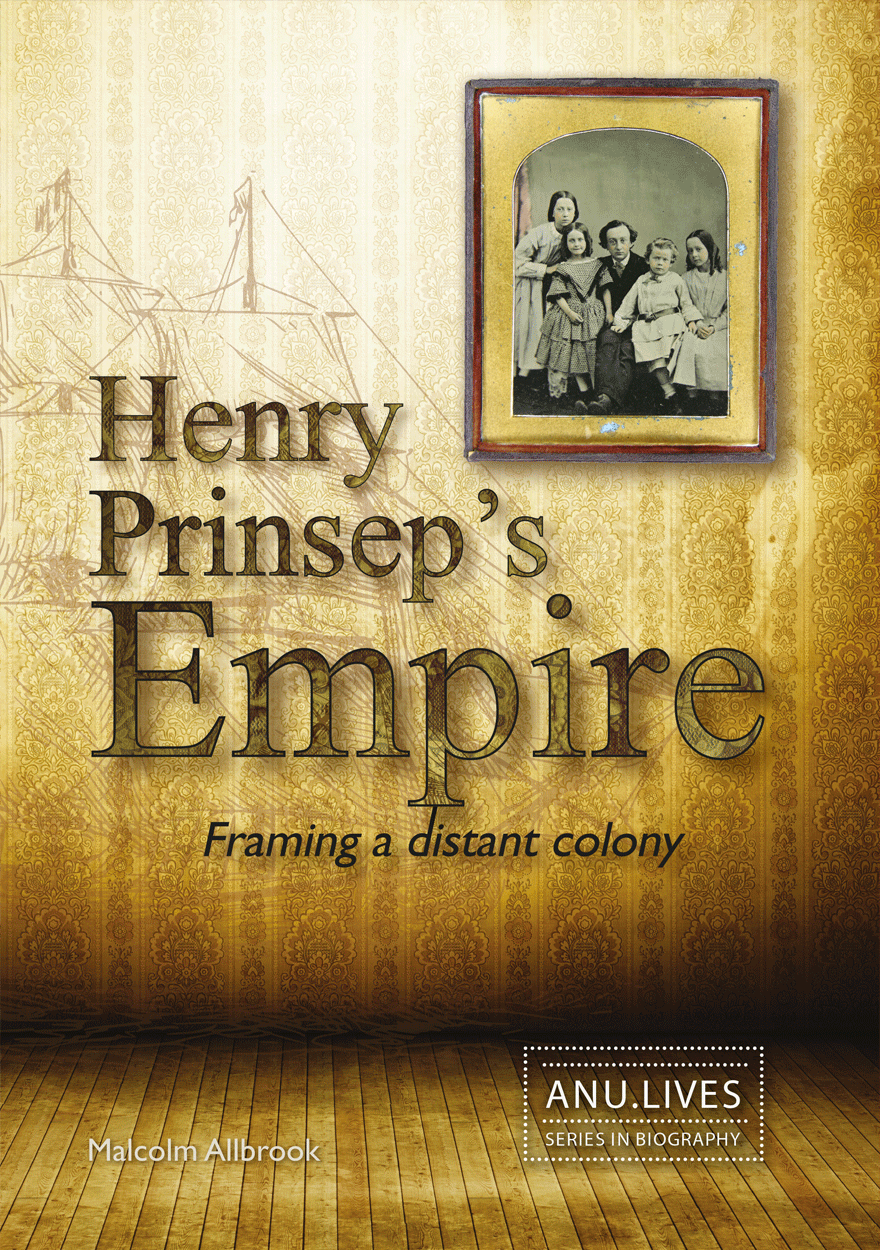
Henry Prinsep's Empire »
Framing a distant colony
Authored by: Malcolm Allbrook
Publication date: September 2014
Henry Prinsep is known as Western Australia’s first Chief Protector of Aborigines in the colonial government of Sir John Forrest, a period which saw the introduction of oppressive laws that dominated the lives of Aboriginal people for most of the 20th century.
But he was also an artist, horse-trader, member of a prominent East India Company family, and everyday citizen, whose identity was formed during his colonial upbringing in India and England. As a creator of Imperial culture, he supported the great men and women of history while he painted, wrote about and photographed the scenes around him. In terms of naked power he was a middle man, perhaps even a small man. His empire is an intensely personal place, a vast network of family and friends from every quarter of the British imperial world, engaged in the common tasks of making a home and a career, while framing new identities, new imaginings and new relationships with each other, Indigenous peoples and fellow colonists. This book traces Henry Prinsep’s life from India to Western Australia and shows how these texts and images illuminate not only Prinsep the man, but the affectionate bonds that endured despite the geographic bounds of empire, and the historical, social, geographic and economic origins of Aboriginal and colonial relationships which are important to this day.

Coastal Themes »
An Archaeology of the Southern Curtis Coast, Queensland
Authored by: Sean Ulm
Publication date: December 2006
Coastal archaeology in Australia differs in many respects from that of other areas, with the potential to examine relatively fine-scale variation. Nevertheless, there has been a general tendency in Australian archaeology to play down the variability and to subsume the evidence into broader homogenising models of Aboriginal cultural change. This case study clearly and self-consciously addresses the need to focus on local and regional patterns before moving on to more general levels of explanation.
Coastal Themes builds a detailed chronology of Aboriginal occupation for the southern Curtis Coast in Queensland. Innovative analyses refine radiocarbon dates and explore discard behaviours and post-depositional processes affecting the integrity of coastal archaeological sites. The resulting insights highlight major changes in Aboriginal use of this region over the last 5,000 years and disjunctions between the course of occupation in this and adjacent regions.
Black Words White Page »
Aboriginal Literature 1929–1988
Authored by: Adam Shoemaker
Publication date: March 2004
Fifteen years after its first publication, Black Words White Page remains as fresh as ever. This award-winning study – the first comprehensive treatment of the nature and significance of Indigenous Australian literature – was based upon the author’s doctoral research at The Australian National University and was first published by UQP in 1989. Adam Shoemaker combines historical and literary analysis as he explores the diversity and difference of writings that have gained increasing strength and visibility since that time. Shoemaker’s special focus is those dynamic years between 1963 and 1988, when advances in Indigenous affairs were paralleled by a rapid growth of all types of Black Australian literature. He examines the achievements of leading figures in the Aboriginal movement such as Jack Davis, Kevin Gilbert, Charles Perkins and Oodgeroo. He also provides intriguing insights into the socio-political contexts of the time while tracing the history of black-white relations in Australia. Black Words White Page also offers some provocative re-evaluations of white Australian writers Xavier Herbert, Ion Idriess, Katharine Susannah Prichard, Patrick White and Judith Wright.
Winner of the 1990 Walter McRae Russell Award of the Association for the Study of Australian Literature

Peter Marralwanga »
Painter of the Djang of western Arnhem Land
Authored by: Luke Taylor, Ivan Namirrkki
Publication date: March 2026
Peter Marralwanga (1916–1987) was a leading figure in one of the great art practices of the world. He grew up in western Arnhem Land surrounded by artists painting in rock shelters and he learned to paint this way himself. The subjects of his paintings were the Djang who made his country and placed the spirits of people within it. Marralwanga’s story highlights the way bark painting became important as a way of evading assimilation policies rife within Northern Territory towns. Marralwanga established an outstation at Marrkolidjban where he could teach his children how to properly care for Ancestral lands, with part of this care involving a knowledge of how to paint. As a senior person who had travelled widely in his youth, and gained extensive ceremonial knowledge, Marralwanga was highly influential among a broad group of painters. Ivan Namirrkki, a painter of note and Peter Marralwanga’s son, has provided here his own account of his father’s life.
This book tracks Marralwanga’s life of learning about country and conveys the religious meaning of numerous major works, offering outsiders a richer understanding and appreciation of Arnhem Land art. It also shows the crucial role of individuals working for the community arts cooperative Maningrida Arts and Culture in facilitating Marralwanga’s rise to recognition as a major Australian and world artist.
Extensively illustrated, Peter Marralwanga: Painter of the Djang of western Arnhem Land is a study of unique knowledge and beauty.
‘There are only a handful of studies that give such brilliant, in-depth, serious analysis of an individual Aboriginal Australian artist’s life and work. The combination of genealogical, cultural and thematic analysis is superb.’
—Dr Henry Skerritt, University of Virginia
‘Australia’s foremost expert on the bark art of West Arnhem Land provides an exceptional biography of the complex cultural life and oeuvre of the late Peter Marralwanga. This is at once highly accessible, superbly illustrated, well researched and highly collaborative. It is an important resource for art historians, anthropologists and most importantly regional audiences of Aboriginal (Bininj) people determined to maintain the bark painting tradition that is so central to their livelihood and identity.’
—Emeritus Professor Jon Altman, The Australian National University
Format: Hardback
Dreaming Ecology »
Nomadics and Indigenous Ecological Knowledge, Victoria River, Northern Australia
Edited by: Darrell Lewis, Margaret Jolly
Authored by: Deborah Bird Rose
Publication date: May 2024
In the author’s own words, Dreaming Ecology ‘explores a holistic understanding of the interconnections of people, country, kinship, creation and the living world within a context of mobility. Implicitly it asks how people lived so sustainably for so long’. It offers a telling critique of the loss of Indigenous life, human and non-human, in the wake of white settler colonialism and this becoming ‘cattle country’. It offers a fresh perspective on nomadics grounded in ‘footwalk epistemology’ and ‘an ethics of return sustained across different species, events, practices and scales’.
‘This is the final and most substantial of Debbie’s love letters to the Aboriginal people of the Victoria River Downs. I say this because there is such a sense of reverence, wonder and respect throughout the book. The introduction of concepts of double-death, footwalk epistemology, wild country … are not only organising ideas but characterisations arising from what Debbie hears, sees and feels of herself and Aboriginal others … I think of it in terms of love, if love is care, reciprocal respect, deep connectivity and a strong desire to never make less of the people she chose to commit herself to.’
—Richard Davis
‘This book was a pleasure to read, filled with careful description of people, places, and various plants and animals, and insightful analysis of the patterns and commitments that hold them together in the world.’
—Thom van Dooren
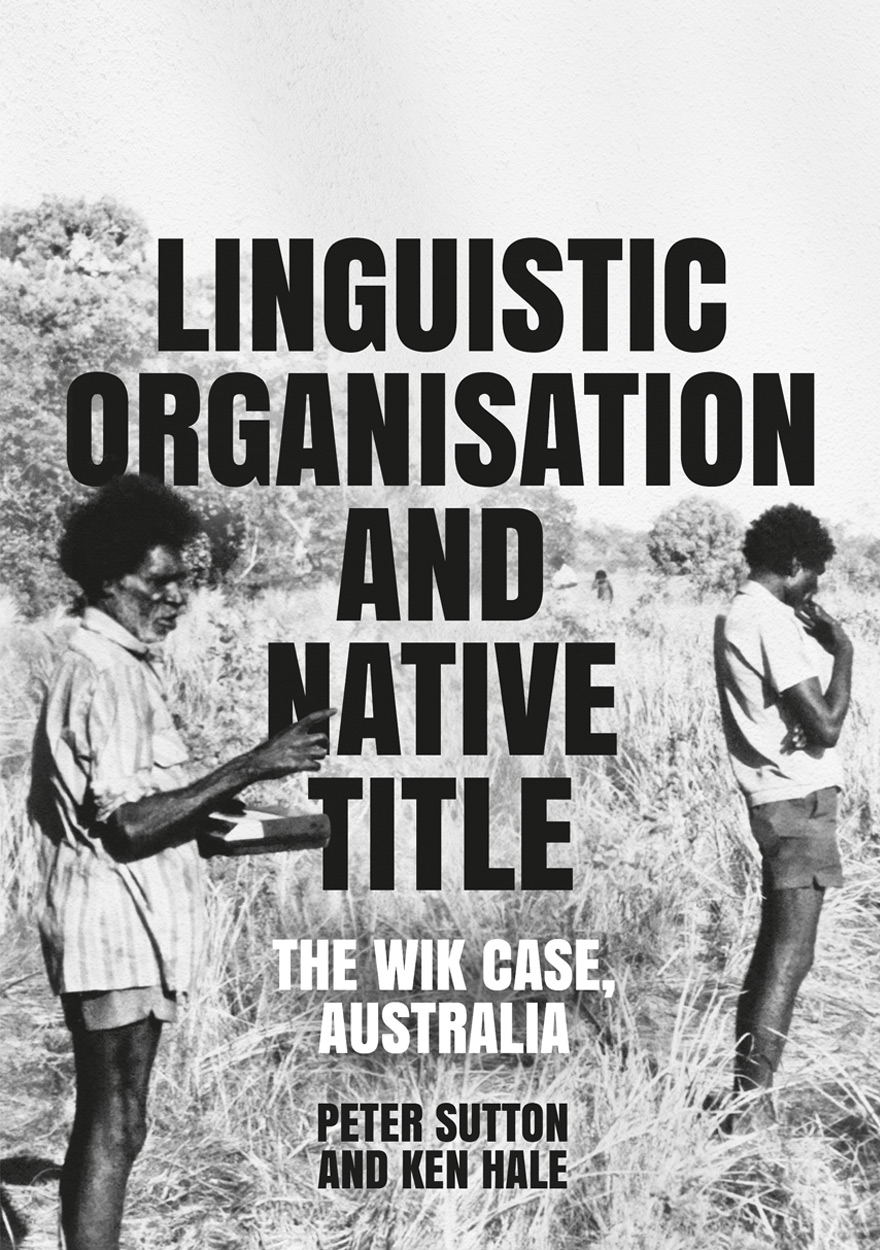
Linguistic Organisation and Native Title »
The Wik Case, Australia
Authored by: Peter Sutton, Kenneth Locke Hale
Publication date: September 2021
Classical Aboriginal societies in Australia have commonly been described in terms of social organisation and local organisation. This book presents rich detail on a third and related domain that has not been given the same kind of attention: linguistic organisation.
Basing their analyses on fieldwork among the Wik peoples of Cape York Peninsula, north Australia, Peter Sutton and Ken Hale show how cosmology, linguistic variation, language prehistory, clan totemic identities, geopolitics, land use and land ownership created a vibrant linguistic organisation in a classical Aboriginal society.
This has been a society long in love with language and languages. Its people have richly imbued the domain of rights and interests in country—the foundations of their native title as recognised in Australian law—with rights and interests in the abundance of languages and dialects given to them at the start of the world.
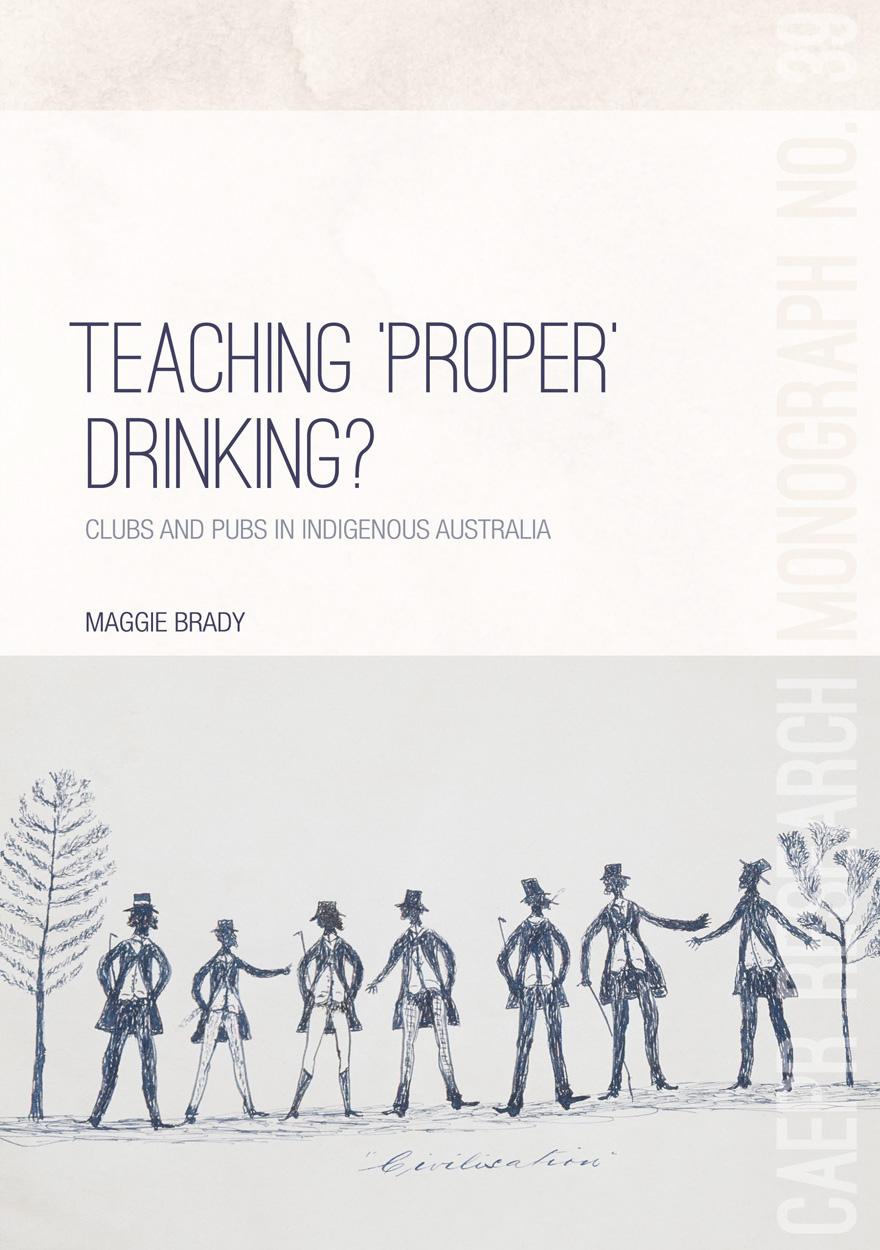
Teaching ‘Proper’ Drinking? »
Clubs and pubs in Indigenous Australia
Authored by: Maggie Brady
Publication date: December 2017
In Teaching ‘Proper’ Drinking?, the author brings together three fields of scholarship: socio-historical studies of alcohol, Australian Indigenous policy history and social enterprise studies. The case studies in the book offer the first detailed surveys of efforts to teach responsible drinking practices to Aboriginal people by installing canteens in remote communities, and of the purchase of public hotels by Indigenous groups in attempts both to control sales of alcohol and to create social enterprises by redistributing profits for the community good. Ethnographies of the hotels are examined through the analytical lens of the Swedish ‘Gothenburg’ system of municipal hotel ownership.
The research reveals that the community governance of such social enterprises is not purely a matter of good administration or compliance with the relevant liquor legislation. Their administration is imbued with the additional challenges posed by political contestation, both within and beyond the communities concerned.
‘The idea that community or government ownership and management of a hotel or other drinking place would be a good way to control drinking and limit harm has been commonplace in many Anglophone and Nordic countries, but has been less recognised in Australia. Maggie Brady’s book brings together the hidden history of such ideas and initiatives in Australia … In an original and wide-ranging set of case studies, Brady shows that success in reducing harm has varied between communities, largely depending on whether motivations to raise revenue or to reduce harm are in control.’
— Professor Robin Room, Director, Centre for Alcohol Policy Research, La Trobe University
In the Media
Read the Alice Spring News article: ‘Proper’ drinking: elusive goal but how hard have we tried?
Awards
Shortlisted – 2019 Chief Minister's Northern Territory History Book Award

Better Than Welfare? »
Work and livelihoods for Indigenous Australians after CDEP
Edited by: Kirrily Jordan
Publication date: August 2016
The end of the very long-standing Community Development Employment Projects (CDEP) scheme in 2015 marked a critical juncture in Australian Indigenous policy history. For more than 30 years, CDEP had been among the biggest and most influential programs in the Indigenous affairs portfolio, employing many thousands of Aboriginal and Torres Strait Islander people. More recently, it had also become a focus of intense political contestation that culminated in its ultimate demise.
This book examines the consequences of its closure for Indigenous people, communities and organisations. The end of CDEP is first situated in its broader historical and political context: the debates over notions of ‘self-determination’ versus ‘mainstreaming’ and the enduring influence of concerns about ‘passive welfare’ and ‘mutual obligation’. In this way, the focus on CDEP highlights more general trends in Indigenous policymaking, and questions whether the dominant government approach is on the right track.
Each chapter takes a different disciplinary approach to this question, variously focusing on the consequences of change for community and economic development, individual work habits and employment outcomes, and institutional capacity within the Indigenous sector. Across the case studies examined, the chapters suggest that the end of CDEP has heralded the emergence of a greater reliance on welfare rather than the increased employment outcomes the government had anticipated. Concluding that CDEP was ‘better than welfare’ in many ways, the book offers encouragement to policymakers to ensure that future reforms generate livelihood options for Aboriginal and Torres Strait Islander Australians that are, in turn, better than CDEP.