



Search titles
Displaying results 901 to 910 of 1179.

Agenda - A Journal of Policy Analysis and Reform: Volume 16, Number 3, 2009 »
Edited by: William Coleman
Publication date: September 2009
Agenda is a refereed, ECONLIT-indexed and RePEc-listed journal of the College of Business and Economics, The Australian National University. Launched in 1994, Agenda provides a forum for debate on public policy, mainly (but not exclusively) in Australia and New Zealand. It deals largely with economic issues but gives space to social and legal policy and also to the moral and philosophical foundations and implications of policy.
Subscribe to the Agenda Alerting service if you wish to be advised on forthcoming or new issues.
Download for free
Not available for purchase
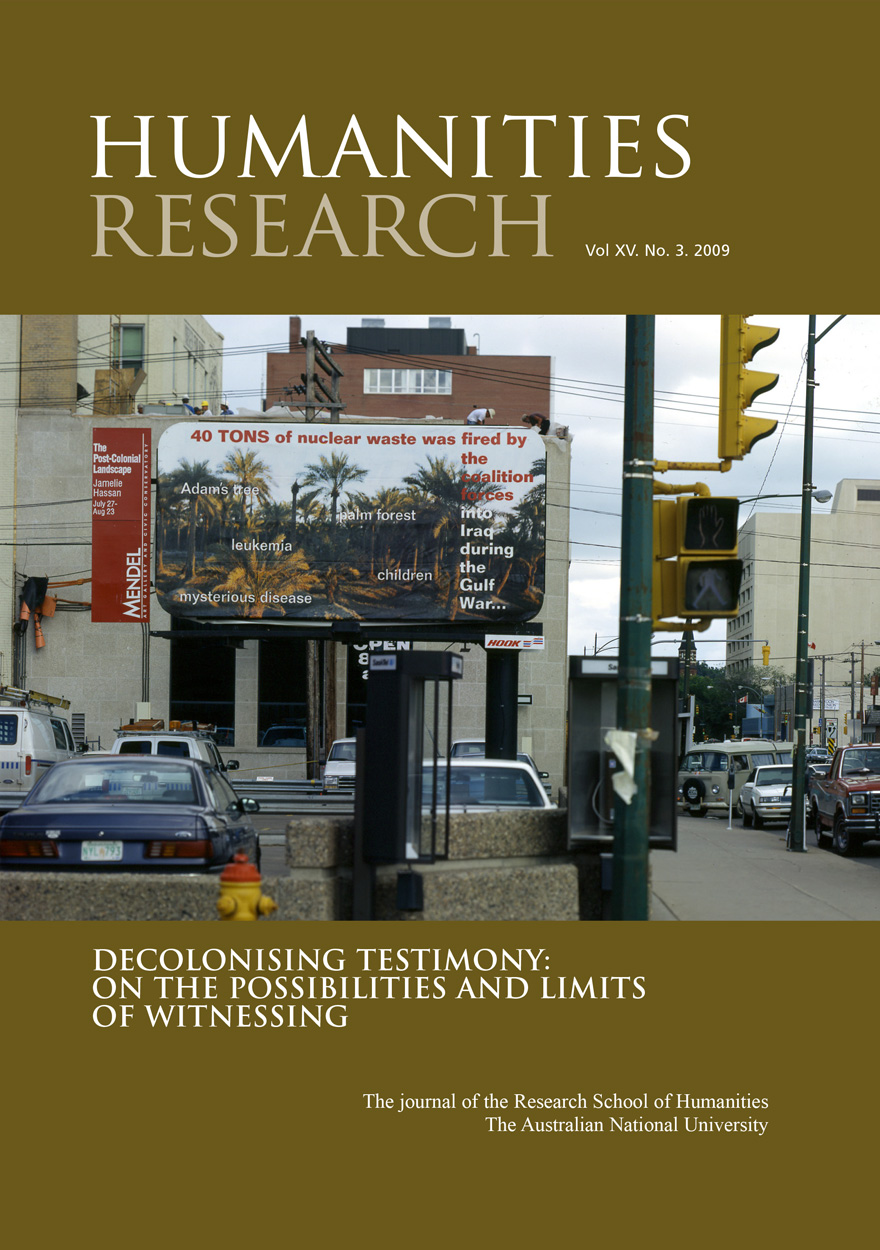
Humanities Research: Volume XV. No. 3. 2009 »
Decolonising Testimony: On the possibilities and limits of witnessing
Edited by: Lynne Bell, Julia Emberley, Rosanne Kennedy
Publication date: September 2009
Humanities Research is an internationally peer-reviewed journal published by the Research School of Humanities at The Australian National University. The Research School of Humanities came into existence in January 2007 and consists of the Humanities Research Centre, Centre for Cross-Cultural Research, National Europe Centre and Australian National Dictionary Centre. Launched in 1997, issues are thematic with guest editors and address important and timely topics across all branches of the humanities.
Download for free
Not available for purchase
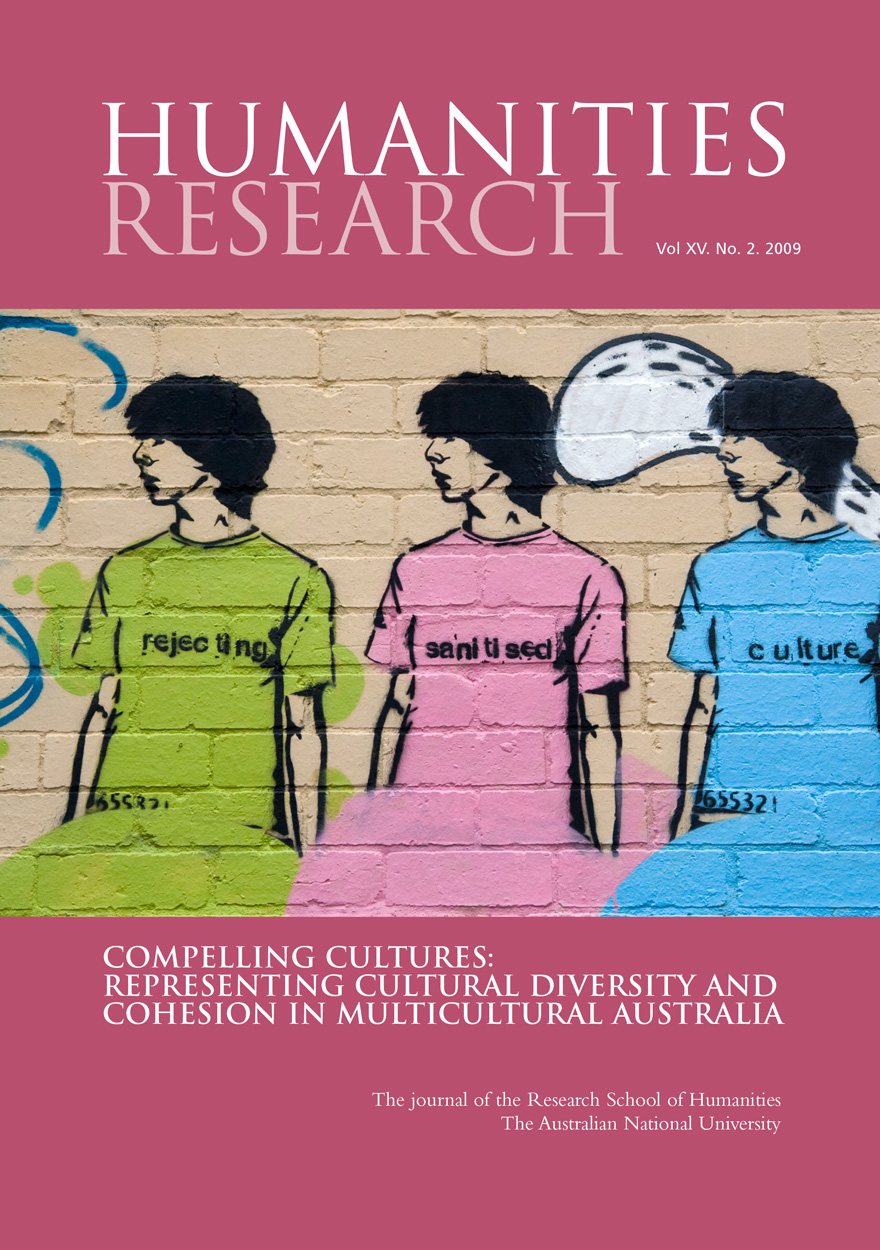
Humanities Research: Volume XV. No. 2. 2009 »
Compelling Cultures: Representing Cultural Diversity and Cohesion in Multicultural Australia
Edited by: Anna Edmundson, Ursula K. Frederick, Kylie Message
Publication date: September 2009
Humanities Research is an internationally peer-reviewed journal published by the Research School of Humanities at The Australian National University. The Research School of Humanities came into existence in January 2007 and consists of the Humanities Research Centre, Centre for Cross-Cultural Research, National Europe Centre and Australian National Dictionary Centre. Launched in 1997, issues are thematic with guest editors and address important and timely topics across all branches of the humanities.
Download for free
Not available for purchase
Sounds in Translation »
Intersections of music, technology and society
Edited by: Amy Chan, Alistair Noble
Publication date: September 2009
Sounds in Translation: Intersections of music, technology and society joins a growing number of publications taking up R. Murray Schafer’s challenge to examine and to re-focus attention on the sound dimensions of our human environment. This book takes up his challenge to contemporary audiologists, musicologists and sound artists working within areas of music, cultural studies, media studies and social science to explore the idea of the ‘soundscape’ and to investigate the acoustic environment that we inhabit. It seeks to raise questions regarding the translative process of sound: 1) what happens to sound during the process of transfer and transformation; and 2) what transpires in the process of sound production/expression/performance. Sounds in Translation was conceived to take advantage of new technology and a development in book publishing, the electronic book. Much of what is written in the book is best illustrated by the sound itself, and in that sense, permits sound to ‘speak for itself’.

Does History Matter? »
Making and debating citizenship, immigration and refugee policy in Australia and New Zealand
Edited by: Klaus Neumann, Gwenda Tavan
Publication date: September 2009
This volume of essays represents the first systematic attempt to explore the use of the past in the making of citizenship and immigration policy in Australia and New Zealand. Focussing on immigration and citizenship policy in Australia and New Zealand, the contributions to this volume explore how history and memory are implicated in policy making and political debate, and what processes of remembering and forgetting are utilised by political leaders when formulating and defending policy decisions. They remind us that a nuanced understanding of the past is fundamental to managing the politics and practicalities of immigration and citizenship in the early 21st century.

Framing the Global Economic Downturn »
Crisis rhetoric and the politics of recessions
Edited by: Paul `t Hart, Karen Tindall
Publication date: September 2009
The global economic downturn that followed the collapse of major US financial institutions is no doubt the most significant crisis of our times. Its effects on corporate and governmental balance sheets have been devastating, as have been its impacts on the employment and well being of tens of millions of citizens. It continues to pose major challenges to national policymakers and institutions around the world.
Managing public uncertainty and anxiety is vital in coping with financial crises. This requires not just prompt action but, most of all, persuasive communication by government leaders. At the same time, the very occurrence of such crises raises acute questions about the effectiveness and robustness of current government policies and institutions. With the stakes being so high, defining and interpreting what is going on, how and why it happened, and what ought to be done now become key questions in the political and policy struggles that crises invariably unleash.
In this volume, we study how heads of government, finance ministers and national bank governors in eight countries as well as the EU engage in such ‘framing contests’, and how their attempts to interpret the cascading events of the economic downturn were publicly received. Using systematic content analysis of speeches and media coverage, this volume offers a unique comparative assessment of public leadership in times of crisis.
Policy Making and Implementation »
Studies from Papua New Guinea
Edited by: R.J. May
Publication date: September 2009
There is a vast literature on the principles of public administration and good governance, and no shortage of theoreticians, practitioners and donors eager to push for public sector reform, especially in less-developed countries. Papua New Guinea has had its share of public sector reforms, frequently under the influence of multinational agencies and aid donors. Yet there seems to be a general consensus, both within and outside Papua New Guinea, that policy making and implementation have fallen short of expectations, that there has been a failure to achieve ‘good governance’.
This volume, which brings together a number of Papua New Guinean and Australian-based scholars and practitioners with deep familiarity of policy making in Papua New Guinea, examines the record of policy making and implementation in Papua New Guinea since independence. It reviews the history of public sector reform in Papua New Guinea, and provides case studies of policy making and implementation in a number of areas, including the economy, agriculture, mineral development, health, education, lands, environment, forestry, decentralization, law and order, defence, women and foreign affairs, privatization, and AIDS.
Policy is continuously evolving, but this study documents the processes of policy making and implementation over a number of years, with the hope that a better understanding of past successes and failures will contribute to improved governance in the future.

The Making of The Australian National University »
1946-1996
Authored by: Stephen Foster, Margaret Varghese
Publication date: August 2009
The Australian National University has always been a university with a difference. Conceived in the mid–1940s to serve Australia’s post-war needs for advanced research and postgraduate training, it quickly embraced the ideals and traditions of Oxford and Cambridge. Undergraduate teaching was introduced in 1960, following amalgamation with Canberra University College. The University continued to adapt to changes in Australian society, while retaining much of its unique structure and objectives.
Stephen Foster and Margaret Varghese trace the history of ANU from its wartime origins to its fiftieth anniversary in 1996, featuring many of the prominent Australians who contributed to its making: ‘Nugget’ Coombs, Howard Florey, Mark Oliphant, W.K. Hancock, Douglas Copland, John Crawford, Peter Karmel; and others who stood out in particular fields, such as J.C.Eccles, Arthur Birch, Manning Clark, Russell Mathews, Ernest Titterton, Beryl Rawson, John Mulvaney, John Passmore and Frank Fenner.
The Making of The Australian National University explores many themes in higher education during the last half century, including academic freedom, relations between universities and politicians, recruitment practices, the ‘two cultures’ of science and the humanities, collegial versus managerial structures, equality of opportunity, student politics, academics and architecture and universities in the marketplace.
This is an affectionate and critical account of a remarkable Australian institution; and, more broadly, a fascinating study of how institutions work.

Migration and Transnationalism »
Pacific Perspectives
Edited by: Helen Lee, Steve Tupai Francis
Publication date: August 2009
Pacific Islanders have engaged in transnational practices since their first settlement of the many islands in the region. As they moved beyond the Pacific and settled in nations such as New Zealand, the U.S. and Australia these practices intensified and over time have profoundly shaped both home and diasporic communities. This edited volume begins with a detailed account of this history and the key issues in Pacific migration and transnationalism today. The papers that follow present a range of case studies that maintain this focus on both historical and contemporary perspectives. Each of the contributors goes beyond a narrowly economic focus to present the human face of migration and transnationalism; exploring questions of cultural values and identity, transformations in kinship, intergenerational change and the impact on home communities.
Pacific migration and transnationalism are addressed in this volume in the context of increasing globalisation and growing concerns about the future social, political and economic security of the Pacific region. As the case studies presented here show, the future of the Pacific depends in many ways on the ties diasporic Islanders maintain with their homelands.

Research Integration Using Dialogue Methods »
Authored by: David McDonald, Gabriele Bammer, Peter Deane
Publication date: August 2009
Research on real-world problems—like restoration of wetlands, the needs of the elderly, effective disaster response and the future of the airline industry—requires expert knowledge from a range of disciplines, as well as from stakeholders affected by the problem and those in a position to do something about it. This book charts new territory in taking a systematic approach to research integration using dialogue methods to bring together multiple perspectives. It links specific dialogue methods to particular research integration tasks.
Fourteen dialogue methods for research integration are classified into two groups:
Dialogue methods for understanding a problem broadly: integrating judgements
Dialogue methods for understanding particular aspects of a problem: integrating visions, world views, interests and values.
The methods are illustrated by case studies from four research areas: the environment, public health, security and technological innovation.