



Search titles
Displaying results 71 to 80 of 101.

What does the Honeybee See? And how do we Know? »
A critique of scientific reason
Authored by: Adrian Horridge
Publication date: October 2009
This book is the only account of what the bee, as an example of an insect, actually detects with its eyes. Bees detect some visual features such as edges and colours, but there is no sign that they reconstruct patterns or put together features to form objects. Bees detect motion but have no perception of what it is that moves, and certainly they do not recognize “things” by their shapes. Yet they clearly see well enough to fly and find food with a minute brain. Bee vision is therefore relevant to the construction of simple artificial visual systems, for example for mobile robots. The surprising conclusion is that bee vision is adapted to the recognition of places, not things.
In this volume, Adrian Horridge also sets out the curious and contentious history of how bee vision came to be understood, with an account of a century of neglect of old experimental results, errors of interpretation, sharp disagreements, and failures of the scientific method. The design of the experiments and the methods of making inferences from observations are also critically examined, with the conclusion that scientists are often hesitant, imperfect and misleading, ignore the work of others, and fail to consider alternative explanations. The erratic path to understanding makes interesting reading for anyone with an analytical mind who thinks about the methods of science or the engineering of seeing machines.

Framing the Global Economic Downturn »
Crisis rhetoric and the politics of recessions
Edited by: Paul `t Hart, Karen Tindall
Publication date: September 2009
The global economic downturn that followed the collapse of major US financial institutions is no doubt the most significant crisis of our times. Its effects on corporate and governmental balance sheets have been devastating, as have been its impacts on the employment and well being of tens of millions of citizens. It continues to pose major challenges to national policymakers and institutions around the world.
Managing public uncertainty and anxiety is vital in coping with financial crises. This requires not just prompt action but, most of all, persuasive communication by government leaders. At the same time, the very occurrence of such crises raises acute questions about the effectiveness and robustness of current government policies and institutions. With the stakes being so high, defining and interpreting what is going on, how and why it happened, and what ought to be done now become key questions in the political and policy struggles that crises invariably unleash.
In this volume, we study how heads of government, finance ministers and national bank governors in eight countries as well as the EU engage in such ‘framing contests’, and how their attempts to interpret the cascading events of the economic downturn were publicly received. Using systematic content analysis of speeches and media coverage, this volume offers a unique comparative assessment of public leadership in times of crisis.
Sounds in Translation »
Intersections of music, technology and society
Edited by: Amy Chan, Alistair Noble
Publication date: September 2009
Sounds in Translation: Intersections of music, technology and society joins a growing number of publications taking up R. Murray Schafer’s challenge to examine and to re-focus attention on the sound dimensions of our human environment. This book takes up his challenge to contemporary audiologists, musicologists and sound artists working within areas of music, cultural studies, media studies and social science to explore the idea of the ‘soundscape’ and to investigate the acoustic environment that we inhabit. It seeks to raise questions regarding the translative process of sound: 1) what happens to sound during the process of transfer and transformation; and 2) what transpires in the process of sound production/expression/performance. Sounds in Translation was conceived to take advantage of new technology and a development in book publishing, the electronic book. Much of what is written in the book is best illustrated by the sound itself, and in that sense, permits sound to ‘speak for itself’.
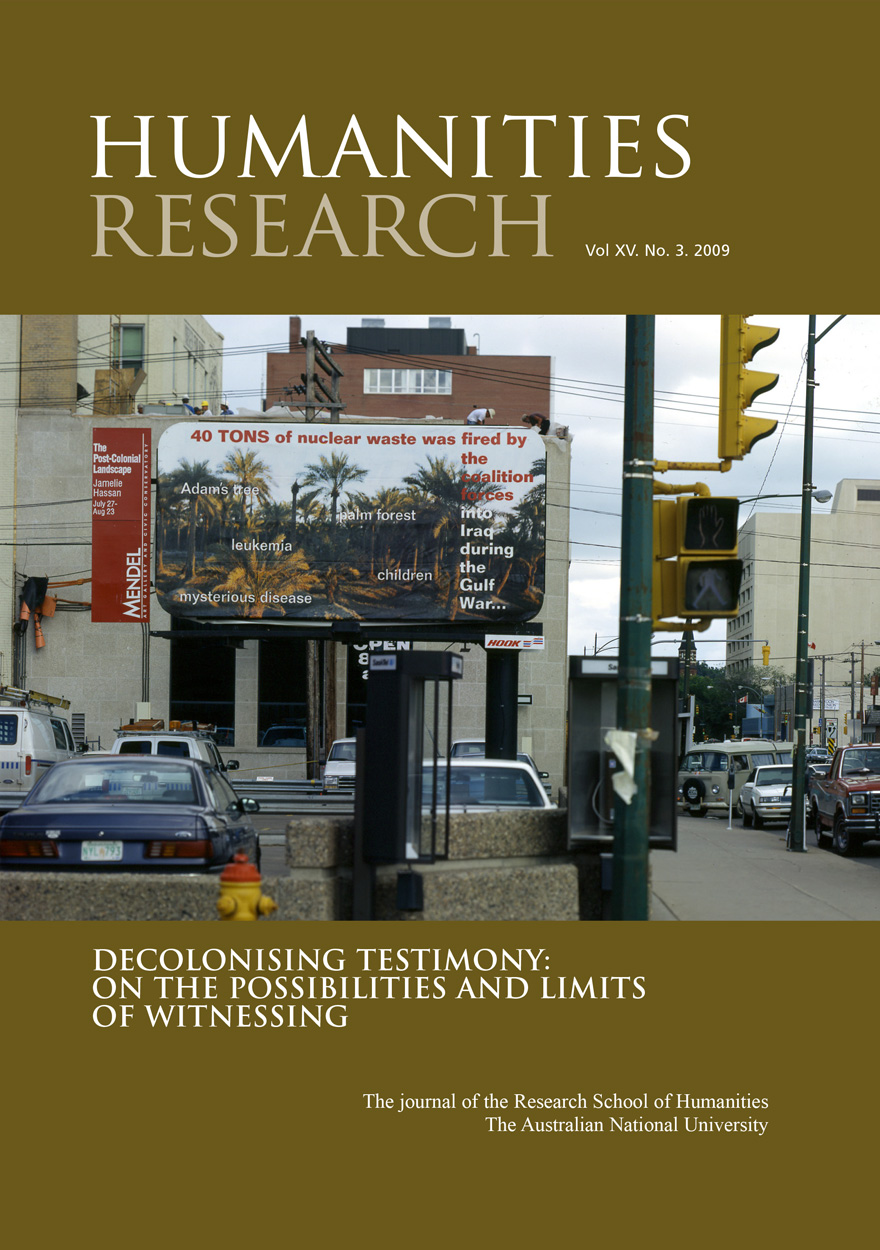
Humanities Research: Volume XV. No. 3. 2009 »
Decolonising Testimony: On the possibilities and limits of witnessing
Edited by: Lynne Bell, Julia Emberley, Rosanne Kennedy
Publication date: September 2009
Humanities Research is an internationally peer-reviewed journal published by the Research School of Humanities at The Australian National University. The Research School of Humanities came into existence in January 2007 and consists of the Humanities Research Centre, Centre for Cross-Cultural Research, National Europe Centre and Australian National Dictionary Centre. Launched in 1997, issues are thematic with guest editors and address important and timely topics across all branches of the humanities.
Download for free
Not available for purchase
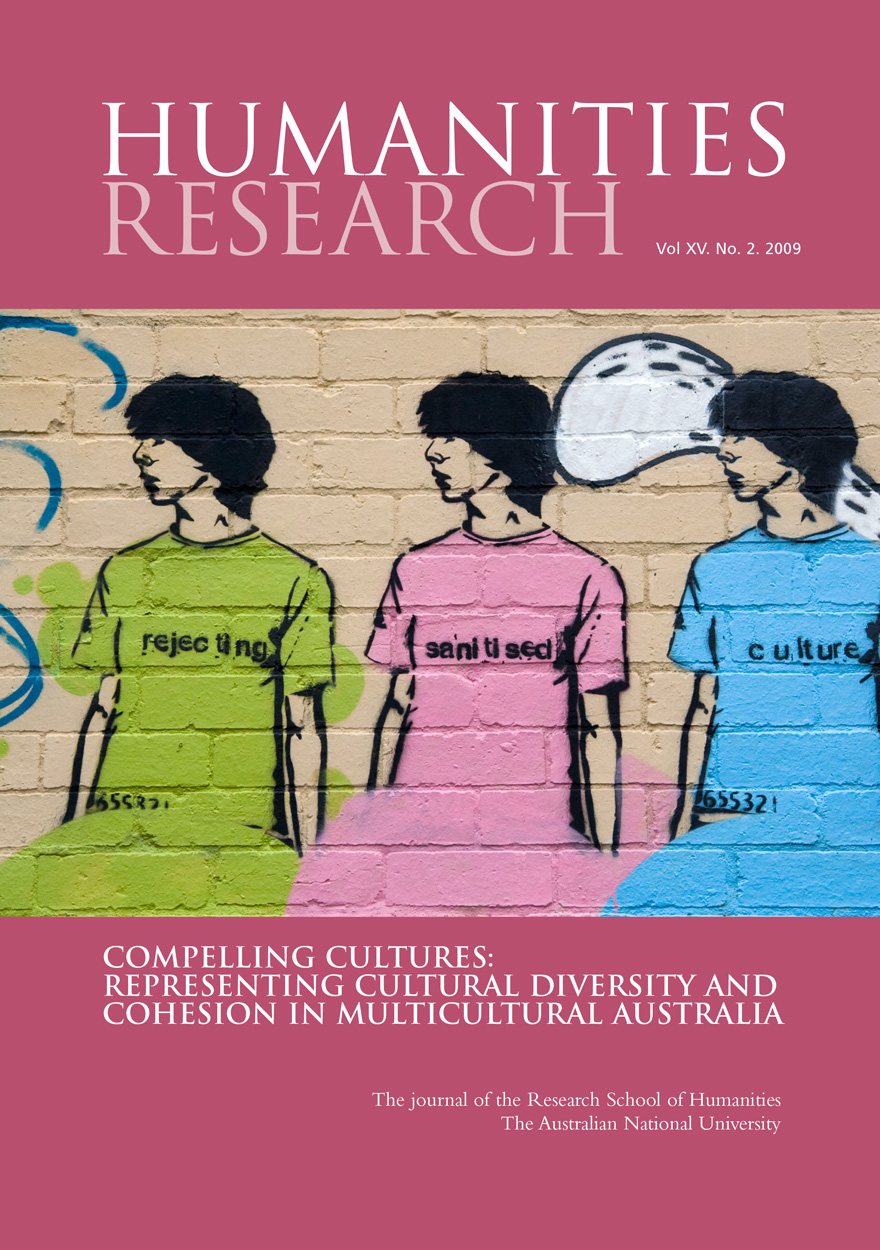
Humanities Research: Volume XV. No. 2. 2009 »
Compelling Cultures: Representing Cultural Diversity and Cohesion in Multicultural Australia
Edited by: Anna Edmundson, Ursula K. Frederick, Kylie Message
Publication date: September 2009
Humanities Research is an internationally peer-reviewed journal published by the Research School of Humanities at The Australian National University. The Research School of Humanities came into existence in January 2007 and consists of the Humanities Research Centre, Centre for Cross-Cultural Research, National Europe Centre and Australian National Dictionary Centre. Launched in 1997, issues are thematic with guest editors and address important and timely topics across all branches of the humanities.
Download for free
Not available for purchase

Research Integration Using Dialogue Methods »
Authored by: David McDonald, Gabriele Bammer, Peter Deane
Publication date: August 2009
Research on real-world problems—like restoration of wetlands, the needs of the elderly, effective disaster response and the future of the airline industry—requires expert knowledge from a range of disciplines, as well as from stakeholders affected by the problem and those in a position to do something about it. This book charts new territory in taking a systematic approach to research integration using dialogue methods to bring together multiple perspectives. It links specific dialogue methods to particular research integration tasks.
Fourteen dialogue methods for research integration are classified into two groups:
Dialogue methods for understanding a problem broadly: integrating judgements
Dialogue methods for understanding particular aspects of a problem: integrating visions, world views, interests and values.
The methods are illustrated by case studies from four research areas: the environment, public health, security and technological innovation.

An Atlas of the Global Water Cycle »
Based on the IPCC AR4 Climate Models
Authored by: Wee Ho Lim, Michael L. Roderick
Publication date: July 2009
What do climate models predict for the rainfall where you live? What about evaporation or runoff? Should your local community consider constructing new dams or do the existing water storages appear adequate? What about the availability of water for irrigation farming? Do the predictions differ between different climate models or do all the models basically predict the same changes in water availability where you live?
These are all simple questions but it is surprisingly hard for an individual, whether they be a farmer, water resources engineer, teacher or interested citizen, to answer them. As researchers active in the field we could not answer the questions either. In fact, we had never seen a compilation of the rainfall, evaporation and runoff predictions made by all the different climate models.
The Atlas contains maps and tables that document model predictions contributed by international climate modelling groups to the 2007 4th Assessment Report of the Intergovernmental Panel on Climate Change. The predictions are made available here via the wonders of the internet and ongoing cooperation by the international climate modelling community who routinely archive their results.
The maps and tables in the Atlas document rainfall, evaporation and runoff estimates for the 20th century along with predictions of the same quantities at the end of the 21st century. Whatever your interest, we hope you find the Atlas as helpful as we do.
Humanities Research: No. 1. 2000 »
Publication date: July 2009
Humanities Research is an internationally peer-reviewed journal published by the Research School of Humanities at The Australian National University. The Research School of Humanities came into existence in January 2007 and consists of the Humanities Research Centre, Centre for Cross-Cultural Research, National Europe Centre and Australian National Dictionary Centre. Launched in 1997, issues are thematic with guest editors and address important and timely topics across all branches of the humanities.
Download for free
Not available for purchase
Humanities Research: No. 2. 1999 »
Publication date: July 2009
Humanities Research is an internationally peer-reviewed journal published by the Research School of Humanities at The Australian National University. The Research School of Humanities came into existence in January 2007 and consists of the Humanities Research Centre, Centre for Cross-Cultural Research, National Europe Centre and Australian National Dictionary Centre. Launched in 1997, issues are thematic with guest editors and address important and timely topics across all branches of the humanities.
Download for free
Not available for purchase
Humanities Research: No. 1. 1999 »
Publication date: July 2009
Humanities Research is an internationally peer-reviewed journal published by the Research School of Humanities at The Australian National University. The Research School of Humanities came into existence in January 2007 and consists of the Humanities Research Centre, Centre for Cross-Cultural Research, National Europe Centre and Australian National Dictionary Centre. Launched in 1997, issues are thematic with guest editors and address important and timely topics across all branches of the humanities.
Download for free
Not available for purchase