



Search titles
Displaying results 61 to 70 of 100.

A New Idea Each Morning »
How food and agriculture came together in one international organisation
Authored by: Wendy Way
Publication date: May 2013
In the years between the two world wars of the twentieth century leaders in Western countries worried about a food surplus. The hardships of the Great Depression were intensified by a glut of wheat and consequent low prices on the world market. Yet at the same time nutrition scientists protested that significant proportions of populations, even in affluent countries, were unable to afford a diet ‘adequate for health’. Fresh fruits, vegetables, dairy products and meat were out of reach for the poor.
This book traces the work of three men who sought to bring together the interests of farmers and the needs of the hungry: scientist and passionate campaigner for better nutrition, John Boyd Orr; Australian politician and international statesman, Stanley Melbourne Bruce; and Economic Adviser to Bruce at the Australian High Commission in London, Frank Lidgett McDougall. Bruce once said ‘McDougall brings me a new idea every morning’. One of those ideas became the genesis of their work, which helped bring about the formation of the Food and Agriculture Organization of the United Nations in 1945. All three undertook significant roles in the formative years of the organisation.
The story of this contribution to the international world order is little known. The cooperation, diplomacy and persistence of these men provides inspiration for tackling the alarming prospect of food shortages in the present century.

Corruption and Anti-Corruption »
Edited by: Peter Larmour, Nick Wolanin
Publication date: March 2013
There is new international attention being given to the old problem of corruption. It has been taken up by international organisations, and driven by economic analysis. It is impatient of cultural justifications, and suspicious of state action. It is concerned with corruption prevention as much as detection, investigation and prosecution.
Corruption and Anti-Corruption deals with the international dimensions of corruption, including campaigns to recover the assets of former dictators, and the links between corruption, transnational and economic crime. It deals with corruption as an issue in political theory, and shows how it can be addressed in campaigns for human rights. It also presents case studies of reform efforts in Philippines, India and Thailand.
The book explains the doctrines of a well-established domestic anticorruption agency. It is based on research to develop a curriculum for a unique international training course on ‘Corruption and Anti-Corruption’, designed and taught by academics at The Australian National University, the Australian Institute of Criminology and public servants in the New South Wales Independent Commission Against Corruption. Versions have been taught in Canberra, and several countries in South East Asia.
Disciplining Interdisciplinarity »
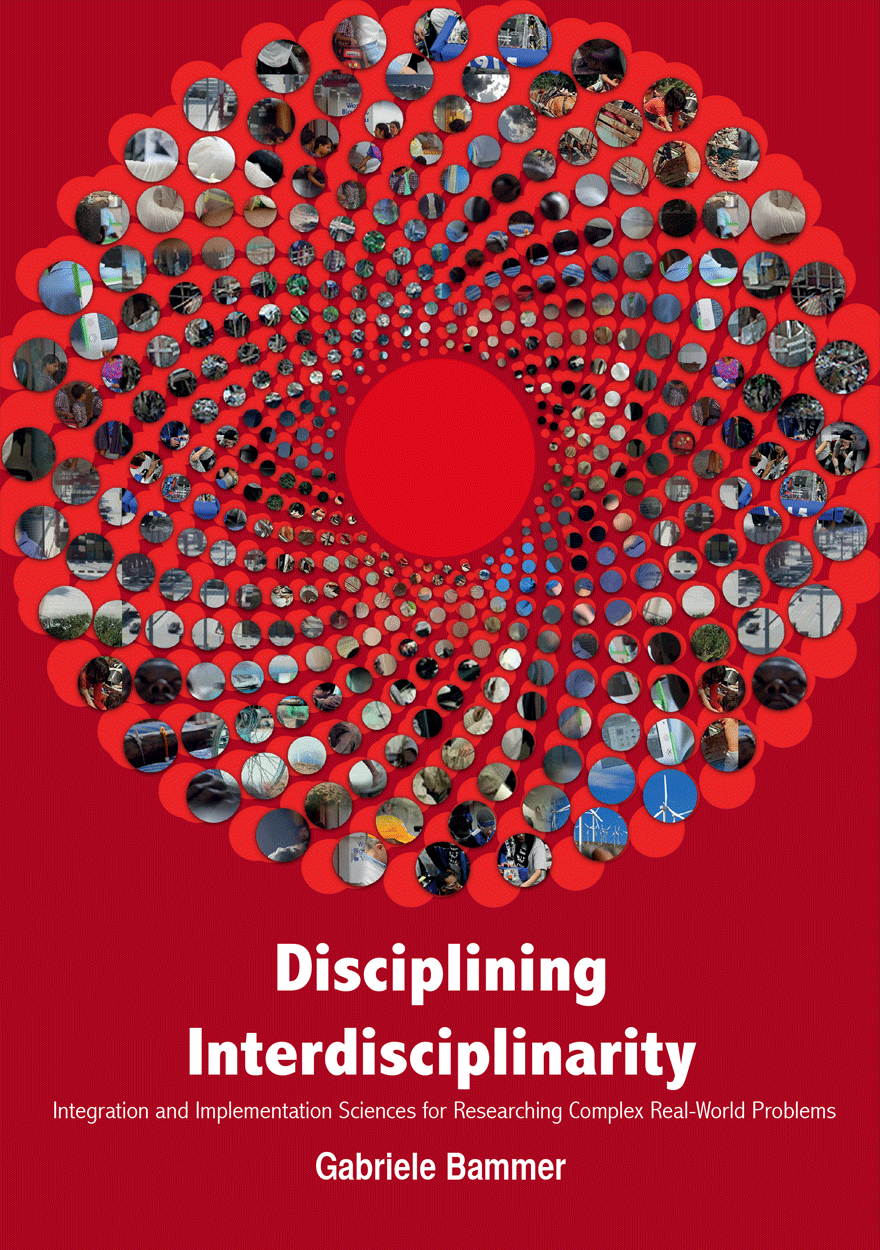
Integration and Implementation Sciences for Researching Complex Real-World Problems
Authored by: Gabriele Bammer
Publication date: January 2013
This book provides collaborative research teams with a systematic approach for addressing complex real-world problems like widespread poverty, global climate change, organised crime, and escalating health care costs. The three core domains are
Synthesising disciplinary and stakeholder knowledge,
Understanding and managing diverse unknowns, and
Providing integrated research support for policy and practice change.
Each of these three domains is organised around five questions
For what and for whom?
Which knowledge, unknowns and aspects of policy or practice?
How?
Context?
Outcome?
This simple framework lays the foundations for developing compilations of concepts, methods and case studies about applying systems thinking, scoping and boundary setting, framing, dealing with values, harnessing and managing differences, undertaking dialogue, building models, applying common metrics, accepting unknowns, advocacy, end-user engagement, understanding authorisation, dealing with organisational facilitators and barriers, and much more.
The book makes a case for a new research style—integrative applied research—and a new discipline of Integration and Implementation Sciences or I2S. It advocates for progressing these through an I2S Development Drive. It builds on theory and practice-based research in multi-, inter- and transdisciplinarity, post-normal science, systemic intervention, integrated assessment, sustainability science, team science, mode 2, action research and other approaches.
The book concludes with 24 commentaries by Simon Bronitt; L. David Brown; Marcel Bursztyn and Maria Beatriz Maury; Lawrence Cram; Ian Elsum; Holly J. Falk-Krzesinski; Fasihuddin; Howard Gadlin and L. Michelle Bennett; Budi Haryanto; Julie Thompson Klein; Ted Lefroy; Catherine Lyall; M. Duane Nellis; Linda Neuhauser; Deborah O’Connell with Damien Farine, Michael O’Connor and Michael Dunlop; Michael O’Rourke; Christian Pohl; Merritt Polk; Alison Ritter; Alice Roughley; Michael Smithson; Daniel Walker; Michael Wesley; and Glenn Withers. These begin a process of appraisal, discussion and debate across diverse networks.
Australian Humanities Review: Issue 51, 2011 »
Edited by: Monique Rooney, Russell Smith
Publication date: December 2011
Australian Humanities Review is a peer-reviewed interdisciplinary journal featuring articles, essays and reviews focusing on a wide array of topics related to literature, culture, history and politics.
Download for free
Not available for purchase

Australian Humanities Review: Issue 50, 2011 »
Unloved Others: Death of the Disregarded in the Time of Extinctions
Edited by: Deborah Bird Rose, Thom van Dooren
Publication date: May 2011
Australian Humanities Review is a peer-reviewed interdisciplinary journal featuring articles, essays and reviews focusing on a wide array of topics related to literature, culture, history and politics.
Download for free
Not available for purchase
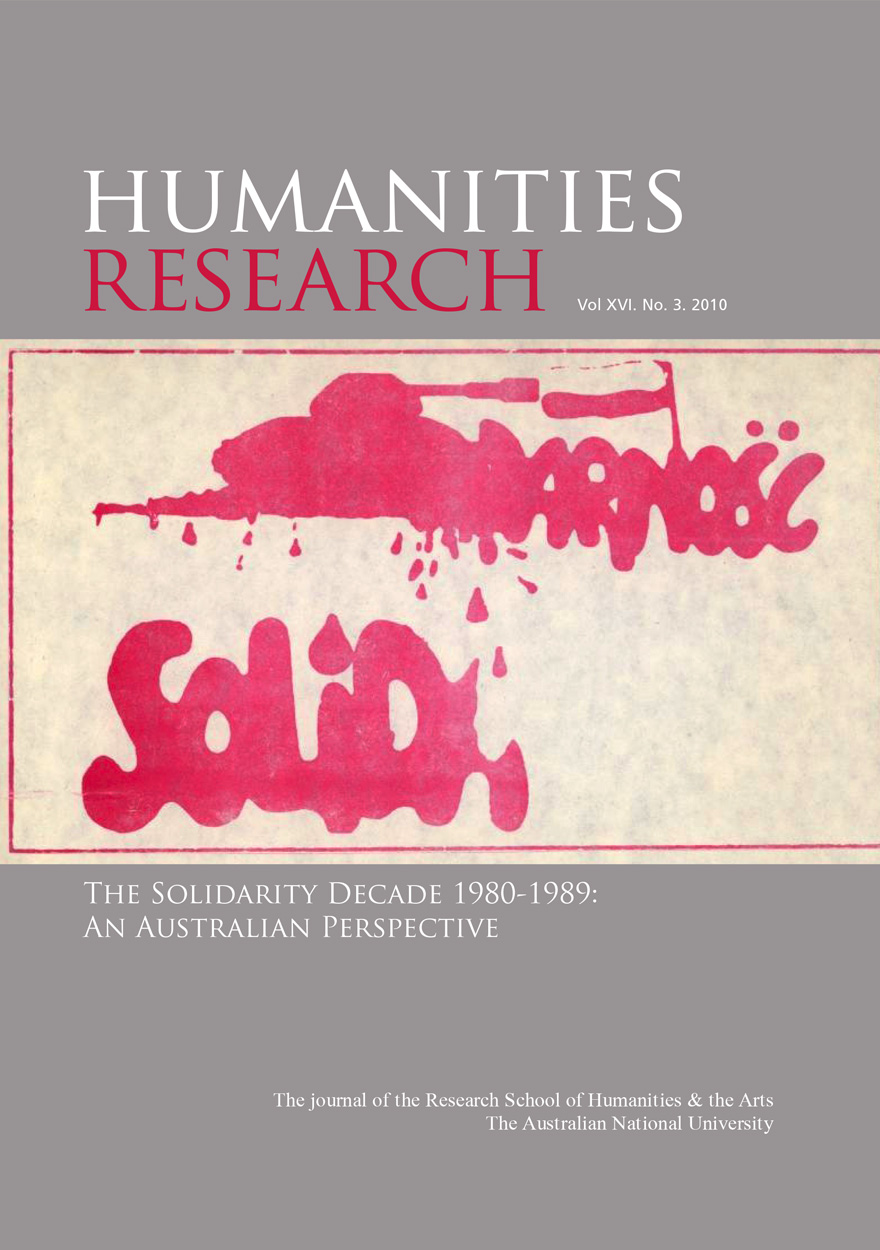
Humanities Research: Volume XVI. No. 3. 2010 »
The Solidarity Decade 1980-1989: An Australian Perspective
Edited by: Stefan Markowski, Jan Pakulski
Publication date: November 2010
Humanities Research is an internationally peer-reviewed journal published by the Research School of Humanities at The Australian National University. The Research School of Humanities came into existence in January 2007 and consists of the Humanities Research Centre, Centre for Cross-Cultural Research, National Europe Centre and Australian National Dictionary Centre. Launched in 1997, issues are thematic with guest editors and address important and timely topics across all branches of the humanities.
Download for free
Not available for purchase
Humanities Research: Volume XVI. No. 2. 2010 »
Key Thinkers and Their Contemporary Legacy
Edited by: Ned Curthoys
Publication date: October 2010
Humanities Research is an internationally peer-reviewed journal published by the Research School of Humanities at The Australian National University. The Research School of Humanities came into existence in January 2007 and consists of the Humanities Research Centre, Centre for Cross-Cultural Research, National Europe Centre and Australian National Dictionary Centre. Launched in 1997, issues are thematic with guest editors and address important and timely topics across all branches of the humanities.
Download for free
Not available for purchase
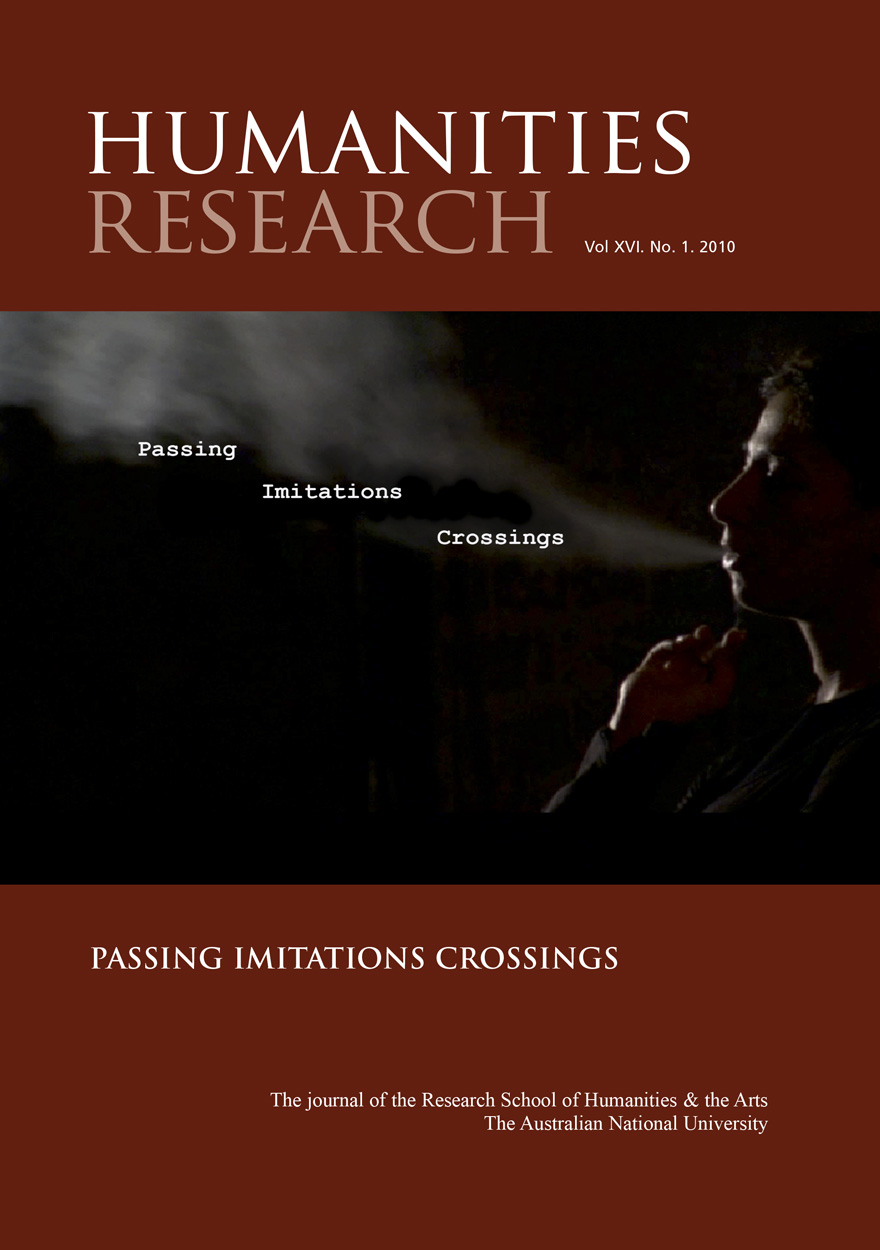
Humanities Research: Volume XVI. No. 1. 2010 »
Passing, Imitations, Crossings
Edited by: Monique Rooney, Carolyn Strange
Publication date: April 2010
Humanities Research is an internationally peer-reviewed journal published by the Research School of Humanities at The Australian National University. The Research School of Humanities came into existence in January 2007 and consists of the Humanities Research Centre, Centre for Cross-Cultural Research, National Europe Centre and Australian National Dictionary Centre. Launched in 1997, issues are thematic with guest editors and address important and timely topics across all branches of the humanities.
Download for free
Not available for purchase

One World—Many Paths to Peace »
Edited by: Venerable Alex Bruce
Publication date: November 2009
In June 2007, The Australian National University’s College of Law hosted an extraordinary symposium in Canberra of religious leaders to discuss the issue of religion and world peace. In a world torn by violence and intolerance in the name of religion, the visit to Australia of His Holiness the Dalai Lama represented an ideal opportunity to bring together representatives of the Buddhist, Christian, Islamic and Jewish traditions to further the fundamental message that the world’s religions are really causes for peace and harmony. In the presence of His Holiness the Dalai Lama, representatives of the Christian, Jewish and Islamic spiritual traditions explained why their respective traditions embodied the highest ideals of wisdom and compassion and thus were not the principal cause of war and dissention within society. As part of that process, this volume includes chapters that explain the basic tenets of Christianity, Buddhism, Islam and Judaism. Experts in their fields have written these chapters for the sole purpose of presenting their spiritual tradition in as transparent and accessible a form as possible

What does the Honeybee See? And how do we Know? »
A critique of scientific reason
Authored by: Adrian Horridge
Publication date: October 2009
This book is the only account of what the bee, as an example of an insect, actually detects with its eyes. Bees detect some visual features such as edges and colours, but there is no sign that they reconstruct patterns or put together features to form objects. Bees detect motion but have no perception of what it is that moves, and certainly they do not recognize “things” by their shapes. Yet they clearly see well enough to fly and find food with a minute brain. Bee vision is therefore relevant to the construction of simple artificial visual systems, for example for mobile robots. The surprising conclusion is that bee vision is adapted to the recognition of places, not things.
In this volume, Adrian Horridge also sets out the curious and contentious history of how bee vision came to be understood, with an account of a century of neglect of old experimental results, errors of interpretation, sharp disagreements, and failures of the scientific method. The design of the experiments and the methods of making inferences from observations are also critically examined, with the conclusion that scientists are often hesitant, imperfect and misleading, ignore the work of others, and fail to consider alternative explanations. The erratic path to understanding makes interesting reading for anyone with an analytical mind who thinks about the methods of science or the engineering of seeing machines.