



Search titles
Displaying results 61 to 70 of 136.
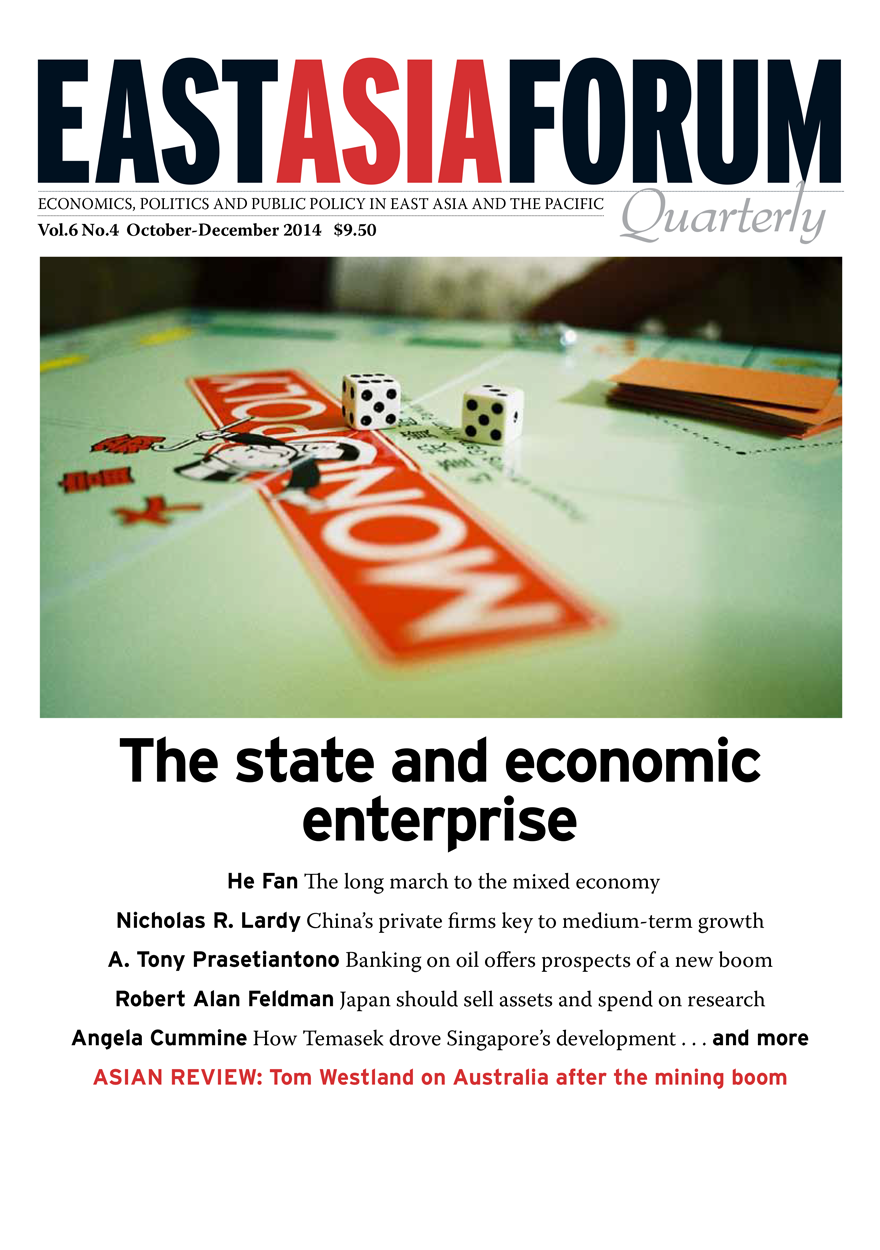
East Asia Forum Quarterly: Volume 6, Number 4, 2014 »
Publication date: November 2014
East Asia Forum Quarterly grew out of East Asia Forum (EAF) online, which has developed a reputation for providing a platform for the best in Asian analysis, research and policy comment on the Asia Pacific region in world affairs. EAFQ aims to provide a further window onto research in the leading research institutes in Asia and to provide expert comment on current developments within the region. The East Asia Forum Quarterly, like East Asia Forum online, is an initiative of the East Asia Forum (EAF) and its host organisation, the East Asian Bureau of Economic Research (EABER) in the Crawford School of Economics and Government in the College of Asia & the Pacific at The Australian National University.
Download for free
Not available for purchase
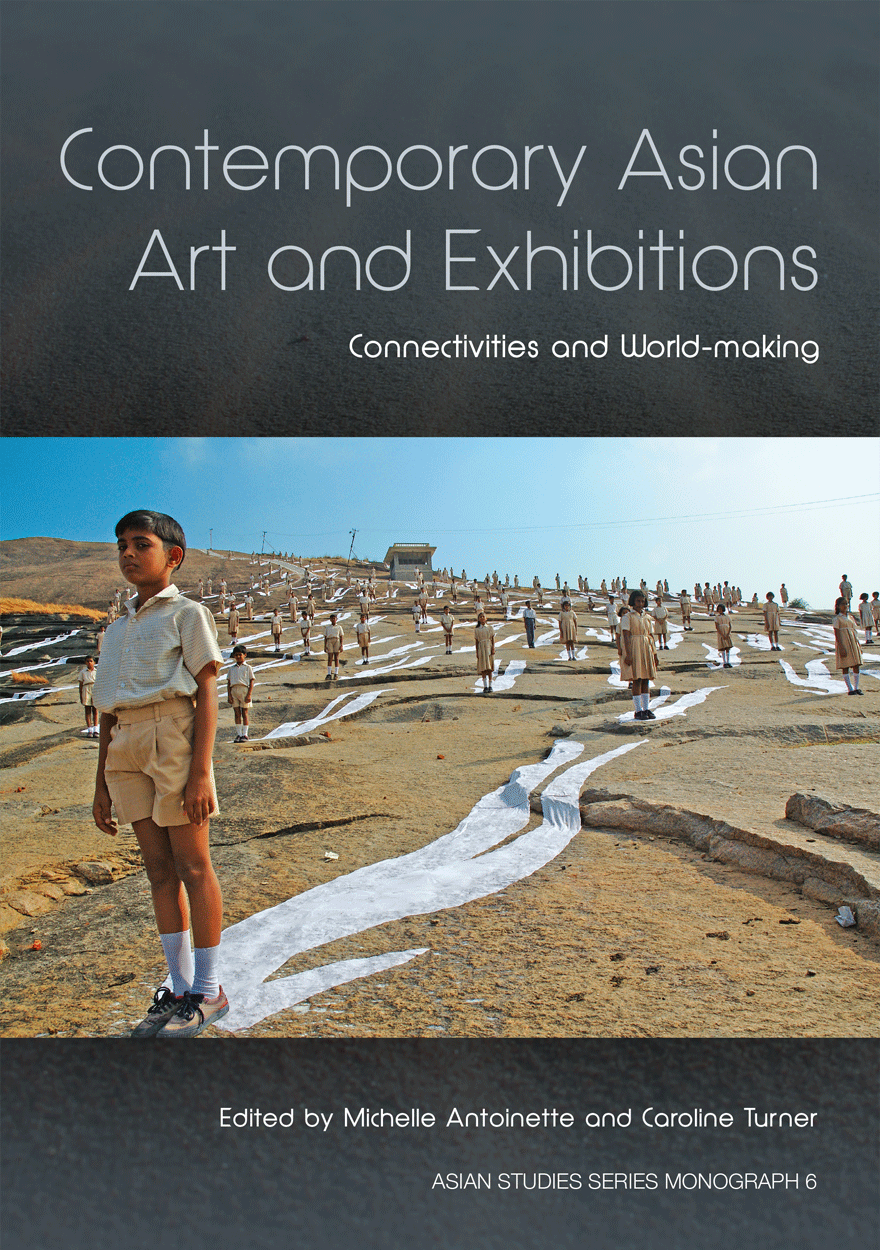
Contemporary Asian Art and Exhibitions »
Connectivities and World-making
Edited by: Michelle Antoinette, Caroline Turner
Publication date: October 2014
“… a diverse and stimulating group of essays that together represents a significant contribution to thinking about the nascent field of contemporary Asian art studies … Contemporary Asian Art and Exhibitions: Connectivities and World-making … brings together essays by significant academics, curators and artist working in Australia, Asia and the United Kingdom that reflect on contemporary art in the Asia-Pacific region, and Australia’s cultural interconnections with Asia. It will be a welcome addition to the body of literature related to these emergent areas of art historical study. ”
— Dr Claire Roberts, Senior Lecturer in Art History, University of Adelaide
This volume draws together essays by leading art experts observing the dramatic developments in Asian art and exhibitions in the last two decades. The authors explore new regional and global connections and new ways of understanding contemporary Asian art in the twenty-first century.
The essays coalesce around four key themes: world-making; intra-Asian regional connections; art’s affective capacity in cross-cultural engagement; and Australia’s cultural connections with Asia. In exploring these themes, the essays adopt a diversity of approaches and encompass art history, art theory, visual culture and museum studies, as well as curatorial and artistic practice.
With introductory and concluding essays by editors Michelle Antoinette and Caroline Turner this volume features contributions from key writers on the region and on contemporary art: Patrick D Flores, John Clark, Chaitanya Sambrani, Pat Hoffie, Charles Merewether, Marsha Meskimmon, Francis Maravillas, Oscar Ho, Alison Carroll and Jacqueline Lo.
Richly illustrated with artworks by leading contemporary Asian artists, Contemporary Asian Art and Exhibitions: Connectivities and World-making will be essential reading for those interested in recent developments in contemporary Asian art, including students and scholars of art history, Asian studies, museum studies, visual and cultural studies.
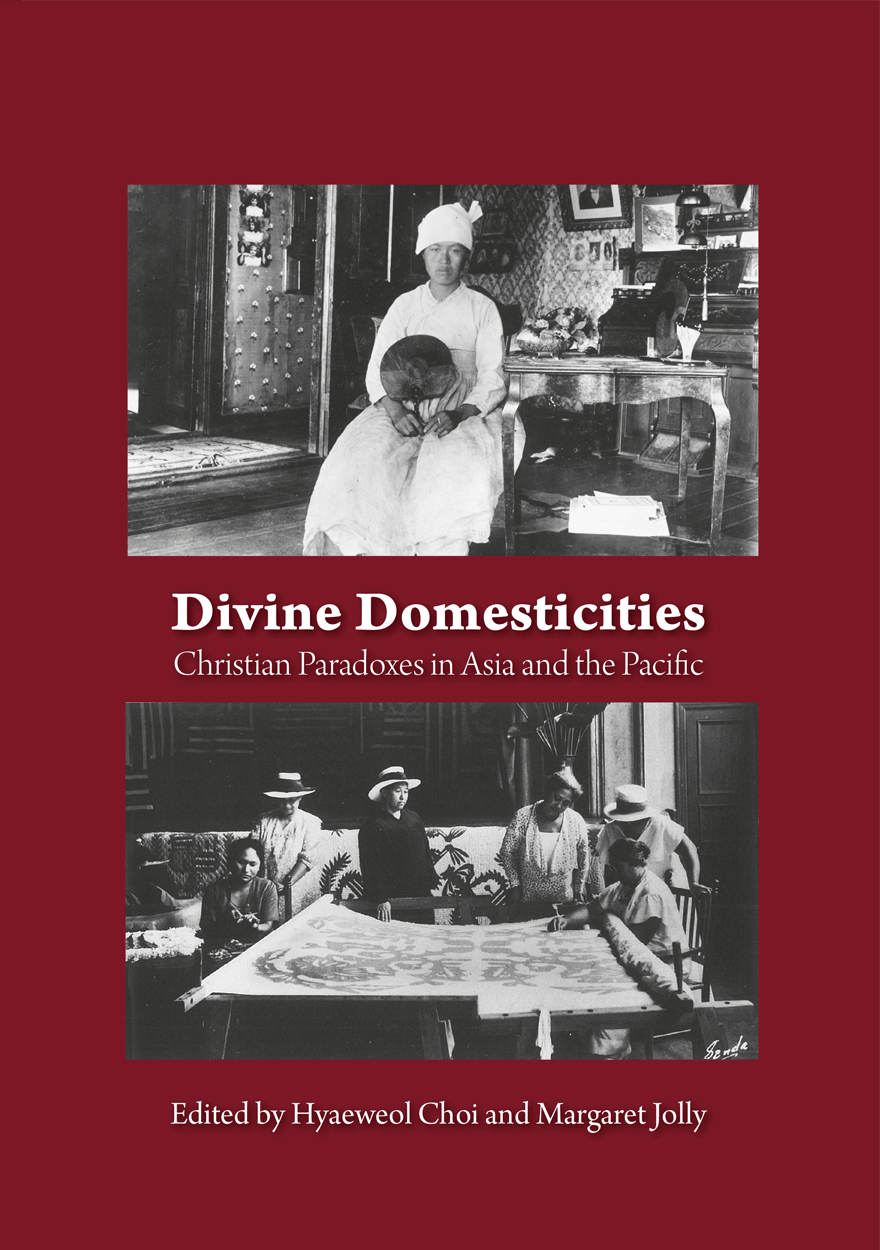
Divine Domesticities »
Christian Paradoxes in Asia and the Pacific
Edited by: Hyaeweol Choi, Margaret Jolly
Publication date: October 2014
Divine Domesticities: Christian Paradoxes in Asia and the Pacific fills a huge lacuna in the scholarly literature on missionaries in Asia/Pacific and is transnational history at its finest. Co-edited by two eminent scholars, this multidisciplinary volume, an outgrowth of several conferences/seminars, critically examines various encounters between western missionaries and indigenous women in the Pacific/Asia … Taken as a whole, this is a thought-provoking and an indispensable reference, not only for students of colonialism/imperialism but also for those of us who have an interest in transnational and gender history in general. The chapters are very clearly written, engaging, and remarkably accessible; the stories are compelling and the research is thorough. The illustrations are equally riveting and the bibliography is extremely useful.
—Theodore Jun Yoo, History Department, University of Hawai’i
The editors of this collection of papers have done an excellent job of creating a coherent set of case studies that address the diverse impacts of missionaries and Christianity on ‘domesticity’, and therefore on the women and children who were assumed to be the rightful inhabitants of that sphere … The introduction to the volume is beautifully written and sets up the rest of the volume in a comprehensive way. It explains the book’s aim to advance theoretical and methodological issues by exploring the role of missionary encounters in the development of modern domesticities; showing the agency of indigenous women in negotiating both change and continuity; and providing a wide range of case studies to show ‘breadth and complexity’ and the local and national specificities of engagements with both missionaries and modernity. My view is that all three aims are well and truly fulfilled.
—Helen Lee, Head, Sociology and Anthropology, La Trobe University, Melbourne

East Asia Forum Quarterly: Volume 6, Number 3, 2014 »
Publication date: October 2014
East Asia Forum Quarterly grew out of East Asia Forum (EAF) online, which has developed a reputation for providing a platform for the best in Asian analysis, research and policy comment on the Asia Pacific region in world affairs. EAFQ aims to provide a further window onto research in the leading research institutes in Asia and to provide expert comment on current developments within the region. The East Asia Forum Quarterly, like East Asia Forum online, is an initiative of the East Asia Forum (EAF) and its host organisation, the East Asian Bureau of Economic Research (EABER) in the Crawford School of Economics and Government in the College of Asia & the Pacific at The Australian National University.
Download for free
Not available for purchase

Deepening Reform for China's Long-term Growth and Development »
Edited by: Ross Garnaut, Cai Fang, Ligang Song
Publication date: July 2014
The Chinese economy has entered a new phase of development in which sources of growth are not so much dependent upon pure increases in labour, investment and credit expansion, but from productivity improvement, structural changes, technological progress and the benefits from improvement of the social security and welfare improvement. When market functions are fully established to become a main channel for allocating resources, the entrepreneurship will flourish engaging in more innovative activities, workers will move more freely and have more incentives to improve their skills, firms will become more productive through market entry and exit, the economic structure will become more balanced because of the improved resource allocation, and in the end, growth will become more spontaneous and sustainable. In this sense, reforms could deliver ‘dividend’ by raising China’s potential economic growth rates.
For China to confront all the challenges it faces at present, the reforms undertaken now have to be deep, comprehensive and far-reaching in order to succeed in paving the way for China to complete the task of transformation in the long-term. There is no better alternative than deepening the market-oriented reform in advancing the course of China’s modernisation for future development and prosperity and lifting China to the status of a developed economy in the next two decades. The recent China update books have covered the topic of reform from different angles and this new book is another attempt to address this important issue.
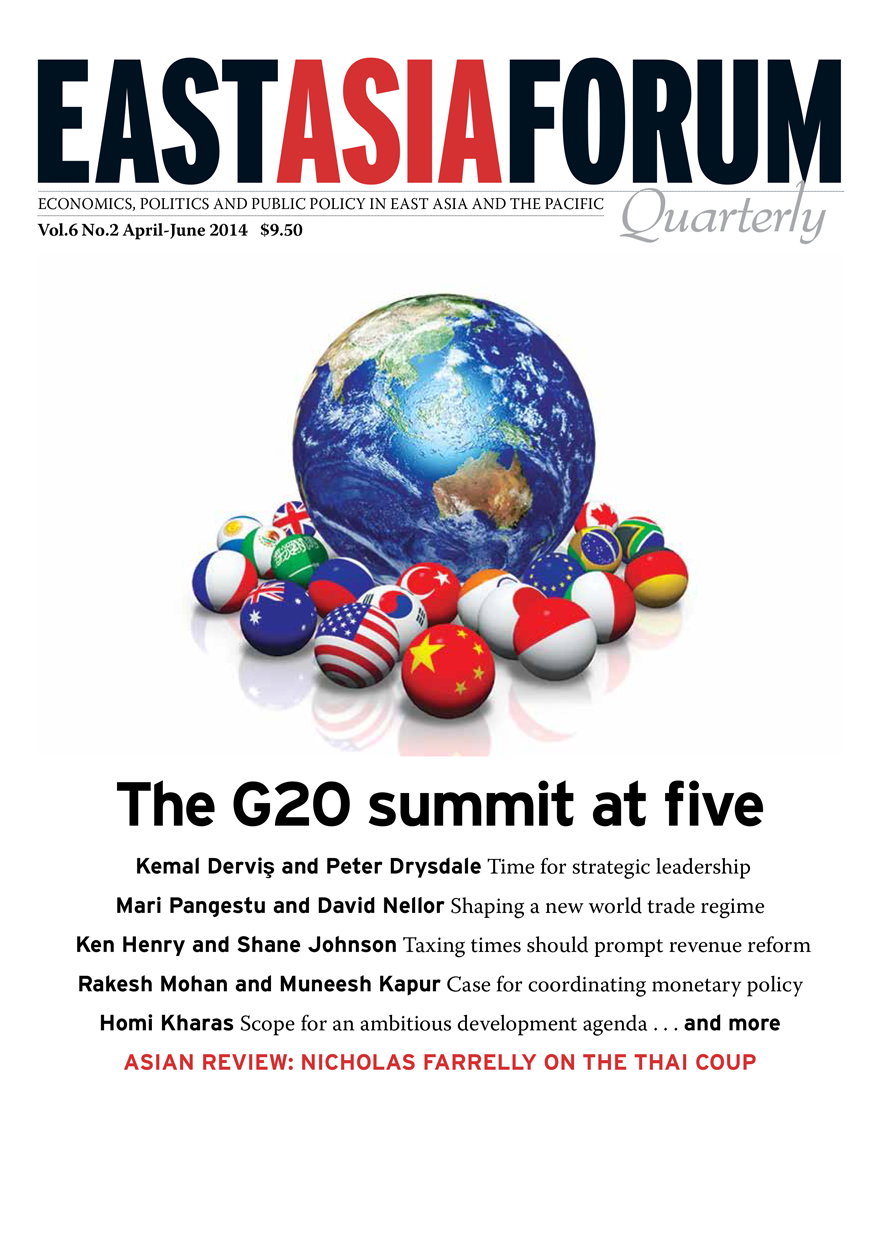
East Asia Forum Quarterly: Volume 6, Number 2, 2014 »
Publication date: June 2014
East Asia Forum Quarterly grew out of East Asia Forum (EAF) online, which has developed a reputation for providing a platform for the best in Asian analysis, research and policy comment on the Asia Pacific region in world affairs. EAFQ aims to provide a further window onto research in the leading research institutes in Asia and to provide expert comment on current developments within the region. The East Asia Forum Quarterly, like East Asia Forum online, is an initiative of the East Asia Forum (EAF) and its host organisation, the East Asian Bureau of Economic Research (EABER) in the Crawford School of Economics and Government in the College of Asia & the Pacific at The Australian National University.
Download for free
Not available for purchase

Measuring and Promoting Wellbeing »
How Important is Economic Growth?
Edited by: Andrew Podger, Dennis Trewin
Publication date: April 2014
Australia continues to be at the forefront of international work on measuring and promoting wellbeing, Ian Castles being a significant contributor over the last forty years as an official and academic. This book combines a selection of Castles’ important work with contemporary research from a range of contributors.
The material is in four parts:
1. The role of economics in defining and promoting wellbeing
2. Measuring real income and wellbeing
3. Measuring inequality
4. Climate change and the limits to growth.
The issues canvassed are both long-standing and current. Does economic growth contribute to wellbeing? How different is income to wellbeing? How do we measure societal wellbeing and take its distribution into account? The book will be of value to all those looking to informed debate on global challenges such as reducing poverty, sustaining the environment and advancing the quality of life, including politicians, commentators, officials and academics.

East Asia Forum Quarterly: Volume 6, Number 1, 2014 »
Publication date: March 2014
East Asia Forum Quarterly grew out of East Asia Forum (EAF) online, which has developed a reputation for providing a platform for the best in Asian analysis, research and policy comment on the Asia Pacific region in world affairs. EAFQ aims to provide a further window onto research in the leading research institutes in Asia and to provide expert comment on current developments within the region. The East Asia Forum Quarterly, like East Asia Forum online, is an initiative of the East Asia Forum (EAF) and its host organisation, the East Asian Bureau of Economic Research (EABER) in the Crawford School of Economics and Government in the College of Asia & the Pacific at The Australian National University.
Download for free
Not available for purchase
Developing Asian Bondmarkets »
Edited by: Takatoshi Ito, Yung Chul Park
Publication date: January 2014
The absence of vibrant bondmarkets in East Asia was a significant contributor to the 1997–98 financial crisis. Ever since, the development of local bondmarkets has been a major objective of financial reforms in many East Asian economies. This effort has been frustrated by the inability to reach a consensus on whether Asian bondmarkets are truly needed in East Asia, whether they can be made viable in the competitive environment of the global economy, how they should be created and what role intergovernmental cooperation should play in their definition and creation.
Developing Asian Bondmarkets helps build this consensus, proposing how to develop robust and efficient bondmarkets in East Asia.
This book, the first of its kind, comes from the Finance Forum of the Pacific Economic Cooperation Council.
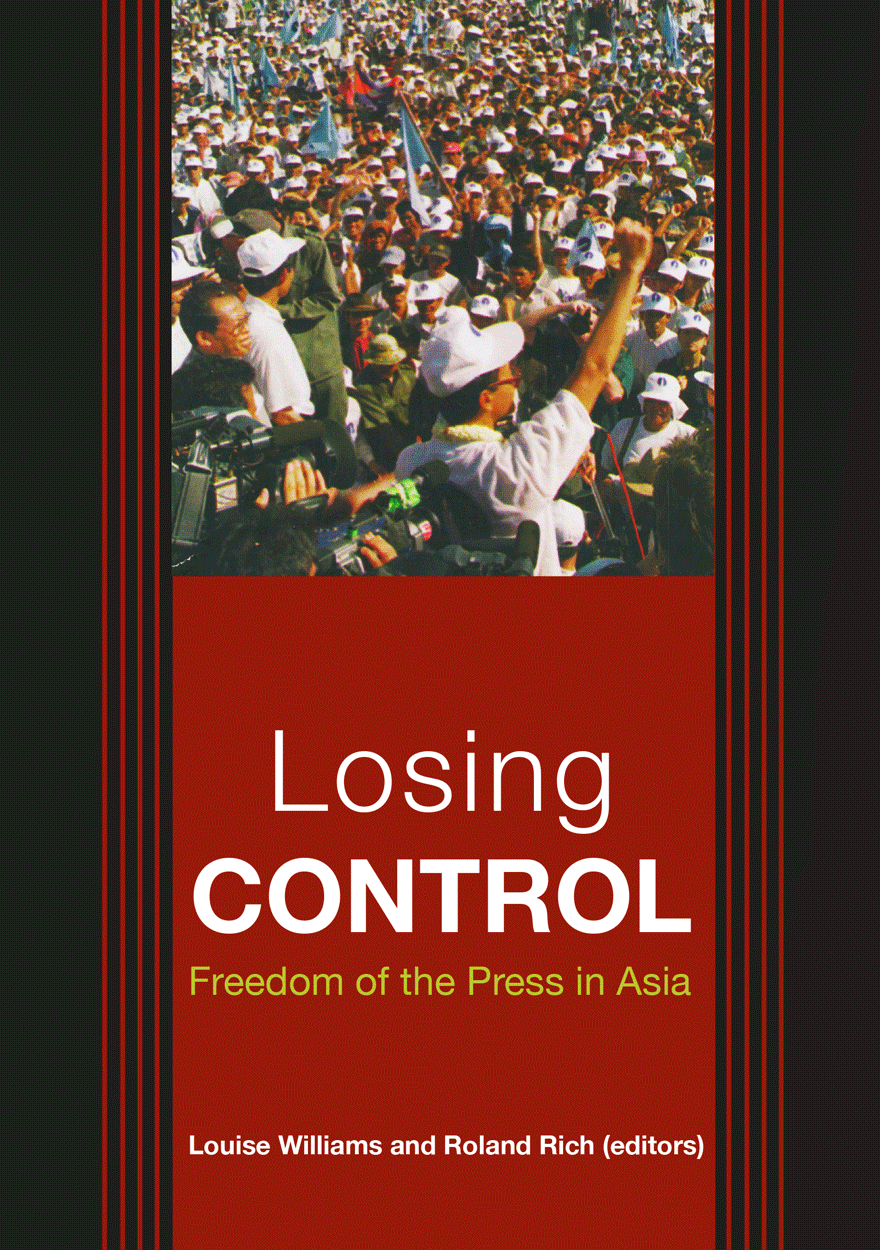
Losing Control »
Freedom of the Press in Asia
Edited by: Louise Williams, Roland Rich
Publication date: January 2014
‘A free press is not a luxury. A free press is at the absolute core of equitable development’ according to World Bank President James Wolfensohn. A free press is also the key to transparency and good governance and is an indispensable feature of a democracy. So how does Asia rate? In Losing Control, leading journalists analyse the state of play in all the countries of North Asia and Southeast Asia. From the herd journalism of Japan to the Stalinist system of North Korea, Losing Control provides an inside look at journalism and freedom of the press in each country. One conclusion—a combination of new technology and greater democracy is breaking the shackles that once constrained the press in Asia.
‘Brings together Asia’s best and brightest observers of the press.’
Hamish McDonald, Foreign Editor, The Sydney Morning Herald
‘A rare insiders’ view exposing the real dynamics behind social and political change in Asia.’
Evan Williams, Foreign Correspondent, ABC TV
‘A timely and necessary contribution to the debate over the quality of freedom in Asia.’
Geoffrey Barker, The Australian Financial Review