



Search titles
Displaying results 181 to 190 of 362.

Discretion and Public Benefit in a Regulatory Agency »
The Australian Authorisation Process
Authored by: Vijaya Nagarajan
Publication date: July 2013
This book explores the manner in which a variety of public benefits such as environmental protection and consumer safety have been accommodated through the authorisation process within competition law and policy in Australia. While the regulator’s use of its discretion can be explained as a triumph of practice over theory, this book explores the potential for competition principles to be imbued by the wider discourses of democratic participation and human rights. In doing so it makes a significant contribution to the Australian competition policy as well as reconceptualising the way in which discretion is used by regulators.
… a very important and creative contribution to the literatures on both business regulation in general and Australian competition and consumer protection law in particular. It pays special attention to an everyday regulatory function that is often ignored in scholarship. And it is very important in challenging—on both empirical and normative policy oriented grounds—a narrowly economic approach to competition law, and proposing an alternative understanding and practice for the public benefit test in ACCC authorisations.
— Professor Christine Parker
The data Vij Nagarajan has analysed is quite unique in its focus. It is a kind of data and analysis that has not been completed before in the international literature. It is well written, theoretically sophisticated and incisive in its policy analysis.
— John Braithwaite
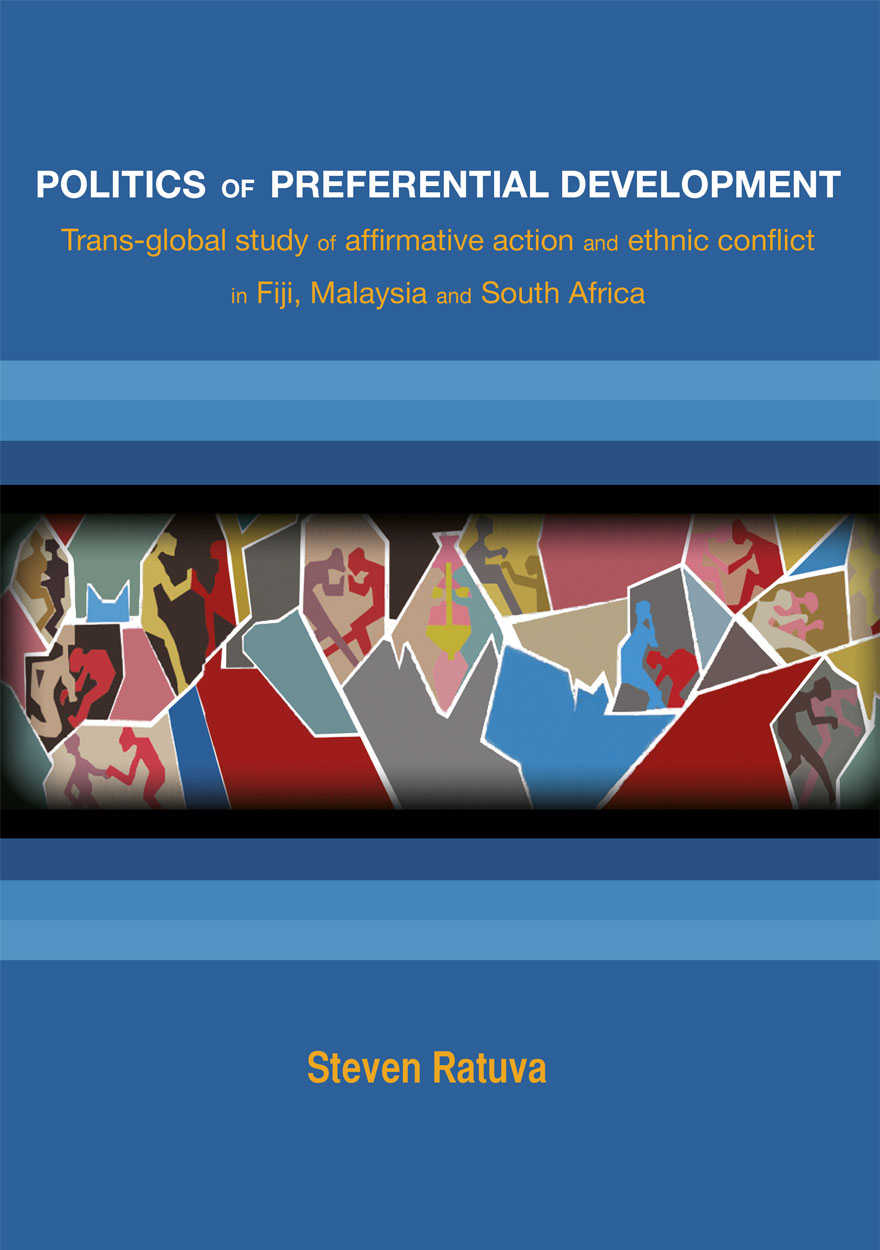
Politics of preferential development »
Trans-global study of affirmative action and ethnic conflict in Fiji, Malaysia and South Africa
Authored by: Steven Ratuva
Publication date: July 2013
The book is a critical examination of affirmative action, a form of preferential development often used to address the situation of disadvantaged groups. It uses a trans-global approach, as opposed to the comparative approach, to examine the relationship between affirmative action, ethnic conflict and the role of the state in Fiji, Malaysia and South Africa. While affirmative action has noble goals, there are often intervening political and ideological factors in the form of ethno-nationalism and elite interests, amongst others, which potentially undermine fair distribution of affirmative action resources. The book examines the affirmative action philosophies and programs of the three countries and raises pertinent questions about whether affirmative action has led to equality, social justice, harmony and political stability and explores future possibilities.
Steven Ratuva provides a brilliant critical study, not just of affirmative action policy and practice in three very different postcolonial contexts, but of the very complex matters of principle, justification and ideology that are involved more generally. It is an invaluable contribution to the literature on this important topic.
— Dr Stephanie Lawson, Professor of Politics and International Relations, Macquarie University.
Scholarly and provocative, Steven Ratuva’s Politics of Preferential Development is an original and insightful comparative contribution to the growing literature on affirmative action around the world.
— Dr Ralph Premdas, Professor of Public Policy, University of West Indies; Former Professor, University of California Berkeley and University of Toronto.
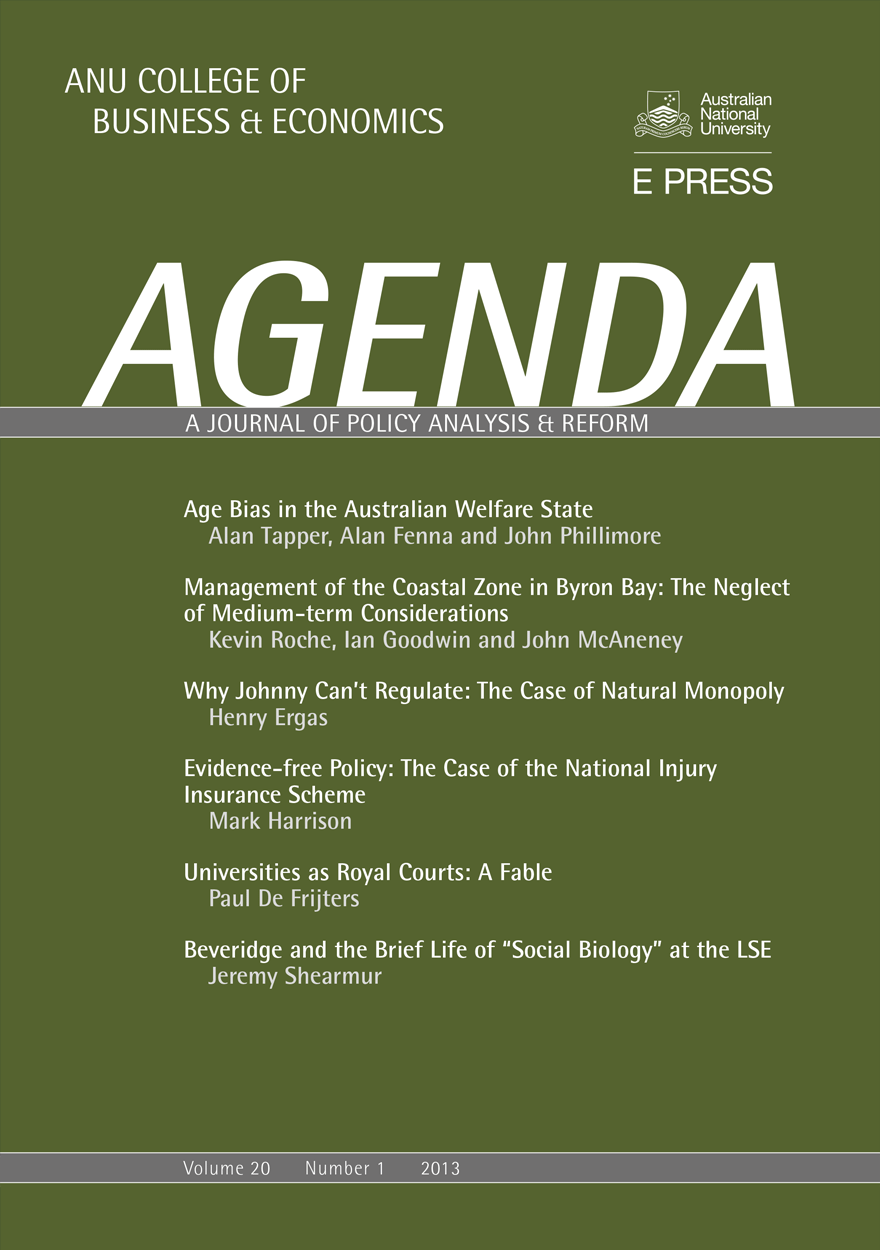
Agenda - A Journal of Policy Analysis and Reform: Volume 20, Number 1, 2013 »
Edited by: William Coleman
Publication date: July 2013
Agenda is a refereed, ECONLIT-indexed and RePEc-listed journal of the College of Business and Economics, The Australian National University. Launched in 1994, Agenda provides a forum for debate on public policy, mainly (but not exclusively) in Australia and New Zealand. It deals largely with economic issues but gives space to social and legal policy and also to the moral and philosophical foundations and implications of policy.
Subscribe to the Agenda Alerting service if you wish to be advised on forthcoming or new issues.
Download for free
Not available for purchase

France in the South Pacific »
Power and Politics
Authored by: Denise Fisher
Publication date: May 2013
France is a Pacific power, with three territories, a military presence, and extensive investments. Once seen by many as a colonial interloper in the South Pacific, by the early 2000s, after it ended nuclear testing in French Polynesia and negotiated transitional Accords responding to independence demands in New Caledonia, France seems to have become generally accepted as a regional partner, even if its efforts concentrate on its own territories rather than the independent island states.
But France’s future in the region has yet to be secured. By 2014 it is to have handed over a set of agreed autonomies to the New Caledonian government, before an independence referendum process begins. Past experience suggests that a final resolution of the status of New Caledonia will be divisive and could lead once again to violent confrontations. In French Polynesia, calls continue for independence and for treatment under UN decolonisation procedures, which France opposes. Other island leaders are watching, so far putting faith in the Noumea Accord, but wary of the final stages. The issues and possible solutions are more complex than the French Pacific island population of 515,000 would suggest.
Combining historical background with political and economic analysis, this comprehensive study offers vital insight into the intricate history – and problematic future – of several of Australia’s key neighbours in the Pacific and to the priorities and options of the European country that still rules them. It is aimed at policy-makers, scholars, journalists, businesspeople, and others who want to familiarise themselves with the issues as France’s role in the region is redefined in the years to come.

My Country, Mine Country »
Indigenous people, mining and development contestation in remote Australia
Authored by: Benedict Scambary
Publication date: May 2013
Agreements between the mining industry and Indigenous people are not creating sustainable economic futures for Indigenous people, and this demands consideration of alternate forms of economic engagement in order to realise such ‘futures’. Within the context of three mining agreements in north Australia this study considers Indigenous livelihood aspirations and their intersection with sustainable development agendas. The three agreements are the Yandi Land Use Agreement in the Central Pilbara in Western Australia, the Ranger Uranium Mine Agreement in the Kakadu region of the Northern Territory, and the Gulf Communities Agreement in relation to the Century zinc mine in the southern Gulf of Carpentaria in Queensland.
Recent shifts in Indigenous policy in Australia seek to de-emphasise the cultural behaviour or imperatives of Indigenous people in undertaking economic action, in favour of a mainstream conventional approach to economic development. Concepts of ‘value’, ‘identity’, and ‘community’ are key elements in the tension between culture and economics that exists in the Indigenous policy environment. Whilst significant diversity exists within the Indigenous polity, Indigenous aspirations for the future typically emphasise a desire for alternate forms of economic engagement that combine elements of the mainstream economy with the maintenance and enhancement of Indigenous institutions and ‘livelihood’ activities. Such aspirations reflect ongoing and dynamic responses to modernity, and typically concern the interrelated issues of access to and management of ‘country’, the maintenance of Indigenous institutions associated with family and kin, access to resources such as cash and vehicles, the establishment of robust representative organisations, and are integrally linked to the derivation of both symbolic and economic value of livelihood pursuits.

A New Idea Each Morning »
How food and agriculture came together in one international organisation
Authored by: Wendy Way
Publication date: May 2013
In the years between the two world wars of the twentieth century leaders in Western countries worried about a food surplus. The hardships of the Great Depression were intensified by a glut of wheat and consequent low prices on the world market. Yet at the same time nutrition scientists protested that significant proportions of populations, even in affluent countries, were unable to afford a diet ‘adequate for health’. Fresh fruits, vegetables, dairy products and meat were out of reach for the poor.
This book traces the work of three men who sought to bring together the interests of farmers and the needs of the hungry: scientist and passionate campaigner for better nutrition, John Boyd Orr; Australian politician and international statesman, Stanley Melbourne Bruce; and Economic Adviser to Bruce at the Australian High Commission in London, Frank Lidgett McDougall. Bruce once said ‘McDougall brings me a new idea every morning’. One of those ideas became the genesis of their work, which helped bring about the formation of the Food and Agriculture Organization of the United Nations in 1945. All three undertook significant roles in the formative years of the organisation.
The story of this contribution to the international world order is little known. The cooperation, diplomacy and persistence of these men provides inspiration for tackling the alarming prospect of food shortages in the present century.

Securing Village Life »
Development in Late Colonial Papua New Guinea
Authored by: Scott MacWilliam
Publication date: May 2013
Securing Village Life: Development in Late Colonial Papua New Guinea examines the significance for post-World War II Australian colonial policy of the modern idea of development. Australian officials emphasised the importance of bringing development for both the colony of Papua and the United Nations Trust Territory of New Guinea. The principal form that development took involved securing smallholders against the tendencies of other forms of capitalist development that might have separated households from land. In order to make household occupation of their holdings more secure and at higher standards of living, the colonial administration coordinated and supervised increases in production of crops and other agricultural produce.
Contrary to suggestions that colonial policy and practice ignored indigenous agriculture and concentrated on plantation crops grown by international firms and expatriate owner-occupiers, the study shows how the main focus was instead upon increasing smallholder output for immediate consumption as well as for local and international markets. Simultaneously development stimulated increases in consumption, including of goods produced through manufacturing processes and imported into the colony.
Only as Independence approached was the pre-eminence of the earlier focus upon smallholders weakened. In part the change occurred due to the political advance of the indigenous capitalist class and their allies seeking to extend their base in largeholding agriculture and related commercial activities. This advance and the uncertainty over which form of development would prevail once indigenes held state power in post-colonial Papua New Guinea stood in marked contrast to the definite direction pursued under the colonial administration of the 1950s and early 1960s.

Politics, Development and Security in Oceania »
Edited by: David Hegarty, Darrell Tryon
Publication date: April 2013
The chapters in this volume canvass political change and development across the Pacific Islands from a variety of perspectives, each contributing to the analysis of a region growing in complexity and in confidence. They fall neatly into three sections: Oceania and its Inheritance; Oceania – Current Needs and Challenges; and Oceania and its Wider Setting.
The new states of the Pacific have demonstrated considerable resilience, and in many cases, an extraordinary capacity to bounce back from difficulty and to maintain optimism for the future. The continuing professionalisation of public management across the region is building on that tradition. The growth of civil society organisations is also beginning to play a positive role in policy and implementation. Donors are becoming more coherent in their strategies, more attuned to the realities of generating development outcomes in small island states, and are beginning to acknowledge and map progress.
This book explores these themes of governance, development and security that signal both continuity and change in the Pacific’s pattern of islands.

The Governance of Common Property in the Pacific Region »
Edited by: Peter Larmour
Publication date: March 2013
In a region where mining, forestry, fish and other primary resources are so basic to income, employment and national prosperity, an understanding of rights to land, water and minerals is fundamental. Tenure regimes in the Asia-Pacific region are vastly more diverse and complex than in those of any other part of the world for comparable population numbers. These studies will overcome the simplistic misunderstandings that have obscured understanding in so many instances.
This book provides an up-to-date overview of the main patterns of indigenous property rights, particularly those held by corporate groups, in the South Pacific Forum region (Australia, New Zealand and the independent Pacific island nations) plus a valuable comparative chapter on Canada. It explores the relative success and failure of a variety of approaches to the management of these complex systems, and offers insights and suggestions for the amelioration of present and likely future stresses in the systems. It is a valuable contribution to the understanding of both governance and property, and to the effective sociopolitical development of the region.
- Ron Crocombe, Emeritus Professor, University of the South Pacific

Protection of intellectual, biological & cultural property in Papua New Guinea »
Edited by: Kathy Whimp, Mark Busse
Publication date: March 2013
Intellectual, biological and cultural property rights are a powerful and debatable topic. They offer the possibility for protection of rights to intangible resources, including the products of knowledge and creativity. The forces of globalisation have made this subject of immediate, international concern. Struggles for ownership of intellectual property occur between and within local and global arenas.
This book examines important questions which Papua New Guinea must ask in the development of intellectual property legislation. The chapters are written by specialists in the fields of medicine, law, the environment, music, genetics and traditional cultural knowledge.
The wise and creative protection of intellectual, biological and cultural property is important if Papua New Guinea is to successfully define and realise its future. This book is for all those interested in finding the best policies for protecting these rights wherever they may live and work.