



Search titles
Displaying results 71 to 75 of 75.

Transgressions »
Critical Australian Indigenous histories
Edited by: Ingereth Macfarlane, Mark Hannah
Publication date: December 2007
This volume brings together an innovative set of readings of complex interactions between Australian Aboriginal people and colonisers. The underlying theme is that of ‘transgression’, and Michel Foucault’s account of the necessary dynamic that exists between transgression and limit. We know what constitutes the limit, not by tracing or re-stating the boundaries, but by crossing over them. By exploring the mechanisms by which limits are set and maintained, unexamined cultural assumptions and dominant ideas are illuminated. We see the expectations and the structures that inform and support them revealed, often as they unravel. Such illuminations and revelations are at the core of the Australian Indigenous histories presented in this collection.
For more information on Aboriginal History Inc. please visit aboriginalhistory.org.au.

Arndt's Story »
The life of an Australian economist
Authored by: Peter Coleman, Selwyn Cornish, Peter Drake
Publication date: March 2007
‘H.W. Arndt has been Australia’s leading scholar of Asian economic development for over thirty years’
- Former World Bank President James D Wolfensohn.
The year of Heinz Wolfgang Arndt’s birth, 1915, was not a good time for a German boy to be born. His country was soon to be defeated in a great war, his school years were shadowed by the rise of Hitler. Yet when Heinz’s long-buried Jewish background led his academic father to lose his chair in chemistry and flee to Oxford, Heinz followed. As Heinz put it, the calamity of Hitler’s rise to power led him to ‘the incredible good fortune of an Oxford education and a life spent in England and Australia.’
This was a man of inexhaustible energy and optimism, who returned from months behind barbed wire interned in Canada to write a historical classic—The Economic Lessons of the Nineteen-Thirties. He seized the opportunity of an unexpected job offer to set off with his young family for Sydney where he quickly established himself as a leading authority on the Australian banking system, embarked on his fifty year career as a gifted university teacher and enjoyed the first of many vigorous forays as a public intellectual.
But it was at ANU that Heinz took the bold step which led him to become the Grand Old Man of Asian Economics. In 1966, just after the Sukarno coup and the year of living dangerously, he determined the time had come to study the Indonesian economy. It took all his charm, persistence and formidable intellect to persuade the Indonesians to open their doors to him. The result was a world-leading centre of Indonesian economics which greatly contributed to the development of modern Indonesia.

Australian Political Lives »
Chronicling political careers and administrative histories
Edited by: Tracey Arklay, John Nethercote, John Wanna
Publication date: October 2006
This monograph brings together some of the best practitioners of the art and craft of political biography in Australia. They are simultaneously some of our best scholars who, at least in part, have turned their attention to writing Australian political lives. They are not merely chroniclers of our times but multidisciplinary analysts constructing layers of explanation and theoretical insight. They include academic, professional and amateur biographers; scholars from a range of disciplines (politics, history, sociology, public administration, gender studies); and politicians who for a time strutted the political stage. The assembled papers explore the strengths and weaknesses of the biographical approach; the enjoyment it can deliver; the problems and frustrations of writing biographies; and the various ways the ‘project’ can be approached by those constructing these lives. They probe the art and craft of the political biographer.

Maverick Mathematician »
The Life and Science of J.E. Moyal
Authored by: Ann Moyal
Publication date: August 2006
J.E. Moyal has been pronounced ‘one of Australia’s most remarkable thinkers’. Yet, he was, essentially, a scientific maverick. Educated in a modest high school in Tel Aviv, he took himself to France to train as an engineer, statistician and mathematician and escaped to England as France fell.
It was from outside academia that he entered into communication with the ‘high priest’ of British theoretical physics, P.A.M. Dirac, challenging him with the idea of a statistical basis of quantum mechanics. Their correspondence forms the core of this book and opens up an important and hitherto unknown chapter for physicists, mathematicians and historians of science. Moyal’s classic paper, ‘A statistical basis for quantum mechanics’, also reproduced here in full, has come to underlie an explosion of research and to underpin an array of major technological developments.
Joe Moyal emerges in this small biography as a witty and intrepid character, a scuba diver and wine connoisseur, a generous teacher and researcher, and a man whose academic life-spanning France, Ireland, Britain, the USA and Australia-intersected with some of the leading scientists of the 20th century.
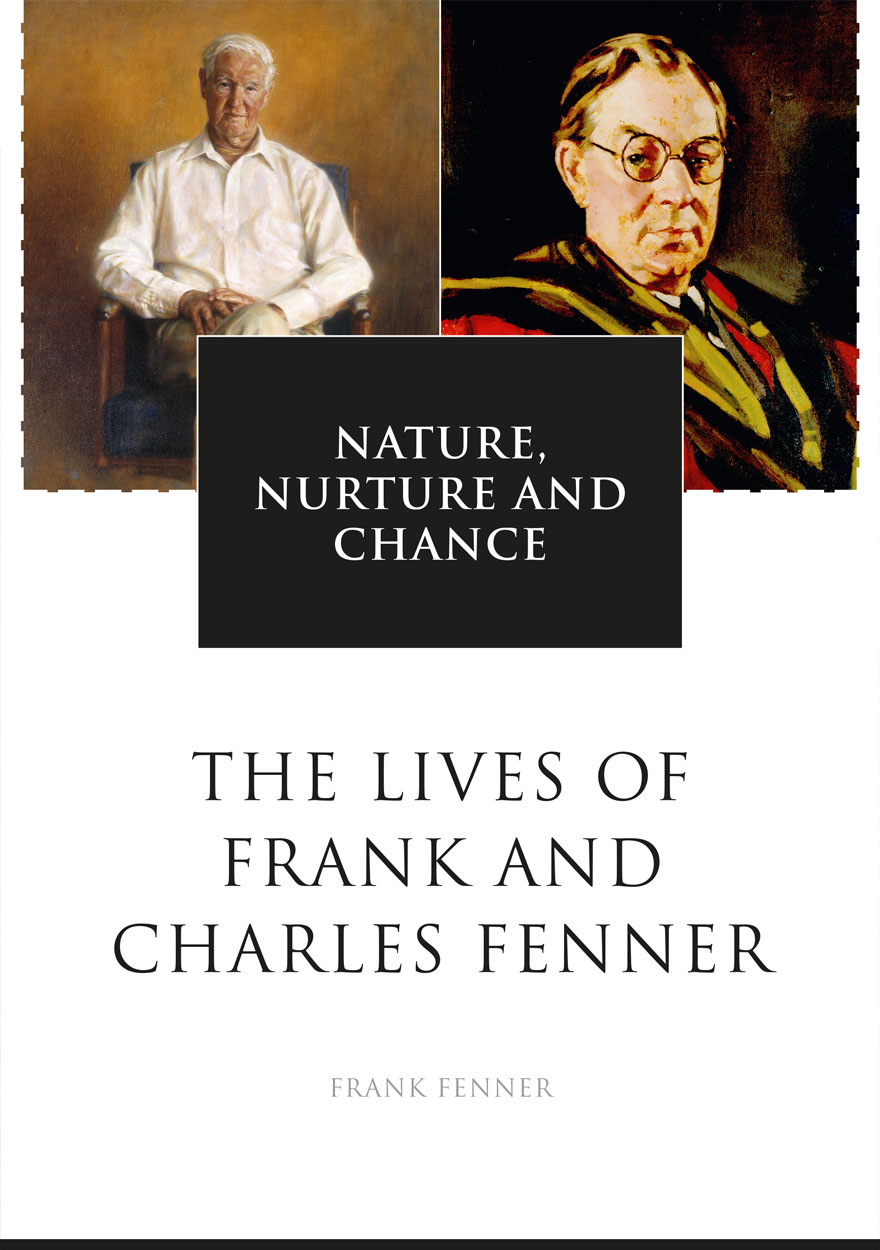
Nature, Nurture and Chance »
The Lives of Frank and Charles Fenner
Authored by: Frank Fenner
Publication date: July 2006
Judging by the numbers of newspaper reviews, biographies (including autobiographies) are amongst the most common literary works published these days. However, it is uncommon to find one book that combines a biography and an autobiography, as this book, Nature, Nurture and Chance: The Lives of Frank and Charles Fenner, does. As the author, Frank Fenner, sees it, ‘nature’ means the combination of genes that we inherit from our parents; ‘nurture’ means the way that our physical and social environment, especially during childhood, influence our mental and emotional characteristics; and chance is defined as ‘the way things fall out’. These three elements define the careers of all human beings. The author uses them to compare his father’s life and his own.