



Search
Books
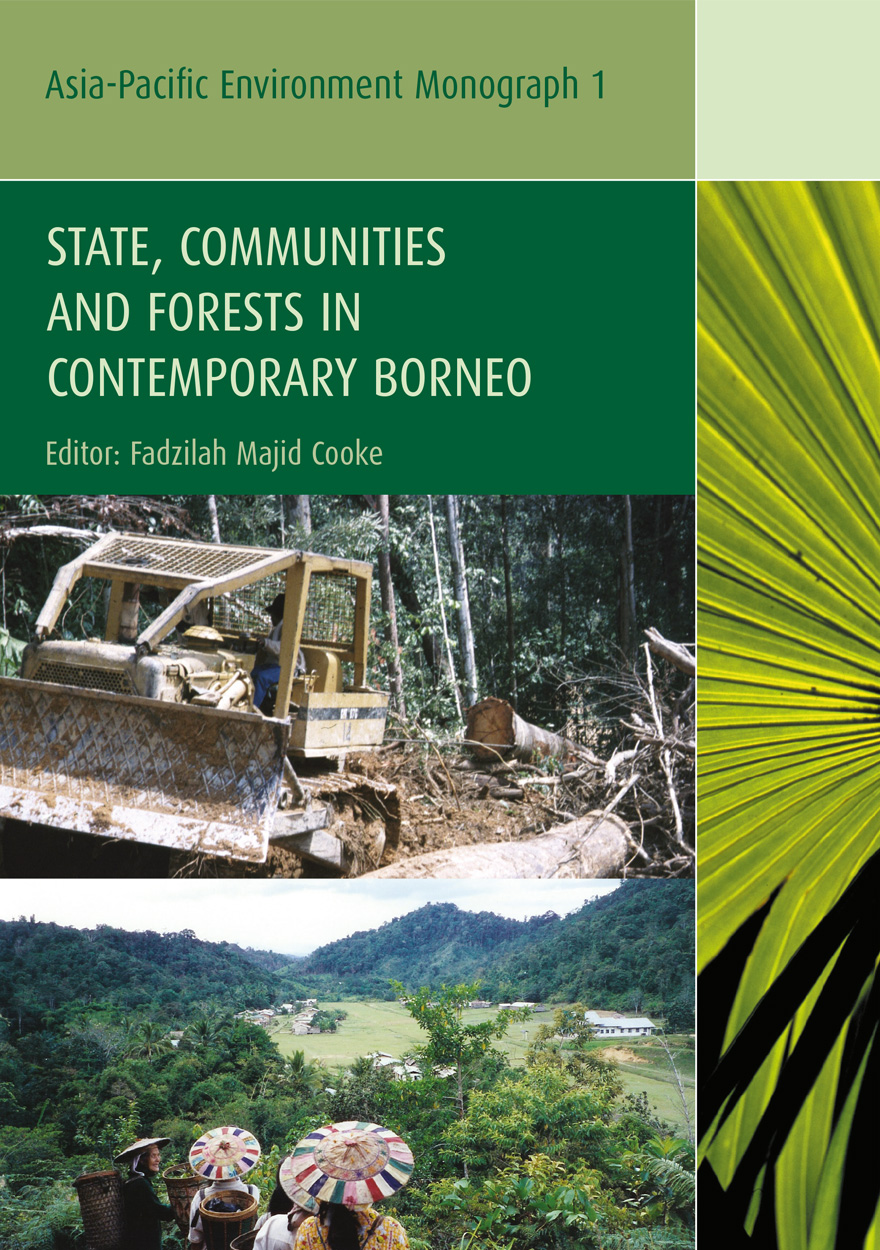
State, Communities and Forests In Contemporary Borneo »
Edited by: Fadzilah Majid Cooke
Publication date: July 2006
The name ‘Borneo’ evokes visions of constantly changing landscapes, but with important island-wide continuities. One of the continuities has been the forests, which have for generations been created and modified by the indigenous population, but over the past three decades have been partially replaced by tree crops, grass or scrub. This book, the first in the series of Asia-Pacific Environmental Monographs, looks at the political complexities of forest management across the whole island of Borneo, tackling issues of tenure, land use change and resource competition, ‘tradition’ versus ‘modernity’, disputes within and between communities, between communities and private firms, or between communities and governments. While it focuses on the changes taking place in local political economies and conservation practices, it also makes visible the larger changes taking place in both Indonesia and Malaysia. The common theme of the volume is the need to situate local complexities in the larger institutional context, and the possible gains to be made from such an approach in the search for alternative models of conservation and development.

Myanmar »
The state, community and the environment
Edited by: Monique Skidmore, Trevor Wilson
Publication date: October 2007
Despite deteriorating economic and developmental conditions, worsening environmental problems, and troubles arising from the unresolved status of its ethnic minorities, Myanmar seems no closer to a political resolution. Myanmar’s economy continues to stagnate, with severe implications for its people. Low levels of international assistance have exacerbated the situation.
Myanmar—the state, community and the environment examines the missed opportunities by government and opposition groups to find a way out of the political impasse and improve the standard of living of the people of Myanmar.
This collection provides insights into the country’s economic development, in particular the vital rice-marketing sector and the attempts to expand existing industrial zones. It focuses, for the first time, on Myanmar’s environmental governance with in-depth case studies, and on the increasing need for effective environmental protection and sustainability.

The Neoliberal State, Recognition and Indigenous Rights »
New paternalism to new imaginings
Edited by: Deirdre Howard-Wagner, Maria Bargh, Isabel Altamirano-Jiménez
Publication date: July 2018
The impact of neoliberal governance on indigenous peoples in liberal settler states may be both enabling and constraining. This book is distinctive in drawing comparisons between three such states—Australia, Canada and New Zealand. In a series of empirically grounded, interpretive micro-studies, it draws out a shared policy coherence, but also exposes idiosyncrasies in the operational dynamics of neoliberal governance both within each state and between them. Read together as a collection, these studies broaden the debate about and the analysis of contemporary government policy.
The individual studies reveal the forms of actually existing neoliberalism that are variegated by historical, geographical and legal contexts and complex state arrangements. At the same time, they present examples of a more nuanced agential, bottom-up indigenous governmentality. Focusing on intense and complex matters of social policy rather than on resource development and land rights, they demonstrate how indigenous actors engage in trying to govern various fields of activity by acting on the conduct and contexts of everyday neoliberal life, and also on the conduct of state and corporate actors.
Journals

Cross-sections, The Bruce Hall Academic Journal: Volume VII, 2011 »
Publication date: November 2011
Representing the combined energies of a large group of authors, editors, artists and researchers associated with Bruce Hall at the ANU, Cross-sections collects a range of works (from academic articles and essays to photography, digital art and installation artwork) that represents the disciplinary breadth and artistic vitality of the ANU.
Presenting a challenging and absorbing way for students to hone vital research skills, in the process, Cross-sections nurtures a fruitful environment of collaborative interaction between academics and students.
Download for free
Not available for purchase
Cross-sections, The Bruce Hall Academic Journal: Volume VI, 2010 »
Publication date: October 2010
Representing the combined energies of a large group of authors, editors, artists and researchers associated with Bruce Hall at the ANU, Cross-sections collects a range of works (from academic articles and essays to photography, digital art and installation artwork) that represents the disciplinary breadth and artistic vitality of the ANU.
Presenting a challenging and absorbing way for students to hone vital research skills, in the process, Cross-sections nurtures a fruitful environment of collaborative interaction between academics and students.
Download for free
Not available for purchase

Cross-sections, The Bruce Hall Academic Journal: Volume V, 2009 »
Publication date: October 2009
Representing the combined energies of a large group of authors, editors, artists and researchers associated with Bruce Hall at the ANU, Cross-sections collects a range of works (from academic articles and essays to photography, digital art and installation artwork) that represents the disciplinary breadth and artistic vitality of the ANU.
Presenting a challenging and absorbing way for students to hone vital research skills, in the process, Cross-sections nurtures a fruitful environment of collaborative interaction between academics and students.
Download for free
Not available for purchase
Textbooks
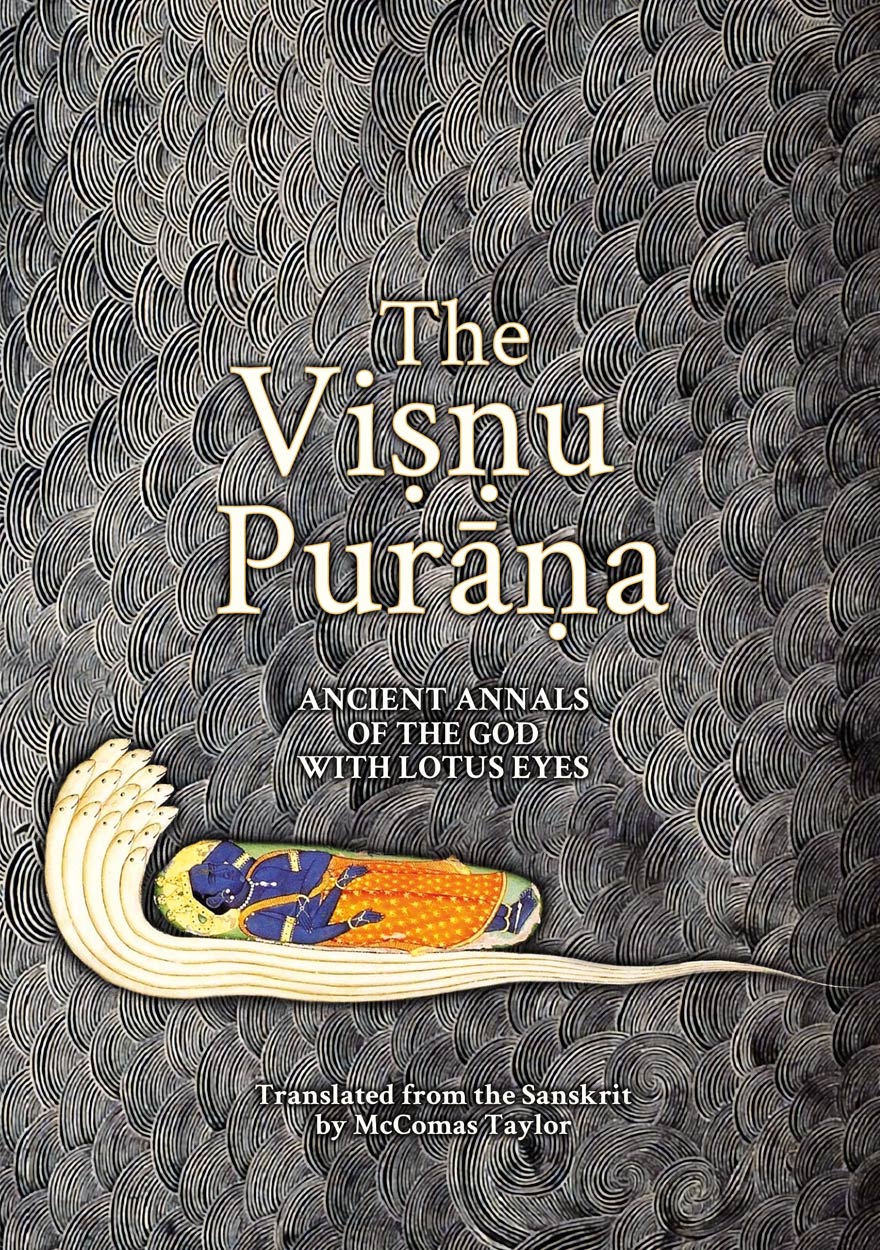
The Viṣṇu Purāṇa »
Ancient Annals of the God with Lotus Eyes
Authored by: McComas Taylor
Publication date: June 2021
This translation of The Viṣṇu Purāṇa is also available as a free audiobook (see the 'Additional Resources' tab).
Viṣṇu is a central deity in the Hindu pantheon, especially in his manifestation as the seductive cattle-herding youth, Kṛṣṇa. The purāṇas are sacred texts, which, as the Sanskrit name implies, are collections of narratives from ‘long ago’. The Viṣṇu Purāṇa is thus an ancient account of the universe and guide to life, which places Viṣṇu-Kṛṣṇa at the centre of creation, theology and reality itself.
This text, composed about 1,500 years ago, provides a comprehensive and accessible introduction to the most important themes and narratives that constitute the Hindu imagination: the creation and destruction of the universe, the origin of gods and mortals, the peopling of the world, and the structure and conduct of ideal brahminical society.
The Viṣṇu Purāṇa describes the trials of exemplary devotees, the existential struggles between gods and demons, and the exploits of legendary cultural heroes. It also contains many ecstatic songs of praise for the deity. The ever-popular accounts of Kṛṣṇa’s love games with the cattle-herding girls of Vṛṇdāvana, which have proliferated in literature, dance, song and visual arts over the millennia, are found here in authoritative form.
This faithful yet fluent blank-verse rendering of this great Hindu classic is the first new English translation in nearly 200 years. It will be welcomed by the scholarly community, while remaining readily accessible to a general readership.

The Plant Detective's Manual »
A research-led approach for teaching plant science
Authored by: Gonzalo M. Estavillo, Ulrike Mathesius, Michael Djordjevic, Adrienne Nicotra
Publication date: November 2014
If global challenges in food production and the impact of ever-declining biodiversity are to be tackled, every country will need plant biologists who have a deep understanding of plant morphology, physiology and genetics, and how these interact to affect plant function in changing environments. These scientists will also need the capacity to use an effective and powerful set of technologies and research strategies. To prepare and inspire our students to become that next generation of researchers and to instill a meaningful involvement in research we created an integrated set of laboratory investigations that we felt truly reflected the mysteries of plant biology and puzzle-solving processes that we had encountered in our research experience. Rather than a set of unconnected experimental activities, we created a series of closely related experiments that focused on solving ‘mysteries’ in the life of the plant Arabidopsis thaliana (thale cress). The activities charge students with finding the ‘suspect’ gene responsible for the specific phenotypes of an unknown Arabidopsis mutant, which are encountered when they expose the plants to different environmental stresses. This, we hoped, would give keen but inexperienced student scientists a realistic taste of the joys (and frustrations!) of plant science research.
Although thrilled by numerous university and national awards for our innovative teaching, we have been most excited by the interest in our ideas and experimental approaches from other plant science educators in Australia and overseas, who are also seeking to improve their plant biology curriculum and attract more students to plant sciences. We are thus proud to present this manual as a gift to our colleagues worldwide. Here you will find a detailed collection of state-of-the-art procedures in plant biology, as well as background information on more commonly used techniques, and tips for class preparation. The concepts and methods we present can be adapted to meet the specific needs and expertise of the teaching staff, and provide inspiration for scaling up for larger audiences, or simplifying for more junior classes. Through this publication, we hope to support our teaching colleagues in making a significant impact on improving the learning experience of plant biology students worldwide, and hope that we will motivate and inspire a new generation of plant detectives.
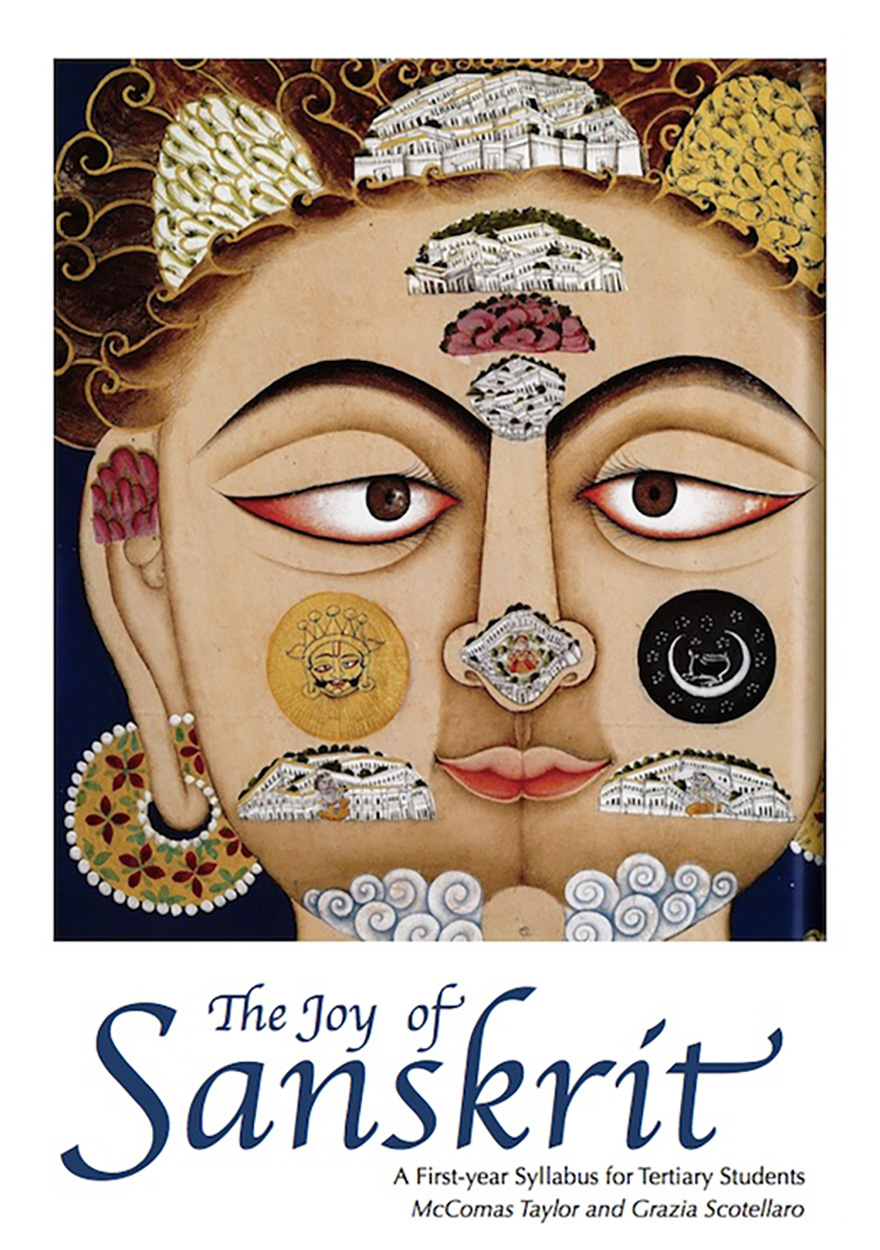
The Joy of Sanskrit »
A first-year syllabus for tertiary students
Authored by: McComas Taylor, Grazia Scotellaro
Publication date: February 2014
The Joy of Sanskrit is a complete first-year course of twenty-five weeks designed for university students. We teach Sanskrit as a living tradition. This is in recognition of the fact that many of our students have backgrounds in Indic religions and Indian cultural practices, including yoga, art, music, dance and song. As a living tradition, we believe that the reception of language (especially the ability to read), should be balanced with its production (writing, speaking, chanting and singing). With this in view, each weekly unit has three parts: 1. simple Sanskrit conversational patterns, 2. a verse from the oral tradition, and 3. the all-important grammar section. The grammar is based on the textbook Introduction to Sanskrit by Prof. Thomas Egenes. Each week includes introductory videos, audio files to help you with correct pronunciation, and an audio commentary on the text book.
By the end of the course, you will be able to conduct a coherent conversation on a range of simple topics, you be able to chant accurately twenty-six well-known verses, and you will have a good grasp of all the most common grammatical forms, so that you are ready to begin reading simple narratives.
In addition to this Joy of Sanskrit e-text, you will need to purchase Introduction to Sanskrit, Parts 1 and 2. (T. Egenes, Motilal Banarsidass, 3rd edition or later), as it contains all the written exercises and solutions.
The Joy of Sanskrit etext is in ePub format, and you will need multimedia-enabled epub reader to access the video and audio content successfully.
If you have an iPad, iPhone or iPod touch, open The Joy of Sanskrit in iBooks
If you have an Android tablet, you will need this app: epubreader
If you have a Mac, Bookreader Lite works very well
If you are running Windows, you can read the ePub with Azardi, available here: http://azardi.infogridpacific.com/azardi-download.html
You can choose to download the complete Joy of Sanskrit e-text or to download each half as separate files.
This textbook is used as course material in:
Sanskrit 1 SKRT1002
Sanskrit 2 SKRT1003
For more information about studying a language at the ANU, please visit the College of Asia and the Pacific Languages website and take a look at the School of Culture, History and Language’s Language Guide (PDF, 2.2 MB).
Download for free
Not available for purchase
Author / Editors
Trevor Wilson »
Trevor Wilson retired in August 2003 after more than thirty-six years as a member of the Australian foreign service, the last fifteen as a member of the Senior Executive Service, after serving as Australian Ambassador to Myanmar (2000-03). Since October 2003 he has been a Visiting Fellow on Myanmar/Burma at the Department of Political and Social Change, School of International, Political and Strategic Studies, The Australian National University.
Since 2004, Trevor Wilson has been co-convener of the Myanmar/Burma Update conference series at ANU. He has (co)-edited four volumes of the conference papers, Myanmar’s Long Road to National Reconciliation (ISEAS 2006); and, with Monique Skidmore, Myanmar: the state, community and the environment (Asia Pacific Press, 2007); and Dictatorship, disorder and decline in Myanmar (ANU Press, 2008); and with Monique Skidmore and Nick Cheesman, Ruling Myanmar From Cyclone Nargis to National Elections (ISEAS 2010) based on the 2009 Myanmar/Burma Update. With David Kinley, he co-authored a case study of Australia’s human rights training in Myanmar ‘Engaging a pariah: Human rights training in Burma/Myanmar’ (Human Rights Quarterly, Vol. 29 No. 2, May 2007). He has written numerous opinion pieces and given many interviews about the situation in Myanmar/Burma.
Anthony Ware »
Anthony Ware is an associate professor of international and community development at Deakin University and a former director of the Australia Myanmar Institute. His research, much of which involves Myanmar, focuses on humanitarian and development approaches in conflict-affected situations. He has a particular interest in conflict sensitivity, ‘do no harm’, everyday peace, peacebuilding, and countering violent and hateful extremism with community-led programming. He is the lead author of Myanmar’s ‘Rohingya’ Conflict (2018).
Monique Skidmore »
Monique Skidmore is an honorary professor at Deakin University’s Alfred Deakin Institute. She is an award- and grant-winning Burmese political and medical anthropologist and an expert media commentator. She has published seven books on Myanmar, including Karaoke Fascism: Burma and the Politics of Fear (2004). She convened the Myanmar/Burma Update conference at The Australian National University for eight years.
Other
State, Society and Governance in Melanesia »
The state, society and governance in Melanesia program at ANU (SSGM) is devoted to the study of the Melanesian peoples and their countries – Papua New Guinea, Solomon Islands, Vanuatu, New Caledonia and Fiji – and constitutes the largest concentration of research expertise on Melanesia in the world
Book Launch: A New Rival State »
Professor Frank Bongiorno AM of the ANU School of History will launch the new book A New Rival State? Australia in Tsarist Diplomatic Communications, followed by Emeritus Professor Richard Rigby and Dr Elena Govor. This book is a unique collection of dispatches written in 1857–1917 by the Russian
Understanding the news in 2021 »
As the Myanmar coup continues to rattle world politics, two books shed a light on Myanmar’s turbulent democratic history. Trevor Wilson’s Eyewitness to Early Reform in Myanmar and Andrew Selth’s 2020 publication Interpreting Myanmar are available for free download. With the UNHCR reporting that