



Search titles
Displaying results 961 to 970 of 1179.
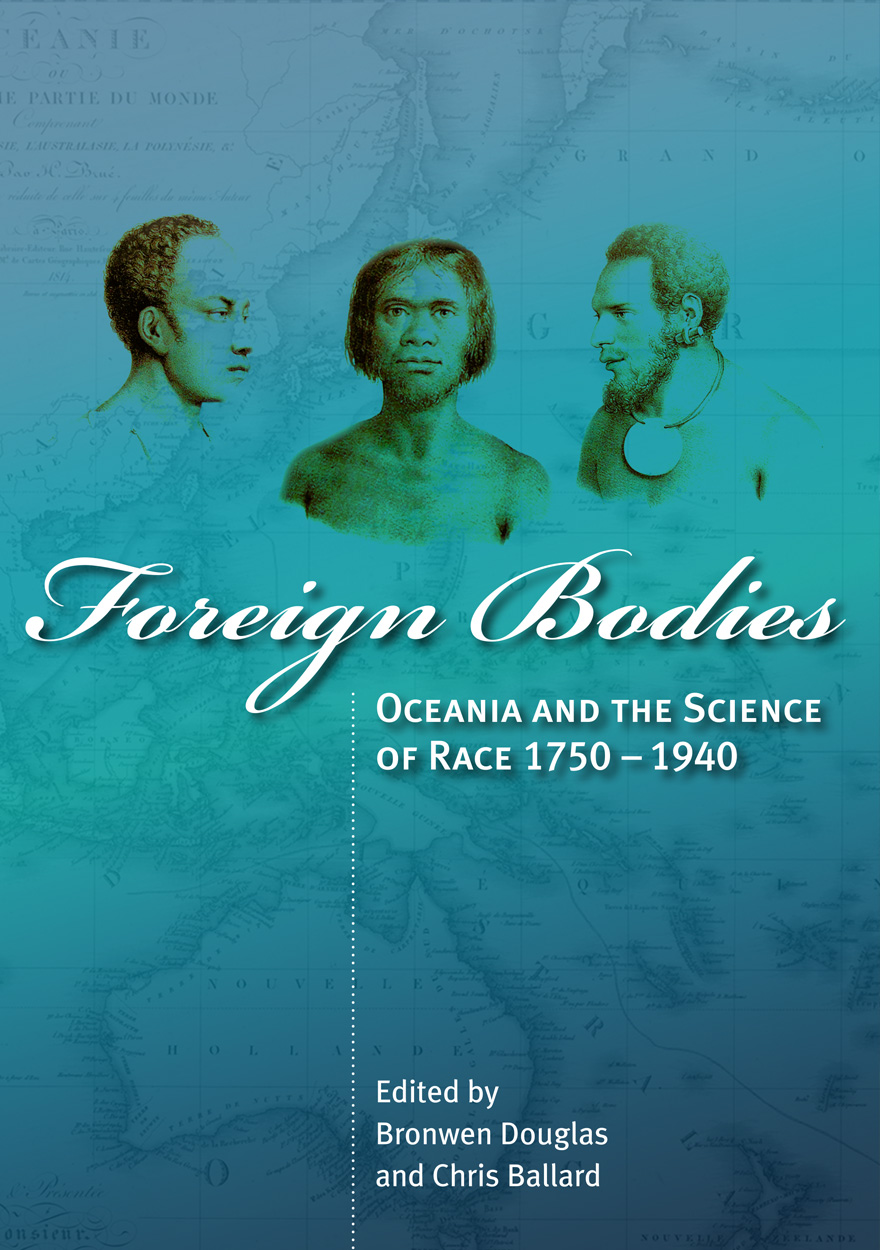
Foreign Bodies »
Oceania and the Science of Race 1750–1940
Edited by: Bronwen Douglas, Chris Ballard
Publication date: October 2008
From the 18th century, Oceania became the principal laboratory of raciology for scholars, voyagers, and colonisers alike. By juxtaposing encounters and theory, this magisterial book explores the semantics of human difference in all its emotional, intellectual, religious, and practical dimensions. The argument developed is subtle, engrossing, and gives the paradigm of ‘race’ its full use value. Foreign Bodies is a model of analysis and erudition from which historians of science and everyone interested in intercultural relations will greatly profit.
— Claude Blanckaert, CNRS (Centre Alexandre Koyré), Paris, and Honorary President, French Society for the History of the Science of Man

Contested Governance »
Culture, power and institutions in Indigenous Australia
Edited by: Janet Hunt, Diane Smith, Stephanie Garling, Will Sanders
Publication date: October 2008
It is gradually being recognised by both Indigenous and non-Indigenous Australians that getting contemporary Indigenous governance right is fundamental to improving Indigenous well-being and generating sustained socioeconomic development. This collection of papers examines the dilemmas and challenges involved in the Indigenous struggle for the development and recognition of systems of governance that they recognise as both legitimate and effective. The authors highlight the nature of the contestation and negotiation between Australian governments, their agents, and Indigenous groups over the appropriateness of different governance processes, values and practices, and over the application of related policy, institutional and funding frameworks within Indigenous affairs.
The long-term, comparative study reported in this monograph has been national in coverage, and community and regional in focus. It has pulled together a multidisciplinary team to work with partner communities and organisations to investigate Indigenous governance arrangements–the processes, structures, scales, institutions, leadership, powers, capacities, and cultural foundations–across rural, remote and urban settings.
This ethnographic case study research demonstrates that Indigenous and non-Indigenous governance systems are intercultural in respect to issues of power, authority, institutions and relationships. It documents the intended and unintended consequences–beneficial and negative–arising for both Indigenous and non-Indigenous Australians from the realities of contested governance. The findings suggest that the facilitation of effective, legitimate governance should be a policy, funding and institutional imperative for all Australian governments.
This research was conducted under an Australian Research Council Linkage Project, with Reconciliation Australia as Industry Partner.

Calvin for the Third Millennium »
Authored by: Hans Mol
Publication date: September 2008
This work is a series of sermons produced by Emeritus Professor Hans Mol, and based on Biblical texts, the Commentaries of John Calvin on these texts, and on Calvin’s Institutes of the Christian Religion. Mol is Australia’s pre-eminent scholar in the sociology of religion, particularly in Australia. His 1971 volume, Religion in Australia, was the first attempt at statistical analysis of religion in Australia, which was also internationally significant. Parallel to Mol’s interest in the sociology of religion has been his interest in Calvin. Indeed the theological basis of his life has been as a Calvinist. Here in this volume he brings both of these interests together. His sermons, preached over the years in Canberra, seek to apply the teachings of Calvin to a world-view in which the scientific study of religion, and indeed the wider study of sociology, are of central significance. In these sermons, he succeeds considerably in this.
The volume is a substantial contribution to scholarship, in that the combination of these two factors has only rarely been attempted. Thus, the volume has originality and will have enduring value. It is especially appropriate that it should be published at this time, in preparation for the 500th Anniversary of Calvin’s birth (1509–2009).

Whistleblowing in the Australian Public Sector »
Enhancing the theory and practice of internal witness management in public sector organisations
Edited by: A. J. Brown
Publication date: September 2008
Of the many challenges in public sector management, few are as complex as the management of whistleblowing. Because it can lead to the discovery and rectification of wrongdoing, public interest whistleblowing is widely acknowledged as being positive for organisations and for society at large. However, the conflicts and reprisal risks often associated with whistleblowing also support a widespread belief that every whistleblower is destined to suffer, and nothing can be done to protect them from reprisals. Even if they did it once, sensible employees are often seen as unlikely to ever blow the whistle a second time around.
The extensive research in this book reveals a more complex and, fortunately, more positive picture. The product of one of the world’s most comprehensive research projects on whistleblowing, evidence from over 8,000 public servants in over 100 federal, state and local government agencies shows that whistleblowers can and do survive, and that often their role is highly valued. Public sector managers face significant challenges in better managing and protecting whistleblowers. There is great variation between the many public agencies making the effort, and the many agencies where the outcomes — for managers and whistleblowers alike — are still likely to be grim. This book is compulsory reading for all public sector managers who wish to turn this negative trend around, and for anyone interested in public accountability generally.
Agenda - A Journal of Policy Analysis and Reform: Volume 15, Number 3, 2008 »
Authored by: William Coleman, Alex Robson
Publication date: September 2008
Agenda is a refereed, ECONLIT-indexed and RePEc-listed journal of the College of Business and Economics, The Australian National University. Launched in 1994, Agenda provides a forum for debate on public policy, mainly (but not exclusively) in Australia and New Zealand. It deals largely with economic issues but gives space to social and legal policy and also to the moral and philosophical foundations and implications of policy.
Subscribe to the Agenda Alerting service if you wish to be advised on forthcoming or new issues.
Download for free
Not available for purchase

Permissive Residents »
West Papuan refugees living in Papua New Guinea
Authored by: Diana Glazebrook
Publication date: September 2008
This book offers another frame through which to view the event of the outrigger landing of 43 West Papuans in Australia in 2006. West Papuans have crossed boundaries to seek asylum since 1962, usually eastward into Papua New Guinea (PNG), and occasionally southward to Australia. Between 1984–86, around 11,000 people crossed into PNG seeking asylum. After the Government of PNG acceded to the United Nations Convention and Protocol Relating to the Status of Refugees, West Papuans were relocated from informal camps on the international border to a single inland location called East Awin. This volume provides an ethnography of that settlement based on the author’s fieldwork carried out in 1998–99.

The Information Systems Academic Discipline in Australia »
Edited by: Guy G. Gable, Shirley Gregor, Roger Clarke, Gail Ridley, Robert Smyth
Publication date: September 2008
This book represents the second phase of a multi-method, multi-study of the ‘Information Systems Academic Discipline in Australia’. Drawing on Whitley’s Theory of Scientific Change, the study analysed the degree of ‘professionalisation’ of the Information Systems Discipline, the overarching research question being ‘To what extent is Information Systems a distinct and mature discipline in Australia?’
The book chapters are structured around three main sections: a) the context of the study; b) the state case studies; and c) Australia-wide evidence and analysis. The book is crafted to be accessible to IS and non-IS types both within and outside of Australia. It represents a ‘check point’; a snapshot at a point in time. As the first in a hoped for series of such snap-shots, it includes a brief history of IS in Australia, bringing us up to the time of this report.
The editorial team comprises Guy Gable, architect and leader; Bob Smyth, project manager; Shirley Gregor, sponsor, host and co-theoretician; Roger Clarke, discipline memory; and Gail Ridley, theoretician. In phase two, the editors undertook to examine each component study, with a view to arriving at an Australia-wide perspective.

Steady Hands Needed »
Reflections on the role of the Secretary of Foreign Affairs and Trade in Australia 1979-1999
Edited by: Trevor Wilson, Graham Cooke
Publication date: August 2008
In this monograph, five former secretaries of the Department of Foreign Affairs and Trade (DFAT) reflect on their experiences and the challenges of their times. A far cry from the pukka fantasies of ‘Yes Minister’, their recollections reveal the realpolitik of the policy front line where the secretary must stay ahead of emerging themes and issues in Australia’s international relations while simultaneously exercising governance oversight and providing leadership to a large, professional, diverse and dispersed organisation. From the Cold War to the War on Terror; from the floating of the dollar to GATT and the WTO; managing relations big and small, within our region and without; through relentless administrative reforms, technological change and changes of government; steering DFAT requires ‘steady hands’. This collection of public lectures presented in 2006 to the Australian Institute of International Affairs (AIIA) offers an invaluable resource for those with an interest in recent Australian history, foreign policy and public sector administration.

The Workshop for Morality »
The Islamic Creativity of Pesantren Daarut Tauhid in Bandung, Java
Authored by: Dindin Solahudin
Publication date: August 2008
This volume is a remarkable study of a most unusual pesantren. Officially known as Pesantren Daarut Tauhid, this pesantren was located in Bandung and flourished at the beginning of a period of Islamic resurgence in Indonesia. More commonly referred to as the Bengkel Akhlaq, this ‘Workshop for Morality’ exerted a special appeal to groups of young urban Muslims, particularly students. Its founder was H. K. Abdullah Gymnastiar, popularly known as Aa Gym, who later went on to become one of Indonesia’s most important Muslim preachers and television celebrities.
The Workshop for Morality is a superb work of both historical and ethnographic relevance that reflects the capacity of its author, Dindin Solahudin, to capture a critical moment in the development of Islam in contemporary Indonesian society.

Remembering Hedley »
Edited by: Coral Bell, Meredith Thatcher
Publication date: August 2008
Remembering Hedley commemorates the life of Hedley Bull (1932–85), a pivotal figure in the fields of international relations and strategic studies. Its publication coincides with the official opening on 6 August 2008 of the Hedley Bull Centre at The Australian National University in Canberra.