



Search titles
Displaying results 81 to 90 of 136.

APEC and liberalisation of the Chinese economy »
Edited by: Peter Drysdale, Zhang Yunling, Ligang Song
Publication date: December 2012
“China is so large that its trading interests and influence are global. But its interests are disproportionately powerful in its immediate Western Pacific and Asia Pacific partners. The evolution of China’s economic relationships with its Asia Pacific partners, in which APEC came to play a significant role in the 1990s, is thus a central part of the story of China’s rapidly growing and changing interaction with the global economy.”
- Ross Garnaut
APEC is an important forum through which China can demonstrate its commitment to economic openness. APEC has also been an important vehicle for China’s trade liberalisation on the way towards accession to the WTO.
In facilitating trade liberalisation, APEC and the WTO are mutually reinforcing. APEC prepares China for the WTO and WTO accession encourages China’s active participation in the APEC process. Both APEC membership and WTO accession help with the huge task of China’s domestic reform.
This book sets out China’s strategic interests in APEC in the lead-up to the APEC summit in Shanghai in 2001. Contributors include leading Chinese economists from the APEC Policy Research Centre in the Chinese Academy of Social Sciences–Zhang Yunling, Zhang Jianjun, Sun Xuegong, Li Kai, Chen Luzhi, Zhou Xiaobing, Zhao Jianglin–and from the Asia Pacific School of Economics and Management at The Australian National University–Peter Drysdale, Ligang Song, Ross Garnaut, Christopher Findlay, Andrew Elek, Yongzheng Yang, Yiping Huang, K.P. Kalirajan, Hadi Soesastro and Chen Chunlai.
This work, originally published by Asia Pacific Press, is reproduced here in the interests of maintaining open access to high-quality academic works no longer in print.
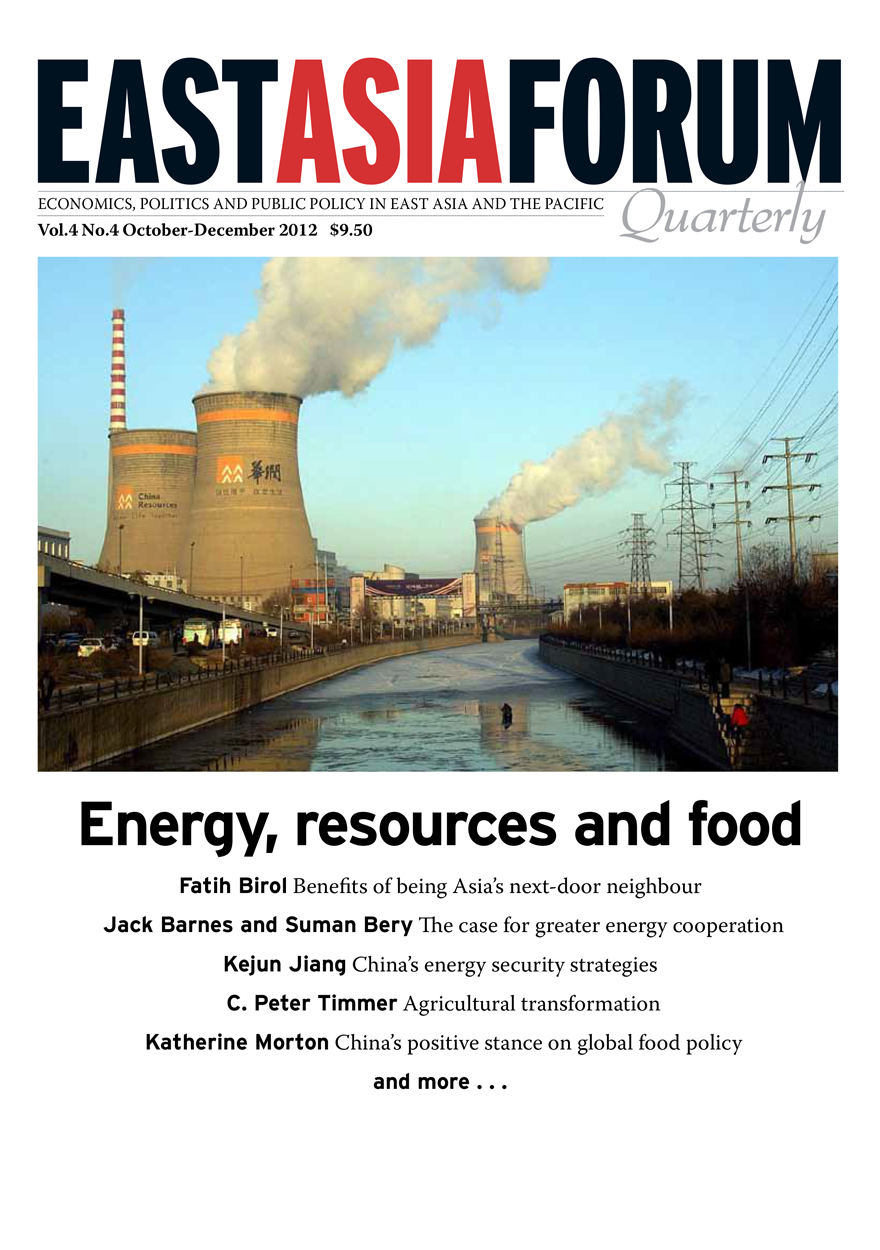
East Asia Forum Quarterly: Volume 4, Number 4, 2012 »
Publication date: December 2012
East Asia Forum Quarterly grew out of East Asia Forum (EAF) online, which has developed a reputation for providing a platform for the best in Asian analysis, research and policy comment on the Asia Pacific region in world affairs. EAFQ aims to provide a further window onto research in the leading research institutes in Asia and to provide expert comment on current developments within the region. The East Asia Forum Quarterly, like East Asia Forum online, is an initiative of the East Asia Forum (EAF) and its host organisation, the East Asian Bureau of Economic Research (EABER) in the Crawford School of Economics and Government in the College of Asia & the Pacific at The Australian National University.
Download for free
Not available for purchase

Dilemmas of China's growth in the Twenty-First Century »
Edited by: Ligang Song
Publication date: December 2012
Since economic reforms began in 1978, China has been a focal point for observing the effects of market liberalisation. China has not only truly become one of the ‘emerging giants’ in the world economy but also provided a successful example for transition from a centrally-planned to a market economy. Thus, there is a keen interest about what lies ahead for such a significant economic player. Dilemmas of China’s Growth in the Twenty-First Century is a comprehensive treatment of China’s economic achievements to date and prospects for the twenty-first century. Covering topics as diverse as economic stability and growth sustainability, WTO membership and its implications, income disparity, agricultural policy, trade and investment prospects, Dilemmas of China’s Growth in the Twenty-First Century is a powerful work and essential guide to the latest trends and prospects for the Chinese economy.
This work, originally published by Asia Pacific Press, is reproduced here in the interests of maintaining open access to high-quality academic works no longer in print.

China 2002 »
WTO entry and world recession
Edited by: Ross Garnaut, Ligang Song
Publication date: December 2012
In 2002 China enters the WTO. Long awaited by the world’s trading economies, it now comes in a year of global recession. What effect will China’s entry into the WTO have at a difficult time? The rapid expansion of China’s trade has required large adjustment in its trading partners, and the expansion and adjustment will accelerate with WTO entry. The internal adjustment pressures in China from WTO entry are also immense.
Recently dubbed Australia’s Ambassador to the region by Rowan Callick of the Financial Review, Ross Garnaut was Australia’s ambassador to China through an earlier exciting period when China took its first major steps towards opening to international trade and investment. He was instrumental in the development of China’s thinking about the WTO.
Ross Garnaut is Chairman of the China Economy and Business Program at The Australian National University. Australian members of the Program and their associates gather each year for the China Update.
Ligang Song is leading authority on the internationalisation of the Chinese economy and on the development of the private sector in China. He has worked at Peking University and People’s University in Beijing and at the International University in Tokyo.
This work, originally published by Asia Pacific Press, is reproduced here in the interests of maintaining open access to high-quality academic works no longer in print.

China: New Engine of World Growth »
Edited by: Ross Garnaut, Ligang Song
Publication date: December 2012
Twenty-five years of reform have transformed China from a centrally planned and closed system to a predominantly market-driven and open economy. As a consequence, China is emerging as the new powerhouse for the world economy. China: new engine for world growth discusses the impact and significance of this transformation. It points out risks to the growth process and unfinished tasks of reform. It presents conclusions from recent research on growth, trade and investment, the financial sector, income and regional disparities, industrial location and private sector development.
This work, originally published by Asia Pacific Press, is reproduced here in the interests of maintaining open access to high-quality academic works no longer in print.
China: Twenty Years of Economic Reform »
Edited by: Ross Garnaut, Ligang Song
Publication date: December 2012
China: Twenty Years of Reform outlines the experiences of China over the past two decades. It highlights the processes of reform, successes achieved, and problems faced during the economic transition.
“China, and its relations with the international community, have been transformed. China’s economy has expanded five times, and its foreign trade by twelve. It has greatly increased consumption levels of what had been about half of the world’s people in poverty.”
- Ross Garnaut
“Tremendous progress has been made over the past twenty years, but much more needs to be done in setting up a more open, efficient and transparent trade system, in line with the requirements of the WTO.”
- Ligang Song
“Radical reform is neither in China’s tradition, nor is it an easy task. Given the difficulties of the reform task and the structure of the political economy, it will probably take a few more years for China to accomplish SOE reform and reforms in other areas.”
- Yiping Huang
“The most remarkable aspect of China’s agricultural reform was it’s “spillover” effect. Non-agricultural activities in rural China sprang up immediately after the reforms began—the gross output value of TVEs grew at 24 per cent per annum from 1978 to 1995 and employment grew at 9 per cent per annum.”
- Yongzheng Yang
This work, originally published by Asia Pacific Press, is reproduced here in the interests of maintaining open access to high-quality academic works no longer in print.

Private Enterprise in China »
Authored by: Ross Garnaut, Ligang Song, Yang Yao, Xiaolu Wang
Publication date: December 2012
The Chinese economy is currently undergoing a profound institutional transformation—a quiet revolution. In a regulated environment geared to the requirements of state-owned enterprises, the successs of the private sector as the main focus for economic growth is remarkable. State-owned enterprises are currently being restructured based on market conditions in which private firms are now permitted to play an important role. Fascinated by the implications of this reform within the Chinese economy, the Asia-Pacific School of Economics and Management of The Australian National University, in conjunction with the China Center for Economic Research of Peking University research team, conducted a large sample survey. Four study sites were chosen: Beijing, Chengdu, Shunde and Wenzhou. Leading economists analyse the nature and dynamics of private sector reform within the Chinese economy and make recommendations for policy which support opportunities for growth and investment.

Australia: Identity, Fear and Governance in the 21st Century »
Edited by: Juliet Pietsch, Haydn Aarons
Publication date: November 2012
The latter years of the first decade of the twenty-first century were characterised by an enormous amount of challenge and change to Australia and Australians. Australia’s part in these challenges and changes is borne of our domestic and global ties, our orientation towards ourselves and others, and an ever increasing awareness of the interdependency of our world. Challenges and changes such as terrorism, climate change, human rights, community breakdown, work and livelihood, and crime are not new but they take on new variations and impact on us in different ways in times such as these.
In this volume we consider these recent challenges and changes and how Australians themselves feel about them under three themes: identity, fear and governance. These themes suitably capture the concerns of Australians in times of such change. Identity is our sense of ourselves and how others see us. How is this affected by the increased presence of religious diversity, especially Islamic communities, and increased awareness of moral and political obligations towards Indigenous Australians? How is it affected by our curious but changing relationship with Asia? Fear is an emotional reaction to particular changes and challenges and produces particular responses from individuals, politicians, communities and nations alike; fear of crime, fear of terrorism and fear of change are all considered in this volume.

East Asia Forum Quarterly: Volume 4, Number 3, 2012 »
Publication date: October 2012
East Asia Forum Quarterly grew out of East Asia Forum (EAF) online, which has developed a reputation for providing a platform for the best in Asian analysis, research and policy comment on the Asia Pacific region in world affairs. EAFQ aims to provide a further window onto research in the leading research institutes in Asia and to provide expert comment on current developments within the region. The East Asia Forum Quarterly, like East Asia Forum online, is an initiative of the East Asia Forum (EAF) and its host organisation, the East Asian Bureau of Economic Research (EABER) in the Crawford School of Economics and Government in the College of Asia & the Pacific at The Australian National University.
Download for free
Not available for purchase

Rebalancing and Sustaining Growth in China »
Edited by: Huw Mckay, Ligang Song
Publication date: July 2012
The idea that China’s economy needs to rebalance is no longer controversial inside or outside the country. Whether it be the increasing recognition of income inequality at home; the still large external surplus; the focus on consumption and industrial upgrading in the policy discourse; the economic, political and social tensions associated with the major decline in housing affordability; the profound conflict between industrialisation, urbanisation and the biosphere; the profitability gulf between the top SOEs and private firms; or the uni-directional pressures pushing on the real exchange rate; the evidence in favour of a highly imbalanced structure is omnipresent.
Rebalancing and Sustaining Growth in China brings together some of the world’s leading observers of the Chinese economy to debate the multifarious questions pertaining to rebalancing. How are we to make sense of the many, often contradictory, proposals that seek the same ultimate objective of a more sustainable growth model? What mix of policies will be most effective in addressing the required structural change without sacrificing prosperity along the way? Where should we look for root causes, and how can we avoid getting distracted by symptoms? How do China’s unique internal migration dynamics – and the Lewis turning point – constrain its options? What role will and should financial, fiscal and welfare reform play in the process? Where do water and energy security fit in? Can China innovate before it gets old – or can China get smart before it gets rich? And are intergenerational issues being taken into account?