



Search titles
Displaying results 31 to 40 of 1168.

The Architecture of Security in the Asia-Pacific »
Edited by: Ron Huisken
Publication date: October 2009
We cannot expect in East Asia over the foreseeable future to see the sort of conflation of sovereign states that has occurred in Europe. We must anticipate that, for the foreseeable future, the requirement will be for the sensible management and containment of competitive instincts.
The establishment of a multilateral security body in East Asia that includes all the key players, and which the major powers invest with the authority to tackle the shaping of the regional security order, remains a critical piece of unfinished business.

Harnessing the Bohemian »
Artists as innovation partners in rural and remote communities
Authored by: Peter Skippington
Publication date: December 2016
Harnessing the Bohemian takes a fresh and interdisciplinary perspective on the intractable problem of shrinking populations and resources in remote/rural communities. It challenges the conventional wisdom of community development theories and practices and envisages more central roles for the creative disciplines in revitalising futures planning.
It argues that the evolution of technologies, the emergence of creative economies, the increasing demand for creative products, and the emergence of new creative talent are continually changing community expectations and opportunities. Consequentially, fresh arguments and new ideas must be developed to stimulate more creative and innovative approaches to community development. Recognising that creativity and innovation exist across all community sectors, this book proposes practical new approaches that harness the creative capital of all community stakeholders.
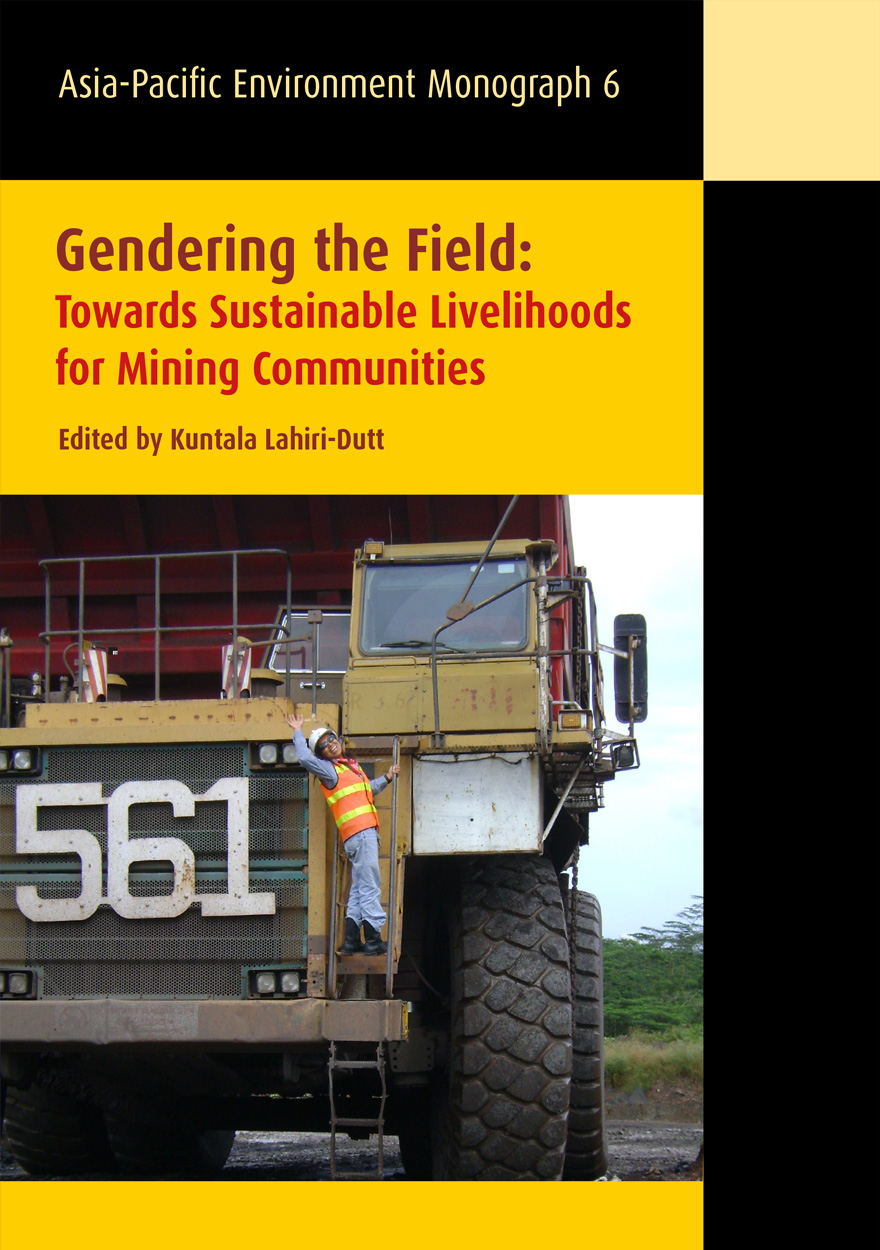
Gendering the Field »
Towards Sustainable Livelihoods for Mining Communities
Edited by: Kuntala Lahiri-Dutt
Publication date: March 2011
The chapters in this book offer concrete examples from all over the world to show how community livelihoods in mineral-rich tracts can be more sustainable by fully integrating gender concerns into all aspects of the relationship between mining practices and mine affected communities. By looking at the mining industry and the mine-affected communities through a gender lens, the authors indicate a variety of practical strategies to mitigate the impacts of mining on women’s livelihoods without undermining women’s voice and status within the mine-affected communities.
The term ‘field’ in the title of this volume is not restricted to the open-cut pits of large scale mining operations which are male-dominated workplaces, or with mining as a masculine, capital-intensive industry, but also connotes the wider range of mineral extractive practices which are carried out informally by women and men of artisanal communities at much smaller geographical scales throughout the mineral-rich tracts of poorer countries.

The Bible in Buffalo Country »
Oenpelli Mission 1925–1931
Publication date: October 2020
Arriving in the remote Arnhem Land Aboriginal settlement of Oenpelli (Gunbalanya) in 1925, Alf and Mary Dyer aimed to bring Christ to a former buffalo shooting camp and an Aboriginal population many whites considered difficult to control. The Bible in Buffalo Country: Oenpelli Mission 1925–1931 represents a snapshot of the tumultuous first six years of the Church Missionary Society’s mission at Oenpelli and the superintendency of Alfred Dyer between 1925 and 1931. Drawing together documentary and photographic sources with local community memory, a story emerges of miscommunication, sickness, constant logistical issues, and an Aboriginal community choosing when and how to engage with the newcomers to their land.
This book provides a fascinating and detailed record of the primary sources of the mission, placed alongside the interpretation and insight of local Traditional Owners. Its contents include the historical and archaeological context of the primary source material, the vivid mission reports and correspondence, along with stunning photographs of the mission and relevant maps, and finally the oral history of Esther Manakgu, presenting Aboriginal memory of this complex era.
The Bible in Buffalo Country emerged from community desire for access to the source documents of their own history and for their story to be known by the broader Australian public. It is intended for the benefit of communities in western Arnhem Land and is also a rich resource for historians of Aboriginal history (and other scholars in relevant disciplines).

Globalisation and Governance in the Pacific Islands »
State, Society and Governance in Melanesia
Edited by: Stewart Firth
Publication date: December 2006
The Pacific Islands are feeling the effects of globalisation. Free trade in sugar and garments is threatening two of Fiji’s key industries. At the same time other opportunities are emerging. Labour migration is growing in importance, and Pacific governments are calling for more access to Australia’s labour market. Fiji has joined Samoa, Tonga, Tuvalu and Kiribati as a remittance economy, with thousands of its citizens working overseas. Meantime, Papua New Guinea and Solomon Islands grapple with an older kind of globalisation in which overseas companies exploit mineral and forest resources.
The Pacific Islands confront unique problems of governance in this era of globalisation. The modern, democratic state often fits awkwardly with traditional ways of doing politics in that part of the world. Just as often, politicians in the Pacific exploit tradition or invent it to serve modern political purposes.
The contributors to this volume examine Pacific globalisation and governance from a wide range of perspectives. They come from Papua New Guinea, Solomon Islands, Hawai’i, the Federated States of Micronesia, Samoa, Fiji, New Zealand and Jamaica as well as Australia.
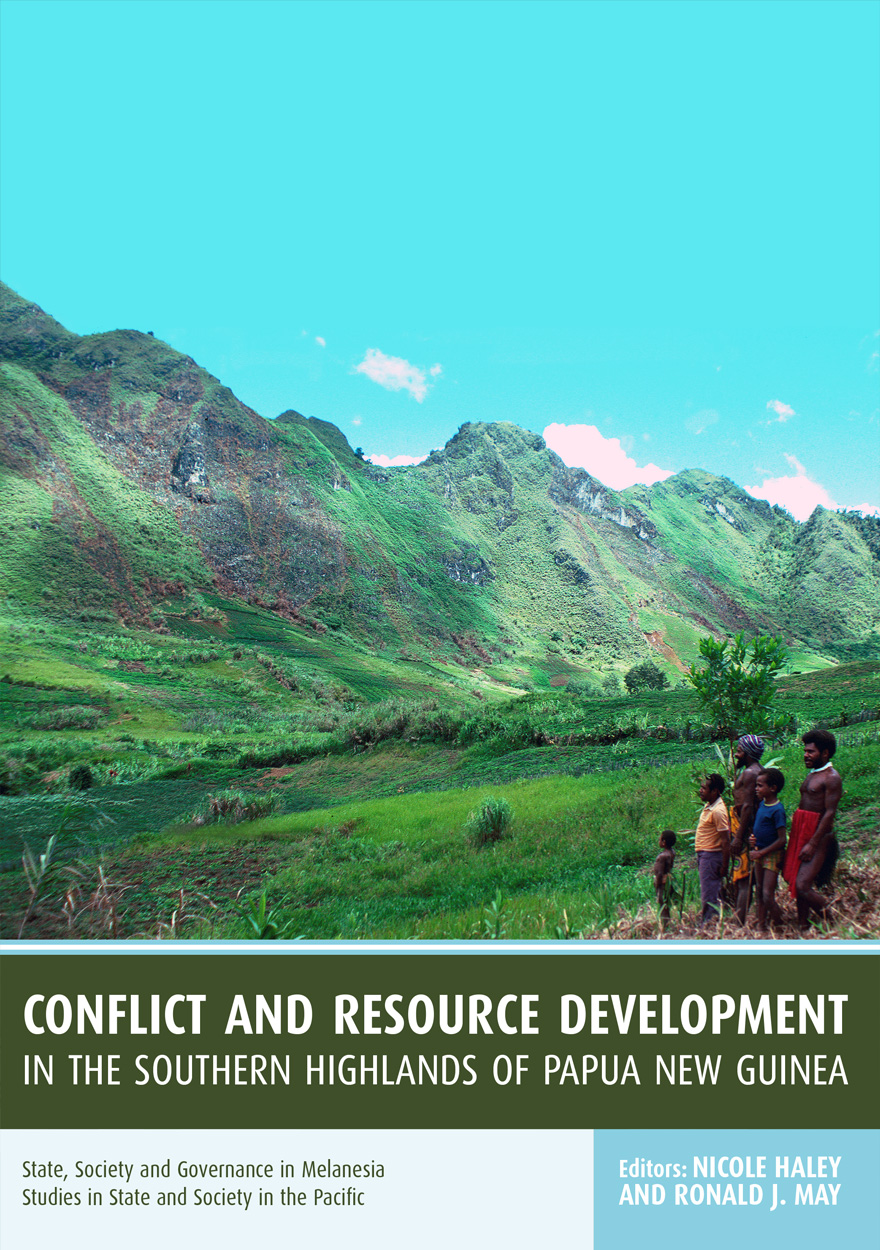
Conflict and Resource Development in the Southern Highlands of Papua New Guinea »
Edited by: Nicole Haley, R.J. May
Publication date: November 2007
The Southern Highlands is one of Papua New Guinea’s most resource-rich provinces, but for a number of years the province has been riven by conflict. Longstanding inter-group rivalries, briefly set aside during the colonial period, have been compounded by competition for the benefits provided by the modern state and by fighting over the distribution of returns from the several big mining and petroleum projects located within the province or impinging upon it. Deaths from the various conflicts over the past decade number in the hundreds. As a result of inter-group fighting, criminal activity and vandalism, a number of businesses have withdrawn from the province. Roadblocks and ambushes have made travel dangerous in many parts and expatriate missionaries and aid workers have left. Many public servants have abandoned their posts with the result that state services are not provided. Corruption is rife. Police are often reluctant to act because they are outnumbered and outgunned.
This volume brings together a number of authors with deep experience of the Southern Highlands to examine the underlying dynamics of resource development and conflict in the province. Its primary purpose is to provide some background to recent events, but the authors also explore possible approaches to limiting the human and economic costs of the ongoing conflict and breakdown of governance.

The Dilemmas of Engagement »
The Role of Consultation in Governance
Authored by: Jenny Stewart
Publication date: June 2009
‘Consultation’ has become something of a mantra in contemporary governance. Governments well understand that policy occurs in a highly contestable environment in which there are multiple, and often competing interests. They well recognise the political imperative to ‘engage’ stakeholders in order to manage potential conflict and, hopefully, obtain acceptance for their policies and programs. As a result, politicians and public officials frequently emphasise the need for consultation as an essential element of the deliberative processes underpinning the development of policy or the implementation of programs and services. But, moving beyond the rhetoric of consultation and engagement, how well is it done? In this monograph, Professor Jenny Stewart maps out the principal approaches used by governments to consult with and engage affected communities of interest. Stewart critically assesses the available literature and draws directly upon the experiences of political actors, bureaucrats and community sector organisations in order to identify the ‘good, bad, and the ugly’ of engagement. Through a judicious use of selected case studies, Stewart distils the essential dilemmas and contradictions inherent in many consultation strategies and highlights their relative strengths and weaknesses. This monograph is a probing and dispassionate analysis of the rationales, methodologies and outcomes of consultation and engagement. It is not intended to be a ‘cookbook’ or a ‘how to’ manual for those consulting or the consulted. Nevertheless, there is much here for the policy practitioner, the researcher and members of those ‘communities of interest’ who might, one day, find themselves the target of engagement.

Australia: Identity, Fear and Governance in the 21st Century »
Edited by: Juliet Pietsch, Haydn Aarons
Publication date: November 2012
The latter years of the first decade of the twenty-first century were characterised by an enormous amount of challenge and change to Australia and Australians. Australia’s part in these challenges and changes is borne of our domestic and global ties, our orientation towards ourselves and others, and an ever increasing awareness of the interdependency of our world. Challenges and changes such as terrorism, climate change, human rights, community breakdown, work and livelihood, and crime are not new but they take on new variations and impact on us in different ways in times such as these.
In this volume we consider these recent challenges and changes and how Australians themselves feel about them under three themes: identity, fear and governance. These themes suitably capture the concerns of Australians in times of such change. Identity is our sense of ourselves and how others see us. How is this affected by the increased presence of religious diversity, especially Islamic communities, and increased awareness of moral and political obligations towards Indigenous Australians? How is it affected by our curious but changing relationship with Asia? Fear is an emotional reaction to particular changes and challenges and produces particular responses from individuals, politicians, communities and nations alike; fear of crime, fear of terrorism and fear of change are all considered in this volume.

The General’s Goose »
Fiji's Tale of Contemporary Misadventure
Authored by: Robbie Robertson
Publication date: August 2017
His admirers said he was a charismatic leader with a dazzling smile, a commoner following an ancient tradition of warrior service on behalf of an indigenous people who feared marginalisation at the hands of ungrateful immigrants. One tourist pleaded with him to stage a coup in her backyard; in private parties around the capital, Suva, infatuated women whispered ‘coup me baby’ in his presence. It was so easy to overlook the enormity of what he had done in planning and implementing Fiji’s first military coup, to be seduced by celebrity, captivated by the excitement of the moment, and plead its inevitability as the final eruption of long-simmering indigenous discontent. A generation would pass before the consequences of the actions of Fiji’s strongman of 1987, Sitiveni Rabuka, would be fully appreciated but, by then, the die had been well and truly cast. The major general did not live happily ever after. No nirvana followed the assertion of indigenous rights. If anything, misadventure became his country’s most enduring contemporary trait. This is Fiji’s very human story.
Political Life Writing in the Pacific »
Reflections on Practice
Edited by: Jack Corbett, Brij V. Lal
Publication date: July 2015
This book aims to reflect on the experiential side of writing political lives in the Pacific region. The collection touches on aspects of the life writing art that are particularly pertinent to political figures: public perception and ideology; identifying important political successes and policy initiatives; grappling with issues like corruption and age-old political science questions about leadership and ‘dirty hands’. These are general themes but they take on a particular significance in the Pacific context and so the contributions explore these themes in relation to patterns of colonisation and the memory of independence; issues elliptically captured by terms like ‘culture’ and ‘tradition’; the nature of ‘self’ presented in Pacific life writing; and the tendency for many of these texts to be written by ‘outsiders’, or at least the increasingly contested nature of what that term means.