



Search titles
Displaying results 581 to 590 of 883.

Aboriginal History Journal: Volume 35 »
Edited by: Shino Konishi, Maria Nugent
Publication date: November 2011
In this volume, Grace Karskens extends her cross-cultural research on early colonial New South Wales by focusing on the uses of European clothing by Aboriginal men. Leah Lui-Chivizhe describes the participation of Torres Strait Islander men in railway construction work in Western Australia. Noah Riseman focuses on the life of one man to explore the experience of institutionalisation as a member of the Stolen Generations and later as a member of the Australian armed forces. Both these articles reflect on the nature of personal and collective remembrance, the ethics of using oral testimony in writing Indigenous history, and the relationship between oral and archival evidence. Ian D. Clark’s article answers Michael Connor’s refutation of the ‘Convincing Ground’ massacre and gives his own interpretations and conclusions regarding the evidence.
Christine Choo and Peta Stephenson, leaders of research into Aboriginal–Asian relations, have edited a special section on this topic, 30 years after James Urry’s Aboriginal History 1981 volume 5 on the same theme. They note in their introduction that the four papers together ‘retrieve pre-colonial and colonial relationships that place white settler narratives of Australia’s social development in a wider perspective. In the process, they challenge the ideological foreclosures and sometimes methodological timidity of mainstream nationalist histories’. Campbell Macknight published a piece in the 1981 volume on his research into contact between Macassans and Aboriginal people in Arnhem Land; in this volume, he reflects on the development of his own scholarship and on research in this area. Anna Shnukal did not contribute a piece to the 1981 volume, but in 1985 (Volume 9) she published an article on Torres Strait Islander creole. Her contribution this time focuses on Filipinos in the outer Torres Strait islands and the families they established with Indigenous women. Marriage is also the theme in Julia Martínez’s article, exploring marriages between Indonesian men and Indigenous Australian women. Victoria Haskins documents one Chinese family’s efforts to be allowed to employ Aboriginal workers in the early twentieth century.
Aboriginal History Inc. is a publishing organisation based in the Australian Centre for Indigenous History, Research School of Social Sciences, The Australian National University, Canberra.
For more information on Aboriginal History Inc. please visit aboriginalhistory.org.au.
Download for free
Not available for purchase

Agenda - A Journal of Policy Analysis and Reform: Volume 18, Number 2, 2011 »
Edited by: William Coleman
Publication date: November 2011
Agenda is a refereed, ECONLIT-indexed and RePEc-listed journal of the College of Business and Economics, The Australian National University. Launched in 1994, Agenda provides a forum for debate on public policy, mainly (but not exclusively) in Australia and New Zealand. It deals largely with economic issues but gives space to social and legal policy and also to the moral and philosophical foundations and implications of policy.
Subscribe to the Agenda Alerting service if you wish to be advised on forthcoming or new issues.
Download for free
Not available for purchase

Law's Anthropology »
From ethnography to expert testimony in native title
Authored by: Paul Burke
Publication date: November 2011
Anthropologists have been appearing as key expert witnesses in native title claims for over 20 years. Until now, however, there has been no theoretically-informed, detailed investigation of how the expert testimony of anthropologists is formed and how it is received by judges. This book examines the structure and habitus of both the field of anthropology and the juridical field and how they have interacted in four cases, including the original hearing in the Mabo case. The analysis of background material has been supplemented by interviews with the key protagonists in each case. This allows the reader a unique, insider’s perspective of the courtroom drama that unfolds in each case. The book asks, given the available ethnographic research, how will the anthropologist reconstruct it in a way that is relevant to the legal doctrine of native title when that doctrine gives a wide leeway for interpretation on the critical questions: what is the relevant grouping, what can be counted as a traditional law and when has there been too much change of tradition? How will such evidence be received by judges who are becoming increasingly sceptical about experts tailoring their evidence to suit the party which called them? This book answers these questions by assuming that there is more at stake here than the mere performance of roles. Rather, there is a complex interaction of distinct social fields each with its own habitus, and individual actors are engaged in an active and constructive agency, however subtle, which the painstaking research for this book uncovers.

Financing Higher Education and Economic Development in East Asia »
Edited by: Shiro Armstrong, Bruce Chapman
Publication date: November 2011
This volume addresses important issues to do with access to higher education and different models of its financing in the East Asia region. It is enriched by diverse perspectives from vastly different starting points and by the historical and institutional settings in the region. The issues are set out in the context of the value of higher education in economic development and how it contributes to the capacities to adopt and adapt to new technologies and undertake institutional innovation. The established and well-functioning higher education loan and financing systems, such as those in Australia, and the experience of different systems tried—both in East Asia and in the United States—are brought to bear in this volume.

Pacific Island Heritage »
Archaeology, Identity & Community
Edited by: Jolie Liston, Geoffrey Clark, Dwight Alexander
Publication date: November 2011
‘This volume emerges from a ground-breaking conference held in the Republic of Palau on cultural heritage in the Pacific. It includes bold investigations of the role of cultural heritage in identity-making, and the ways in which community engagement informs heritage management practices. This is the first broad and detailed investigation of the unique and irreplaceable cultural heritage of the Pacific from a heritage management perspective. It identifies new trends in research and assesses relationships between archaeologists, heritage managers and local communities. The methods which emerge from these relationships will be critical to the effective management of heritage sites in the 21st century. A wonderful book which emerges from an extraordinary conference. Essential reading for cultural heritage managers, archaeologists and others with an interest in caring for the unique cultural heritage of the Pacific Islands.’
— Professor Claire Smith, President World Archaeological Congress

Working Together in Vanuatu »
Research Histories, Collaborations, Projects and Reflections
Edited by: John Taylor, Nick Thieberger
Publication date: October 2011
This collection is derived from a conference held at the Vanuatu National Museum and Cultural Centre (VCC) that brought together a large gathering of foreign and indigenous researchers to discuss diverse perspectives relating to the unique program of social, political and historical research and management that has been fostered in that island nation. While not diminishing the importance of individual or sole-authored methodologies, project-centered collaborative approaches have today become a defining characteristic of Vanuatu’s unique research environment. As this volume attests, this environment has included a dynamically wide range of both ni-Vanuatu and foreign researchers and related research perspectives, most centrally including archaeologists and anthropologists, linguists, historians, legal studies scholars and development practitioners. This emphasis on collaboration has emerged from an ongoing awareness across Vanuatu’s research community of the need for trained researchers to engage directly with pressing social and ethical concerns, and out of the proven fact that it is not just from the outcomes of research that communities or individuals may be empowered, but also through their modes and processes of implementation, as through the ongoing strength and value of the relationships they produce. With this in mind, the papers presented here go beyond the mere celebration of collaboration by demonstrating Vanuatu’s specific environment of cross-cultural research as a diffuse set of historically emergent methodological approaches, and by showing how these work in actual practice.

East Asia Forum Quarterly: Volume 3, Number 3, 2011 »
Publication date: October 2011
East Asia Forum Quarterly grew out of East Asia Forum (EAF) online, which has developed a reputation for providing a platform for the best in Asian analysis, research and policy comment on the Asia Pacific region in world affairs. EAFQ aims to provide a further window onto research in the leading research institutes in Asia and to provide expert comment on current developments within the region. The East Asia Forum Quarterly, like East Asia Forum online, is an initiative of the East Asia Forum (EAF) and its host organisation, the East Asian Bureau of Economic Research (EABER) in the Crawford School of Economics and Government in the College of Asia & the Pacific at The Australian National University.
Download for free
Not available for purchase

Echoes of the Tambaran »
Masculinity, history and the subject in the work of Donald F. Tuzin
Edited by: David Lipset, Paul Roscoe
Publication date: October 2011
In the Sepik Basin of Papua New Guinea, ritual culture was dominated by the Tambaran —a male tutelary spirit that acted as a social and intellectual guardian or patron to those under its aegis as they made their way through life. To Melanesian scholarship, the cultural and psychological anthropologist, Donald F. Tuzin, was something of a Tambaran, a figure whose brilliant and fine-grained ethnographic project in the Arapesh village of Ilahita was immensely influential within and beyond New Guinea anthropology. Tuzin died in 2007, at the age of 61. In his memory, the editors of this collection commissioned a set of original and thought provoking essays from eminent and accomplished anthropologists who knew and were influenced by his work. They are echoes of the Tambaran.
The anthology begins with a biographical sketch of Tuzin’s life and scholarship. It is divided into four sections, each of which focuses loosely around one of his preoccupations. The first concerns warfare history, the male cult and changing masculinity, all in Melanesia. The second addresses the relationship between actor and structure. Here, the ethnographic focus momentarily shifts to the Caribbean before turning back to Papua New Guinea in essays that examine uncanny phenomena, narratives about childhood and messianic promises. The third part goes on to offer comparative and psychoanalytic perspectives on the subject in Fiji, Bali, the Amazon as well as Melanesia. Appropriately, the last section concludes with essays on Tuzin’s fieldwork style and his distinctive authorial voice.
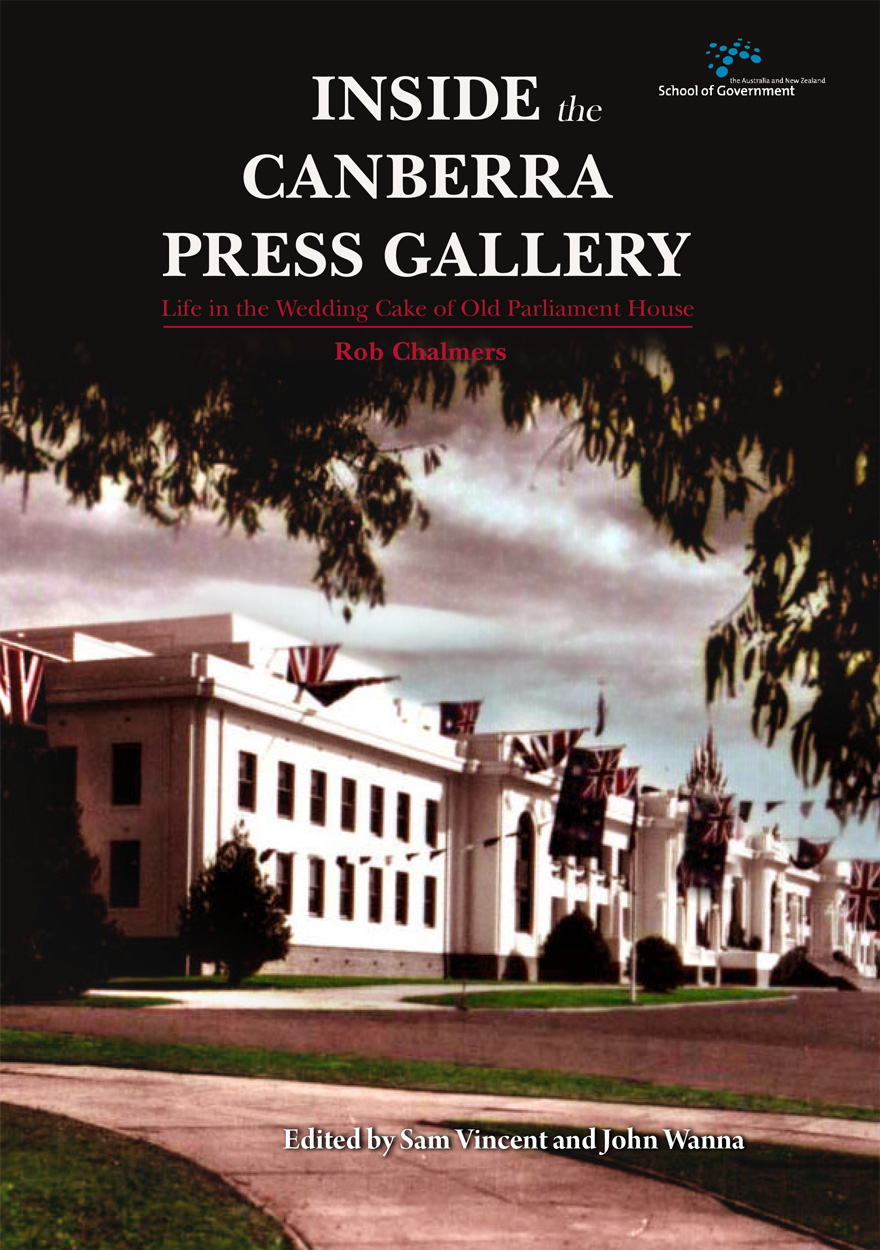
Inside the Canberra Press Gallery »
Life in the Wedding Cake of Old Parliament House
Authored by: Rob Chalmers
Publication date: October 2011
Before television, radio, and later the internet came to dominate the coverage of Australian politics, the Canberra Press Gallery existed in a world far removed from today’s 24-hour news cycle, spin doctors and carefully scripted sound bites.
This historical memoir of a career reporting from The Wedding Cake of Old Parliament House offers a rare insider’s perspective on both how the gallery once operated and its place in the Australian body politic.
Using some of the biggest political developments of the past fifty years as a backdrop, Inside the Canberra Press Gallery – Life in the Wedding Cake of Old Parliament House sheds light on the inner workings of an institution critical to the health of our parliamentary democracy.
Rob Chalmers (1929-2011) entered the Federal Parliamentary Press Gallery in 1951 as a twenty-one-year-old reporter for the now-defunct Sydney Daily Mirror and would retire from political commentary 60 years later – an unprecedented career span in Australian political history. No parliamentary figure – politician, bureaucrat or journalist − can match Chalmers’ experience, from his first Question Time on 7 March 1951 until, desperately ill, he reluctantly retired from editing the iconic newsletter Inside Canberra sixty years, four months and eighteen days later.
As well as being considered a shrewd political analyst, Chalmers was a much-loved member of the gallery and a past president of the National Press Club. Rob Chalmers used to boast that he had outlasted 11 prime ministers; and a 12th, Julia Gillard described him as ‘one of the greats’ of Australian political journalism upon his passing. Rob Chalmers is survived by his wife Gloria and two children from a previous marriage, Susan and Rob jnr.

Whistling While They Work »
A good-practice guide for managing internal reporting of wrongdoing in public sector organisations
Authored by: Peter Roberts, A. J. Brown, Jane Olsen
Publication date: September 2011
This guide sets out results from four years of research into how public sector organisations can better fulfil their missions, maintain their integrity and value their employees by adopting a current best-practice approach to the management of whistleblowing.
This guide focuses on: the processes needed for public employees and employees of public contractors to be able to report concerns about wrongdoing in public agencies and programs; and managerial responsibilities for the support, protection and management of those who make disclosures about wrongdoing, as part of an integrated management approach.
The guide is designed to assist with the special systems needed for managing ‘public interest’ whistleblowing-where the suspected or alleged wrongdoing affects more than the personal or private interests of the person making the disclosure. As the guide explains, however, an integrated approach requires having good systems for managing all types of reported wrongdoing-including personal, employment and workplace grievances-not least because these might often be interrelated with ‘public interest’ matters.