



Asia-Pacific Security Studies
The Asia-Pacific Security Studies series publishes works on the history and prospects of security in the Asia-Pacific region, including military history, Australian defence policy, state- and non-state–based security, international relations of the Asia-Pacific, defence and strategic studies, and war and conflict.
Please note: The following list of titles is sorted by publication date, with the most recent first.
Displaying results 1 to 7 of 7.

Australian Defence Strategic Guidance, 1976–2020 »
Volume I: Defending Australia without a Threat, 1976–1994
Edited by: Jean Bou, Stephan Frühling
Publication date: 2026
Between 1976 and 2020, Australia’s Department of Defence produced a range of strategic guidance documents. Some were classified, intended to inform and guide the government, while others were created for public release and ultimately became statements of government policy. These documents offer an insight into how successive Australian governments understood the nation’s security and what policy and institutional steps should be taken in response. Each paper aimed to develop or shape strategic concepts, provided the basis for significant budget and capability decisions, and directed reforms and policy change across the Defence organisation.
For the first time, the story of how these documents were developed, and the key ideas and debates that shaped them, can now be told. Based on unique access to archival records, this book is the product of a joint research project undertaken between the Australian Commonwealth’s Department of Defence and The Australian National University.
By the early 1970s, Australia had to develop and communicate a new defence policy at a time when there seemed to be no clear threat to the country. This led the government of Malcolm Fraser to commission Australia’s first Defence White Paper in 1976. As a public expression of government policy, this was a fundamentally new format for strategic guidance. Other White Papers followed in 1987 and 1994. The formerly key Defence Committee, previously responsible for the development of the guidance, faded, and longstanding classified guidance papers had their final iterations. This volume traces the demise of these Strategic Basis papers, as well as the rise of White Papers and other ad-hoc guidance documents. In doing so, it helps to show how Australian defence policy and strategic guidance were forged during the Defence of Australia era.
‘At the heart of resilience is knowledge. We are in fraught times. We need to understand how we have seen our strategic requirements historically to benchmark what we need to do now, comprehending strengths and inadequacies in our thinking. These volumes are essential reading.’
—Kim Beazley, former Minister for Defence and leader of the Labor opposition
‘This history of Australian Defence Strategic Guidance shows the messy reality of policy development. Politics, personality, money and deadlines all make for a combustible mix. This is a white-knuckle ride for anyone who has ever worked in the strategy business. The book makes for compelling reading, explaining the, at times, mystifying policy results. It shows how Australia's strategic approach developed, setting the foundations for today's defence capabilities.’
—Peter Jennings, former Deputy Secretary in the Department of Defence and former Director of the Australian Strategic Policy Institute
‘With unique, unfettered access to the classified files, this meticulous, scholarly, lively study illuminates the processes, the personalities and above all the ideas that have shaped Australia’s big defence decisions over the past 50 years. It is a remarkable resource and an essential foundation for the momentous debates we need to have about our defence in the challenging and very different decades ahead.’
—Hugh White AO, Emeritus Professor of Strategic Studies, ANU
Coming soon
Notify me
Australian Defence Strategic Guidance, 1976–2020 »
Documents: Defending Australia without a Threat, 1976–1994
Edited by: Jean Bou, Stephan Frühling
Publication date: 2026
Between 1976 and 2020, Australia’s Department of Defence produced a range of strategic guidance documents. Some were classified, intended to inform and guide the government, while others were created for public release and ultimately became statements of government policy. These documents offer an insight into how successive Australian governments understood the nation’s security and what policy and institutional steps should be taken in response. Each paper aimed to develop or shape strategic concepts, provided the basis for significant budget and capability decisions, and directed reforms and policy change across the Defence organisation.
For the first time, the story of how these documents were developed, and the key ideas and debates that shaped them, can now be told. Based on unique access to archival records, this book is the product of a joint research project undertaken between the Australian Commonwealth’s Department of Defence and The Australian National University.
This volume is a facsimile of all the strategic guidance papers analysed in Volume I. It includes a full copy of the 1976 Australian Strategic Analysis and Defence Policy Objectives; 1976 Defence White Paper; the 1979 Australian Strategic Analysis and Defence Policy Objectives; the 1983 Strategic Basis of Australian Defence Policy; the 1987 Defence White Paper; the 1989 Australia’s Strategic Planning in the 1990s; the 1991 Force Structure Review; the 1993 Strategic Review; and the 1994 Defence White Paper.
‘At the heart of resilience is knowledge. We are in fraught times. We need to understand how we have seen our strategic requirements historically to benchmark what we need to do now, comprehending strengths and inadequacies in our thinking. These volumes are essential reading.’
—Kim Beazley, former Minister for Defence and leader of the Labor opposition
‘This history of Australian Defence Strategic Guidance shows the messy reality of policy development. Politics, personality, money and deadlines all make for a combustible mix. This is a white-knuckle ride for anyone who has ever worked in the strategy business. The book makes for compelling reading, explaining the, at times, mystifying policy results. It shows how Australia's strategic approach developed, setting the foundations for today's defence capabilities.’
—Peter Jennings, former Deputy Secretary in the Department of Defence and former Director of the Australian Strategic Policy Institute
‘With unique, unfettered access to the classified files, this meticulous, scholarly, lively study illuminates the processes, the personalities and above all the ideas that have shaped Australia’s big defence decisions over the past 50 years. It is a remarkable resource and an essential foundation for the momentous debates we need to have about our defence in the challenging and very different decades ahead.’
—Hugh White AO, Emeritus Professor of Strategic Studies, ANU
Coming soon
Notify me
Australian Defence Strategic Guidance, 1976–2020 »
Volume II: The Era of the Balanced Force, 1997–2020
Edited by: Andrew Carr, Stephan Frühling
Publication date: 2026
Between 1976 and 2020, Australia’s Department of Defence produced a range of strategic guidance documents. Some were classified, intended to inform and guide the government, while others were created for public release and ultimately became statements of government policy. These documents offer an insight into how successive Australian governments understood the nation’s security and what policy and institutional steps should be taken in response. Each paper aimed to develop or shape strategic concepts, provided the basis for significant budget and capability decisions, and directed reforms and policy change across the Defence organisation.
For the first time, the story of how these documents were developed, and the key ideas and debates that shaped them, can now be told. Based on unique access to archival records, this book is the product of a joint research project undertaken between the Australian Commonwealth’s Department of Defence and The Australian National University.
In response to regional instability and the War on Terror, the government developed the Australian Defence Force (ADF) as a ‘Balanced Force’, structured to serve a wider range of national interests. A Defence White Paper in 2000 was followed by three short Defence Updates as the Department and ADF grappled with the pace of overseas operations. Three White Papers followed in 2009, 2013 and 2016, produced through increasingly ambitious and lengthy processes that grappled with the emergence of great power competition in the Indo-Pacific and the need to prepare Australia’s defence forces for an increasingly complex region. By the end of the period, the 2020 Defence Strategic Update signalled a shift away from the White Paper model of strategic guidance, which has been replaced today by the National Defence Strategy.
‘At the heart of resilience is knowledge. We are in fraught times. We need to understand how we have seen our strategic requirements historically to benchmark what we need to do now, comprehending strengths and inadequacies in our thinking. These volumes are essential reading.’
—Kim Beazley, former Minister for Defence and leader of the Labor opposition
‘This history of Australian Defence Strategic Guidance shows the messy reality of policy development. Politics, personality, money and deadlines all make for a combustible mix. This is a white-knuckle ride for anyone who has ever worked in the strategy business. The book makes for compelling reading, explaining the, at times, mystifying policy results. It shows how Australia's strategic approach developed, setting the foundations for today's defence capabilities.’
—Peter Jennings, former Deputy Secretary in the Department of Defence and former Director of the Australian Strategic Policy Institute
‘With unique, unfettered access to the classified files, this meticulous, scholarly, lively study illuminates the processes, the personalities and above all the ideas that have shaped Australia’s big defence decisions over the past 50 years. It is a remarkable resource and an essential foundation for the momentous debates we need to have about our defence in the challenging and very different decades ahead.’
—Hugh White AO, Emeritus Professor of Strategic Studies, ANU
Coming soon
Notify me
Australian Defence Strategic Guidance, 1976–2020 »
Documents: The Era of the Balanced Force, 1997–2020
Edited by: Andrew Carr, Stephan Frühling
Publication date: 2026
Between 1976 and 2020, Australia’s Department of Defence produced a range of strategic guidance documents. Some were classified, intended to inform and guide the government, while others were created for public release and ultimately became statements of government policy. These documents offer an insight into how successive Australian governments understood the nation’s security and what policy and institutional steps should be taken in response. Each paper aimed to develop or shape strategic concepts, provided the basis for significant budget and capability decisions, and directed reforms and policy change across the Defence organisation.
For the first time, the story of how these documents were developed, and the key ideas and debates that shaped them, can now be told. Based on unique access to archival records, this book is the product of a joint research project undertaken between the Australian Commonwealth’s Department of Defence and The Australian National University.
This volume is a facsimile of all the strategic guidance papers analysed in Volume II. It includes a full copy of the 1997 Australian Strategic Policy; 2000 Defence White Paper; 2003 Defence Update; 2005 Defence Update; 2007 Defence Update; 2009 Defence White Paper; 2013 Defence White Paper; 2016 Defence White Paper; and the 2020 Defence Strategic Update.
‘At the heart of resilience is knowledge. We are in fraught times. We need to understand how we have seen our strategic requirements historically to benchmark what we need to do now, comprehending strengths and inadequacies in our thinking. These volumes are essential reading.’
—Kim Beazley, former Minister for Defence and leader of the Labor opposition
‘This history of Australian Defence Strategic Guidance shows the messy reality of policy development. Politics, personality, money and deadlines all make for a combustible mix. This is a white-knuckle ride for anyone who has ever worked in the strategy business. The book makes for compelling reading, explaining the, at times, mystifying policy results. It shows how Australia's strategic approach developed, setting the foundations for today's defence capabilities.’
—Peter Jennings, former Deputy Secretary in the Department of Defence and former Director of the Australian Strategic Policy Institute
‘With unique, unfettered access to the classified files, this meticulous, scholarly, lively study illuminates the processes, the personalities and above all the ideas that have shaped Australia’s big defence decisions over the past 50 years. It is a remarkable resource and an essential foundation for the momentous debates we need to have about our defence in the challenging and very different decades ahead.’
—Hugh White AO, Emeritus Professor of Strategic Studies, ANU
Coming soon
Notify me
Military History Supremo »
Essays in Honour of David Horner AM FASSA
Edited by: Joan Beaumont, Garth Pratten
Publication date: June 2025
Professor Emeritus David Horner AM FASSA is one of Australia’s greatest military historians and its fifth official historian of war and military operations. Few who undertake research in the field can do so without consulting his prodigious, authoritative and definitive publications. Serving for 25 years in the Australian Army before joining The Australian National University, Horner is the epitome of the soldier–scholar and has played a key role in establishing military history as an academic discipline in Australia.
This volume honours Horner’s long career of service to history and the nation. Authors pay tribute to Horner’s legacy by engaging with his scholarship, applying his conclusions to new case studies and contexts, reflecting and expanding on the subjects he addressed and the methodologies he employed, and pushing the boundaries of the discipline he was instrumental in founding. The breadth of Horner’s research is demonstrated by the subjects and themes they address, including strategic planning and policy, command, multinational operations, intelligence and defence policy. Military History Supremo both underscores Horner’s contribution to Australia’s military and intelligence history and highlights the vibrancy and relevance of the field today.

Strategic Imagination »
Essays in Honour of Brendan Sargeant
Edited by: Andrew Carr
Publication date: June 2025
This book examines the concept of ‘strategic imagination’ developed by Brendan Sargeant during his distinguished career at the Australian Department of Defence and later as a scholar at the Strategic and Defence Studies Centre (SDSC), The Australian National University. His tragic passing has left this powerful idea awaiting a proper examination. This volume seeks to provide that scholarly account and carry both the concept and Brendan’s legacy forward.
The book is organised in three parts. First, former officials like Dennis Richardson join leading scholars, including Mark McKenna, Anthea Roberts and Ian Hall, to explore the unusual conjunction of strategy and imagination, demonstrating its crucial role in effective scholarship and policy.
Second, analysts from Australia and worldwide examine how strategic imagination improves strategic practice by revealing hidden possibilities, catalysing essential conversations and challenging core assumptions.
The final section offers personal reflections from Brendan’s colleagues at the SDSC, providing a fitting tribute to his life and contribution. The volume also includes selections of Brendan’s own writing on strategic imagination, ensuring his voice continues to inspire scholars and officials to explore this rich and powerful concept.
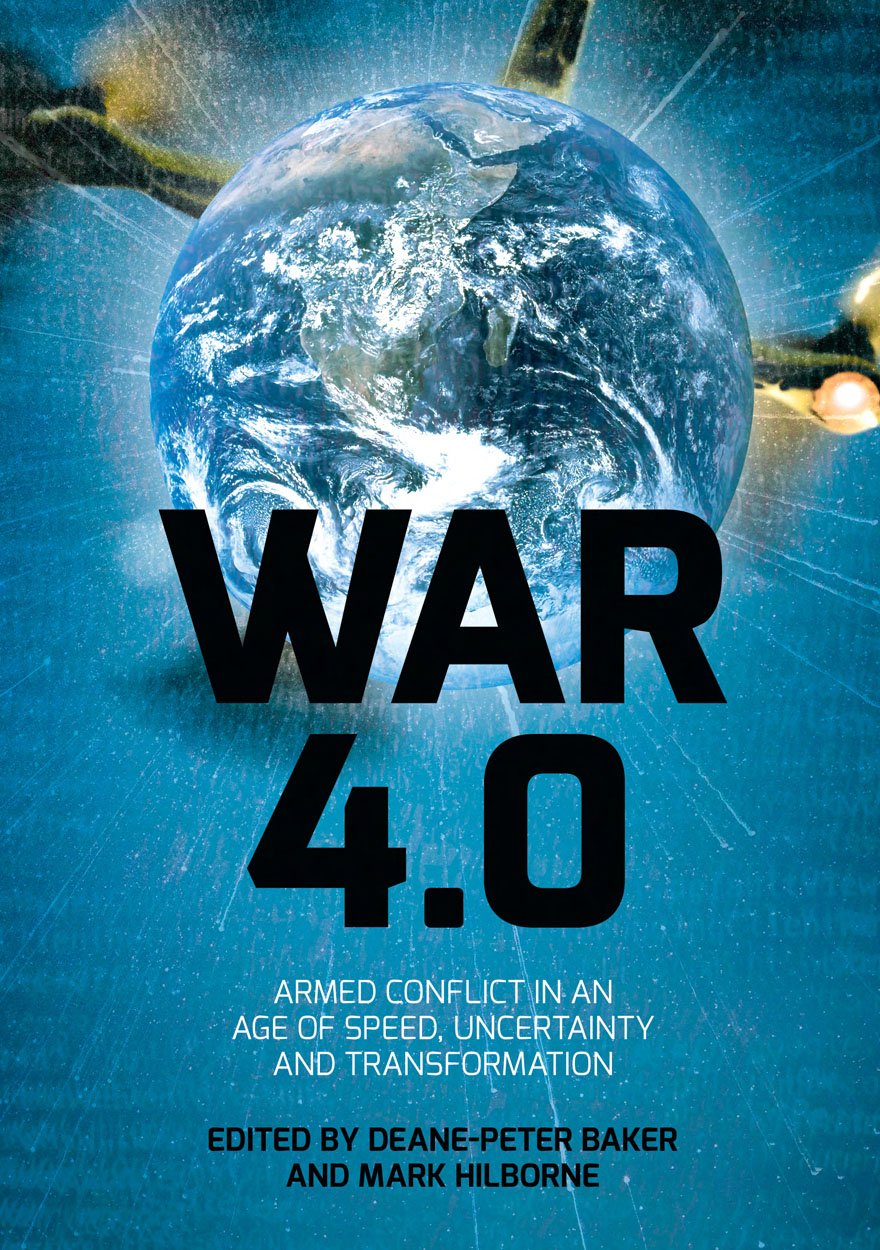
War 4.0 »
Armed Conflict in an Age of Speed, Uncertainty and Transformation
Edited by: Deane-Peter Baker, Mark Hilborne
Publication date: April 2025
This volume explores the impact of technology and new domains on future warfare. It identifies several themes, and highlights the increasing complexity of the security environment and the uncertainty of future war. The sense of time and speed has been, and is being, compressed by developments in quantum technologies, the cyber domain, artificial intelligence, the increased capabilities of sensors and data collection, as well as new propulsion technologies such as hypersonic designs. Concepts regarding the shape and extent of the battlefield are challenged by the notion of hybrid war and sub-threshold tactics, as well as new domains in which competition is increasing, such as space. Further challenging the shape of the battlefield is the increased development of remote and autonomous warfare. Commercial developments will affect how military production is owned and managed, and how military forces are composed.
Thus, a confluence of new technologies exists, combining to create the potential of fundamental transformation at many levels. This wave of technological change has been called the Fourth Industrial Revolution (4IR), characterised by an exponential rather than a linear rate of change, generated by convergence and complementarity of emerging technology domains. These may not affect the fundamental Clausewitzian nature of war, but they will likely affect its character. From a military perspective, the key will be the impact on the speed of operations and on the shape of the operational domain—the factors of time and space. The combination of these shifts will increasingly affect the perception of states and the degree of certainty in approaching and engaging in conflict.