



Books
Browse or search ANU Press' range of books or find out more about the publications' authors and co-publishers. Download the book for free or buy a print-on-demand copy.
Displaying results 671 to 680 of 803.
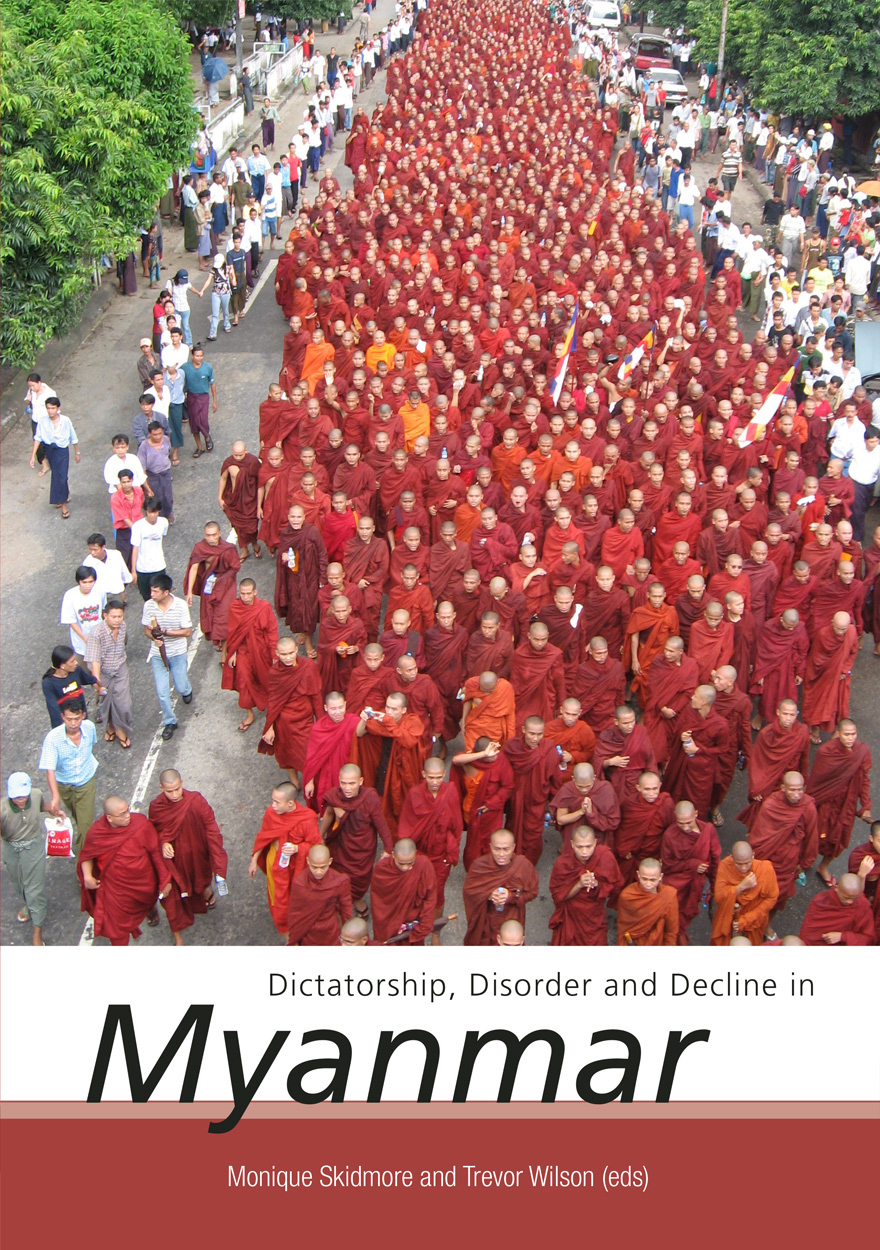
Dictatorship, Disorder and Decline in Myanmar »
Edited by: Monique Skidmore, Trevor Wilson
Publication date: December 2008
Mass peaceful protests in Myanmar/Burma in 2007 drew the world’s attention to the ongoing problems faced by this country and its oppressed people. In this publication, experts from around the world analyse the reasons for these recent political upheavals, explain how the country’s economy, education and health sectors are in perceptible decline, and identify the underlying authoritarian pressures that characterise Myanmar/Burma’s military regime.

Indigenous Biography and Autobiography »
Publication date: December 2008
In this absorbing collection of papers Aboriginal, Maori, Dalit and western scholars discuss and analyse the difficulties they have faced in writing Indigenous biographies and autobiographies. The issues range from balancing the demands of western and non-western scholarship, through writing about a family that refuses to acknowledge its identity, to considering a community demand not to write anything at all.
The collection also presents some state-of-the-art issues in teaching Indigenous Studies based on auto/biography in Austria, Spain and Italy.
For more information on Aboriginal History Inc. please visit aboriginalhistory.org.au.

The Centrelink Experiment »
Innovation in Service Delivery
Authored by: John Halligan, Jules Wills
Publication date: December 2008
Centrelink was established in 1997 as part of the Howard government’s bold experiment in re-framing social policy and re-shaping service delivery. Centrelink was the embodiment of a key tenet of the Howard vision for public service: a specialised service delivery ‘provider’ agency separated from the policy functions of the ‘purchaser’. Carved out of a monolithic Department of Social Security, Centrelink was established along ‘business lines’ operating 320 service centres and delivering payments to 10 million Australians. Although enjoying ‘monopoly provider’ status, the organisation was required to deliver services to many different clients on behalf of its ‘purchasing departments’ (up to 25 in total) under the terms of quasi-contractual service agreements. It was meant to demonstrate a greater level of both transparency and accountability for the administration of payments amounting to over $60 billion of Commonwealth expenditure. For many years there was a real ‘buzz’ around the Centrelink experiment and staff and clients were generally enthusiastic about the transformation. However, after around eight years, the experiment was reined in and Centrelink was placed under closer ministerial direction and under a new managing department. The experiment continues, but its trajectory reflects the different pressures impacting on such dedicated ‘services delivery agencies’.
John Halligan, Professor of Government at the University of Canberra, is a foremost Australian expert on public sector governance and has published extensively on the evolution, form and behaviour of the public sectors in Australia and overseas. This volume is the culmination of an exhaustive empirical study of the origins and experience of ‘the Centrelink Experiment’. I commend this book to researchers, policy practitioners and students with an interest in policy innovation, change management and the realpolitik of public sector reform.
John Wanna, Sir John Bunting Chair of Public Administration, The Australian National University

The Changing South Pacific »
Identities and Transformations
Edited by: Serge Tcherkézoff, Françoise Douaire-Marsaudon
Publication date: December 2008
The texts collected in this volume take an anthropological approach to the variety of contemporary societal problems which confront the peoples of the contemporary South Pacific: religious revival, the sociology of relations between local groups, regions and nation-States, the problem of culture areas, the place of democracy in the transition of States founded on sacred chiefdoms, the role of ceremonial exchanges in a market economy, and so forth.
Each chapter presents a society seen from a specific point of view, but always with reference to the issue of collective identity and its confrontation with history and change. The collection thus invites the reader to understand how the inhabitants of these societies seek to affirm both an individual identity and a sense of belonging to the contemporary world. In doing so, it informs the reader about the contemporary realities experienced by the inhabitants of the South Pacific, with a view to contributing to an intercultural dialogue between the reader and these inhabitants.
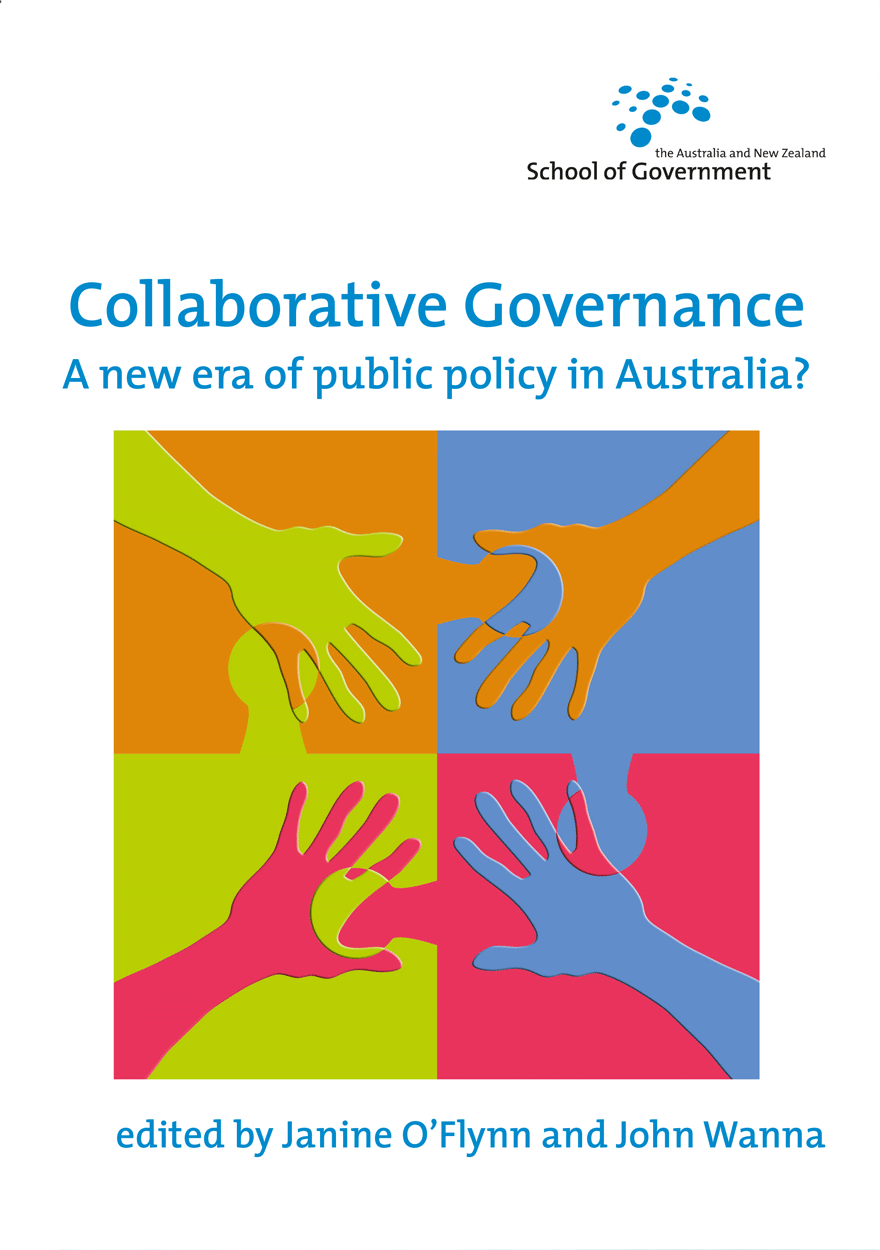
Collaborative Governance »
A new era of public policy in Australia?
Edited by: Janine O'Flynn, John Wanna
Publication date: December 2008
Collaboration has emerged as a central concept in public policy circles in Australia and a panacea to the complex challenges facing Australia. But is this really the cure-all it seems to be? In this edited collection we present scholarly and practitioner perspectives on the drivers, challenges, prospects and promise of collaboration. The papers, first presented at the 2007 ANZSOG Conference, draw on the extensive experience of the contributors in either trying to enact collaboration, or studying the processes of this phenomenon. Together the collection provides important insights into the potential of collaboration, but also the fiercely stubborn barriers to adopting more collaborative approaches to policy and implementation.
The collection includes chapter from public servants, third sector managers, and both Australian and international academics which together make it a stimulating read for those working with or within government. It adds considerably to the debate about how to address current challenges of public policy and provides a significant resource for those interested in the realities of collaborative governance.

Coup »
Reflections on the Political Crisis in Fiji
Edited by: Brij V. Lal, Michael Pretes
Publication date: December 2008
May 19, 2000. Fiji’s democratically elected multiracial government is hijacked by a group of armed gunmen led by George Speight, and held hostage for fifty days. Suva, the capital, is torched and looted as Speight’s supporters gather on the lawns of the parliamentary complex, dancing, cooking food, celebrating the purported abrogation of the constitution that brought the People’s Coalition government to power. The country is plunged into darkness yet again, enduring the pain of three coups in a period of just thirteen years. The process of healing and reconciliation, symbolised by the enactment of a new Constitution, unanimously approved by Parliament and blessed by the powerful Great Council of Chiefs, lies discarded, as winds of ethnic chauvinism sweep through the countryside, damaging the fragile fabric of multiculturalism that was carefully constructed by so many over many years. The economy is on the brink of collapse, investor confidence has vanished, and the best and the brightest are seeking succour on other shores. Fiji falls victim, yet again, to the prejudice and greed of a section of its people.
This book gathers together a handful of memoirs of those tragic events in Fiji. They were written while the gun was still smoking; personal, anguished reactions of people from all walks of life, concerned about a country they all love but deeply distressed by the developments there. They are first reactions. They will in time become essential building blocks for a larger interpretive framework of academic analysis about origins, processes and impacts. Straight from the heart, these memoirs will be remembered as the people of Fiji and their friends elsewhere contemplate the wreckage and ruin brought about by that act of madness in the month of May 2000.

Islamising Indonesia »
The Rise of Jemaah Tarbiyah and the Prosperous Justice Party (PKS)
Authored by: Yon Machmudi
Publication date: November 2008
The Prosperous Justice Party (PKS) is the most interesting phenomenon in contemporary Indonesian politics. Not only is it growing rapidly in membership and electoral support, it is also bringing a new and markedly different approach to Islamic politics, one which has no precedent in Indonesian history.
Understanding PKS and analysing its political behaviour presents challenges to scholars and observers. This is partly due to the fact that the party represents a new trend within Indonesian Islam which has few parallels with preceding movements.
Yon Machmudi has rendered us a valuable service. In this book, he provides a thoughtful and authoritative context for viewing PKS. He critiques the existing categorisations for Indonesian Islam and points to their inadequacy when describing the PKS and the campus-based Tarbiyah movement from which it sprang. He reworks the santri typology, dividing it into convergent, radical and global substreams. This offers new possibilities for explaining the PKS phenomenon and assists in differentiating between various types of Islamic revivalism in contemporary Indonesia. It also allows a more understanding of the accommodatory stance which PKS has towards the state and other political forces.
Yon’s text provides a good overview of the development of PKS from its Tarbiyah movement origins to its impressive success at the 2004 general elections. It considers the party’s attitude towards the issues of sharia implementation and community welfare and closes by examining the future challenges facing PKS.
It is a well written and authoritative account from a scholar who has done wideranging research on the party.

Public Leadership »
Perspectives and practices
Edited by: Paul `t Hart, John Uhr
Publication date: November 2008
‘Leadership’ is routinely admired, vilified, ridiculed, invoked, trivialised, explained and speculated about in the media and in everyday conversation. Despite all this talk, there is surprisingly little consensus about how to answer basic questions about the nature, place, role and impact of leadership in contemporary society. This book brings together academics from a broad array of social science disciplines who are interested in contemporary understandings of leadership in the public domain. Their work on political, administrative and civil society leadership represents a stock-take of what we need to know and offers original examples of what we do know about public leadership. Although this volume connects scholars living in, and mostly working on, public leadership in Australia and New Zealand, their contributions have a much broader scope and relevance.

Remaining Karen »
A Study of Cultural Reproduction and the Maintenance of Identity
Authored by: Ananda Rajah
Publication date: November 2008
This publication of Remaining Karen is intended as a tribute to Ananda Rajah and his consummate skills as an ethnographer. It is also a tribute to his long-term engagement in the study of the Karen. Remaining Karen was Ananda Rajah’s first focused study of the Sgaw Karen of Palokhi in northern Thailand, which he submitted in 1986 for this PhD in the Department of Anthropology in the Research School of Pacific and Asian Studies at The Australian National University. It is a work of superlative ethnography set in an historical and regional context and as such retains its value to the present.

Struggling for Self Reliance »
Four case studies of Australian Regional Force Projection in the late 1980s and the 1990s
Authored by: Bob Breen
Publication date: October 2008
Military force projection is the self-reliant capacity to strike from mainland ports, bases and airfields to protect Australia’s sovereignty as well as more distant national interests.
Force projection is not just a flex of military muscle in times of emergency or the act of dispatching forces. It is a cycle of force preparation, command, deployment, protection, employment, sustainment, rotation, redeployment and reconstitution. If the Australian Defence Force consistently gets this cycle wrong, then there is something wrong with Australia’s defence.
This monograph is a force projection audit of four Australian regional force projections in the late 1980s and the 1990s—valid measures of competence. It concludes that Australia is running out of luck and time.
The Rudd Government has commissioned a new Defence White paper. This monograph is Exhibit A for change.