



Search titles
Displaying results 531 to 540 of 1161.

craft + design enquiry: issue 7, 2015 »
Landscape, Place and Identity in Craft and Design
Edited by: Kay Lawrence
Publication date: November 2015
craft + design enquiry is an open-access, peer-reviewed journal promoting and disseminating research excellence generated by and about the craft and design sector. craft + design enquiry investigates the contribution that contemporary craft and design makes to society, establishing a dialogue between craft and design practice and cultural, social and environmental concerns. It includes submissions from across the field of craft and design from artists and practitioners, curators, historians, art and cultural theorists, educationalists, museum professionals, philosophers, scientists and others with a stake in the future developments of craft and design.
Download for free
Not available for purchase

Journeys into the Rainforest »
Archaeology of Culture Change and Continuity on the Evelyn Tableland, North Queensland
Authored by: Åsa Ferrier
Publication date: November 2015
This monograph presents the results of archaeological research that takes a longitudinal approach to interpreting and understanding Aboriginal–European contact. It focuses on a small but unique area of tropical rainforest in far north Queensland’s Wet Tropics Bioregion, located within the traditional lands of the JirrbalAboriginal people on the Evelyn Tableland. The research integrates a diverse range of data sources: archaeological evidence recovered from Aboriginal open sites occupied in the pre- to post-contact periods, historical documents of early ethnographers, settlers and explorers in the region, supplemented with Aboriginal oral history testimony. Analyses of the archaeological evidence excavated from three open sites facilitated the identification of the trajectories of culture change and continuity that this investigation focused on: Aboriginal rainforest material culture and technology, plant subsistence strategies, and rainforest settlement patterns.
Analyses of the data sets demonstrate that initial use of the rainforest environment on the Evelyn Tableland occurred during the early Holocene period, with successful adaptation and a change towards more permanent Aboriginal use of the rainforest becoming established in the late Holocene period. European arrival and settlement on traditional Aboriginal land resulted in a period of historical upheaval for the Aboriginal rainforest people. Following an initial period of violent interactions and strong Aboriginal resistance from the rainforest, Jirrbal Aboriginal people continued to adapt and transform their traditional culture to accommodate for the many changes forced upon them throughout the post‑contact period.
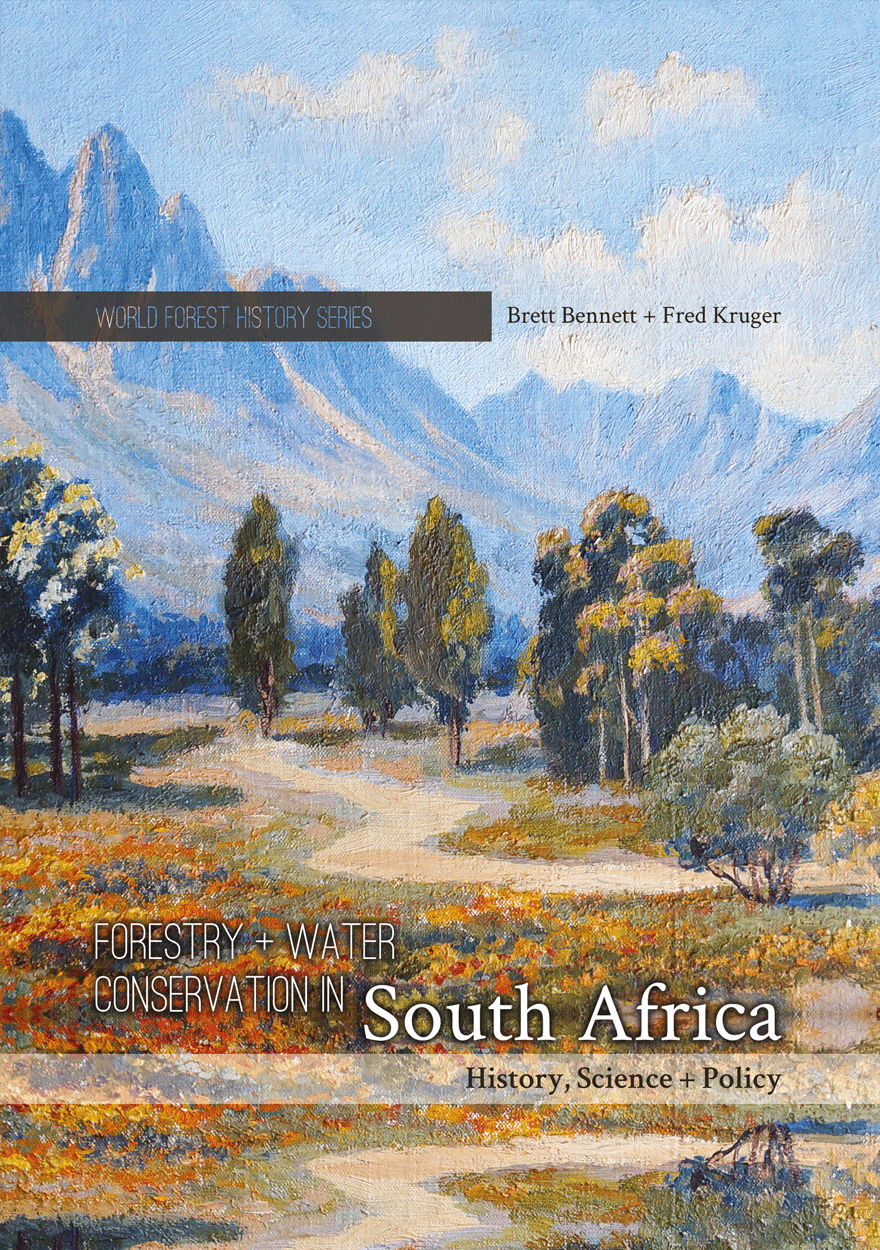
Forestry and Water Conservation in South Africa »
History, Science and Policy
Authored by: Brett Bennett, Fred Kruger
Publication date: November 2015
This innovative interdisciplinary study focuses on the history, science, and policy of tree planting and water conservation in South Africa. South Africa’s forestry sector has sat—often controversially—at the crossroads of policy and scientific debates regarding water conservation, economic development, and biodiversity protection. Bennett and Kruger show how debates about the hydrological impact of exotic tree planting in South Africa shaped the development of modern scientific ideas and state policies relating to timber plantations, water conservation, invasive species control, and biodiversity management within South Africa as well as elsewhere in the world. Forestry and Water Conservation in South Africa shows how scientific research on the impact of exotic and native vegetation led to the development of a comprehensive national policy for conserving water, producing timber, and protecting indigenous species from invasive alien plants. Policies and laws relating to forests and water began to change in the late 1980s and early 1990s as a result of political and administrative changes within South Africa. This book suggests that the country’s contemporary policies towards timber plantations, guided by the National Water Act of 1998, need to be reconsidered in light of the authors’ findings. Bennett and Kruger also call for more interdisciplinary research and greater emphasis on integrated policies and management plans for forestry, invasive alien plants, water conservation, and biodiversity preservation.

Maudu' »
A Way of Union with God
Authored by: Muhammad Adlin Sila
Publication date: November 2015
This volume offers a fascinating case study of the Sayyid community of Cikoang in South Sulawesi – in particular, an examination of the role of the descendants of Sayyid Jalaluddin al-‘Aidid, a Hadhrami merchant-teacher of great authority and charisma who is said to have initially settled in Gowa in the 17th century. It is of particular interest because the migration of Sayydid Jalaluddin occurred well before the major Hadhrami diaspora to Southeast Asia in the mid-19th century. Of particular interest is the way Sayyid Jalaluddin and his descendants became integrated within the Makassar community.
Sayyid Jalaluddin’s legacy to the Cikoang community is the Tarekat Bahr ul-Nur, whose mystic teachings expound the creation of the world from the ‘Nur Muhammad’. A consequence of this teaching is an enormous emphasis on the celebration of Maudu’ (Maulid or the Birth of the Prophet) as expressed in the local assertion: ‘My existence on this earth is for nothing but Maudu’.’ Every year this prompts the Cikoang community to hold one of the most elaborate and colourful Maulid celebrations in Indonesia.
This study was originally submitted as an MA thesis at ANU in 1998, but soon became recognised as an important contribution to Hadhrami studies. Its author, M. Adlin Sila, has since gone on to complete his PhD at ANU, Being Muslim in Bima of Sumbawa, Indonesia: Practice, Politics and Cultural Diversity. This study of Bima and its religious history establishes him as a major researcher on the diverse traditions of Islam in eastern Indonesia.

Shared Destiny »
Publication date: November 2015
Humanity as never before shares a common destiny, whether it be in terms of the resources of the planet, the global environment, economic integration, or the movement of peoples, ideas, cultures. For better or worse humankind is a Community of Shared Destiny 命运共同体.
The People’s Republic of China under the leadership of the Chinese Communist Party and its ‘Chairman of Everything’, Xi Jinping, has declared that it shares in the destiny of the countries of the Asia and Pacific region, as well as of nations that are part of an intertwined national self-interest. The Party, according to Marxist-Leninist-Maoist theory, is the vanguard of progressive social forces; it cleaves to the concept of shared destiny and its historical role in shaping that destiny. Since its early days nearly a century ago it has emphasised the collective over the individual, the end rather than the means. It addresses majority opinion while guiding and moulding the agenda both for today, and for the future.
Chapter notes are available to view online.

The First Fleet Piano: Volume One »
A Musician’s View
Authored by: Geoffrey Lancaster
Publication date: November 2015
During the late eighteenth century, a musical–cultural phenomenon swept the globe. The English square piano—invented in the early 1760s by an entrepreneurial German guitar maker in London—not only became an indispensable part of social life, but also inspired the creation of an expressive and scintillating repertoire. Square pianos reinforced music as life’s counterpoint, and were played by royalty, by musicians of the highest calibre and by aspiring amateurs alike.
On Sunday, 13 May 1787, a square piano departed from Portsmouth on board the Sirius, the flagship of the First Fleet, bound for Botany Bay. Who made the First Fleet piano, and when was it made? Who owned it? Who played it, and who listened? What music did the instrument sound out, and within what contexts was its voice heard? What became of the First Fleet piano after its arrival on antipodean soil, and who played a part in the instrument’s subsequent history? Two extant instruments contend for the title ‘First Fleet piano’; which of these made the epic journey to Botany Bay in 1787–88?
The First Fleet Piano: A Musician’s View answers these questions, and provides tantalising glimpses of social and cultural life both in Georgian England and in the early colony at Sydney Cove. The First Fleet piano is placed within the musical and social contexts for which it was created, and narratives of the individuals whose lives have been touched by the instrument are woven together into an account of the First Fleet piano’s conjunction with the forces of history.
View ‘The First Fleet Piano: Volume Two Appendices’.

The First Fleet Piano: Volume Two Appendices »
A Musician’s View
Authored by: Geoffrey Lancaster
Publication date: November 2015
During the late eighteenth century, a musical–cultural phenomenon swept the globe. The English square piano—invented in the early 1760s by an entrepreneurial German guitar maker in London—not only became an indispensable part of social life, but also inspired the creation of an expressive and scintillating repertoire. Square pianos reinforced music as life’s counterpoint, and were played by royalty, by musicians of the highest calibre and by aspiring amateurs alike.
On Sunday, 13 May 1787, a square piano departed from Portsmouth on board the Sirius, the flagship of the First Fleet, bound for Botany Bay. Who made the First Fleet piano, and when was it made? Who owned it? Who played it, and who listened? What music did the instrument sound out, and within what contexts was its voice heard? What became of the First Fleet piano after its arrival on antipodean soil, and who played a part in the instrument’s subsequent history? Two extant instruments contend for the title ‘First Fleet piano’; which of these made the epic journey to Botany Bay in 1787–88?
The First Fleet Piano: A Musician’s View answers these questions, and provides tantalising glimpses of social and cultural life both in Georgian England and in the early colony at Sydney Cove. The First Fleet piano is placed within the musical and social contexts for which it was created, and narratives of the individuals whose lives have been touched by the instrument are woven together into an account of the First Fleet piano’s conjunction with the forces of history.
View ‘The First Fleet Piano: Volume One’.

East Asia Forum Quarterly: Volume 7, Number 4, 2015 »
Publication date: November 2015
East Asia Forum Quarterly grew out of East Asia Forum (EAF) online, which has developed a reputation for providing a platform for the best in Asian analysis, research and policy comment on the Asia Pacific region in world affairs. EAFQ aims to provide a further window onto research in the leading research institutes in Asia and to provide expert comment on current developments within the region. The East Asia Forum Quarterly, like East Asia Forum online, is an initiative of the East Asia Forum (EAF) and its host organisation, the East Asian Bureau of Economic Research (EABER) in the Crawford School of Economics and Government in the College of Asia & the Pacific at The Australian National University.
Download for free
Not available for purchase
Bayesian Methods for Statistical Analysis »
Authored by: Borek Puza
Publication date: October 2015
Bayesian methods for statistical analysis is a book on statistical methods for analysing a wide variety of data. The book consists of 12 chapters, starting with basic concepts and covering numerous topics, including Bayesian estimation, decision theory, prediction, hypothesis testing, hierarchical models, Markov chain Monte Carlo methods, finite population inference, biased sampling and nonignorable nonresponse. The book contains many exercises, all with worked solutions, including complete computer code. It is suitable for self-study or a semester-long course, with three hours of lectures and one tutorial per week for 13 weeks.

Cross-sections, The Bruce Hall Academic Journal: Volume XI, 2015 »
Publication date: October 2015
Representing the combined energies of a large group of authors, editors, artists and researchers associated with Bruce Hall at the ANU, Cross-sections collects a range of works (from academic articles and essays to photography, digital art and installation artwork) that represents the disciplinary breadth and artistic vitality of the ANU.
Presenting a challenging and absorbing way for students to hone vital research skills, in the process, Cross-sections nurtures a fruitful environment of collaborative interaction between academics and students.
Download for free
Not available for purchase