


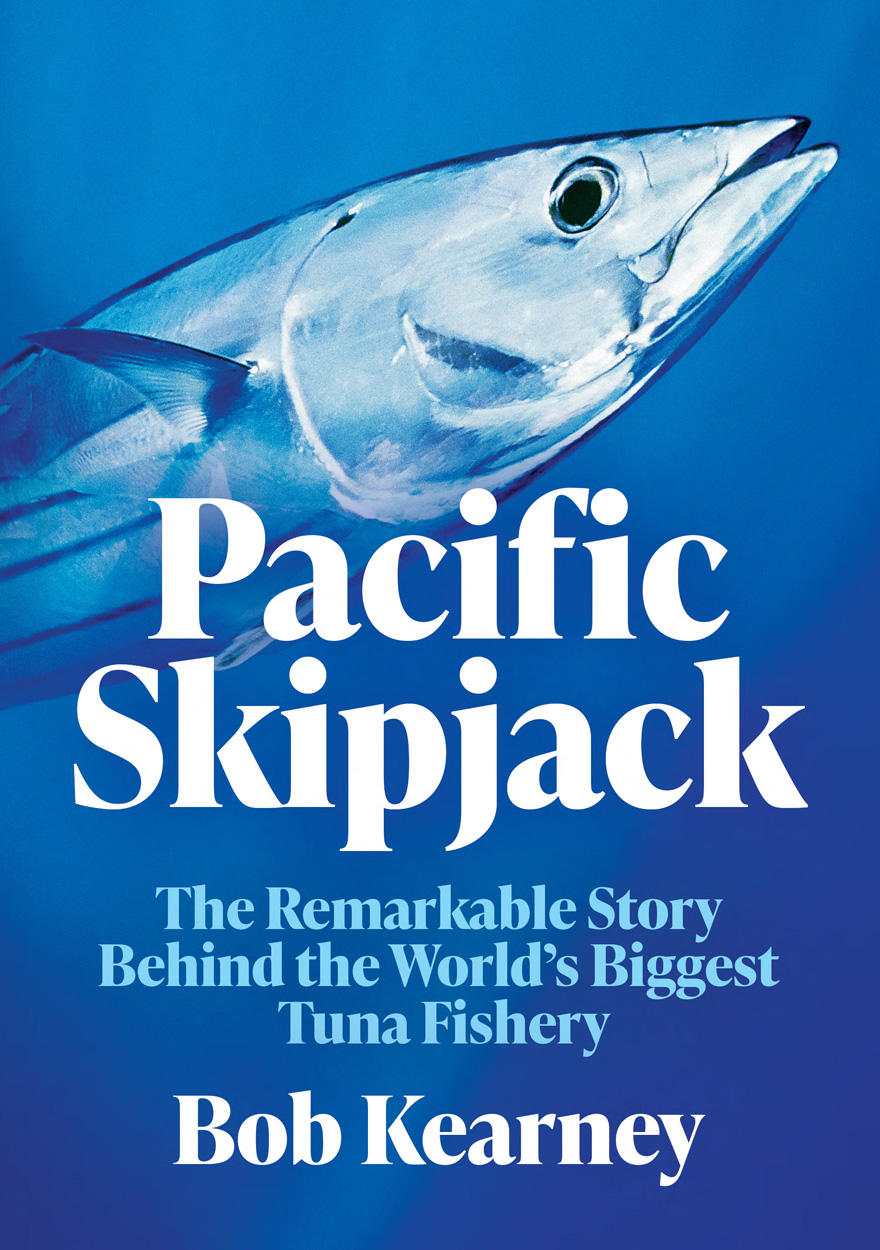
Pacific Skipjack
The Remarkable Story Behind the World’s Biggest Tuna Fishery
Authored by: Bob KearneyPlease read Conditions of use before downloading the formats.
Description
The Pacific skipjack tuna is a remarkable fish. With nowhere to hide in the wide-open spaces of the Pacific, it is one of the fastest and most mobile fish in the world. It is also one of the quickest fish to reproduce, such that the largest tuna fishery in the world, co-managed by more than twenty Pacific island nations, can yield enormous catches of skipjack without threat to the well-being of the species. The south-western Pacific is the only region in the world where all tuna stocks have a ‘healthy’ status. It supports the acknowledged best researched and managed tuna fishery on the planet. With skipjack being the most important renewable natural resource in the region, the fishery is crucial to the economic and wider social wellbeing of Pacific Island peoples, who are now largely managing these resources for themselves.
Astonishingly, while many individuals, groups, organisations, institutions and governments from around the world were involved in the establishment of this gigantic fishery, it came to be successfully managed primarily through the vision and tenacious efforts of a single young Australian scientist, Dr Bob Kearney. In this book, Kearney tells the extraordinary, colourful story of how, beginning in Papua New Guinea at the start of the 1970s, he crossed paths, and sometimes swords, with philanthropists, bankers, fishing executives, scientists, lawyers, government leaders and representatives from many nations, and even the Indonesian military. Kearney personally designed, obtained funding for, administered, managed, and demonstrated the scientific and commercial value of his dream experiment, carried out across more than thirty million square kilometres of ocean.
Pacific Skipjack is co-published with ACIAR (Australian Centre for International Agricultural Research).
Details
- ISBN (print):
- 9781760467647
- ISBN (online):
- 9781760467630
- Publication date:
- Oct 2026
- Imprint:
- ANU Press
- DOI:
- http://doi.org/10.22459/PS.2026
- Series:
- Science
- Disciplines:
- Science
- Countries:
- Pacific
PDF Chapters
Please read Conditions of use before downloading the formats.
If your web browser doesn't automatically open these files, please download a PDF reader application such as the free Adobe Acrobat Reader.
To copy a chapter DOI link, right-click (on a PC) or control+click (on a Mac) and then select ‘Copy link location’.
- Preliminary pages (PDF, 232 KB)
- Foreword (PDF, 127 KB)
- Acknowledgements (PDF, 131 KB)
- Introduction (PDF, 134 KB)
- Skipjack or stripeys (PDF, 239 KB) doi
- The concept of the Skipjack Program starts to materialise (PDF, 137 KB) doi
- Increased travelling as fact‑finding for the pursuit of funding (PDF, 177 KB) doi
- Life at the South Pacific Commission (PDF, 144 KB) doi
- The support of the Rockefeller Foundation (PDF, 156 KB) doi
- Dick Baird’s passing and ICLARM’s emergence (PDF, 137 KB) doi
- The pursuit of individual donors (PDF, 187 KB) doi
- Increased emphasis on the Law of the Sea (PDF, 175 KB) doi
- The donors suggest a novel way to fund the programme (PDF, 163 KB) doi
- Serious things begin to happen (PDF, 136 KB) doi
- An attempted coup, or two (PDF, 156 KB) doi
- Recruiting staff and procuring equipment (PDF, 179 KB) doi
- Getting a research vessel (plus some lessons in Japanese culture) (PDF, 199 KB) doi
- Some seriously exciting times: The beginning of fieldwork, 1977 (PDF, 163 KB) doi
- Reporting of the programme’s work (PDF, 154 KB) doi
- The relationship with the Forum Fisheries Agency (PDF, 170 KB) doi
- The Skipjack Programme in 1979 (PDF, 163 KB) doi
- The conclusion of fieldwork, 1980 (PDF, 149 KB) doi
- Final results: Had the programme achieved its objectives? (PDF, 233 KB) doi
- Do I now know enough about skipjack to know how little I know? (PDF, 191 KB) doi
- The South Pacific Commission’s tuna programmes post the Skipjack Programme (PDF, 144 KB) doi
Other publications that may interest you