



Books
Browse or search ANU Press' range of books or find out more about the publications' authors and co-publishers. Download the book for free or buy a print-on-demand copy.
Displaying results 31 to 40 of 84.

Brokers and boundaries »
Colonial exploration in Indigenous territory
Publication date: April 2016
Colonial exploration continues, all too often, to be rendered as heroic narratives of solitary, intrepid explorers and adventurers. This edited collection contributes to scholarship that is challenging that persistent mythology. With a focus on Indigenous brokers, such as guides, assistants and mediators, it highlights the ways in which nineteenth-century exploration in Australia and New Guinea was a collective and socially complex enterprise. Many of the authors provide biographically rich studies that carefully examine and speculate about Indigenous brokers’ motivations, commitments and desires. All of the chapters in the collection are attentive to the specific local circumstances as well as broader colonial contexts in which exploration and encounters occurred.
'This collection breaks new ground in its emphasis on Indigenous agency and Indigenous–explorer interactions. It will be of value to historians and others for a very long time.'
— Professor Ann Curthoys, University of Sydney
'In bringing together this group of authors, the editors have brought to histories of colonialism the individuality of these intermediaries, whose lives intersected colonial exploration in Australia and New Guinea.'
— Dr Jude Philp, Macleay Museum

Ebenezer Mission Station, 1863–1873 »
The Diary of Missionaries Adolf and Polly Hartmann
Edited by: Felicity Jensz
Publication date: July 2023
This book contains the annotated diary of Adolf and Mary (Polly) Hartmann, missionaries of the Moravian Church who worked at the Ebenezer mission station on Wotjobaluk country, in the north-west of the Colony of Victoria, Australia. The diary begins in 1863, as the Hartmanns are preparing to travel from Europe to take up their post, and ends in 1873, by which time they are working in Canada as missionaries to the Lenni Lenape people.
Recording the Hartmann’s eight years at the Ebenezer mission, the diary presents richly detailed insights into the daily interactions between Aboriginal people and their colonisers. The inhabitants of the mission are overwhelmingly described in the diary as agents in their lives, moving in and out of the missionaries’ sphere of influence, yet restricted at times by the boundaries of the mission. The diary reveals moments of laughter, shared grief, community, advocacy and reciprocal learning, alongside the mundane everyday chores of mission life.
Through the personal writings of a missionary couple, this diary brings to light the regular, routine and extraordinary events on a mission station in Australia in the third quarter of the nineteenth century—a period just prior to British high imperialism, and a period before increasingly restrictive legislation was enforced on Indigenous people in the Colony of Victoria.
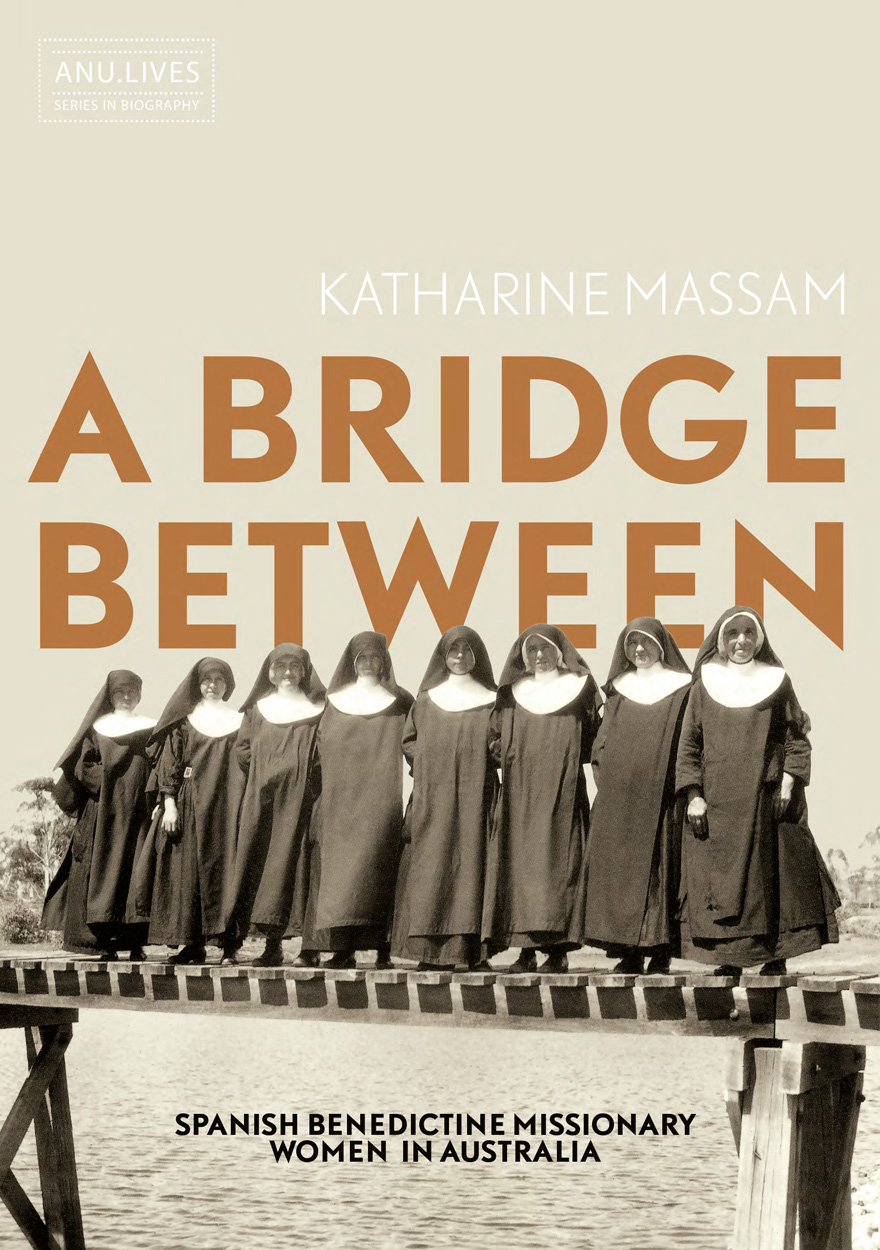
A Bridge Between »
Spanish Benedictine Missionary Women in Australia
Authored by: Katharine Massam
Publication date: October 2020
This sensitive account of Spanish Benedictine women at an Aboriginal mission in Western Australia is poignant and disturbing. Notable for its ecumenical spirit, depth of research and deep engagement with the subject, A Bridge Between is a model of how religious history, in its broader bearings, can be written.
— Graeme Davison, Monash University
With great insight and care, A Bridge Between presents a sympathetic but not uncritical history of the lives of individuals who have often been invisible. The story of the nuns at New Norcia is a timely contribution to Australia’s religious history. Given the findings of the Royal Commission, it will be widely read both within and beyond the academy. History is, here, a spiritual discipline, and an exercise in hope and reconciliation.
— Laura Rademaker, The Australian National University
A Bridge Between is the first account of the Benedictine women who worked at New Norcia and the first book-length exploration of twentieth-century life in the Western Australian mission town. From the founding of a grand school intended for ‘nativas’, through links to Mexico and Paraguay then Ireland, India and Belgium, as well as to their house in the Kimberley, and a network of villages near Burgos in the north of Spain, this is a complex international history. A Bridge Between gathers a powerful, fragmented story from the margins of the archive, recalling the Aboriginal women who joined the community in the 1950s and the compelling reunion of missionaries and former students in 2001. By tracing the all-but-forgotten story of the community of Benedictine women who were central to the experience of the mission for many Aboriginal families in the twentieth century, this book lays a foundation for further work.

Indigenous Self-Determination in Australia »
Histories and Historiography
Edited by: Laura Rademaker, Tim Rowse
Publication date: September 2020
Histories of the colonisation of Australia have recognised distinct periods or eras in the colonial relationship: ‘protection’ and ‘assimilation’. It is widely understood that, in 1973, the Whitlam Government initiated a new policy era: ‘self-determination’. Yet, the defining features of this era, as well as how, why and when it ended, are far from clear. In this collection we ask: how shall we write the history of self-determination? How should we bring together, in the one narrative, innovations in public policy and Aboriginal and Torres Strait Islander initiatives? How (dis)continuous has ‘self-determination’ been with ‘assimilation’ or with what came after? Among the contributions to this book there are different views about whether Australia is still practising ‘self-determination’ and even whether it ever did or could.
This book covers domains of government policy and Indigenous agency including local government, education, land rights, the outstation movement, international law, foreign policy, capital programs, health, public administration, mission policies and the policing of identity. Each of the contributors is a specialist in his/her topic. Few of the contributors would call themselves ‘historians’, but each has met the challenge to consider Australia’s recent past as an era animated by ideas and practices of Indigenous self-determination.

In Search of the Never-Never »
Mickey Dewar: Champion of History Across Many Genres
Edited by: Ann McGrath
Publication date: April 2019
Mickey Dewar made a profound contribution to the history of the Northern Territory, which she performed across many genres. She produced high‑quality, memorable and multi-sensory histories, including the Cyclone Tracy exhibition at the Museum and Art Gallery of the Northern Territory and the reinterpretation of Fannie Bay Gaol. Informed by a great love of books, her passion for history was infectious. As well as offering three original chapters that appraise her work, this edited volume republishes her first book, In Search of the Never-Never. In Dewar’s comprehensive and incisive appraisal of the literature of the Northern Territory, she provides brilliant, often amusing insights into the ever-changing representations of a region that has featured so large in the Australian popular imagination.

Reluctant Representatives »
Blackfella bureaucrats speak in Australia’s north
Authored by: Elizabeth Ganter
Publication date: November 2016
‘How can you make decisions about Aboriginal people when you can’t even talk to the people you’ve got here that are blackfellas?’ So ‘Sarah’, a senior Aboriginal public servant, imagines a conversation with the Northern Territory Public Service. Her question suggests tensions for Aboriginal and Torres Strait Islanders who have accepted the long-standing invitation to join the ranks of the public service.
Reluctant Representatives gives us a rare glimpse into the working world of the individuals behind the Indigenous public sector employment statistics. This empathetic exposé of the challenges of representative bureaucracy draws on interviews with Aboriginal and Torres Strait Islander Australians who have tried making it work. Through Ganter’s engaging narration, we learn that the mere presence of Aboriginal and Torres Strait Islanders in the public service is not enough. If bureaucracies are to represent the communities they serve, Aboriginal and Torres Strait Islander public servants need to be heard and need to know their people are heard.

Experiments in self-determination »
Histories of the outstation movement in Australia
Edited by: Nicolas Peterson, Fred Myers
Publication date: January 2016
Outstations, which dramatically increased in numbers in the 1970s, are small, decentralised and relatively permanent communities of kin established by Aboriginal people on land that has social, cultural or economic significance to them. In 2015 they yet again came under attack, this time as an expensive lifestyle choice that can no longer be supported by state governments. Yet outstations are the original, and most striking, manifestation of remote-area Aboriginal people’s aspirations for self-determination, and of the life projects by which they seek, and have sought, autonomy in deciding the meaning of their life independently of projects promoted by the state and market. They are not simply projects of isolation from outside influences, as they have sometimes been characterised, but attempts by people to take control of the course of their lives. In the sometimes acrimonious debates about outstations, the lived experiences, motivations and histories of existing communities are missing. For this reason, we invited a number of anthropological witnesses to the early period in which outstations gained a purchase in remote Australia to provide accounts of what these communities were like, and what their residents’ aspirations and experiences were. Our hope is that these closer-to-the-ground accounts provide insight into, and understanding of, what Indigenous aspirations were in the establishment and organisation of these communities.
This volume will be a great addition not only to the origins and history of outstations, but in light of the closing of over 100 Aboriginal communities in Western Australia, it should be a required bedtime reading for all politicians across Australia. The contributors do not simply concentrate on the so-called outstations movement of the 1970s, but rather help the reader understand why in the 1930s, ‘40s, ‘50s, and ‘60s, Aboriginal people moved away from cattle stations, missions and settlements to reconstruct their moral compass in settings which made more contemporaneous sense, not only to them but often to the whites who were there as well.
—Professor Francoise Dussart, University of Connecticut.

Long History, Deep Time »
Deepening Histories of Place
Edited by: Ann McGrath, Mary Anne Jebb
Publication date: August 2015
The vast shape-shifting continent of Australia enables us to take a long view of history. We consider ways to cross the great divide between the deep past and the present. Australia’s human past is not a short past, so we need to enlarge the scale and scope of history beyond 1788. In ways not so distant, these deeper times happened in the same places where we walk today. Yet, they were not the same places, having different surfaces, ecologies and peoples. Contributors to this volume show how the earth and its past peoples can wake us up to a sense of place as history – as a site of both change and continuity.
This book ignites the possibilities of what the spaces and expanses of history might be. Its authors reflect upon the need for appropriate, feasible timescales for history, pointing out some of the obstacles encountered in earlier efforts to slice human time into thematic categories. Time and history are considered from the perspective of physics, archaeology, literature, western and Indigenous philosophy. Ultimately, this collection argues for imaginative new approaches to collaborative histories of deep time that are better suited to the challenges of the Anthropocene. Contributors to this volume, including many leading figures in their respective disciplines, consider history’s temporality, and ask how history might expand to accommodate a chronology of deep time. Long histories that incorporate humanities, science and Indigenous knowledge may produce deeper meanings of the worlds in which we live.
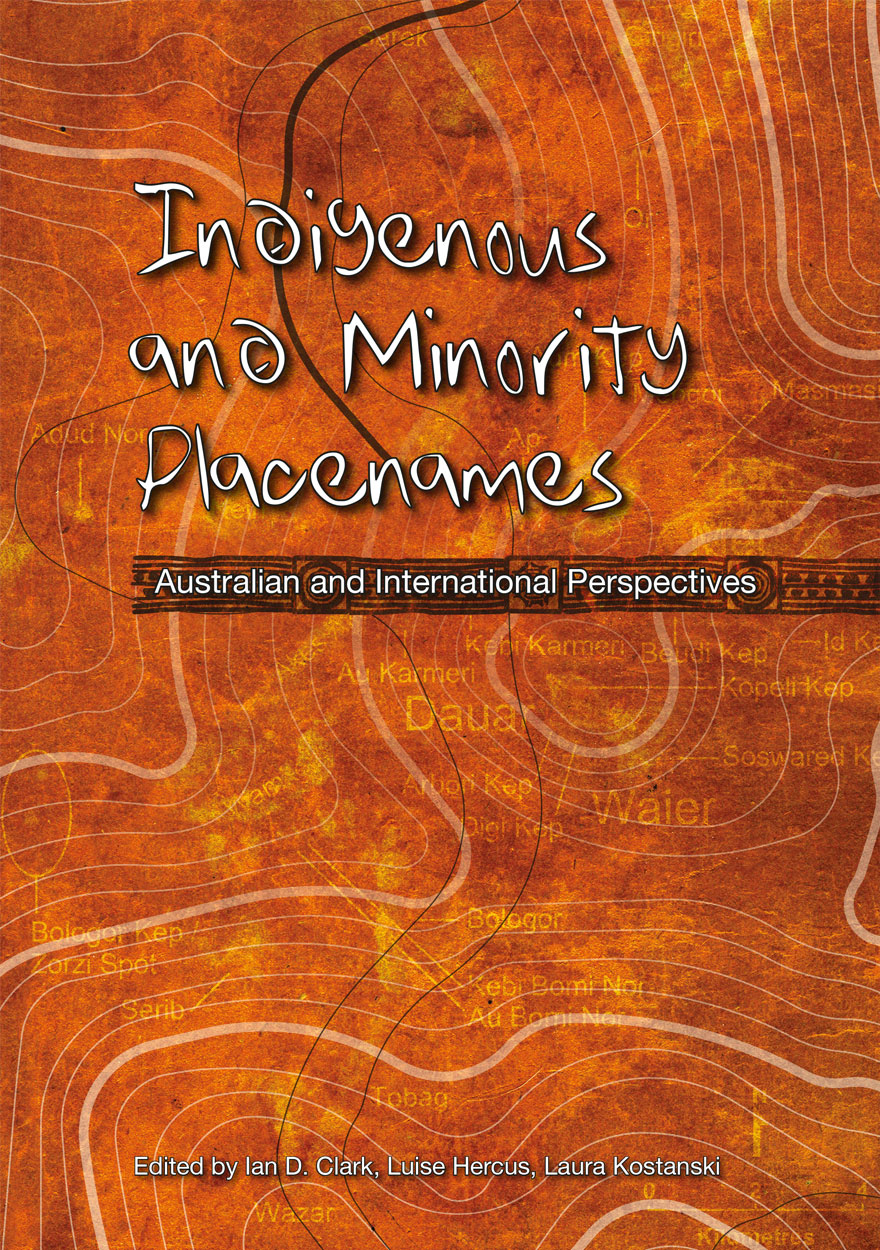
Indigenous and Minority Placenames »
Australian and International Perspectives
Publication date: August 2014
This book showcases current research into Indigenous and minority placenames in Australia and internationally. Many of the chapters in this volume originated as papers at a Trends in Toponymy conference hosted by the University of Ballarat in 2007 that featured Australian and international speakers. The chapters in this volume provide insight into the quality of toponymic research that is being undertaken in Australia and in countries such as Canada, Finland, South Africa, New Zealand, and Norway. The research presented here draws on the disciplines of linguistics, geography, history, and anthropology. The book includes meticulous studies of placenames in central NSW and the Upper Hunter region; Gundungurra cave names; western Arnhem Land; Northern Cape York Peninsula and Mount Wheeler in Queensland; saltwater placenames around Mer in the Torres Strait; and the Kaurna in South Australia.
For more information on Aboriginal History Inc. please visit aboriginalhistory.org.au.

Country, Native Title and Ecology »
Edited by: Jessica K Weir
Publication date: March 2012
Country, native title and ecology all converge in this volume to describe the dynamic intercultural context of land and water management on Indigenous lands. Indigenous people’s relationships with country are discussed from various speaking positions, including identity and knowledge, the homelands debate, water planning, climate change and market environmentalism. The inter-disciplinary chapters range from an ethnographic description of living waters in the Great Sandy Desert, negotiating the eradication of yellow crazy ants in Arnhem Land, and legal analysis of native title rights in emerging carbon markets. A recurrent theme is the contentions over meaning, knowledge, and authority.
'Because this volume is scholarly, original and very timely it represents a key resource and reference work for land and sea managers; policy makers; scholars of the interface between post-native title responsibilities, NRM objectives and appropriate heritage protocols; and students based in the social sciences, natural sciences and humanities. It is rare for volumes to have this much cross-academy purchase and for this reason alone – it will have ongoing worth and value as a seminal collection.'
– Associate Professor Peter Veth, ANU College of Arts and Social Sciences, The Australian National University.