



Search titles
Displaying results 1 to 10 of 105.
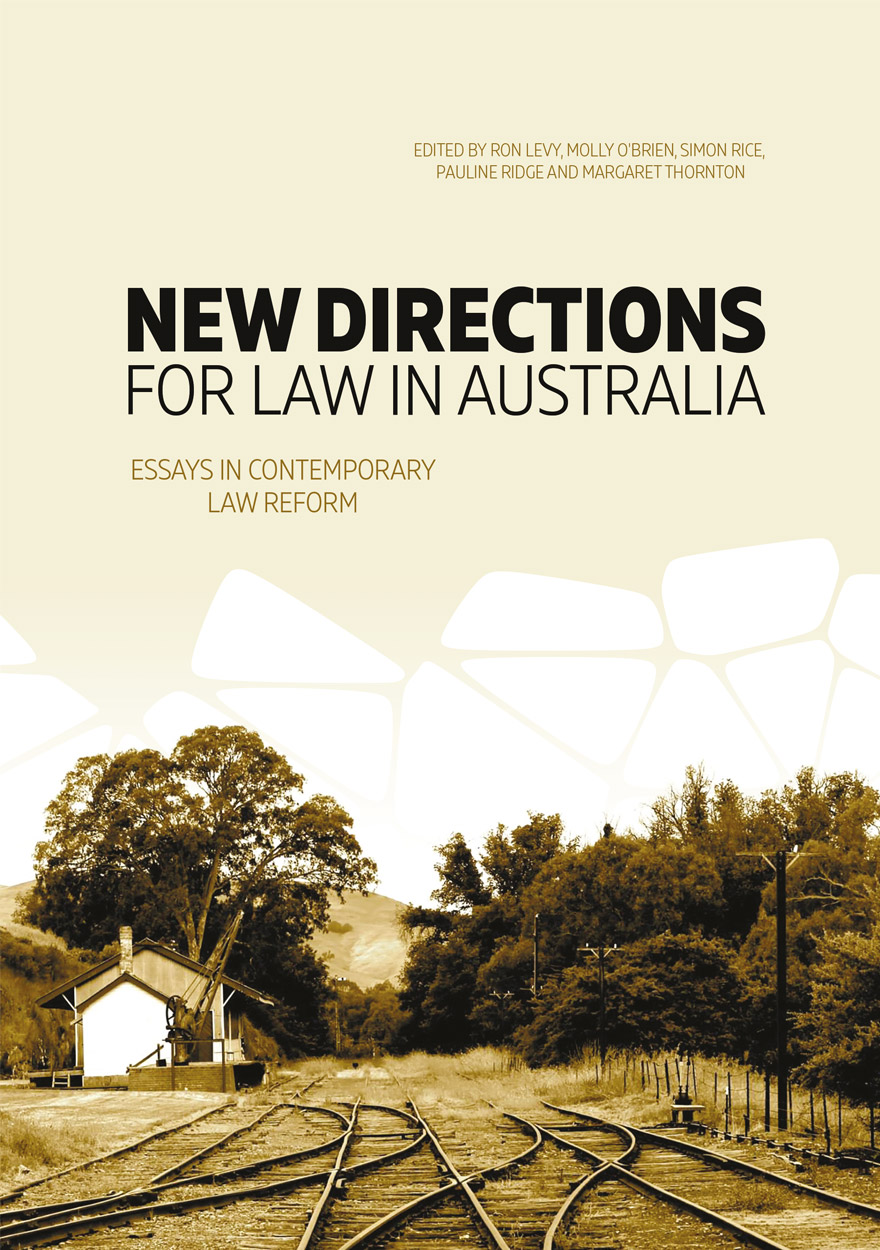
New Directions for Law in Australia »
Essays in Contemporary Law Reform
Edited by: Ron Levy, Molly O’Brien, Simon Rice, Pauline Ridge, Margaret Thornton
Publication date: September 2017
For reasons of effectiveness, efficiency and equity, Australian law reform should be planned carefully. Academics can and should take the lead in this process. This book collects over 50 discrete law reform recommendations, encapsulated in short, digestible essays written by leading Australian scholars. It emerges from a major conference held at The Australian National University in 2016, which featured intensive discussion among participants from government, practice and the academy. The book is intended to serve as a national focal point for Australian legal innovation. It is divided into six main parts: commercial and corporate law, criminal law and evidence, environmental law, private law, public law, and legal practice and legal education. In addition, Indigenous perspectives on law reform are embedded throughout each part. This collective work—the first of its kind—will be of value to policy makers, media, law reform agencies, academics, practitioners and the judiciary. It provides a bird’s eye view of the current state and the future of law reform in Australia.

Administrative Decision-Making in Australian Migration Law »
Authored by: Alan Freckelton
Publication date: May 2015
The ANU College of Law, Migration Law Program is pleased to introduce a text in administrative decision-making in Australian migration law. Over the past eight years we have assembled a team of some of Australia’s most highly qualified migration agents and migration law specialists to deliver the Graduate Certificate in Australian Migration Law & Practice, and the Master of Laws in Migration Law.
Alan Freckelton has worked with the Migration Law Program since 2008. Through personal recollections and a comprehensive analysis of administrative decision-making, he brings his professional expertise and experience in this complex field of law to the fore. The examination of High Court decisions, parliamentary speeches and public opinion bring a contentious area of law and policy to life, enabling the reader to consider the impact that legislation and decision-making has upon the individual and society as a whole.

Law and Democracy »
Contemporary Questions
Edited by: Glenn Patmore, Kim Rubenstein
Publication date: December 2014
Law and Democracy: Contemporary Questions provides a fresh understanding of law’s regulation of Australian democracy. The book enriches public law scholarship, deepening and challenging the current conceptions of law’s regulation of popular participation and legal representation. The book raises and addresses a number of contemporary questions about legal institutions, principles and practices:
How should the meaning of ‘the people’ in the Australian Constitution be defined by the High Court of Australia?
How do developing judicial conceptions of democracy define citizenship?
What is the legal right to participate in the political community?
Should political advisors to Ministers be subject to legal accountability mechanisms?
What challenges do applied law schemes pose to notions of responsible government and how can they be best addressed?
How can the study of the ritual of electoral politics in Australia and other common law countries supplement the standard account of democracy?
How might the ritual of the pledge of Australian citizenship limit or enhance democratic participation?
What is the conflict between legal restrictions of freedom of expression and democracy, and the role of social media?
Examining the regulation of democracy, this book scrutinises the assumptions and scope of constitutional democracy and enhances our understanding of the frontiers of accountability and responsible government. In addition, key issues of law, culture and democracy are revealed in their socio-legal context.
The book brings together emerging and established scholars and practitioners with expertise in public law. It will be of interest to those studying law, politics, cultural studies and contemporary history.

Law's Anthropology »
From ethnography to expert testimony in native title
Authored by: Paul Burke
Publication date: November 2011
Anthropologists have been appearing as key expert witnesses in native title claims for over 20 years. Until now, however, there has been no theoretically-informed, detailed investigation of how the expert testimony of anthropologists is formed and how it is received by judges. This book examines the structure and habitus of both the field of anthropology and the juridical field and how they have interacted in four cases, including the original hearing in the Mabo case. The analysis of background material has been supplemented by interviews with the key protagonists in each case. This allows the reader a unique, insider’s perspective of the courtroom drama that unfolds in each case. The book asks, given the available ethnographic research, how will the anthropologist reconstruct it in a way that is relevant to the legal doctrine of native title when that doctrine gives a wide leeway for interpretation on the critical questions: what is the relevant grouping, what can be counted as a traditional law and when has there been too much change of tradition? How will such evidence be received by judges who are becoming increasingly sceptical about experts tailoring their evidence to suit the party which called them? This book answers these questions by assuming that there is more at stake here than the mere performance of roles. Rather, there is a complex interaction of distinct social fields each with its own habitus, and individual actors are engaged in an active and constructive agency, however subtle, which the painstaking research for this book uncovers.

Rule of Law, Legitimate Governance & Development in the Pacific »
Authored by: Iutisone Salevao
Publication date: December 2005
The notion that the rule of law embodies or guarantees all the essential requirements for a perfectly just society is extravagant and naïve. Nonetheless, the rule of law remains an essential human virtue whose usefulness the world has yet to outgrow. Using the rule of law as a mobilising theme, this book recasts Western theories of law, good governance and development in a Pacific perspective. While Iutisone Salevao works primarily within a legal analytical framework, he employs a multifaceted approach to address the challenge of making Western theories relevant to the concrete and normative contexts of the Pacific peoples, and to accommodate Pacific values, ideologies, structures and practices within the modern discourse on law.

Critical Perspectives on the Scholarship of Assessment and Learning in Law »
Volume 1: England
Edited by: Alison Bone, Paul Maharg
Publication date: July 2019
The Assessment in Legal Education book series offers perspectives on assessment in legal education across a range of Common Law jurisdictions. Each volume in the series provides:
Information on assessment practices and cultures within a jurisdiction.
A sample of innovative assessment practices and designs in a jurisdiction.
Insights into how assessment can be used effectively across different areas of law, different stages of legal education and the implications for regulation of legal education assessment.
Appreciation of the multidisciplinary and interdisciplinary research bases that are emerging in the field of legal education assessment generally.
Analyses and suggestions of how assessment innovations may be transferred from one jurisdiction to another.
The series will be useful for those seeking a summary of the assessment issues facing academics, students, regulators, lawyers and others in the jurisdictions under analysis. The exemplars of assessment contained in each volume may also be valuable in assisting cross-jurisdictional fertilisation of ideas and practices.
This first volume focuses on assessment in law schools in England. It begins with an introduction to some recent trends in the culture and practice of legal education assessment. The first chapter focuses on the general regulatory context of assessment and learning in that jurisdiction, while the remainder of the book offers useful exemplars and expert critical discussion of assessment theories and practices.
The series is based in the PEARL Centre (Profession, Education and Regulation in Law), in The Australian National University’s College of Law.

Past Law, Present Histories »
Edited by: Diane Kirkby
Publication date: September 2012
This collection brings methods and questions from humanities, law and social sciences disciplines to examine different instances of lawmaking. Contributors explore the problematic of past law in present historical analysis across indigenous Australia and New Zealand, from post-Franco Spain to current international law and maritime regulation, from settler colonial humanitarian debates to efforts to end cruelty to children and animals. They highlight problems both national and international in their implication. From different disciplines and theoretical positions, they illustrate the diverse and complex study of law’s history.
Law and the Quest for Gender Equality »
Authored by: Margaret Thornton
Publication date: April 2023
For centuries, law was used to subordinate women and exclude them from the public sphere, so it cannot be expected to become a source of equality instantaneously or without resistance from benchmark men—that is, those who are white, heterosexual, able-bodied and middle class. Equality, furthermore, was attainable only in the public sphere, whereas the private sphere was marked as a site of inequality; a wife, children and servants could never be the equals of the master. Despite their ambivalence about the role of law and its contradictions, women and Others felt that they had no alternative but to look to it as a means of liberation.
This skewed patriarchal heritage, the subtext of this collection of essays, has continued to impede the quest for equality by women and Others. It informs not only gender relations in the private sphere, as illustrated by domestic violence and sexual assault, but also the status of women in the public sphere. Despite the fact that women have entered the paid workforce—including the professions—in large numbers, they are still expected to assume responsibility for the preponderance of society’s caring. The essays show how maternal and caring roles, which are still largely viewed as belonging to an unregulated private sphere, continue to be invoked to detract from the authority of the feminine in the public sphere. The promise of antidiscrimination legislation in overcoming the heritage of the past is also shown to be somewhat hollow.

Grassroots Law in Papua New Guinea »
Edited by: Melissa Demian
Publication date: December 2023
The introduction of village courts in Papua New Guinea in 1975 was an ambitious experiment in providing semi-formal legal access to the country’s overwhelmingly rural population. Nearly 50 years later, the enthusiastic adoption of these courts has had a number of ramifications, some of them unanticipated. Arguably, the village courts have developed and are working exactly as they were supposed to do, adapted by local communities to modes and styles consistent with their own dispute management sensibilities. But with little in the way of state oversight or support, most village courts have become, of necessity, nearly autonomous.
Village courts have also become the blueprint for other modes of dispute management. They overlap with other sources of authority, so the line between what does and does not constitute a ‘court’ is now indistinct in many parts of the country. Rather than casting this issue as a problem for legal development, the contributors to Grassroots Law in Papua New Guinea ask how, under conditions of state withdrawal, people seek to retain an understanding of law that holds out some promise of either keeping the attention of the state or reproducing the state’s authority.
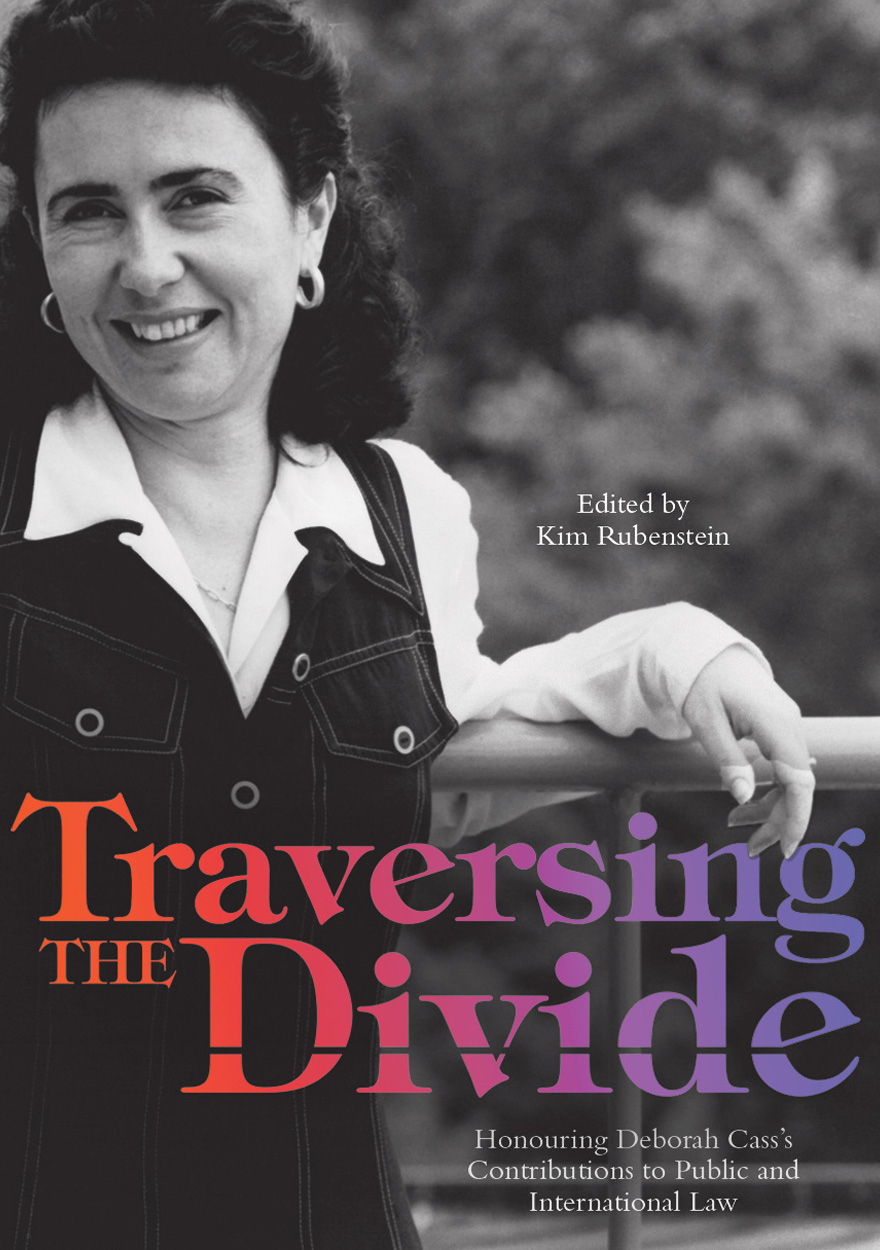
Traversing the Divide »
Honouring Deborah Cass’s Contributions to Public and International Law
Edited by: Kim Rubenstein
Publication date: March 2021
‘While devoting fine attention to the stuff of everyday life, Deborah Cass was also a brilliant scholar. Although the deep sense of loss and sadness at Deborah’s death remains, it is wonderful to have her writings as a continuing source of inspiration and consolation. In them, we continue to hear Deborah’s firm, clear voice, her appreciation of language, her seriousness, her curiosity, her sensitivity and her wry humour.’
—Professor Hilary Charlesworth
This collection honours the work of Deborah Cass, 15 February 1960 – 4 June 2013, a brilliant Australian constitutional and international lawyer. Deborah studied at the University of Melbourne and Harvard Law School and taught at Melbourne Law School, The Australian National University and the London School of Economics. A member of The Australian National University’s Centre for International and Public Law from 1993 to 2000, Deborah’s work offered illuminating new perspectives in a range of fields, from the right to self-determination, critical international legal theory, and feminist legal theory to the international trade law system. The title of this edited collection draws on one of her articles, ‘Traversing the Divide: International Law and Australian Constitutional Law’ (1998) 20 Adelaide Law Review 73. This book evolves from a symposium held to draw together academics from around the globe to reflect on Deborah’s extensive scholarship and contributions to public law and international law, and to examine how her work is of value to current domestic and international law issues. The pieces selected for this volume both remind us of Deborah’s outstanding academic career and provide important insights on current public law and international law pressing issues.