



Search titles
Displaying results 281 to 290 of 572.

A Good Life »
Human rights and encounters with modernity
Authored by: Mary Edmunds
Publication date: May 2013
This book is a story. It’s a story about ordinary people in very different parts of the world dealing with rapid change in the late twentieth and early twenty-first centuries. It’s about times of turbulent and violent social upheaval and rupture with the past. It’s about modern times. It’s also about being human; what it is to be human in a modernising and globalising world; how, in responding to the circumstances of their times, different groups define, redefine, and attempt to put into practice their understandings of the good and of what constitutes a good life. And it’s about how human rights have come to be not abstract universal principles but a practical source of consciousness and practice for real people.
Drawing on the author’s experience as an anthropologist, the book examines different groups over the last three decades of the twentieth century and the first years of the twenty-first: Thai factory workers over a period of two coups in the 1970s; Spanish nuns in the 1980s, in the aftermath of the Second Vatican Council and the end of the Franco dictatorship; Aboriginal people in the remote Pilbara region of Western Australia dealing with the impact of late colonialism and moves towards self-determination, from the 1980s to the present. Each of these groups has its own stories, illuminating ways in which, despite the assault of modernisation on deeply held traditional beliefs and practices, particular cultural understandings and practices continue to shape people’s responses to their novel circumstances. The very diversity of the studies presented in the book raises some of the most compelling moral and social questions of our time and invites the reader, both academic and lay, to focus on what it is that makes us human; whether there are human universals as well as cultural particularities; whether human rights provide universal norms and practices; what unites as well as divides us; and where morality, and understandings of a good life, can be sourced in a secular modern world.
“This is a book about hope, the hope that we have ways to live together in a rapidly changing world which will enable us to ‘live a good life in the modern world.’”
Hon. Fred Chaney AO.

My Country, Mine Country »
Indigenous people, mining and development contestation in remote Australia
Authored by: Benedict Scambary
Publication date: May 2013
Agreements between the mining industry and Indigenous people are not creating sustainable economic futures for Indigenous people, and this demands consideration of alternate forms of economic engagement in order to realise such ‘futures’. Within the context of three mining agreements in north Australia this study considers Indigenous livelihood aspirations and their intersection with sustainable development agendas. The three agreements are the Yandi Land Use Agreement in the Central Pilbara in Western Australia, the Ranger Uranium Mine Agreement in the Kakadu region of the Northern Territory, and the Gulf Communities Agreement in relation to the Century zinc mine in the southern Gulf of Carpentaria in Queensland.
Recent shifts in Indigenous policy in Australia seek to de-emphasise the cultural behaviour or imperatives of Indigenous people in undertaking economic action, in favour of a mainstream conventional approach to economic development. Concepts of ‘value’, ‘identity’, and ‘community’ are key elements in the tension between culture and economics that exists in the Indigenous policy environment. Whilst significant diversity exists within the Indigenous polity, Indigenous aspirations for the future typically emphasise a desire for alternate forms of economic engagement that combine elements of the mainstream economy with the maintenance and enhancement of Indigenous institutions and ‘livelihood’ activities. Such aspirations reflect ongoing and dynamic responses to modernity, and typically concern the interrelated issues of access to and management of ‘country’, the maintenance of Indigenous institutions associated with family and kin, access to resources such as cash and vehicles, the establishment of robust representative organisations, and are integrally linked to the derivation of both symbolic and economic value of livelihood pursuits.

Securing Village Life »
Development in Late Colonial Papua New Guinea
Authored by: Scott MacWilliam
Publication date: May 2013
Securing Village Life: Development in Late Colonial Papua New Guinea examines the significance for post-World War II Australian colonial policy of the modern idea of development. Australian officials emphasised the importance of bringing development for both the colony of Papua and the United Nations Trust Territory of New Guinea. The principal form that development took involved securing smallholders against the tendencies of other forms of capitalist development that might have separated households from land. In order to make household occupation of their holdings more secure and at higher standards of living, the colonial administration coordinated and supervised increases in production of crops and other agricultural produce.
Contrary to suggestions that colonial policy and practice ignored indigenous agriculture and concentrated on plantation crops grown by international firms and expatriate owner-occupiers, the study shows how the main focus was instead upon increasing smallholder output for immediate consumption as well as for local and international markets. Simultaneously development stimulated increases in consumption, including of goods produced through manufacturing processes and imported into the colony.
Only as Independence approached was the pre-eminence of the earlier focus upon smallholders weakened. In part the change occurred due to the political advance of the indigenous capitalist class and their allies seeking to extend their base in largeholding agriculture and related commercial activities. This advance and the uncertainty over which form of development would prevail once indigenes held state power in post-colonial Papua New Guinea stood in marked contrast to the definite direction pursued under the colonial administration of the 1950s and early 1960s.

Edward M. Curr and the Tide of History »
Authored by: Samuel Furphy
Publication date: March 2013
Edward M. Curr (1820–89) was a pastoralist, horse trader, stock inspector, Aboriginal administrator, author and ethnologist. A prominent figure in the history of the Colony of Victoria, he rose to a senior position in the public service and authored several influential books and essays. He is best remembered for his nostalgic memoir, Recollections of Squatting in Victoria (1883), which has become a standard historical source.
This book is the first comprehensive biography of Curr and explores both his life and legacy. In particular, it considers his posthumous influence on the Yorta Yorta native title case (1994–2001), when his written account of the Yorta Yorta ancestors played a key role in the failure of the claim. By exploring Curr’s interactions with Aboriginal people—as a pastoralist and Aboriginal administrator—this book advocates a more nuanced, critical, and historically informed interpretation of Curr’s ethnological writings than was evident in the Yorta Yorta case.
For more information on Aboriginal History Inc. please visit aboriginalhistory.org.au.

The Governance of Common Property in the Pacific Region »
Edited by: Peter Larmour
Publication date: March 2013
In a region where mining, forestry, fish and other primary resources are so basic to income, employment and national prosperity, an understanding of rights to land, water and minerals is fundamental. Tenure regimes in the Asia-Pacific region are vastly more diverse and complex than in those of any other part of the world for comparable population numbers. These studies will overcome the simplistic misunderstandings that have obscured understanding in so many instances.
This book provides an up-to-date overview of the main patterns of indigenous property rights, particularly those held by corporate groups, in the South Pacific Forum region (Australia, New Zealand and the independent Pacific island nations) plus a valuable comparative chapter on Canada. It explores the relative success and failure of a variety of approaches to the management of these complex systems, and offers insights and suggestions for the amelioration of present and likely future stresses in the systems. It is a valuable contribution to the understanding of both governance and property, and to the effective sociopolitical development of the region.
- Ron Crocombe, Emeritus Professor, University of the South Pacific

Australian Politics in a Digital Age »
Authored by: Peter Chen
Publication date: February 2013
Information and communications technologies are increasingly important in the Australian political landscape. From the adoption of new forms of electoral campaigning to the use of networking technology to organise social movements, media technology has the potential to radically change the way politics is conducted and experienced in this country. The first comprehensive volume on the impact of digital media on Australian politics, this book examines the way these technologies shape political communication, alter key public and private institutions, and serve as the new arena in which discursive and expressive political life is performed. Employing a range of theoretical perspectives, empirical data, and case examples, the book provides insights on political behaviour of Australia’s elites, as well as the increasingly important politics of micro-activism and social media. Energetic and fast-paced, the book draws together a wide range of Australian and international scholarship on the interface between communications technology and politics. Crossing several genres, the book will find a wide audience amongst scholars of both politics and communication, among public relations professionals, and with members of the media themselves.

Aboriginal History Journal: Volume 36 »
Edited by: Shino Konishi, Maria Nugent
Publication date: January 2013
In this volume, Bain Attwood details the personalities and the politics surrounding the foundation and early years of the Aboriginal History journal and the intellectual stakes involved in the various disputes that emerged. Attwood has drawn extensively on the journal’s archives, as well as interviewed many of the players involved. Jonathan Richards’ article explores the evacuation of the Cape Bedford mission in Queensland during the Second World War. Muriel Swijghuisen Reigersberg is an ethnomusicologist. Her article examines the contemporary uses of church music and song to tell local histories and to express belonging to place at Hopevale, Queensland. Amanda Nettelbeck and Robert Foster provide a history of rationing on the nineteenth-century settler frontiers in Australia and North West Canada, showing the value of a comparative approach. Jennifer Jones’ piece about the editing of Ella Simon’s autobiographical text, Through My Eyes, provides original insights into the complicated politics and meanings of assimilation. Anne Scrimgeour illuminates an important event in twentieth-century history, looking at the Pindan mob’s challenge to the restrictive leper line in Western Australia.
Aboriginal History Inc. is a publishing organisation based in the Australian Centre for Indigenous History, Research School of Social Sciences, The Australian National University, Canberra.
For more information on Aboriginal History Inc. please visit aboriginalhistory.org.au.
Download for free
Not available for purchase
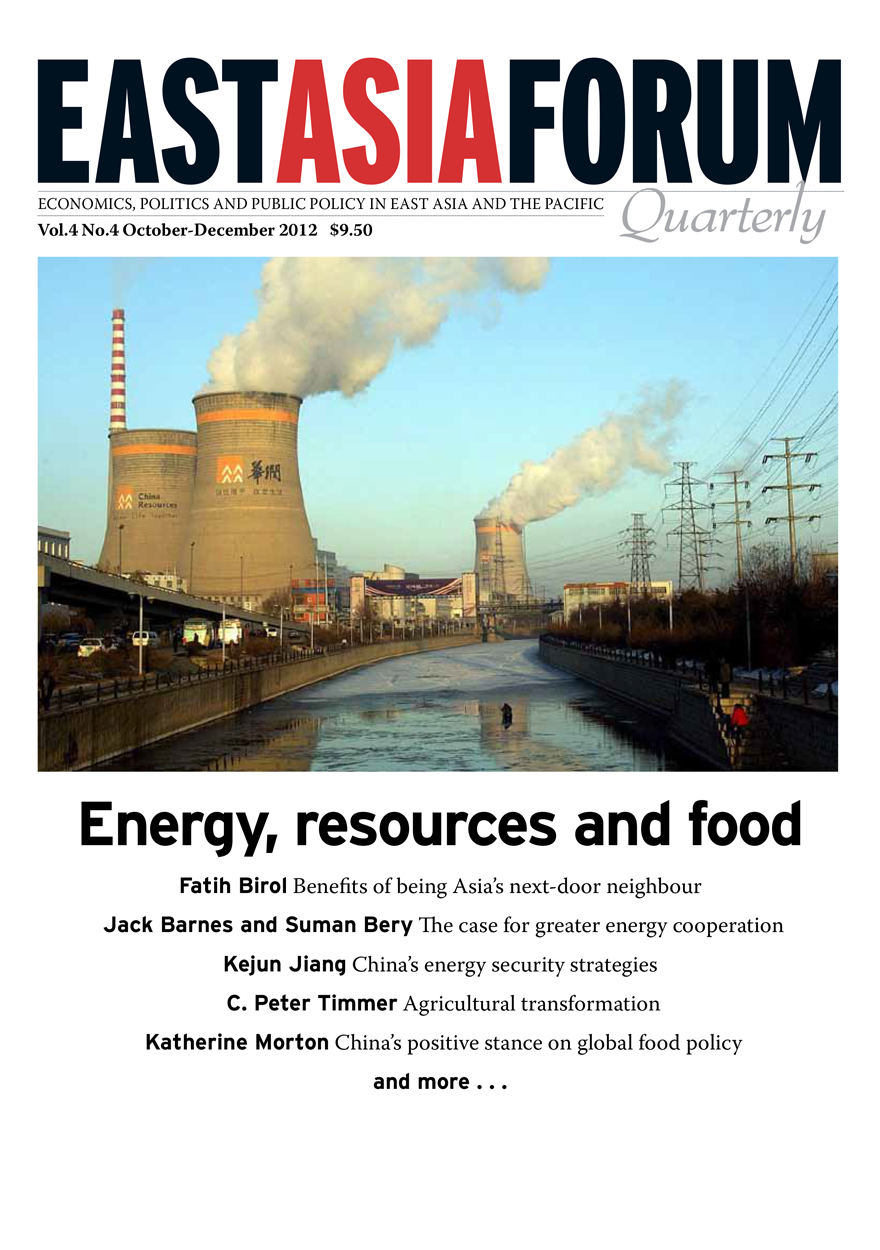
East Asia Forum Quarterly: Volume 4, Number 4, 2012 »
Publication date: December 2012
East Asia Forum Quarterly grew out of East Asia Forum (EAF) online, which has developed a reputation for providing a platform for the best in Asian analysis, research and policy comment on the Asia Pacific region in world affairs. EAFQ aims to provide a further window onto research in the leading research institutes in Asia and to provide expert comment on current developments within the region. The East Asia Forum Quarterly, like East Asia Forum online, is an initiative of the East Asia Forum (EAF) and its host organisation, the East Asian Bureau of Economic Research (EABER) in the Crawford School of Economics and Government in the College of Asia & the Pacific at The Australian National University.
Download for free
Not available for purchase

Australia: Identity, Fear and Governance in the 21st Century »
Edited by: Juliet Pietsch, Haydn Aarons
Publication date: November 2012
The latter years of the first decade of the twenty-first century were characterised by an enormous amount of challenge and change to Australia and Australians. Australia’s part in these challenges and changes is borne of our domestic and global ties, our orientation towards ourselves and others, and an ever increasing awareness of the interdependency of our world. Challenges and changes such as terrorism, climate change, human rights, community breakdown, work and livelihood, and crime are not new but they take on new variations and impact on us in different ways in times such as these.
In this volume we consider these recent challenges and changes and how Australians themselves feel about them under three themes: identity, fear and governance. These themes suitably capture the concerns of Australians in times of such change. Identity is our sense of ourselves and how others see us. How is this affected by the increased presence of religious diversity, especially Islamic communities, and increased awareness of moral and political obligations towards Indigenous Australians? How is it affected by our curious but changing relationship with Asia? Fear is an emotional reaction to particular changes and challenges and produces particular responses from individuals, politicians, communities and nations alike; fear of crime, fear of terrorism and fear of change are all considered in this volume.

The Eye of the Crocodile »
Edited by: Lorraine Shannon
Authored by: Val Plumwood
Publication date: November 2012
Val Plumwood was an eminent environmental philosopher and activist who was prominent in the development of radical ecophilosophy from the early 1970s until her death in 2008. Her book Feminism and the Mastery of Nature (1992) has become a classic.
In 1985 she was attacked by a crocodile while kayaking alone in the Kakadu national park in the Northern Territory. She was death rolled three times before being released from the crocodile’s jaws. She crawled for hours through swamp with appalling injuries before being rescued. The experience made her well placed to write about cultural responses to death and predation.
The first section of The Eye of the Crocodile consists of chapters intended for a book on crocodiles that remained unfinished at the time of Val’s death. The remaining chapters are previously published papers brought together to form an overview of Val’s ideas on death, predation and nature.