



Search titles
Displaying results 1 to 10 of 82.

Wild Partners »
Indigenous Worlds and Industrial Giants in Papua New Guinea
Authored by: Patrick Guinness
Publication date: February 2026
Wild Partners traces the history of the Maututu Nakanai of West New Britain, Papua New Guinea. According to a Maututu ontology, or worldview, they are surrounded by a forest filled with threatening wild forces. It is believed that outstanding men and women pioneer ways to engage these forces to bring benefit to their village community. In recent times, the Maututu have had to engage with human outsiders, including government officers, church administrators, industrial managers and migrant settlers, who like their mythological counterparts have threatened to disrupt the established world.
This study captures Maututu approaches to the threats and challenges they have faced over the last hundred years—the proclamation of the Christian world, the dislocation of the Pacific war, the development programs of the colonial and independent governments and the industrial expansion of oil palm. The challenges have at times threatened the very essence of their being through the destruction of forests, loss of land, competition for schooling and health care, marginalisation within the oil palm industry and the emergence of ‘big shot’ individuals who ignore community obligations.
Maututu have adapted to these threats, becoming successful oil palm producers and prominent professionals throughout Papua New Guinea while seeking to rejuvenate Christianity, protect forest and marine environments and build partnerships that benefit their village communities. Central to these efforts has been partnership with outside forces.

East Asia Forum Quarterly: Volume 18, Number 1, 2026 »
Publication date: February 2026
Critical minerals and rare earths have moved to the centre of economic security agendas. As decarbonisation accelerates and US–China rivalry deepens, governments are racing to secure the supply chains that power green technologies and advanced manufacturing. This issue of the East Asia Forum Quarterly examines the geopolitics of Asia’s resources trade. It explores the tensions between interdependence and rising protectionism, or ‘resource nationalism’, and assesses the implications for regional growth and the global energy transition. Strategic competition may be reshaping mineral supply chains, but the region’s enduring complementarity between producers and consumers suggests that managing vulnerabilities—rather than dismantling interdependence—offers the more durable path forward.
Download for free
Not available for purchase
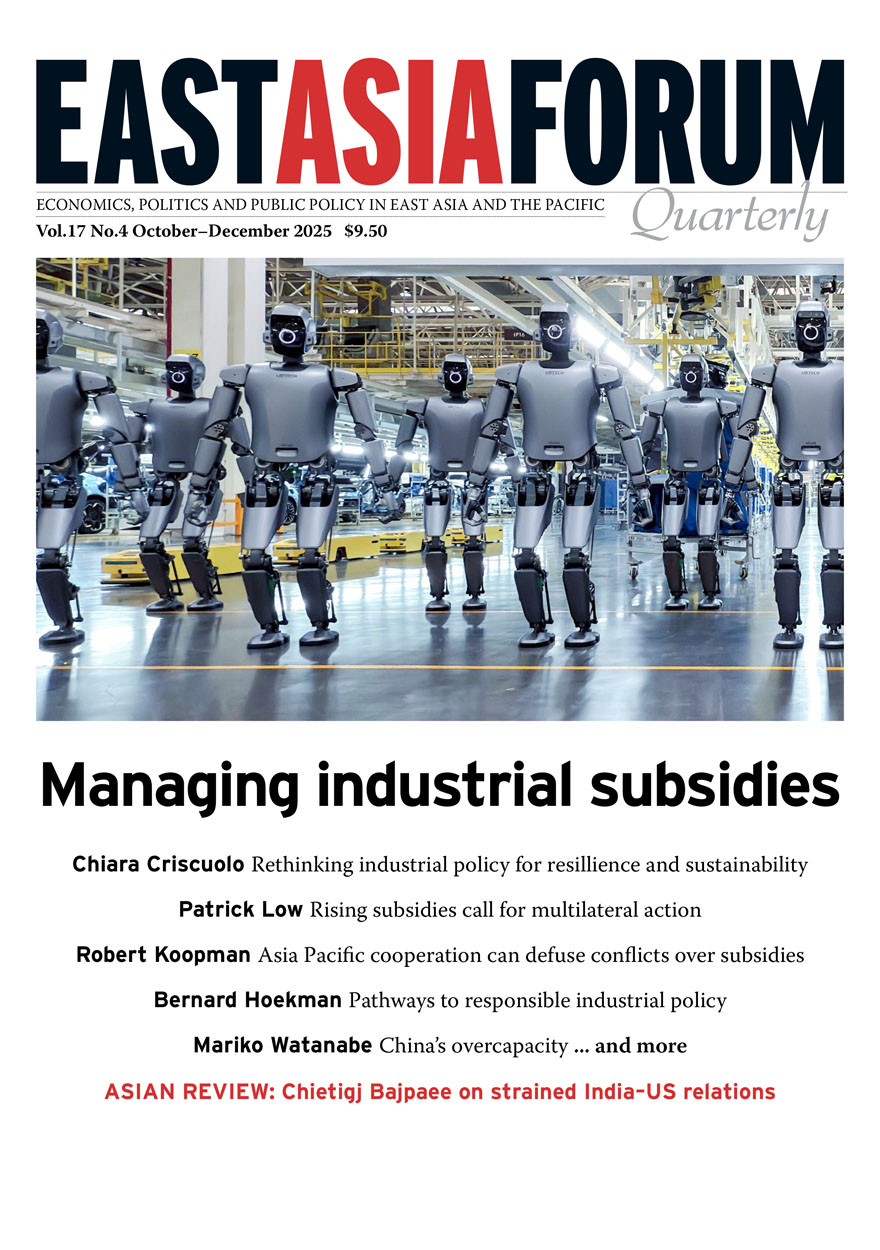
East Asia Forum Quarterly: Volume 17, Number 4, 2025 »
Publication date: December 2025
Industrial policy has returned to the mainstream, with subsidies as an increasingly popular policy instrument of choice. While East Asia is deeply invested in the open global trade regime, multilateral rules are outdated, weakly enforced and ill-equipped to manage the widening gap among countries with unequal fiscal capacity. This issue of the East Asia Forum Quarterly examines the rationale, forms and effects of industrial policy resurgence, identifying both its risks and the conditions for its success. It argues that regional coordination of industrial policy would require greater transparency and peer review, using existing frameworks as well as new plurilateral agreements for that purpose. The region has the platforms and leverage to lead collective efforts to manage industrial policies without undermining the rules-based multilateral order, but whether it can will depend on mobilising the political will.
Download for free
Not available for purchase
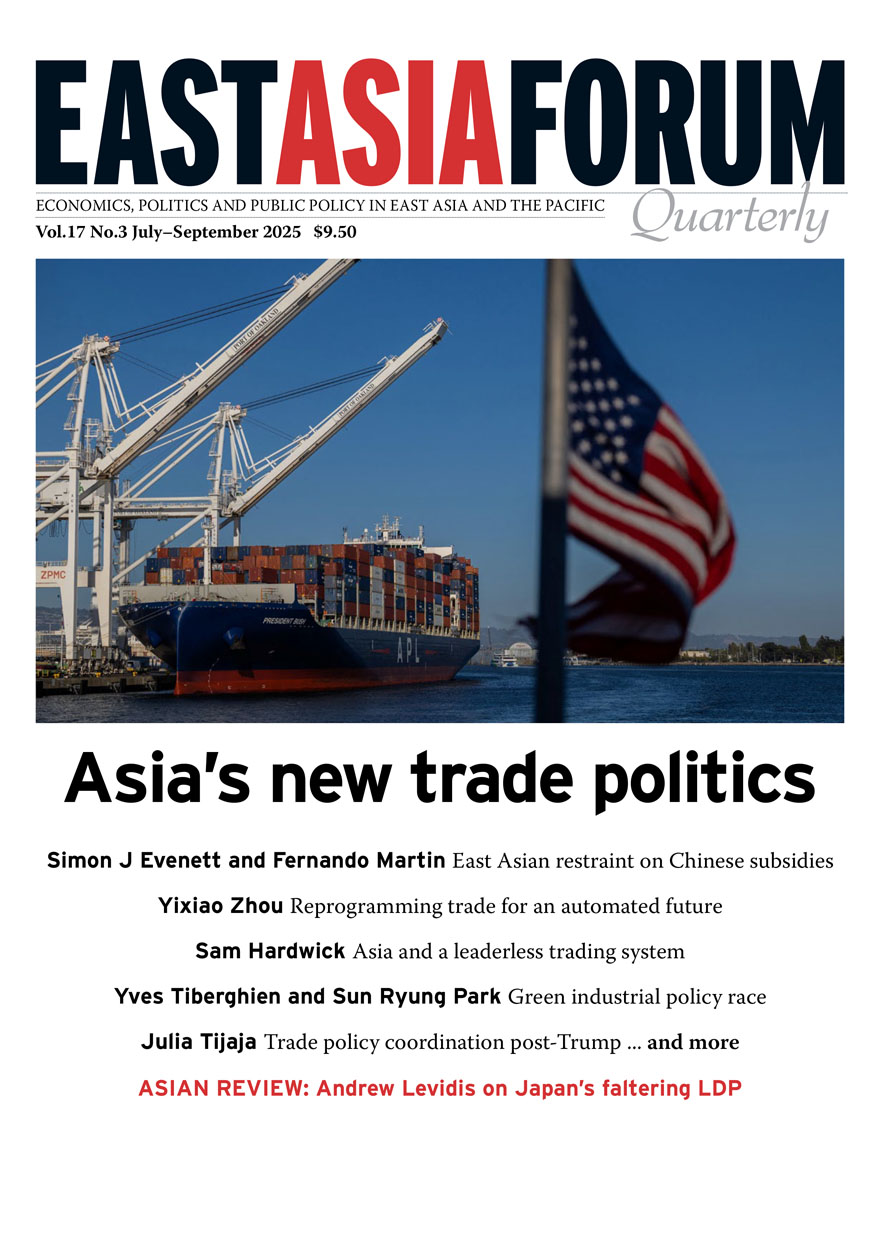
East Asia Forum Quarterly: Volume 17, Number 3, 2025 »
Publication date: August 2025
US protectionism is reshaping Asia’s trade politics. Rising tariffs and unpredictability from Washington are chilling investment, disrupting supply chains and driving governments towards transactional deals that corrode longstanding multilateral rules. This edition of East Asia Forum Quarterly maps the terrain on which Asia must choose between short-term accommodation and long-term growth and resilience. In an increasingly fragmented world, Asia’s best defence is to strengthen institutions to safeguard integration and hunker down behind the multilateral system—while preparing to take a leading role in rebuilding it.
Download for free
Not available for purchase
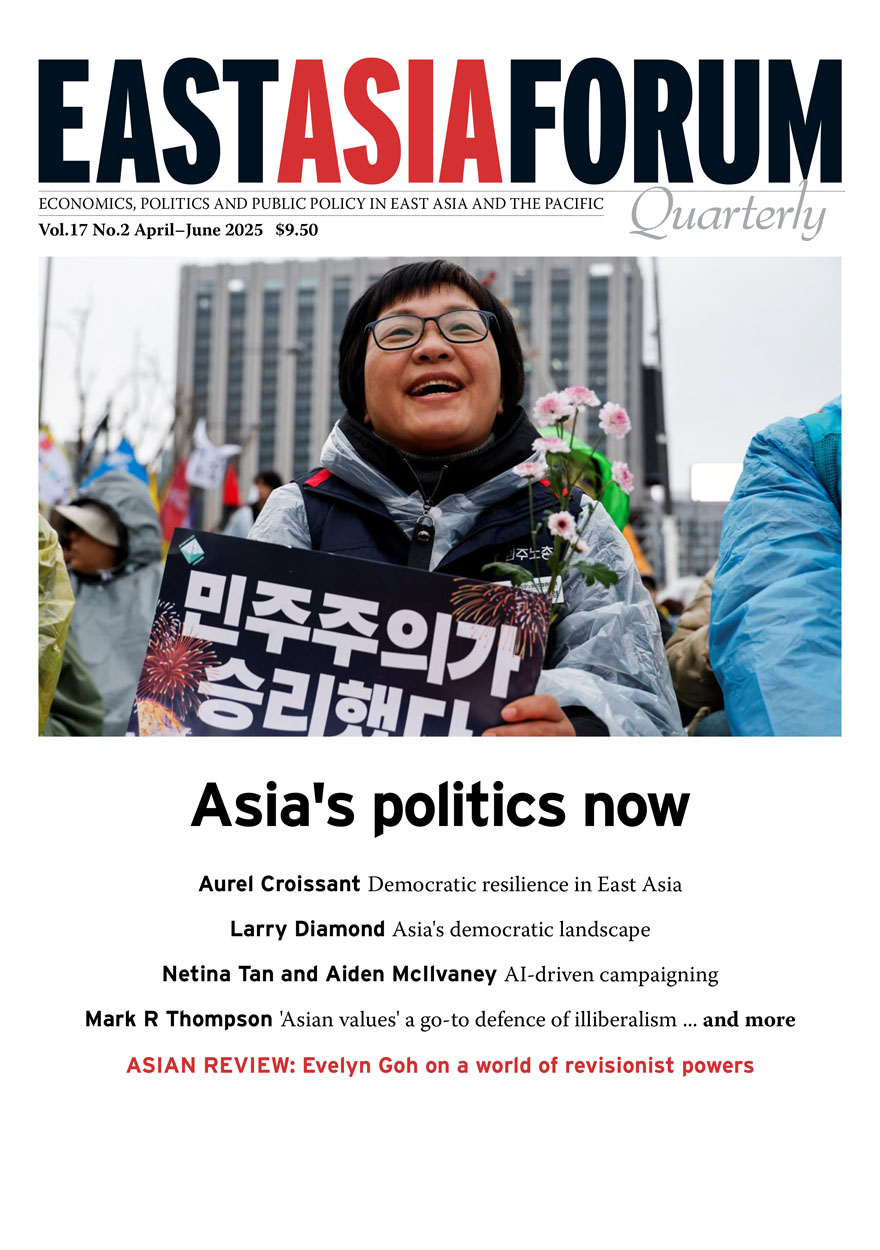
East Asia Forum Quarterly: Volume 17, Number 2, 2025 »
Publication date: May 2025
Asia is home to some of the world’s most diverse political systems—from liberal democracies to authoritarian regimes and hybrid states. As global democracy faces renewed pressure, this edition of East Asia Forum Quarterly explores how political systems across Asia are evolving amid rising autocratisation. It examines why economic development alone cannot explain democratic outcomes in the region and how authoritarian success stories are reshaping debates about governance. With ideological contestation intensifying, Asia is not just adapting to global political trends—it is helping to define them.
Download for free
Not available for purchase

East Asia Forum Quarterly: Volume 17, Number 1, 2025 »
Publication date: March 2025
The global landscape has shifted dramatically since Donald Trump’s return to the presidency in January 2025. His decision to exit the Paris Agreement and impose heavy tariffs has escalated uncertainty surrounding both climate action and the global economic order. This edition of East Asia Forum Quarterly explores how ASEAN and its regional partners can step in to safeguard multilateral trade and climate cooperation, advocating for green trade policies and sustainable investment. The region has the potential to reshape the global response to climate change and maintain economic stability through strategic collaboration.
Download for free
Not available for purchase

East Asia Forum Quarterly: Volume 16, Number 4, 2024 »
Publication date: December 2024
The global economy’s trajectory toward instability has been evident since Trump 1.0. A second Trump presidency will likely amplify protectionism, strategic competition and global disorder. This edition of East Asia Forum Quarterly examines how Asia can respond, emphasising the region’s role in defending multilateralism, addressing climate change and ensuring global stability.
Download for free
Not available for purchase
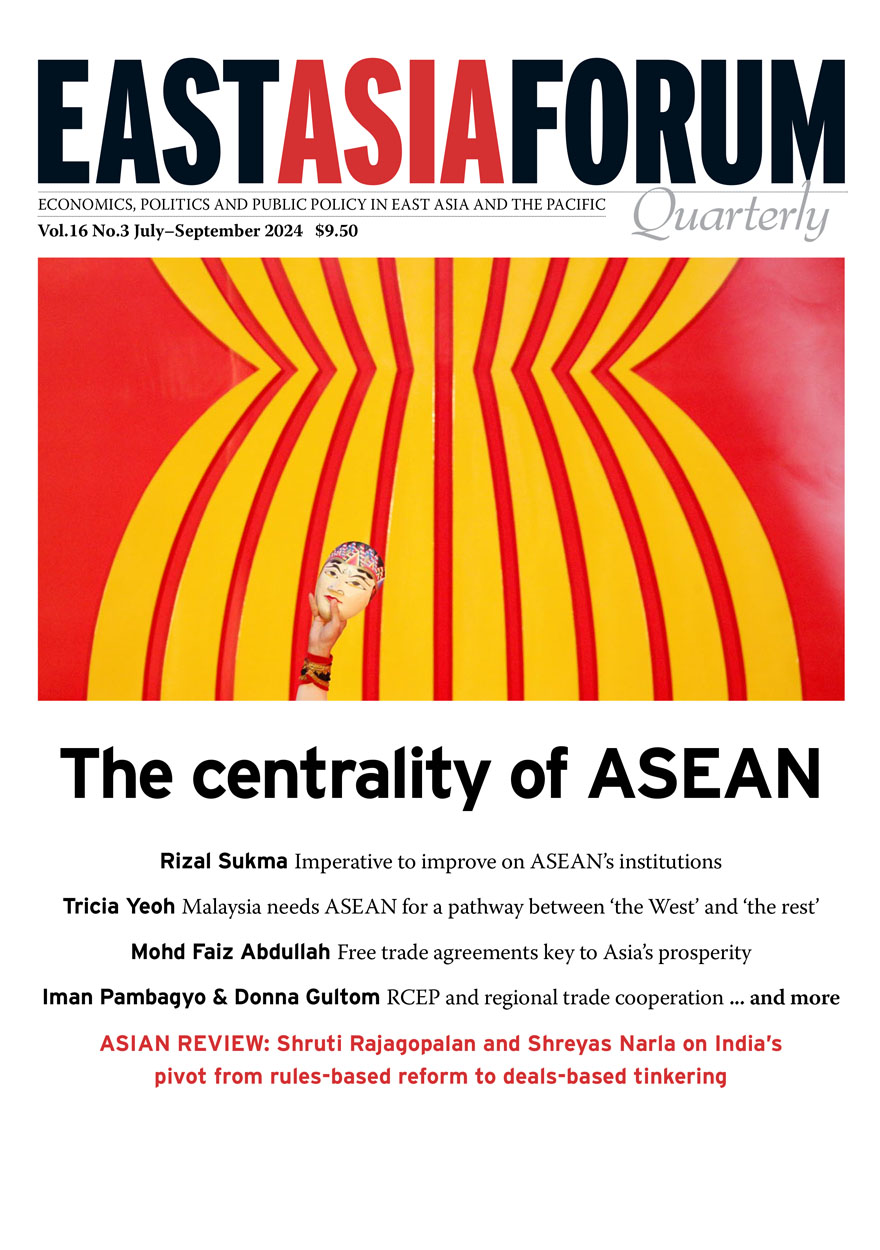
East Asia Forum Quarterly: Volume 16, Number 3, 2024 »
Publication date: September 2024
ASEAN's rise as the cornerstone of regional diplomacy and security in the 1990s may have seemed improbable, but it was crucial. Today, a shifting regional geopolitical landscape challenges ASEAN’s relevance. Great power competition and waning global political commitment to multilateral arrangements threaten its role as East Asia’s 'steering committee'. This edition of East Asia Forum Quarterly explores how ASEAN can maintain its centrality, calling for proactive leadership and stronger regional cooperation.
Download for free
Not available for purchase

East Asia Forum Quarterly: Volume 16, Number 2, 2024 »
Publication date: June 2024
Key in globalisation, supply chains connect producers to consumers across nations and specialisations. Recently, geopolitics, the COVID-19 pandemic and European conflicts have reshaped these networks. Supply chains are increasingly influenced by statecraft and protectionism, moving away from multilateral cooperation. This issue of East Asia Forum Quarterly explores the rapid transformation of supply chains, the paradox of digital innovation in trade and the consequences of economic isolationism.
Download for free
Not available for purchase

East Asia Forum Quarterly: Volume 16, Number 1, 2024 »
Publication date: April 2024
As India charts its post-colonial journey, its pursuit of great-power status intensifies. This issue of East Asia Forum Quarterly delves into India's regional and global positioning, exploring avenues to leverage its economic, demographic and geopolitical advantages. Key insights highlight India's subordinate role to China in the Asia-Pacific, the need for job creation in manufacturing, revamp education and seize opportunities in global manufacturing. As India heads to the polls, its future trajectory hinges on addressing these complexities.
Download for free
Not available for purchase