



Search titles
Displaying results 11 to 20 of 1161.

Uneven Rewards »
Milestones in Labour Economics
Authored by: Alison L Booth
Publication date: 2026
Uneven Rewards brings together major studies of workplace relations and behaviour from the distinguished labour economist Alison L Booth. Over more than three decades, Booth has forged a distinctive intellectual path combining a strong interest in the role of gender and culture on labour markets with acute expertise in data collection, and cognate social science fields and methods.
With her co-authors, Booth examines the effects on men and women of evolving industrial relations’ rules and contexts. She studies the changing gendered and culturally-specific nature of labour markets, and analyses the findings of a set of data-rich social experiments to reveal insights about women’s and men’s behaviour in labour, educational and wider social settings.
Finally, Booth shares new conclusions arising from this extensive body of research. She shows how culture and nurture associated with the upbringing of boys and girls can have profound implications for educational and labour market performance and relative outcomes by gender:
There is no right or wrong place for young women and men to be. What matters is that they are given the opportunity to go where their talents lead them without being thwarted by cultural pressures.
Coming soon
Notify me
ANU Historical Journal II: Number 5 »
Publication date: January 2026
Published amid rising student fees, shrinking university departments and increasing political scrutiny of research, this fifth issue of ANU Historical Journal II brings together eight peer-reviewed articles examining how histories of place, memory and violence are made and contested. Articles explore community collaboration in the Mount Ainslie Labyrinth, grassroots memorialisation of the Spanish Civil War in Canberra, Australian tourism to 1930s Stalinist Russia and the national legacy of Victor Hugo. Other contributions examine slave resistance in colonial Haiti, the political power of documentary film in shaping narratives of Guantanamo Bay, the Vietnam-era historiography of Australia’s role in the Boer War and scholarly memory of the Watergate scandal. Five book reviews round out the issue, engaging with recent publications in Australian, political and global history.

Vā Moana »
Space and Relationality in Pacific Thought and Identity
Edited by: Albert L. Refiti, A.-Chr. Engels-Schwarzpaul, Lana Lopesi, Billie Lythberg, Arielle Walker, Emily Parr
Publication date: 2026
Vā may be a small word, but it carries expansive meaning. Rooted in Indigenous Pacific knowledges—Samoan vā, Tongan tā vā, Māori and Hawaiian wā—this concept of relational space binds people, ancestors and cosmologies across time and place. Since the late 1990s, vā has become a powerful framework in academic and cultural contexts, energising conversations across Oceania and beyond.
As the world grapples with the rise of hyper-individualism, vā offers an urgent and restorative alternative: one that centres connection, responsibility and collective belonging. This rich collection of individually and collaboratively authored chapters explores how vā, wā, and related Indigenous concepts are lived, theorised and practised today. Drawing from diverse disciplines and grounded in specific cultural contexts, these contributions deepen our understanding of relationality, space and place across the Moana.
The AUT Vā Moana Research Centre is dedicated to exploring spatial concepts through Moananui (Pacific) thought. Established in 2012 by Albert L. Refiti and A.-Chr. Engels-Schwarzpaul at Auckland University of Technology’s School of Art and Design, Vā Moana brings together a vibrant international network of scholars. Their work reimagines how space is understood and experienced, both in contemporary and customary Pacific contexts. By engaging Indigenous ways of knowing—through the making of space, objects, rituals and performance—Vā Moana contributes to transforming global conversations around relationality, place and being in the world.
Coming soon
Notify me
Believing on Upside Down Country »
The Changing Faith-scape of Bendigo
Publication date: 2026
The city of Bendigo and surrounds, in central Victoria, Australia, is described today by its Traditional Owners, the Djaara people, as ‘upside down country’, because since 1851 the sacred earth has been rotated and removed by mining, changing its spiritual ‘faith-scape’. Since the arrival of settlers and sojourners of European and Chinese descent, relations between peoples in this region have been powerfully shaped not only by the quest for gold and subsequent bases of material wealth, but also by developments in this religious and spiritual faith-scape. In this innovative study, the authors examine a range of historically distinctive Bendigo customs, rituals, activities and events, from the famous Easter Fair, saved for posterity by the intervention of a Chinese community figure in the 1870s, and now led each year by Djaara people, to demonstrations associated with the Bendigo mosque controversy of 2014. They find that an understanding of spirituality and belief has often been a strong basis for connecting with and showing humanity towards others. Drawing on both oral sources and the objects and spaces of the material culture of religion and belief, the authors provide a fascinating elucidation of past and present meanings of faith, in and around Bendigo, as a lived dimension of experience.
Coming soon
Notify me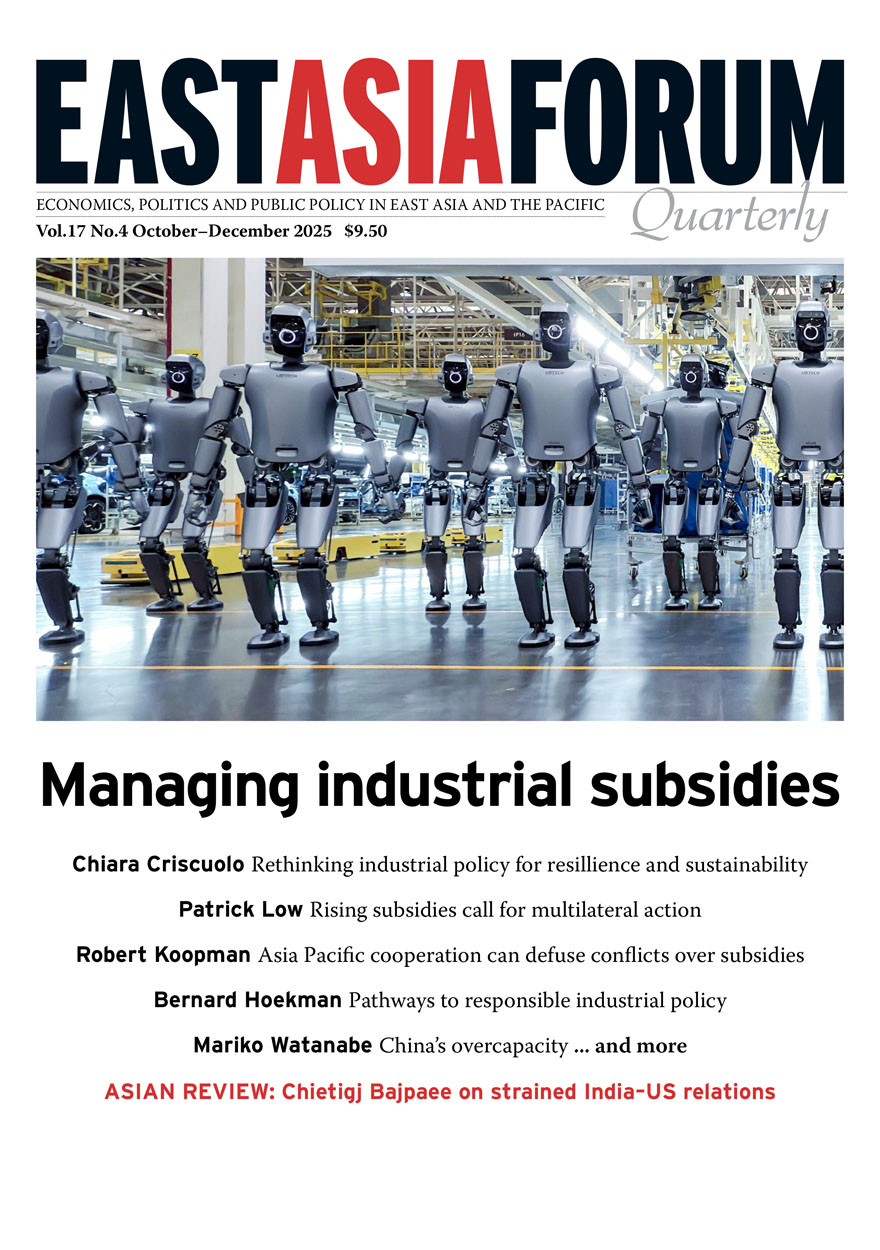
East Asia Forum Quarterly: Volume 17, Number 4, 2025 »
Publication date: December 2025
Industrial policy has returned to the mainstream, with subsidies as an increasingly popular policy instrument of choice. While East Asia is deeply invested in the open global trade regime, multilateral rules are outdated, weakly enforced and ill-equipped to manage the widening gap among countries with unequal fiscal capacity. This issue of the East Asia Forum Quarterly examines the rationale, forms and effects of industrial policy resurgence, identifying both its risks and the conditions for its success. It argues that regional coordination of industrial policy would require greater transparency and peer review, using existing frameworks as well as new plurilateral agreements for that purpose. The region has the platforms and leverage to lead collective efforts to manage industrial policies without undermining the rules-based multilateral order, but whether it can will depend on mobilising the political will.
Download for free
Not available for purchase
The Great Energy Transformation in China »
Edited by: Ligang Song, Yixiao Zhou
Publication date: November 2025
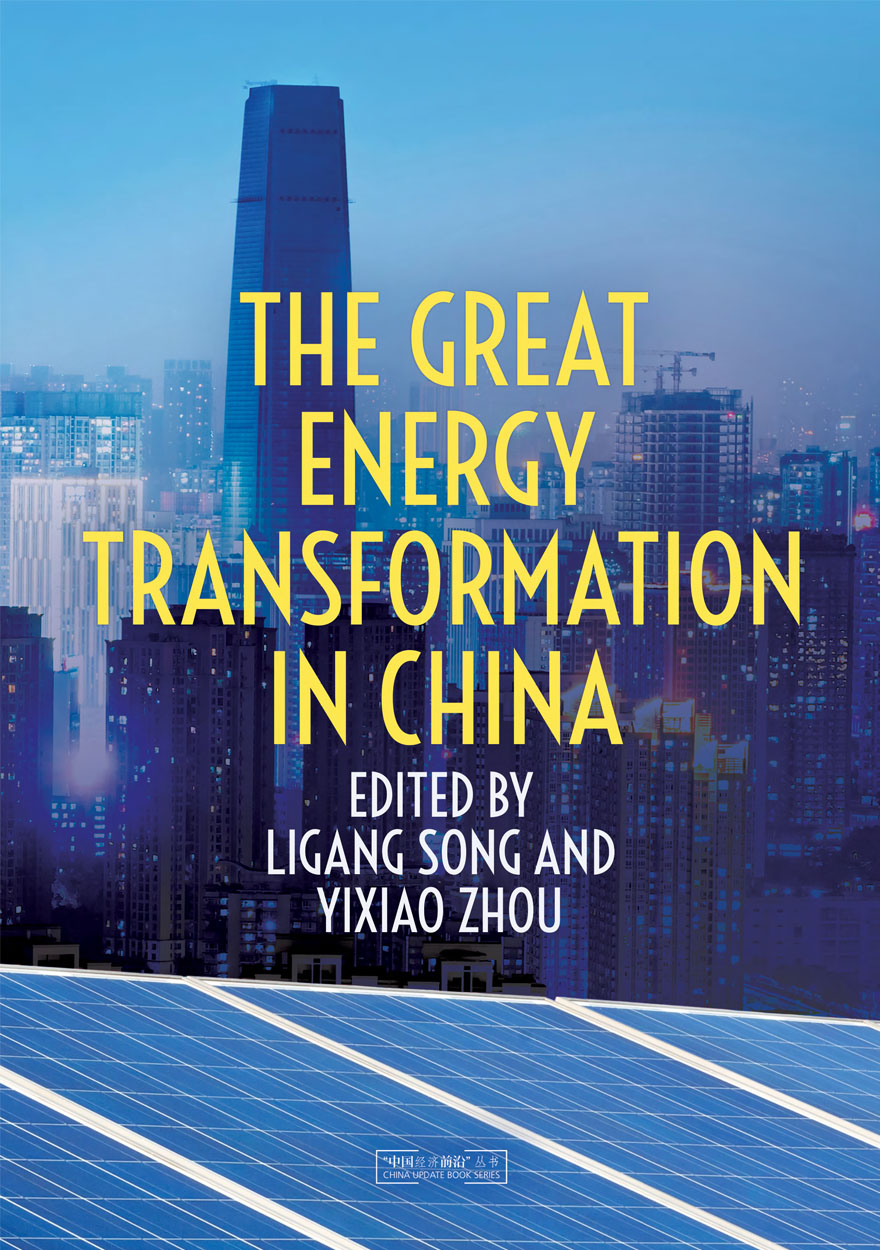
In 2020, China started the drive to commence a reduction in carbon emissions by 2030 and reach carbon neutrality by 2060, setting in motion a transition to a green, sustainable and clean economy. China has ambitiously developed clean energy alternatives to coal. This transformation encompasses multifaceted strategies ranging from investment in renewable energy and the development of low-emission technologies to more stringent policy regulations on emissions. Renewable energy sources like hydroelectric power, wind, solar and biomass have received substantial attention and investment, with China emerging as a global leader in renewable energy capacity.
In the technology space, China’s transitioning to electric vehicles (EVs) has catalysed the development of a robust EV market, fostering innovation in battery technology and charging infrastructure. China has now become the largest exporter of EVs in the world market. These developments have the potential to materially help curb the world’s carbon footprint and mitigate environmental degradation.
Nevertheless, challenges persist domestically, including the need for grid modernisation to accommodate intermittent renewable energy sources and addressing the socio-economic impacts on coal-dependent regions. In the international market, China’s efforts towards a cleaner and more sustainable energy landscape have helped position it as a leader in sustainable economic development. This could enhance trade of green products, the development of global renewable energy and international investments in energy transformation. However, global trade and investment in green technologies and products are faced with rising geopolitical tensions and trade protectionism. This book discusses China’s achievements in its transition towards renewable energies and identifies new opportunities and challenges for deepening energy transformation in China.
Made in China Journal: Volume 10, Issue 1, 2025 »
Edited by: Ivan Franceschini, Nicholas Loubere
Publication date: October 2025
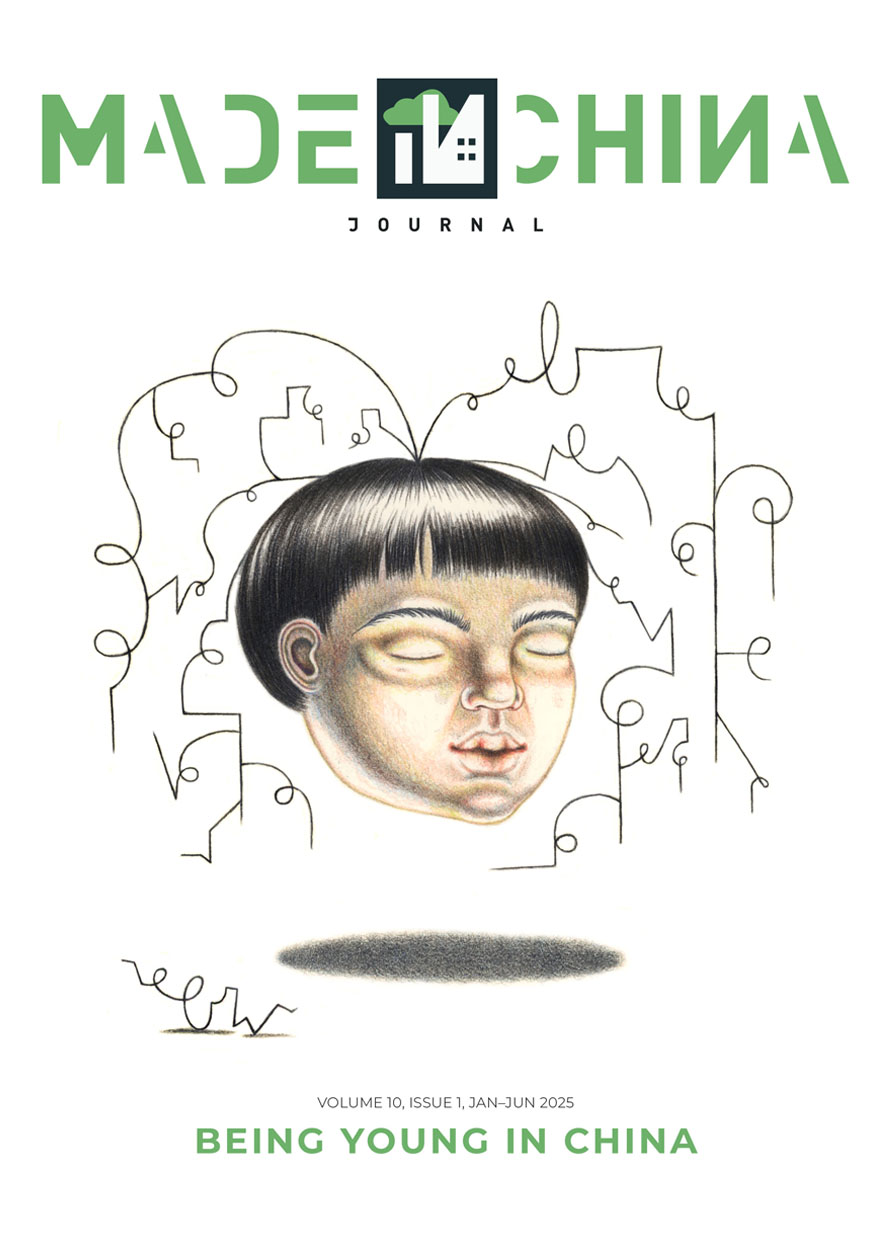
What does it mean to come of age in a society where the paths to adulthood are increasingly uncertain, yet the pressure to succeed remains relentless? In today’s China, youth navigate the fading promise of reform-era mobility, the grind of economic slowdown, and a moralising narrative that glorifies hardship. Two expressions have come to define this generational mood: neijuan (内卷, ‘involution’), the feeling of being trapped in endless competition with little reward, and tangping (躺平, ‘lying flat’), a quiet refusal to play by those rules. In response to these pressures, young people are experimenting with new ways of living, working, and imagining the future, even as that future grows more precarious. This issue of Made in China Journal explores how these dynamics unfold across schools, homes, workplaces, digital platforms, and creative spaces. Rather than casting youth as rebels or victims, the contributions examine the everyday strategies and compromises that define life under constraint.

Australian Journal of Biography and History: No. 10, 2025 »
Publication date: 2025
The articles in the Australian Journal of Biography and History No. 10 cover a diverse range of people, most of them little known in the annals of Australian history. Each lived on the edges of societal expectations and norms and so raise questions about Australian identity. These articles utilise biographical methods to illuminate lives full of risk, excitement, uncertainty and unconventionality.
Bianka Vidonja Balanzategui relates the complex and conflicted story of the writer John Naish (1923–1963). Born and raised in Wales, he came to North Queensland in his twenties and produced a significant body of literature on life in the sugar cane industry and the tropical north. Uncertainty and conflict also feature in James Cotton’s article on the two years (1921–23) Edward Selby Little spent as Australian trade commissioner in Shanghai. In a brief and unhappy but still portentous career, Little was in part a victim of the ad hoc and personal nature of the policy experiments of Prime Minister W. M. Hughes, while also a victim of the machinations of his countrymen. Georgina Fitzpatrick’s portrait of Eric Shimada (Shimada Masakazu) considers an individual whose bicultural identity brought a seemingly fluent transformation from Japanese soldier to interpreter for the Australian and British occupation forces and then the International Military Tribunal in Japan.
In his article ‘A Cat with Two Tales’, Andrew Marshall examines the conflict between the Australian-born cartoonist and entrepreneur Patrick Sullivan and the American illustrator Otto Messmer over who was the rightful creator of the popular cartoon character Felix the Cat. James McDonald uses collective biographical methods to discuss the way the largely forgotten racist term ‘King Billy’ was deployed in colonial Australia to diminish and mock the status of senior Aboriginal men. Similarly, Toby Raeburn, Paul Sanders and Kerry Doyle, in their article ‘Boorong of the Burramattagai’, elevate the status of a young woman from indentured servant to important cultural and linguistic intermediary. Kate White’s article ‘Creating the Mirage’ considers the private, along with the public, lives of the 1980s business couple Christopher and Pixie Skase. This private world is also the focus of Kay Whitehead and Belinda MacGill in their article on Annie Sharpley, a teacher at Naracoorte. While Sharpley’s career seems extraordinary in length, the selfless woman teacher in a country school is a typical personification of rural education in settler countries such as Australia.
Coming soon
Notify me
Wild Partners »
Indigenous Worlds and Industrial Giants in Papua New Guinea
Authored by: Patrick Guinness
Publication date: 2025
Wild Partners traces the history of the Maututu Nakanai of West New Britain, Papua New Guinea. According to a Maututu ontology, or worldview, they are surrounded by a forest filled with threatening wild forces. It is believed that outstanding men and women pioneer ways to engage these forces to bring benefit to their village community. In recent times, the Maututu have had to engage with human outsiders, including government officers, church administrators, industrial managers and migrant settlers, who like their mythological counterparts have threatened to disrupt the established world.
This study captures Maututu approaches to the threats and challenges they have faced over the last hundred years—the proclamation of the Christian world, the dislocation of the Pacific war, the development programs of the colonial and independent governments and the industrial expansion of oil palm. The challenges have at times threatened the very essence of their being through the destruction of forests, loss of land, competition for schooling and health care, marginalisation within the oil palm industry and the emergence of ‘big shot’ individuals who ignore community obligations.
Maututu have adapted to these threats, becoming successful oil palm producers and prominent professionals throughout Papua New Guinea while seeking to rejuvenate Christianity, protect forest and marine environments and build partnerships that benefit their village communities. Central to these efforts has been partnership with outside forces.
Coming soon
Notify me
Law in the New Democracy »
Authored by: Paula Jane Byrne
Publication date: September 2025
In the 1850s, opposition to the Crown in New South Wales made for unsteady ground for the administration of criminal law. This study of skirmishes between magistrates, constables and the metropolis reveals just how far understandings of law could be stretched and warped by recalcitrant local populations. At Carcoar, the local population entirely controlled how law worked; on the South Coast, ‘the people’ influenced how law intervened in their lives; in the north west of the colony publicans dominated; on the north coast, violence against First Nations/Aboriginal people was forcibly meshed into the day to day working of the courts. This study shows a ‘frontier’ centred on the coasts and in the minds of legal officials of the metropolis, but elsewhere, some recognition of the Aboriginal polity and an early understanding of Aboriginal rights.
With right of reply by First Nations/Aboriginal people
Coming soon
Notify me